
14
Chapter 07 – Measurement and Scaling
actual behavior. Intentions are better than attitudes at predicting behavior, but the strongest
predictor of future behavior is past behavior.
VIII. Comparative and Noncomparative Rating Scales (PPT slides 7-20 to 7-21)
A noncomparative rating scale is used when the objective is to have a respondent express his or
her attitudes, behavior, or intentions about a specific object (e.g., person or phenomenon) or its
attributes without making reference to another object or its attributes. In contrast, a comparative
rating scale is used when the objective is to have a respondent express his or her attitudes, feelings,
or behaviors about an object or its attributes on the basis of some other object or its attributes.
Exhibit 7.13 gives several examples of graphic rating scale formats, which are among the most
widely used noncomparative scales.
Graphic rating scales use a scaling descriptor format that presents a respondent with a continuous
line as the set of possible responses to a question. For example, the first graphic rating scale
displayed in Exhibit 7.13 is used in situations where the researcher wants to collect “usage
behavior” data about an object.
Rank-order scales use a format that enables respondents to compare objects by indicating their
order of preference or choice from first to last. Rank-order scales are easy to use as long as
respondents are not asked to rank too many items. Use of rank-order scales in traditional or
computer-assisted telephone interviews may be difficult, but it is possible as long as the number of
items being compared is kept to four or five. When respondents are asked to rank objects or
attributes of objects, problems can occur if the respondent’s preferred objects or attributes are not
listed. Another limitation is that only ordinal data can be obtained using rank-order scales.
15
Chapter 07 – Measurement and Scaling
IX. Other Scale Measurement Issues (PPT slide 7-22)
Attention to scale measurement issues will increase the usefulness of research results.
A. Single-Item and Multiple-Item Scales (PPT slide 7-22)
A single-item scale involves collecting data about only one attribute of the object or construct
being investigated. One example of a single item scale would be age. The respondent is asked a
single question about his or her age and supplies only one possible response to the question. In
contrast, many marketing research projects that involve collecting attitudinal, emotional, and
The decision to use a single-item versus a multiple-item scale is made when the construct is
being developed. The following two factors play a significant role in the process.
• The number of dimensions of the construct: The researcher must assess the various
factors or dimensions that make up the construct under investigation.
In general, multiple-item scales are more reliable and more valid. Thus, multiple-item scales
generally are preferred over single item scales.
B. Clear Wording (PPT slide 7-22)
When phrasing the question setup element of the scale use clear wording and avoid ambiguity.
Also avoid using “leading” words or phrases in any scale measurement’s question. Regardless
of the data collection method (personal, telephone, computer-assisted interviews, or online
surveys), all necessary instructions for both respondent and interviewer are part of the scale
measurement’s setup. All instructions should be kept simple and clear.
16
Chapter 07 – Measurement and Scaling
Exhibit 7.15 provides a summary checklist for evaluating the appropriateness of scale designs.
The guidelines are also useful in developing and evaluating questions to be used on
questionnaires.
Marketing Research in Action
What Can You Learn From a Customer Loyalty Index? (PPT slides 7-23 to 7-25)
The Marketing Research in Action highlights the point customer loyalty is a composite of number
of qualities:
• The intention to buy again and/or buy additional products or services from the same
company.
Customer behaviors that reflect loyalty include:
• repeat purchasing of products or services.
• purchasing more and different products or services from the same company.
• recommending the company to others.
Companies are increasingly able to link customer satisfaction and customer loyalty to bottom-line
benefits. By examining customer behaviors over time and comparing them to SCI® scores, a strong
connection can be shown between secure customers and repeat purchasing of products or services.
Using a customer loyalty index helps companies better understand their customers.
Answers to Hands-On Exercise
1. In your judgment, what level of scale design would be the most appropriate in creating the
necessary scale measurements for collecting primary data on each construct?
If a person is going to use a number of measures of product/service satisfaction, price, and
quality of customer service to obtain a composite measure of customer satisfaction, an
17
Chapter 07 – Measurement and Scaling
2. For each construct, design an example of the actual scale measurement that could be used by
Burke, Inc. to collect the data.
A single-item measure for repeat purchase intention (one of Burke’s components of loyalty)
could be the following: How likely are you to dine at the Santa Fe Grill at least once in the
3. What are several weaknesses associated with how Burke, Inc. measured its Secure Customer
Index® (SCI®)? Make sure you clearly identify each weakness and explain why you feel it is
a weakness.
The Secure Customer Index® is seeking to determine customer loyalty. Customer loyalty is
not necessarily a measure of customer satisfaction. It is a multi-dimensional construct that is
partially a matter of satisfaction, but also consists of the customer’s commitment to buy in
4. If you were the lead researcher, what types of scale measurement would you have used to
collect the needed data for calculating SCI®? Why? Write some scale measurements you
would use.
5. Do you agree or disagree with the Burke, Inc. interpretation of the value they provide their
clients using the Customer Loyalty Index? Support your response.
It is difficult to tell whether to agree or disagree with the Burke, Inc., interpretation because
18
Chapter 07 – Measurement and Scaling
Answers to Review Questions
1. What is measurement?
2. Among the four basic levels of scales, which one provides the researcher with the most
information?
When compared with nominal, ordinal, and interval levels, a ratio scale provides the most
3. Explain the main differences between interval and ratio scale measurements.
Interval scale measurements have the scaling properties of assignment, order, and distance,
4. What are the major differences between ordinal and interval scales? In your response include
an example of each type of scale.
While interval scale measurements have the scaling properties of assignment, order, and
distance, ordinal scales have only assignment and order. Ultimately this affects the data
analysis tools that are appropriate.
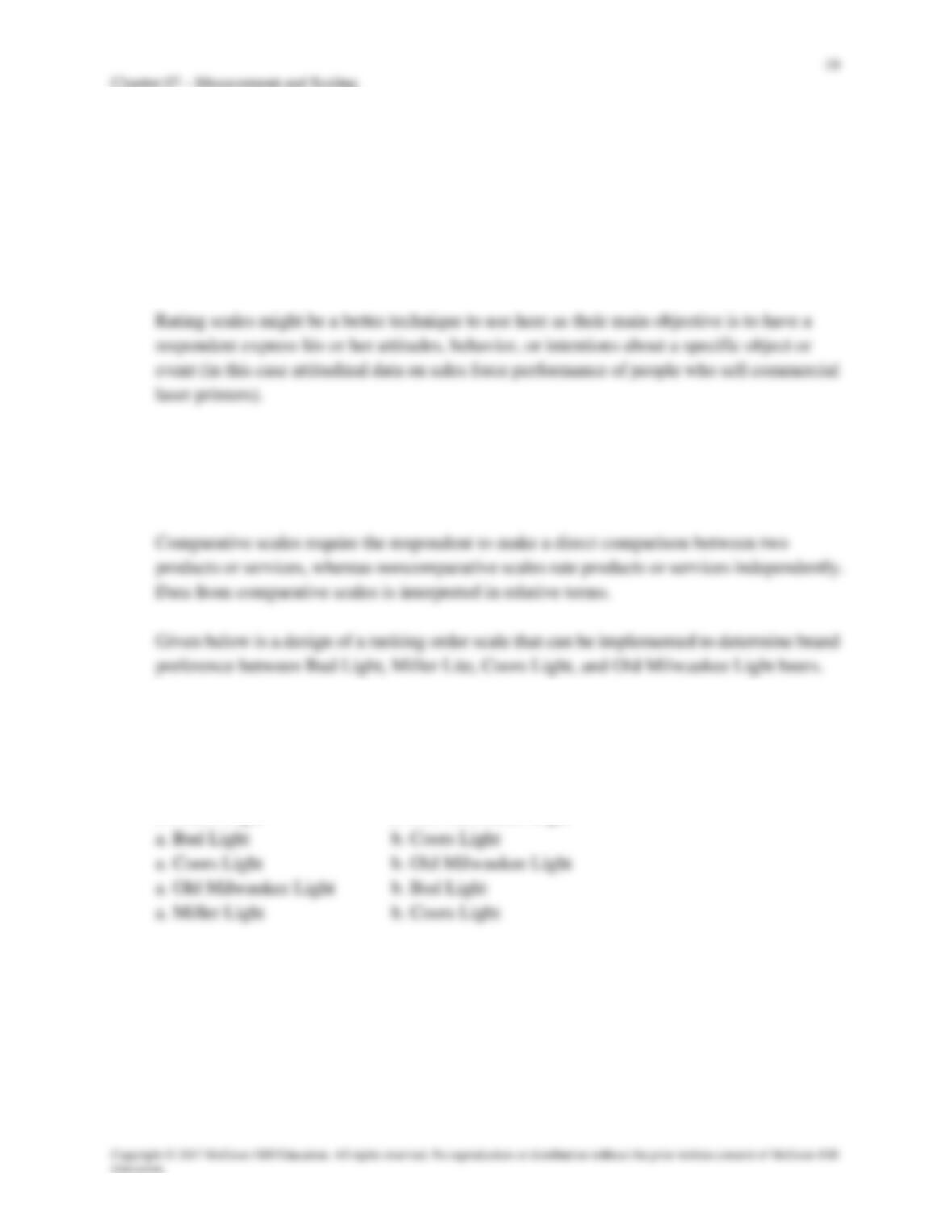
5. Explain the major differences between “rating” and “ranking” scales. Which is a better scale
measurement technique for collecting attitudinal data on sales force performance of people
who sell commercial laser printers? Why?
A rating scale asks for the respondent to express his or her attitudes, feelings, or behaviors
about an object, while a ranking scale asks the respondent to indicate an order of preference
about several objects.
6. What are the benefits and limitations of comparative scale measurements? Design a ranking
order scale that will enable you to determine brand preference between Bud Light, Miller
Lite, Coors Light, and Old Milwaukee Light beers.
For each of the following pairs of beer brand names, please circle the brand that you prefer in
that pairing. Make sure you select only one brand name per pairing.
a. Bud Light b. Miller Light
a. Miller Light b. Old Milwaukee Light
Answers to Discussion Questions
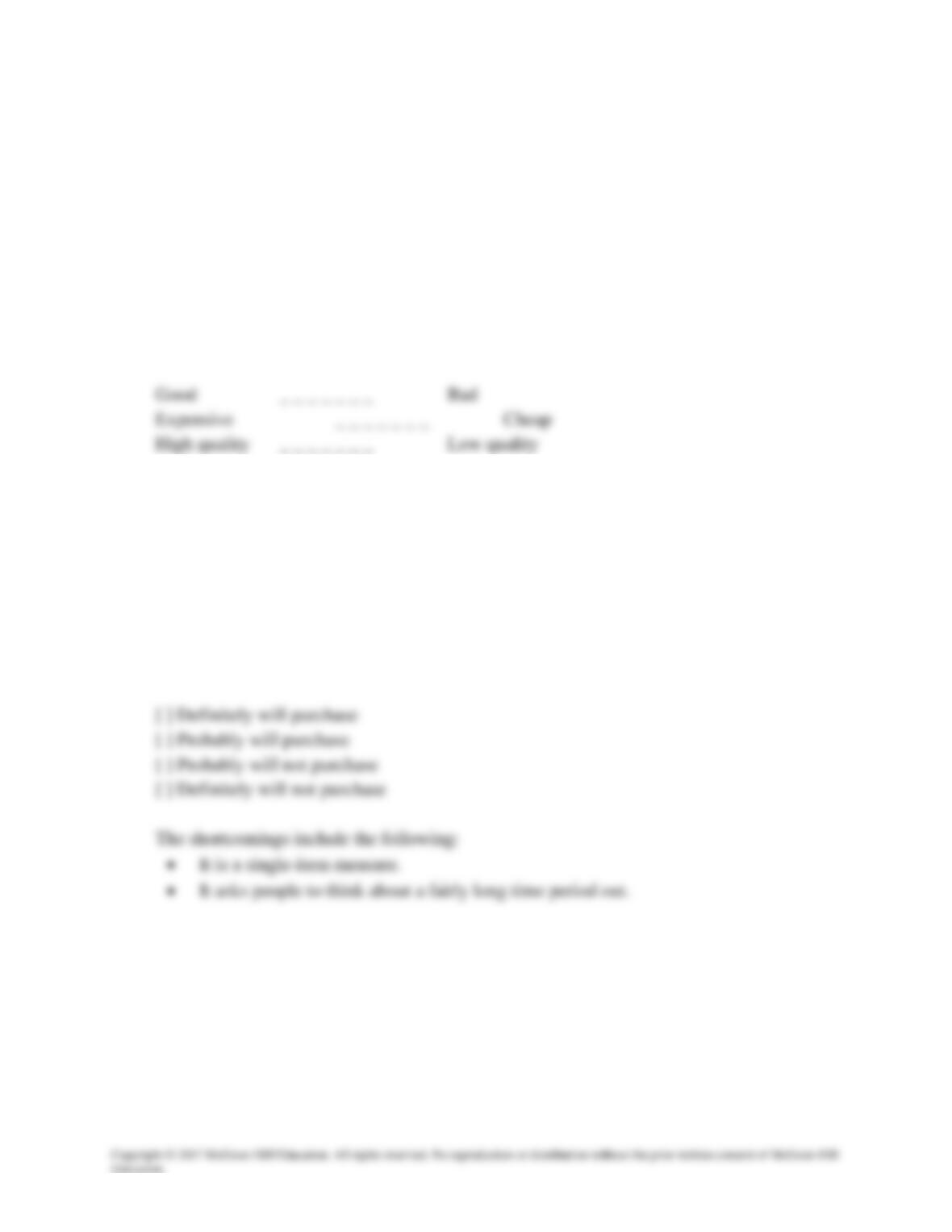
1. Develop a semantic differential scale that can identify the perceptual profile differences
between Outback Steakhouse and Longhorn Steakhouse restaurants.
Listed below is a possible semantic differential scale design that can be implemented.
20
Chapter 07 – Measurement and Scaling
Based on your perception of Outback Steakhouse, please select the space that best expresses
your opinion about that item.
Good _ _ _ _ _ _ _ Bad
Expensive _ _ _ _ _ _ _ Cheap
High quality _ _ _ _ _ _ _ Low quality
Based on your perception of Longhorn Steakhouse restaurants, please select the space that
best expresses your opinion about that item:
2. Design a behavioral intention scale that can answer the following research question: To what
extent are college students likely to purchase a new automobile within six months after
graduating? Discuss the potential shortcomings of your scale design.
Listed below is a possible behavior intention scale design that can be implemented.
Please check the one response that best expresses how likely you are to purchase a new
automobile within six months after graduating from college.
3. For each of the scales shown below (A, B, and C), answer the following questions:
a. What type of data is being collected?
b. What level of scale measurement is being used?
c. What is the most appropriate measure of central tendency?
d. What is the most appropriate measure of dispersion?
e. What weakness, if any, exists with the scale?
21
Chapter 07 – Measurement and Scaling
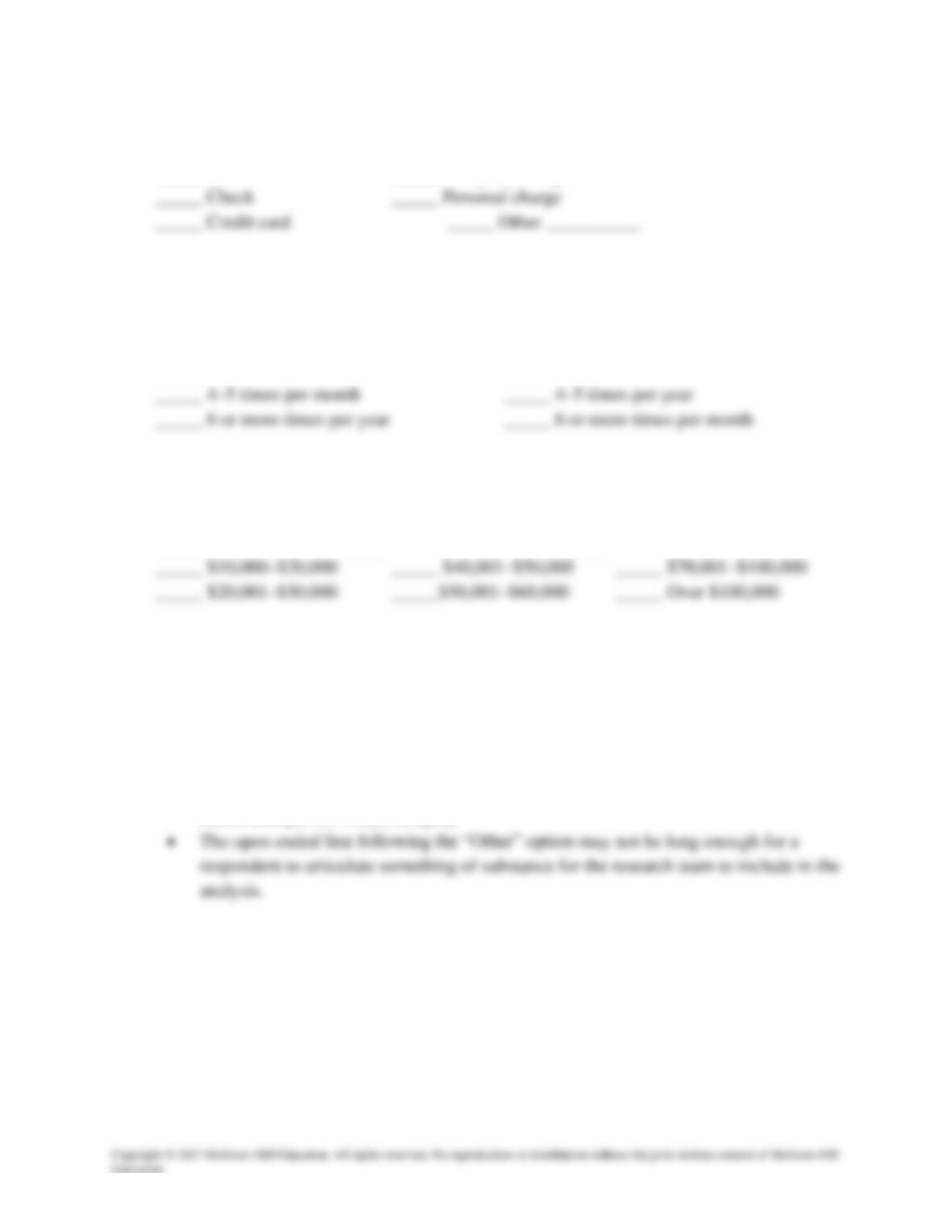
A. How do you pay for your travel expenses?
_____ Cash _____ Company charge
B. How often do you travel for business or pleasure purposes?
For Business For Pleasure
_____ 0–1 times per month _____ 0–1 times per year
_____ 2–3 times per month _____ 2–3 times per year
C. Check the one category that best approximates your total family annual income, before
taxes. (Check only one category.)
_____ Under $10,000 _____ $30,001–$40,000 _____ $60,001–$70,000
A. Example:
Raw data being collected here is the mode of payment for travel. This is a nominal question,
so only an assignment property is activated. The only measure which can be used here is a
measure of central tendency, the mode. There are two problems which may cause glitches
for the research team after the data is collected.
• It might be better to change the question to “What is the most frequent (or preferred)
way to pay for your travel expenses?” to avoid having to deal with respondents who
check multiple (or every) category.
For any type of nominal scale design that focuses on having the respondent just select one
category [or multiple] descriptor, one should try to initially include all possible choices. If
the research is unsure that all category choices are included, it is reasonable to add a “some
other: please specify _____” choice and have the respondent write in his or her choice
answer.
B. Example:
22
Chapter 07 – Measurement and Scaling
The raw data being collected is information on the frequency of doing a specific type of
behavior [travel]. The level is interval; the scaling properties of assignment, order, and
distance are activated. The most appropriate measure of central tendency would be the mean,
with dispersion—standard deviation. One can argue there are two problems with this
question.
• It is double-barreled, coupling traveling for business and pleasure together when they
should appear in separate questions.
It could be suggested that once the original question is separated into two questions, one
might want to use a ratio scale design to capture the data responses to maximize analytical
options later.
C. Example:
The raw data being captured here is a respondent’s income level before taxes. This is an
interval question, so assignment, order, and distance are being activated. The measures of
central tendency and dispersion will be the same as those listed for Example A, unless of
course some of the class participants raise worthwhile arguments to classify the question as
an ordinal one. The following are the two problems with this question.
• Some hesitate to answer income questions accurately.
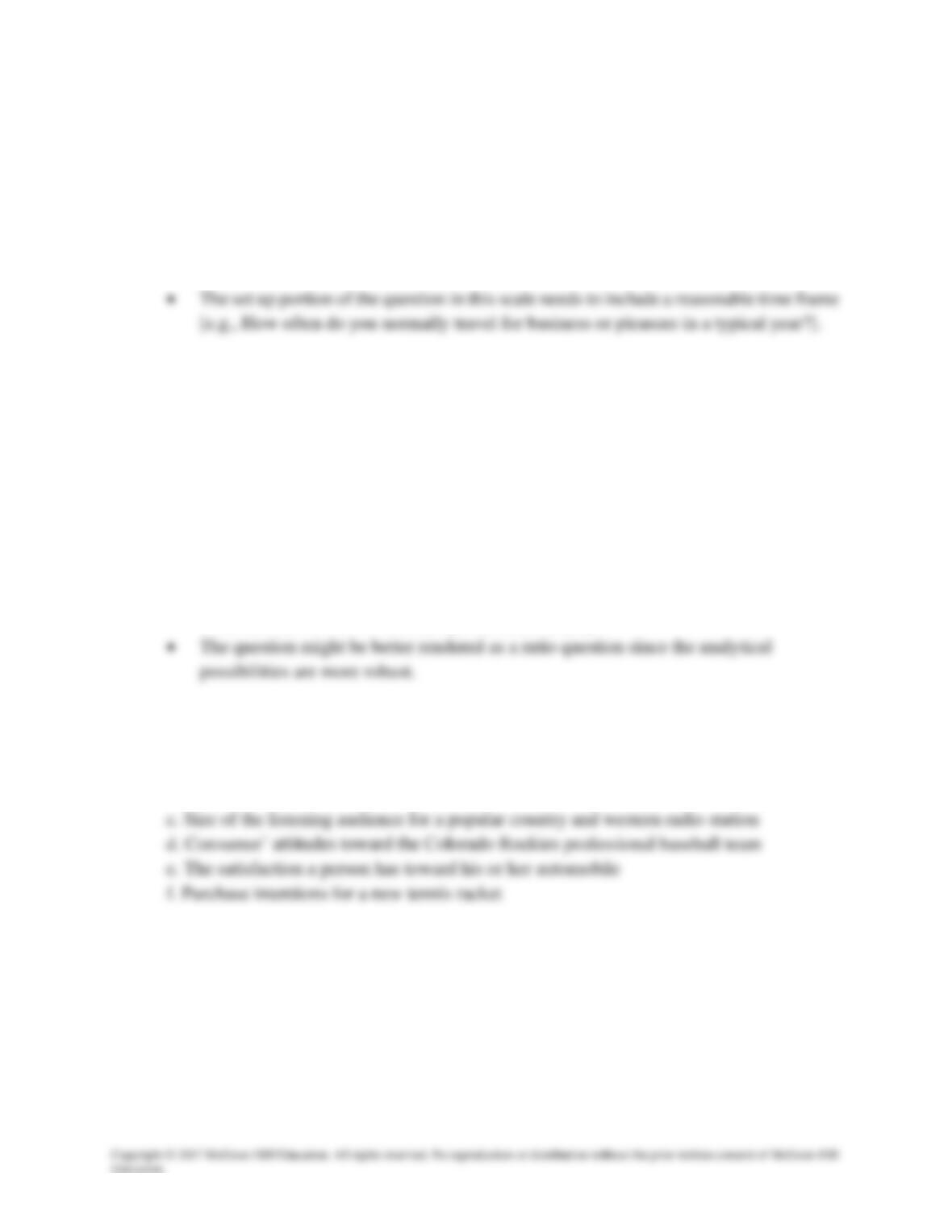
4. For each of the listed concepts or objects, design a scale measurement that would enable you
to collect data on that concept or object.
a. An excellent long-distance runner
b. A person’s favorite Mexican restaurant
a. Example: State-of-being, mind, behavior, and intention all figure in here. If the excellence
refers to “timing” and/or “distance,” a ratio question format might be most appropriate from
a response and analytical standpoint.
b. Example: State-of-mind, behavior, and intention are good candidates here. If the question
seeks to define a “choice” within a local competitive environment, a nominal question might
suffice.

23
Chapter 07 – Measurement and Scaling
c. Example: State-of-being and perhaps behavior could be argued to figure in here. An
interval question would be the best choice from a format standpoint, especially given the
ratings issue tied to audience size.
d. Example: State-of-mind and perhaps intention qualify as candidates here.
5. Identify and discuss the key issues a researcher should consider when choosing a scale for
capturing consumers’ expressions of satisfaction.
Probably the first factor that should be considered is the research objective. The next factor
that should be considered is the available resources to do the project. Time, money, and
talent can serve as constraints in research design. Another important factor to consider is the
6. AT&T is interested in capturing the judgments people make of its new wireless cell phone
services. Determine and justify what service attributes should be used to capture the
performance of its wireless cell phone service. Design two scale measurements that would
allow AT&T to accurately collect the data.
The following might be the three constructs relating to AT&T’s new cell phone services.
• Coverage [the size of the service area]
The following are examples of possible performance scales:
a. For each of the aspects of AT&T’s new cell phone services listed below, please indicate
the response that best expresses your evaluative judgment of how well AT&T is performing
24
Chapter 07 – Measurement and Scaling
on that aspect (Scale = 5 points; 1 = Terrible, 5 = Outstanding).
Coverage
Reliability
Reception quality
b. How satisfied are you with AT&T’s cell phone services? (1 = Very unsatisfied, 5 = Very
satisfied)
7. The local Ford dealership is interested in collecting data to answer the following research
question: How likely are young adults to purchase a new automobile within a year after
graduating from college? Design a nominal, ordinal, interval, and ratio scale measurement
that will enable the dealership to collect the required data. In your opinion, which one of
your designs would be most useful to the dealership, and why?
Students’ responses to this question will vary. Possible answers are listed below.
[ ] Do intend to purchase
[ ] Do not intend to purchase
Ordinal Scale Design:
Please check the one response that best expresses how likely you are to purchase a new
automobile within one year after graduating from college.
[ ] Definitely will purchase
[ ] Unlikely will purchase
Interval Scale:

25
Chapter 07 – Measurement and Scaling
Which one of the following percentages ranges best approximates the likelihood of you
purchasing a new automobile within one year after graduating from college?
[ ] less than 10% chance
[ ] 11%–49% chance
[ ] 50%–79% chance
[ ] 90%–100% chance
Ratio Scale: