Chapter 7: Business Markets and Buying Behavior
CHAPTER SUMMARY AND LEARNING OBJECTIVES
LO 7.1 Compare the major characteristics of the business market to the consumer
market.
Several characteristics distinguish the business market (B2B) from the consumer market (B2C),
including products, size and number of buyers, promotion, distribution, geographic market
concentration, buyer–seller relationships, and purchase decision process.
LO 7.2. Describe the four categories of business markets.
LO 7.3. Summarize the three major ways marketers segment business markets.
Business marketers service a wide variety of customers, so marketers must identify the different
LO 7.4. Describe the three major factors that influence purchase decisions in the
business market.
To understand organizational buying behavior, business marketers require knowledge of
influences on the purchase decision process. These influences are environmental factors,
organizational factors, and interpersonal factors.
LO 7.5. List the seven steps in the organizational buying process.
LO 7.6. Outline the five roles within the buying center.
A company’s buying center encompasses everyone involved in any aspect of its buying activity.
It is an informal group whose composition and size vary among purchase situations and firms.
There are typically five main roles in a buying center: users, influencers, gatekeepers, buyers,
and deciders.
Chapter 7: Business Markets and Buying Behavior
ACTIVATOR EXERCISE: Being a business buyer
Purpose: To orient students to how different business buying is from consumer buying.
Format: Small group discussion, then class presentations.
Time: 20–30 minutes, depending on format.
Activity: Divide students into groups and have them follow these steps:
• Students will imagine they are the buyers for one of the following organizations:
• Brainstorm five of the items you would need to purchase in large volumes for your
organization.
Then have students present their findings to the class.
Result: This exercise is an easy and a fun way to get students thinking about how purchases
Chapter 7: Business Markets and Buying Behavior
LECTURE OUTLINE
7-1 Nature of the Business Market
Several characteristics distinguish the business market (B2B) from the consumer market (B2C):
product, size and number of buyers, promotion, distribution, geographic market concentration,
buyer–seller relationships, and the purchase decision process.
Product
Discussion question: What are some other examples of product categories that are sold in
both the consumer and business markets—but might offer more customization options in the
business market?
Note: For this question, it might be useful to have students first discuss ideas in pairs or small
groups.
Size and Number of Buyers
The business market features a limited number of buyers when compared to the consumer
market; however, most of those buyers purchase larger volumes than individual consumers.
Example: U.S. companies pay more than $300 billion each year for office and
Promotion
Because business customers require more customization and service, and because business
Distribution
Business market distribution channels are typically shorter and more direct, with products
passing through fewer intermediaries than they do for consumer markets.
Chapter 7: Business Markets and Buying Behavior
Geographic Market Concentration
The U.S. business market is more geographically concentrated than the consumer market.
Manufacturers often converge in certain regions of the country, making these areas prime
targets for business marketers.
Discussion question: Let’s brainstorm as many industries as possible where companies seem
to be clustered in specific regions.
Examples: Los Angeles for movie and TV production, San Francisco bay-area for technology
startups, Orlando for theme parks, Boston and New York for financial services firms.
Buyer–Seller Relationships
Purchase Decision Process
Suppliers who serve business markets must work with multiple decision makers, especially
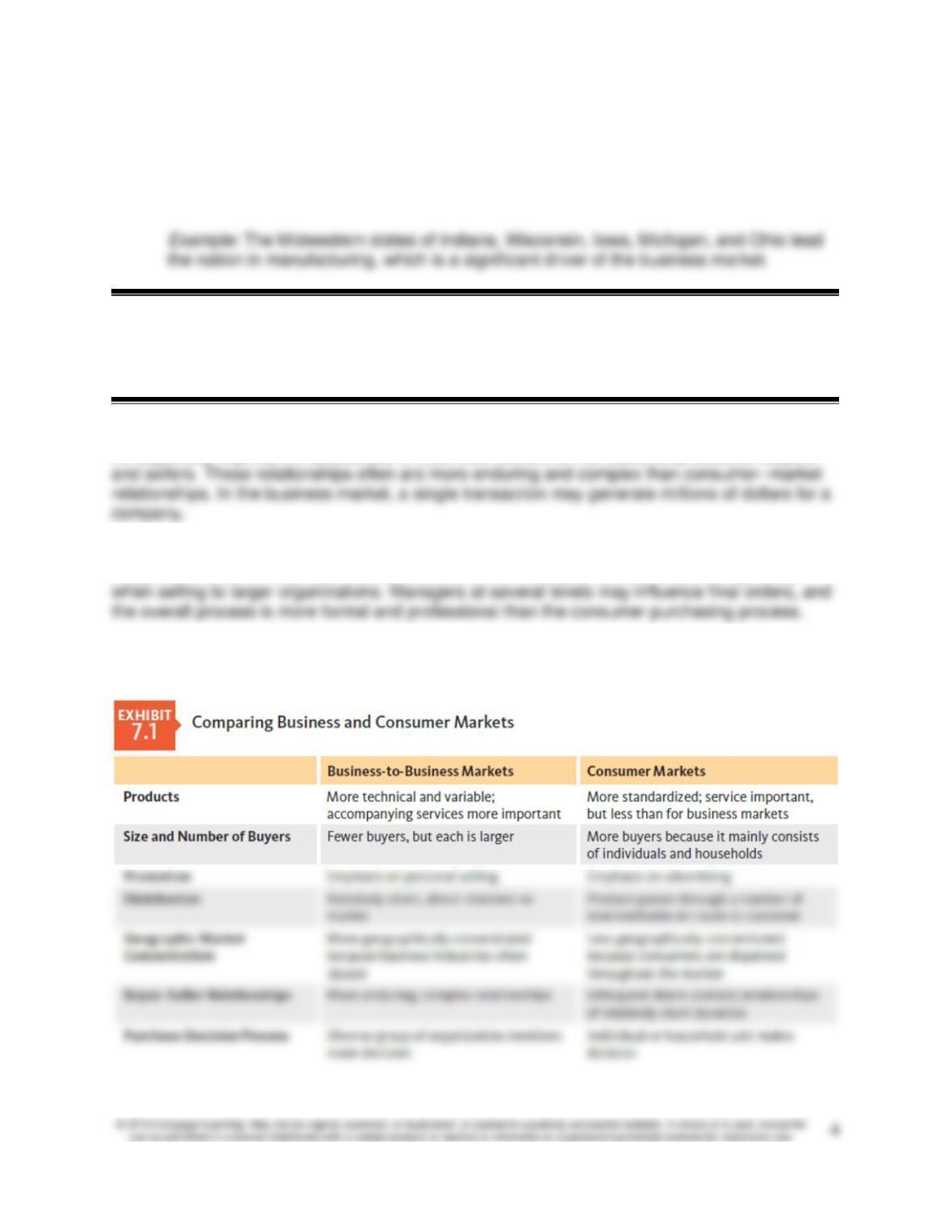
PRESENTATION VISUAL: MindTap Exhibit 7.1 contrasting business and consumer
markets
Chapter 7: Business Markets and Buying Behavior
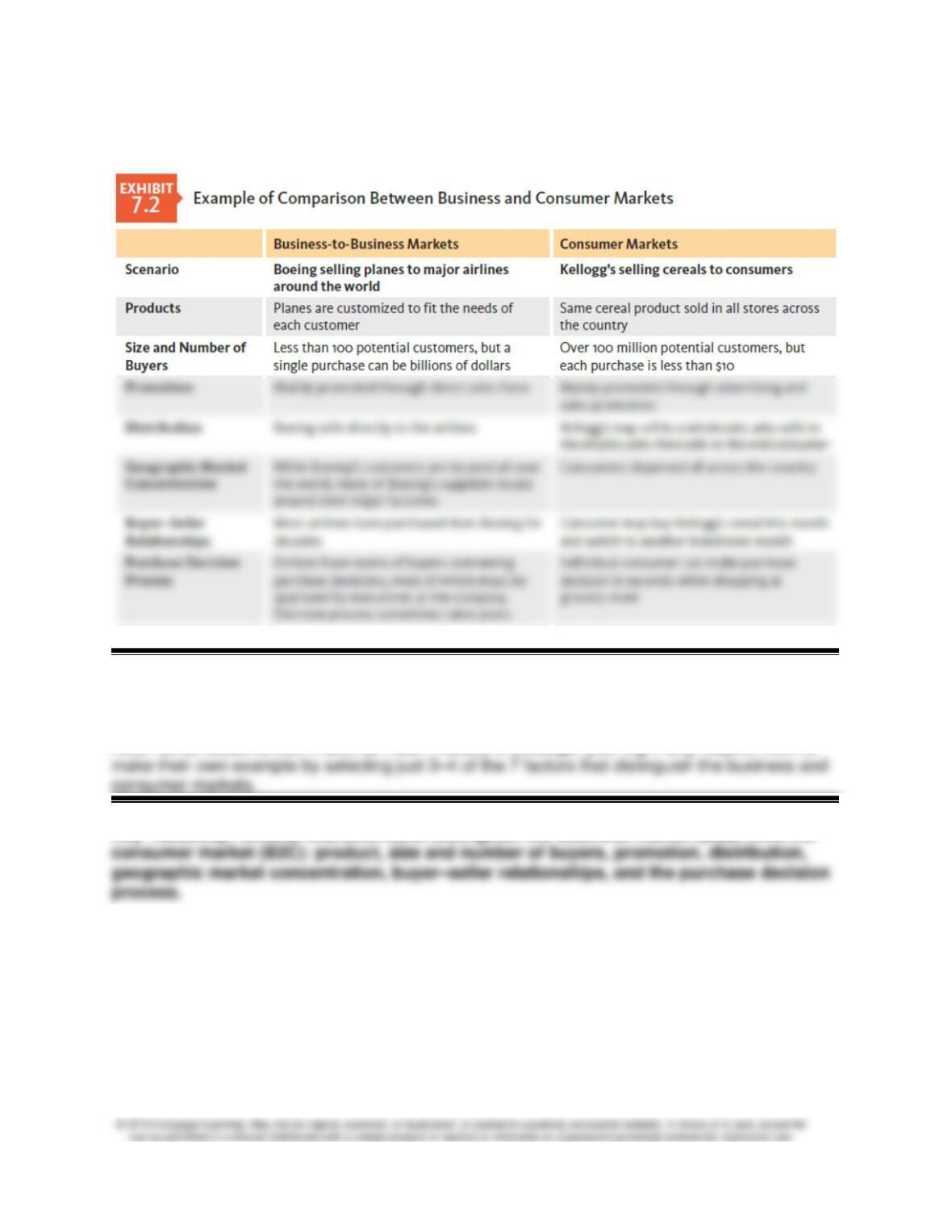
PRESENTATION VISUAL: MindTap Exhibit 7.2 contrasting business and consumer
markets for two specific companies
Classroom activity: Building upon the example in Exhibit 7.2, divide students into small groups
and have them create their own version of Exhibit 7.2 using different companies—one selling to
the business market and one to the consumer market.
Estimated time: 20–40 minutes
7-2 Categories of Business Markets
Four major categories define the business market: commercial, reseller, government, and
institutional. Each is defined by market size, participants, and specific products sold.
Chapter 7: Business Markets and Buying Behavior
Commercial
The commercial market is the largest segment of the business market. It includes all
individuals and firms that acquire products to support, directly or indirectly, production of other
goods and services.
Example: When Dell buys computer chips from Intel for their computers, that transaction
cookies, this takes place in the commercial market.
Discussion question: Let’s come up with 10 more examples of companies who purchase
products that are used to produce other goods and services.
Reseller
The second category includes retailers and wholesalers, known as resellers. Most resale
Discussion questions: What are five examples of resellers who buy and then sell a product
without altering it in any way?
What are three examples of resellers who buy the product and do limited processing before
offering it to customers?
Government
The government category of the business market includes domestic institutions of
Key Takeaway: Four major categories define the business market: commercial, reseller,
government, and institutional. Each is defined by market size, participants, and specific
products sold.
Estimated time: 10–15 minutes
Chapter 7: Business Markets and Buying Behavior
7-3 Segmenting B2B Markets
Business marketers service a wide variety of customers, so marketers must identify the different
Demographic Characteristics
As in consumer markets, demographic characteristics provide useful segmentation criteria for
business markets. For example, firms can be grouped by size, based on sales revenues, or by
number of employees.
Classroom activity: Divide students into small groups and have them follow these steps:
Have student present their findings. Their answers to the last question should tie back to some
of the characteristics mentioned in LO 7.1.
Customer type
Customers can be grouped by type or industry. This is more specific than the four business
Discussion question: Within the education industry, what are the different customer types and
how might this affect your approach to marketing? Especially in terms of the types of products
you’d offer.
Example: Decisions in the K-12 industry often happen at the district or even state level, while
decisions in the higher education market happen professor by professor.
End-Use Application
End-use application segments the business market based on the ultimate way in which a
buyer uses a product.
Example: Xerox’s business market customers for its printers may range from a local
Chapter 7: Business Markets and Buying Behavior
selling to those customers before allocating resources to the businesses who don’t print
as much.
Key Takeaway: Beyond the basic categories of business markets, companies can be
Estimated time: 10–30 minutes (depending on whether you facilitate the classroom activity)
7-4 The Business Buying Process
Environmental Factors
Environmental factors include economic, political, regulatory, competitive, and technological
considerations. All of these influence business market purchasing decisions.
Discussion question: For each of the four categories of business markets (commercial,
reseller, government, and institutional), provide a couple of examples of a type of B2B purchase
that might decrease if the economy crashed?
Organizational Factors
Interpersonal Influences
Key Takeaway: To understand organizational buying behavior, business marketers
require knowledge of influences on the purchase decision process such as
environmental factors, organization factors, and interpersonal influences.
Estimated time: 10 minutes
Chapter 7: Business Markets and Buying Behavior
7-5 The Organizational Buying Process
The organizational buying process follows a sequence of activities. Although not every buying
situation requires every one of these steps, marketers to business customers must familiarize
themselves with the entire process in order to be most effective.
Step 1: Anticipate or recognize a problem, need, or opportunity
Step 2: Define characteristics and the quantity of a needed good or service
Step 3: Search for and qualify potential suppliers
Classroom activity: The text brings students through a specific example of this process being
played out by the makers of King’s Hawaiian bread.
In small groups, have students write a specific example of this process using another company.
They should pick a specific product that the company needs and create a scenario about it. To
Key Takeaway: Marketers can better plan their selling activities by understanding the
typical buying process for business buyers.
Estimated time: 20–25 minutes
7-6 Buying Center Roles
A company’s buying center encompasses everyone involved in any aspect of its buying
Chapter 7: Business Markets and Buying Behavior
There are typically five main roles in a buying center: users, influencers, gatekeepers, buyers,
and deciders.
Users are the people who will actually use a good or service. Their influence on the purchase
decision will vary, depending on the situation. Users sometimes initiate purchase actions by
requesting products, and they may also help develop product specifications, especially for
custom designs.
Buyers have the formal authority to select a supplier and begin securing the good or service.
Deciders actually select a good or service. In many cases, the buyer and the decider are the
same person—but not always.
Example: A firm’s buyer may have the formal authority to select a supplier, but the firm’s
Classroom activity: In small groups, have students select a company and specify a type of
product that the company might buy in large quantities.
Now, have the group specify who in the organization might play each of the roles of the buying
center—and why.
Key Takeaway: To be effective, B2B marketers face the task of determining the specific
role and the relative decision-making influence of each buying center member.
Estimated time: 25–30 minutes
Chapter 7: Business Markets and Buying Behavior
LEARN IT TODAY . . . USE IT TOMORROW
VIGNETTE AND ACTIVITY
The opening vignette for Chapter 7 introduces Multiverse, a hypothetical manufacturer of fuels
and chemicals for use in industrial applications. A scenario is presented about their new
product, called Trident, and the various options for launching this product to the business
market.
Note: Answers to the chapter-ending activity can be discussed in class after the activity
due date.
Business Markets and Buying Behavior
Multiverse carefully planned its strategy for launching Trident biodiesel fuel. It had already
decided to pursue the business market. Although this market would have fewer buyers and the
sales process would take longer, any single purchase could total millions of dollars.
The good news for Multiverse is that Trident is just one of the products it offers to the business
market. With its extensive understanding of the business market landscape, Multiverse has
strong prospects for growth.
Decision 1
Over the last 12 months, Multiverse has noticed an uptick in the number of business market
customers purchasing its product called Formula 359, a citrus-based chemical solvent normally
sold directly to consumers.
Chapter 7: Business Markets and Buying Behavior
Unlike the consumer market for this product, which is disbursed across the country, Multiverse
has identified a single state that makes up 90% of its business market sales for Formula 359—
California. As Multiverse develops a marketing strategy to further expand Formula 359 into the
business market, which of the following characteristics would differ most from its consumer
market strategy?
#1—Geographic market concentration.
#2—Products.
Answer to Decision #1
#1—Correct. It is apparent that California is a niche market for Formula 359’s business market
Decision 2
Multiverse has determined it can compete successfully in the computer chip manufacturing
industry, as it already produces a line of chemicals that provides a protective coating against
Answer to Decision #2
#1—Correct. End-use segmentation divides the business market based on the ultimate way in
which a buyer uses a product. As Multiverse is interested in understanding how different chip
manufacturers use chemicals in their manufacturing processes, end-use segmentation makes
the most sense.
Decision 3
Multiverse is manufacturing a custom chemical for a specialized rocket manufacturer. In order to
do so, Multiverse has determined that it must use a certain quantity of rare earth minerals in its
#2—Select an order routine.
Answer to Decision #3
#1—Correct. Multiverse has already completed the first three steps in the purchasing process
and must continue with steps 4–7.
Chapter 7: Business Markets and Buying Behavior
#2—Incorrect. This option skips Steps 4 and 5 of the purchasing process.
Decision #4
SpaceX, a Hawthorne, California, based spacecraft company is the only private company ever
to return a spacecraft from low-Earth orbit.
i
Its ultimate goal is to enable people to live on other
planets. In order to do this, SpaceX needs powerful fuels to launch its rockets and land its
spacecraft.
#1—Decider and buyer
#2—Users and influencers
Answer to Decision #4
#1—Correct. In this case, the decider and buyer, Elon Musk, is the one to review and rank all
Decision #5
More than 9 million gallons of crude oil have spilled from pipelines in the United States since
2010.
ii
And though this represents an overall decrease in oil spills over time, Multiverse believes
it has a solution to the problem. “MegaPipe” is a new sealant it developed to sheath oil pipelines
with an indestructible layer of protection against unintended cracks and breaks.
#2—Organizational factors.
Answer to Decision #5
#1—Correct. Environmental factors include economic, political, regulatory, competitive, and
technological considerations. If a state or region decides to mandate the use of a protective
Chapter 7: Business Markets and Buying Behavior
ADDITIONAL HOMEWORK/CLASSROOM ACTIVITIES
The Business-to-Business Market
Purpose: To understand the similarities and differences between the B2B and the B2C
markets.
Background: While the business-to-business market encompasses a huge percent of our
Relationship to Text: Nature of the business market
Estimated Class Time: About 10 minutes
Exercise: Ask your students to brainstorm products that are purchased by both organizations
Questions for Reflection:
• What are the career opportunities in the B2B market?
• What skills would you need to succeed in this environment?
Business-to-Business Marketing Strategy
Purpose: To provide a hands-on opportunity to design a B2B marketing strategy.
Background: Successful B2B marketing relies on an effective strategy, which in turn depends
Relationship to Text: Characteristics of the B2B market
Estimated Class Time: About 20 minutes
Exercise: After you have covered the characteristics of the B2B market, divide your students
into small groups for a brief case study exercise.
Scenario: You and your team were just hired as strategic marketing consultants for a small
Chapter 7: Business Markets and Buying Behavior
work for a handful of low-profile, medium-sized businesses (a wood furniture wholesaler, a
trendy clothing retailer, and a plastic molding producer). Now it would like to expand its
business, which is where you come into play.
When the teams have completed their outlines, ask each group to present to the class. You may
be surprised at the diversity and creativity of their approaches.
Questions for Reflection:
• What kind of information would you need in order to do an actual strategic marketing
plan?
• In general, how does B2B strategy differ from B2C strategy?
The Business Buying Process
Purpose: To trigger student thinking about personal sales in the B2B market.
Background: Given that multiple parties are usually involved in significant B2B purchases,
Relationship to Text: Personal selling
Estimated Class Time: About 20–30 minutes
Exercise: Divide your class into no more than five groups (please note that this exercise works
best for classes that have fewer than 40 students). Distribute the sales scenario.
Scenario: You are a relatively new sales representative for a large cable programmer, and your
Goal: In the next five minutes your group—representing the sales team—must prepare the sales
representative and the sales manager to fully leverage the chance to sell your network to this
pivotal system.
Instruct each group to choose a sales rep and a manager to role-play the sales call for the
Chapter 7: Business Markets and Buying Behavior
class. For the sake of fairness, you may want to role-play the client (Chris) for every group. After
each role-play session, ask the class to identify the strengths of the approach and the
Questions for Reflection:
• In what situations would team selling be most effective? Could it ever be considered
counterproductive?
• How much do listening skills come into play during sales presentations?
• What are the benefits and drawbacks of a career in B2B sales?
Chapter 7: Business Markets and Buying Behavior
KEY TERMS
Commercial market: Individuals and firms that acquire products to support, directly or
indirectly, production of other goods and services.
Resellers: A business market comprised of retailers and wholesalers.
Users: The people who actually use a good or service.
Influencers: People who affect the buying decision by supplying information to guide the
evaluation of alternatives, or by establishing buying specifications.
Gatekeepers: People who control the information that all buying center members ultimately
review.
Buyers: People who have the formal authority to select a supplier and begin securing the good
or service.
Deciders: People who actually select a good or service.