
Chapter 7
Debt and Equity Financing
Go to the Chapter 7 folder in the Additional Instructor Resources & Solutions folder to find
the Excel spreadsheets that accompany the material in this chapter.
Chapter Overview
I. Required rate of return
a. Factors influencing the required rate of return
i. Production opportunities
1. Return on equity capital
II. Equity
a. Types of equity financing
i. Shares
1. Dividends
ii. Retained earnings
b. Stocks
i. Common stock
ii. Board of directors
iii. Price of equity
III. Debt
a. Bonds
i. Coupon rate
ii. Call provisions and premiums

iv. Returns
1. Annual coupon interest payment
2. Current yield
v. Calculating the value of a bond
b. Loans
c. Trade Credit
d. Bankruptcy
i. Liquidation
Key Concepts
When reading this chapter, students should focus on the following key concepts:
1. Factors that impact the required rate of return.
2. Methods that can be used to raise capital.
Concept Check Responses
1. Does higher expected inflation increase, decrease, or have no effect on the required rate
of return?
Higher expected inflation increases the required rate of return because the “real” rate
2. What methods can a company use to raise capital?
The company may allow investors to own part of the company in exchange for the
3. Does a company share its risk by issuing equity or debt?
Issuing equity allows the company to raise capital in exchange for giving some of the
4. What are some of the advantages of equity financing?
As mentioned in the answer to Question 3, equity financing allows the owner to share
some of the risk in the venture without having to pay interest on the capital raised. The
5. What are some of the disadvantages of equity financing, specifically for sport teams?
One reason a sport team may not want to issue publicly traded equity (carry out an IPO)
is that it would lose operating confidentiality. Its financials would become public,

6. Is the yield curve typically upward or downward sloping? Why?
The liquidity spread is the difference between a long-term interest rate and a short-term
7. How are the features of a convertible bond similar to both debt and equity?
A convertible bond is similar to debt in that bondholders receive fixed payments over
Responses to Practice Problems
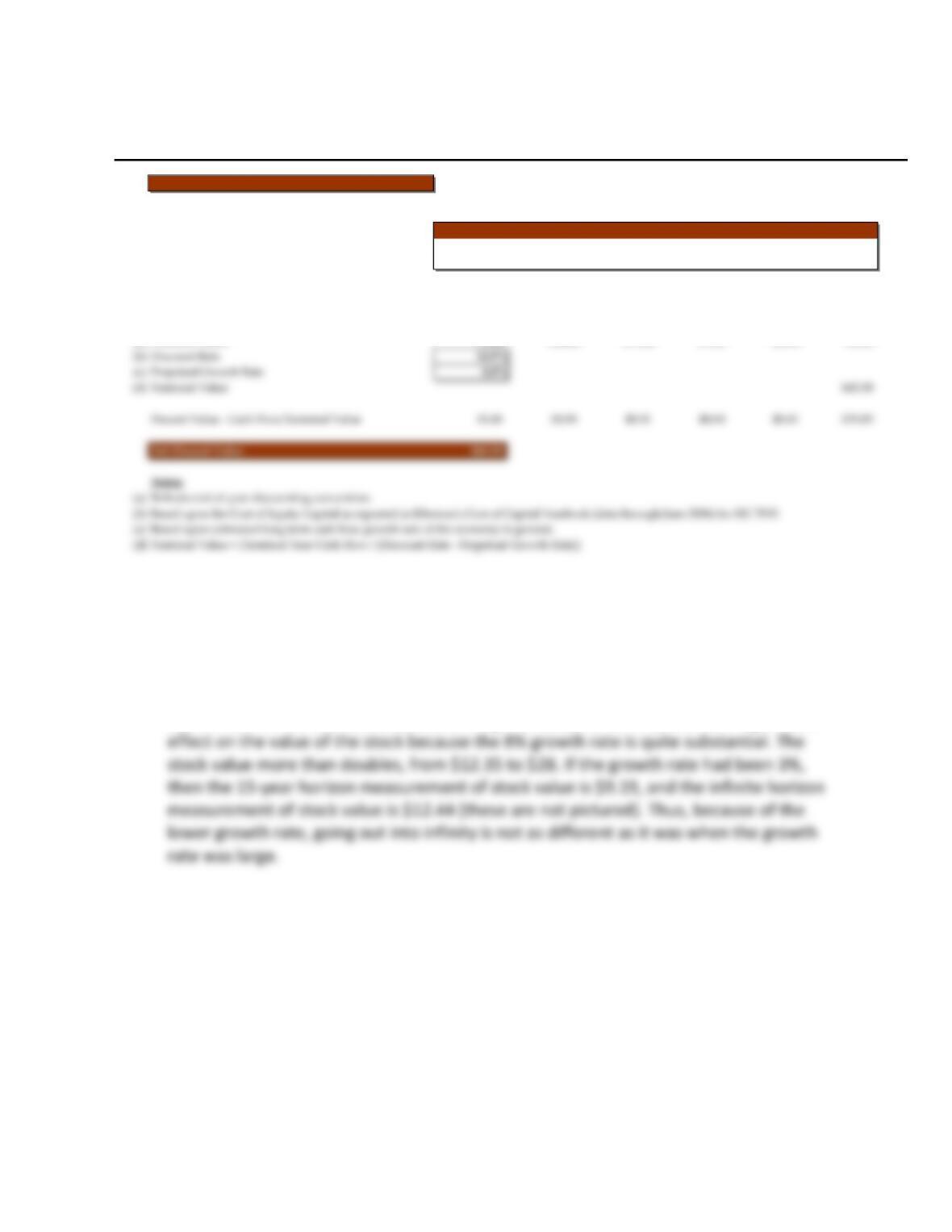
1. Using the information in Exhibit 7.4 for NewFangled Sports Products, Inc., calculate the
new NPV of a share of stock if the perpetual growth rate doubled from 4% to 8%.
Additionally, if the terminal year dividend payment went from $1.40 to $2.80, what is
the new share price?
From the table, change the perpetual growth rate from 4% to 8%. That means that in
the years beyond the terminal year, the stock dividend per share is expected to rise by
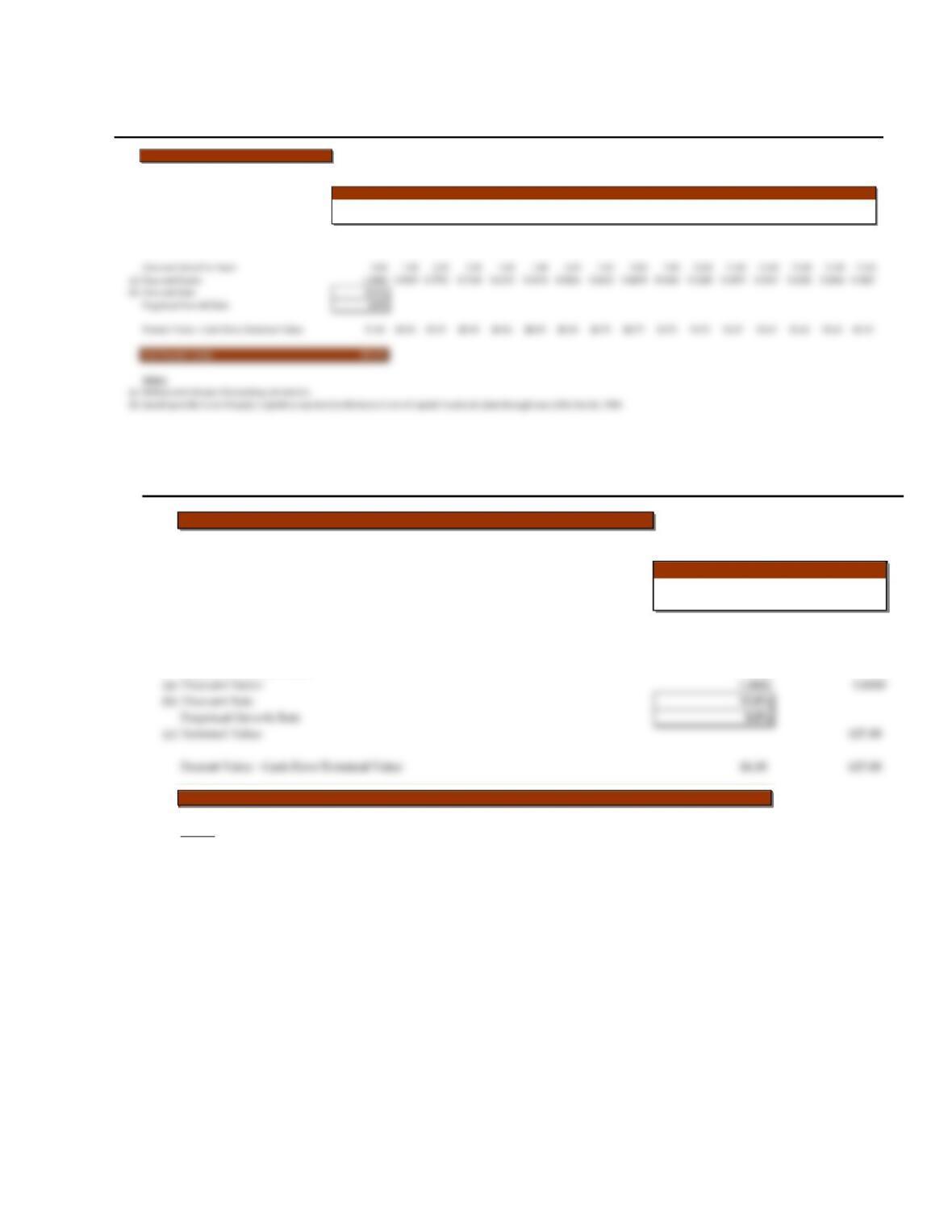
2. A share of NewFangled Sports stock is expected to provide a $1 per year dividend
payment the first year, growing at 8% thereafter. Using a discount rate of 12%, what is
the share worth with a 15-year horizon? What is it worth valued into infinity? Compare
the differences.
The essence of this question is to compare a 15-year horizon and an infinite horizon. As
can be seen in the two tables below, ending the valuation at 15 years has a significant
NewFangled Sports Products, Inc.
Valuation of Stock
Value of Stock Based on Dividend Payments
Projected
FYE FYE FYE FYE FYE Terminal
Current Year CY+1 CY+2 CY+3 CY+4 Year
Expected Dividend Payment Per Share $1.00 $1.10 $1.15 $1.20 $1.30 $2.80
Discount Period in Years 0.00 1.00 2.00 3.00 4.00
(a) Discount Factor 1.0000 0.8890 0.7904 0.7027 0.6247 0.6247
Present Value – Cash Flow/Terminal Value $1.00 $0.98 $0.91 $0.84 $0.81 $39.05
Net Present Value $43.59
3. A minor league professional hockey team embarks on an aggressive facility expansion
that requires additional capital. Management decides to finance the expansion by
borrowing $40 million and halting dividend payments to increase retained earnings. The
projected free cash flows are $5 million for the current year, $10 million for the
following year, and $20 million for the third year. After the third year, free cash flow is
projected to grow at a constant 6%. The overall cost of capital is 10%. What is the total
value? If the company has 10 million shares of stock and $40 million total debt, what is
the price per share?
NewFangled Sports Products, Inc.
Valuation of Stock
Value of Stock Based on Dividend Payments
Projected
FYE FYE FYE FYE FYE FYE FYE FYE FYE FYE FYE FYE FYE FYE FYE FYE
Current Year CY+1 CY+2 CY+3 CY+4 CY+5 CY+6 CY+7 CY+8 CY+9 CY+10 CY+11 CY+12 CY+13 CY+14 CY+15
Expected Dividend Payment Per Share $1.00 $1.08 $1.17 $1.26 $1.36 $1.47 $1.59 $1.71 $1.85 $2.00 $2.16 $2.33 $2.52 $2.72 $2.94 $3.17
NewFangled Sports Products, Inc.
Valuation of Stock
Value of Stock Based on Dividend Payments
Projected
FYE Terminal
Current Year Year
Expected Dividend Payment Per Share $1.00 $1.08
Discount Period in Years 0.00
Net Present Value $28.00
Notes:
(a) Reflects end-of-year discounting convention.
(b) Based upon the Cost of Equity Capital as reported in Ibbotson’s Cost of Capital Yearbook (data through June 2006) for SIC 3949.
(c) Terminal Value = (Terminal Year Cash Flow / (Discount Rate – Perpetual Growth Rate))
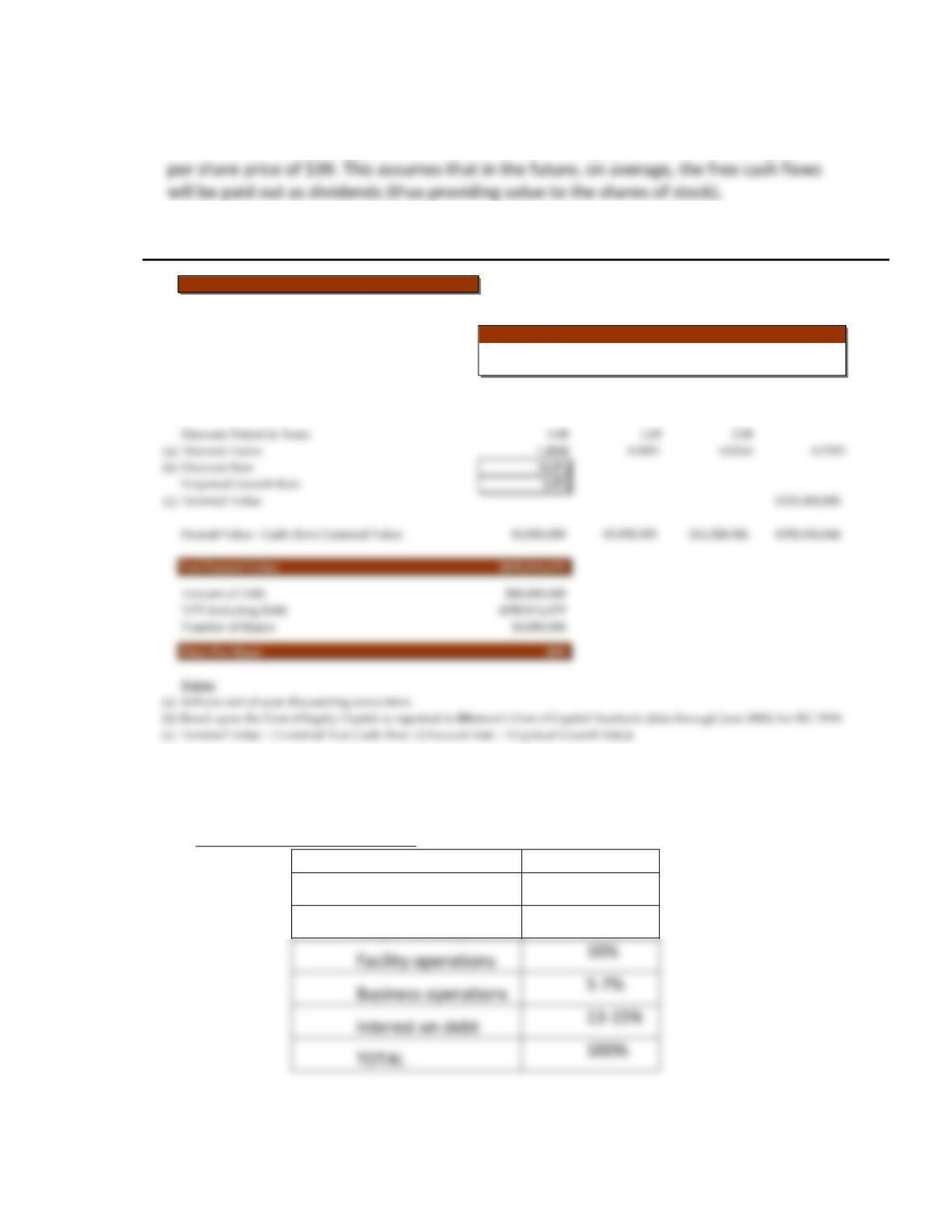
As shown in the table below, the free cash flows in perpetuity, leading to a value of
$428 million. Subtracting $40 million in debt and dividing by ten million shares gives a
Responses to Case Analysis Questions
St. Louis Cardinals’ expenses:
Player salaries
50%
Team operations
10%
Player development
10%
Business operations
Interest on debt
13-15%
TOTAL
100%
Minor League Hockey
Valuation of Stock
Value of Stock Based on Dividend Payments
Projected
FYE FYE FYE Terminal
Current Year CY+1 CY+2 Year
Free Cash Flows $5,000,000 $10,000,000 $20,000,000 $21,200,000
Net Present Value $428,816,679
Price Per Share $39
1. Has the Cardinals’ decision to use debt financing hurt the on-field performance of the
organization? If so, how?
▪ While equity financing wouldn’t require the Cardinals to make more than $20 million
per year in debt payments, those equity holders would likely want to see a return on
their investment. The “dividend” payments to those equity holders might amount to
2. What form of debt financing was likely used by the team to raise its $300 million portion
of the construction costs?
▪ Bonds were likely used, rather than loans, as this method is much more common in
the sport industry.
3. What equity financing options could the club have considered to raise some of the
capital needed to build a new stadium?
▪ The team could have sold shares in the franchise in order to raise capital.
Additional Classroom/Exam Problems
1. The Broomfield Bricklayers has a bond issue outstanding with an annual coupon rate
of 9%. The par value of the bond is $1,000. Calculate the current yield of the bond if
the bond’s current price was $974.

2. Refer to Additional Problem 1. If the sale price of this bond was $1,103 a year later,
what is the capital gains yield?
3. Refer to Additional Problems 1 and 2. What would the total expected return for the
bond be?
4. Refer to the bond valuation calculation on page 181 of the text. Using a financial
calculator, solve for the present value of the 10-year bond on its issue date. The
bond has a par value of $1,000, coupon rate of 10%, and a discount rate of 8%.