
Instructor Manual
Lamb/Hair/McDaniel, MKTG 13E, 9780357127810; Chapter 7: Business Marketing
Table of Contents
Purpose and Perspective of the Chapter …………………………………………………………………………. 2
Cengage Supplements …………………………………………………………………………………………………… 2
Learning Outcomes ……………………………………………………………………………………………………….. 2
Complete List of Chapter Activities and Assessments ……………………………………………………… 3
Key Terms ……………………………………………………………………………………………………………………… 4
What’s New in This Chapter ……………………………………………………………………………………………. 6
Chapter Outline …………………………………………………………………………………………………………….. 6
Discussion Questions …………………………………………………………………………………………………… 15
Additional Activities and Assignments …………………………………………………………………………… 15
Appendix …………………………………………………………………………………………………………………….. 23
Generic Rubrics ……………………………………………………………………………………………………………………… 23
Standard Writing Rubric …………………………..……………………………………………………………………………… 23
Standard Discussion Rubric ……………………………………………………………………………………………………… 24
Purpose and Perspective of the Chapter
The purpose of this chapter is to learn about business marketing, whereby goods and
services are marketed for use in businesses, as opposed to directly to consumers. How
Cengage Supplements
The following product-level supplements provide additional information that may help you
in preparing your course. They are available in the Instructor Resource Center.
• Transition Guide (provides information about what’s new from edition to edition)
• Educator’s Guide (describes assets in the platform with a detailed breakdown of
activities by chapter with seat time)
Learning Outcomes
The following learning outcomes are addressed in this chapter:
7-1 Describe business marketing
7-2 Describe trends in B-to–B Internet marketing

7-4 Identify the four major categories of business market customers
7-5 Explain the North American Industry Classification System
Complete List of Chapter Activities and Assessments
For additional guidance refer to the Teaching Online Guide.
Chapter
Learning
Objective
PPT slide
Activity/Assessment
Duration
Certification
Standard
N/A
MindTap: Why Do
Business Marketing
Customers Matter to
Me?
5 minutes
BUSPROG:
Reflective
Thinking
DISC: Customer
7-3
MindTap: Learn It 7-3:
Relationship Marketing
5 minutes
BUSPROG:
Analytic
Plan
7-4
MindTap: Learn It 7-4:
Major Categories of
Business Customers
5 minutes
BUSPROG:
Analytic
DISC: Customer
7-5
MindTap: Learn It 7-5:
The North American
Industry Classification
System
5 minutes
BUSPROG:
Analytic
DISC: Marketing
Plan
7-6
MindTap: Learn It 7-6:
Business Versus
Consumer Markets
5 minutes
BUSPROG:
Analytic
DISC: Strategy
7-8
MindTap: Learn It 7-8:
Business Buying
Behavior
DISC: Strategy
MindTap: Assignment
25 minutes
BUSPROG:
Analytic
DISC: Marketing
Plan
MindTap: Case Activity
15 minutes
BUSPROG:
Analytic
DISC: Strategy
5 minutes
BUSPROG:
Analytic
7-1
5
Discussion 1 in PPT
15-20 minutes
BUSPROG:
Analytic
DISC: Product
7-2
10
Knowledge Check 1 in
PPT
5 minutes
BUSPROG:
Analytic
DISC: Marketing
Plan
7-3
16
Group Activity 1 in PPT
25-35 minutes
BUSPROG:
Analytic
DISC: Strategy
7-7
43
Group Activity 2 in PPT
25-35 minutes
BUSPROG:
Technology
Online/Computer
7-8
58
Knowledge Check 3 in
PPT
5 minutes
BUSPROG:
Communication
DISC: Customer
[return to top]
Key Terms
accessory equipment: goods, such as portable tools and office equipment, that are less
expensive and shorter-lived than major equipment.
companies with integrated links to their customers and suppliers.
buying center: all the people in an organization who become involved in the purchase
decision.
component parts: either finished items ready for assembly or products that need very
little processing before becoming part of some other product.
multiplier effect (accelerator principle): phenomenon in which a small increase or
decrease in consumer demand can produce a much larger change in demand for the
facilities and equipment needed to make the consumer product.
new buy: a situation requiring the purchase of a product for the first time.
North American Industry Classification System (NAICS): a detailed numbering system
developed by the United States, Canada, and Mexico to classify North American business
establishments by their main production processes.

relationship commitment: a firm’s belief that an ongoing relationship with another firm is
so important that the relationship warrants maximum efforts at maintaining it indefinitely.
straight rebuy: a situation in which the purchaser reorders the same goods or services
without looking for new information or investigating other suppliers.
[return to top]
What’s New in This Chapter
The following elements are improvements in this chapter from the previous edition:
• New examples of strategic alliances
• New discussion of availability of component parts
[return to top]
Chapter Outline
In the outline below, each element includes references (in parentheses) to related content. “LO
CH–##” refers to the chapter learning outcome; “PPT Slide #” refers to the slide number in the
PowerPoint deck for this chapter (provided in the PowerPoints section of the Instructor Resource
Center); and, as applicable for each discipline, accreditation or certification standards (“DISC”).
Introduce Chapter 7 and review the learning outcomes. (PPT Slide 2).
1. What Is Business Marketing? (LO 7-1, PPT Slide 3, DISC: Marketing Plan)
a. Business marketing (industrial, business-to-business, B-to-B, or B2B
marketing) is the marketing of goods and services to individuals and organizations
b. The size of the business market in the United States and most other countries
substantially exceeds that of the consumer market. In the business market, a single
customer can account for a huge volume of purchases. Some large firms that
2. Trends in B-to-B Internet Marketing (LO 7-2, PPT Slide 7, DISC: Online/Computer)
a. There are three main purposes behind digital B-to-B marketing:
• To facilitate communication and orders
• To increase brand awareness
• To position a business as a thought leader, which generates sales leads
b. Trends in B-to-B Internet marketing include:
• Increased use of the Internet as an effective sales and promotion platform
• Greater use of applications to provide additional information about customers
c. Metrics that are useful for increasing the effectiveness of social media campaigns
include:
• Awareness – the attention that social media attracts, such as the number of
followers or fans
3. Relationship Marketing and Strategic Alliances (LO 7-3, PPT Slide 11, DISC: Strategy)
a. Relationship marketing is a strategy that entails seeking and establishing ongoing
partnerships with customers. It enables business suppliers to better compete,

c. Some strategic alliances seem more likely than others, such as the alliance between
Apple and its Apple Watch and high-end fashion brands. Alliances between
competitors, such as Nestlé and Starbucks, may seem more unlikely until you
consider how both can benefit from their mutual interest in the agriculture of
coffee. A successful alliance is built on:
• Relationship commitment – a firm’s belief that an ongoing relationship with
d. Relationships in Other Cultures: Relationship marketing and strategic alliances
are not new concepts. For example, in Japan personal relationships can develop into
formal relationships between companies, which can develop into a keiretsu—a
4. Major Categories of Business Customers (LO 7-4, PPT Slide 18, DISC: Customer)
a. The business market consists of four major categories of customers: producers,
resellers, governments, and institutions. In the United States, there are more than
13 million firms in the producer segment of the business market. Some of these
firms are small, and others are among the world’s largest businesses.
approximately 1.5 million retailers and 500,000 wholesalers operating in the United
States. Business product distributors are wholesalers that buy business products
and resell them to business customers.
d. Governments: The government segment includes thousands of federal, state, and
local buying units. Collectively, these government units account for the greatest

independent units.
• State, County, and City Government: Selling to states, counties, and cities generally
is simpler and less frustrating than marketing to the federal government. State
and local buying agencies include school districts, highway departments,
government-operated hospitals, housing agencies, and many other departments
and divisions.
e. Institutions: Institutions consist of organizations that seek to achieve goals other
than the standard business goals of profit, market share, and return on investment.
5. The North American Industry Classification System (LO 7-5, PPT Slide 25, DISC: Strategy)
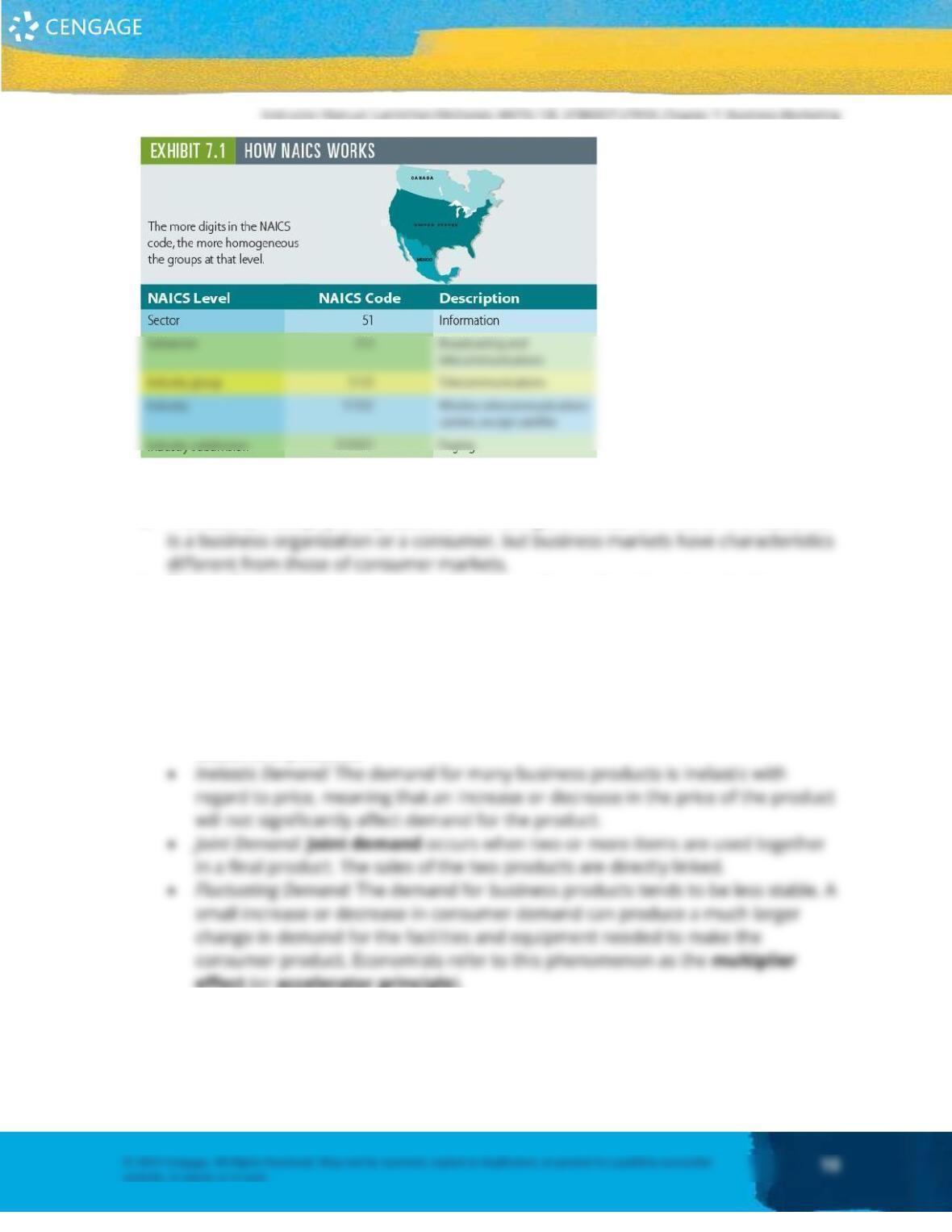
a. The North American Industry Classification System (NAICS) is a detailed
numbering system developed by the United States, Canada, and Mexico to classify
PRESENTATION VISUAL: Exhibit 7.1 How NAICS Works
6. Business Versus Consumer Markets (LO 7-6, PPT Slide 28, DISC: Customer)
a. The basic philosophy and practice of marketing are the same whether the customer
b. Demand: Unlike consumer demand, business demand can be categorized as
derived, inelastic, joint, and fluctuating.
• Derived Demand: The demand for business products is called derived demand
because organizations buy products to be used in producing their customers’
products. For example, the demand for timber is derived from the demand for
new-construction houses. Marketers must monitor their customers’ forecasts
because derived demand is based on expectations of future demand for those
effect (or accelerator principle).
c. Purchase Volume: Business customers tend to buy in large quantities.
d. Number of Customers: Business marketers usually have far fewer customers than
consumer marketers.
e. Concentration of Customers: Manufacturing operations in the United States tend
to be more geographically concentrated in large metropolitan areas than consumer
markets. Most large metropolitan areas host large numbers of business customers.
f. Distribution Structure: Channels of distribution are typically shorter. Also, direct
channels, where manufacturers market directly to users, are much more common.
g. Nature of Buying: Business buyers—typically professionally trained purchasing
agents—usually approach purchasing rather formally. They get to know the
products and sellers well.
h. Nature of Buying Influence: Typically, more experts from a variety of fields are
involved in a single business purchase decision than in a consumer purchase
decision.
i. Type of Negotiations: Negotiating is common in business marketing. Buyers and
sellers negotiate product specifications, delivery dates, payment terms, and other
7. Types of Business Products (LO 7-7, PPT Slide 36, DISC: Product)

Business products generally fall into seven categories:
a. Major Equipment: Major equipment (installations) includes capital goods such as
b. Accessory Equipment: Accessory equipment includes goods, such as portable
tools and office equipment, that are less expensive and shorter-lived than major
equipment. Accessories are more often standardized and are usually bought by
more customers. Accessory equipment is often charged as an expense in the year it
is bought rather than depreciated over its useful life. Local industrial distributors
(wholesalers) play an important role in the marketing of accessory equipment to
geographically dispersed customers.
c. Raw Materials: Raw materials are unprocessed extractive or agricultural products,
Distribution channels are usually direct from producer to business user.
d. Component Parts: Component parts are either finished items ready for assembly
or products that need very little processing before becoming part of some other
product. Component parts often retain their identity after becoming part of the final
product. There are two important markets for component parts: the OEM market
e. Processed Materials: Processed materials are products used directly in
manufacturing other products. They generally are bought according to customer