
1
Chapter 7
Attitudes and Attitude Change
Learning Objectives
After studying this chapter, students should be able to accomplish the following objectives.
7-1 Define attitudes and describe attitude components.
7-3 Understand how the hierarchy of effects concept applies to attitude theory.
7-5 Describe attitude change theories and their role in persuasion.
7-6 Understand how message and source effects influence persuasion.
Lecture Example
Rising gas prices have had a significant impact on consumer behavior. Consumers have realized
that the only way to counter the rise in gas prices is to drive less or opt for more fuel-efficient
cars. They are also making fewer trips to retail stores to save on gas. This demonstrates the
knowledge aspect of consumer attitude, which allows consumers to simplify their decision–
making processes.
Lecture Outline with PowerPoint® Slides
LO 7-1: Define attitudes and describe attitude components.
I. Attitudes and Attitude Components [Instructor PPT Slide 3]
Attitudes are relatively enduring overall evaluations of objects, products, services, issues, or
people. Attitudes play a critical role in consumer behavior. They are particularly important
because they motivate people to behave in relatively consistent ways. It shouldn’t be surprising
2
A. Components of Attitudes [Instructor PPT Slide 4]
According to the ABC approach to attitudes, attitudes possess three important components:
affect, behavior, and cognitions.
• Affect refers to feelings about an object.
• Cognitions refer to beliefs that the consumer has about the object.
• Behavior refers to the overt behaviors that consumers exhibit as well as their intentions
to behave.
Q: Ask students to assume that they own the latest tablet computer with the most
advanced features available in the market. Ask them to describe their reactions to the
tablet and explain how different reactions illustrate the different components of
attitudes.
LO 7-2: Describe the functions of attitudes.
II. Functions of Attitudes [Instructor PPT Slides 5 and 6]
According to the functional theory of attitudes, attitudes perform four functions. The four
functions are the utilitarian function, the knowledge function, the value-expressive function, and
the ego-defensive function. These functions are summarized in Exhibit 7.1.
A. Utilitarian Function
The utilitarian function of attitudes is based on the concept of reward and punishment. This
means that consumers learn to use attitudes as ways to maximize rewards and minimize
punishment. Consumers can reap social rewards through expressing attitudes, and they often
express their attitudes as an attempt to develop or maintain relationships.
B. Knowledge Function
The knowledge function of attitudes allows consumers to simplify decision-making
processes. Attitudes perform the important function of helping consumers avoid undesirable
3
situations and approach more desirable situations. They also help consumers select objects
that they do like.
C. Value-Expressive Function
The value-expressive function of attitudes is found in a number of consumer settings. This
function enables consumers to express their core values, self-concept, and beliefs to others.
Accordingly, this function of attitude provides a positive expression of the type of person a
consumer perceives herself to be and the values that she holds.
D. Ego-Defensive Function
The ego-defensive function of attitudes works as a defense mechanism for consumers. There
are a couple of ways in which this function works.
Q: Have students provide examples for the ego-defensive function of attitudes. How does
this function enhance a consumer’s self-image?
LO 7-3: Understand how the hierarchy of effects concept applies to attitude theory.
III. Hierarchy of Effects [Instructor PPT Slides 7 and 8]
Research indicates that the three components of attitudes may be formed in a sequential pattern.
This process is known as the hierarchy of effects. According to this approach, affect, behavior,
and cognitions (beliefs) form by following one of four hierarchies.
A. High-Involvement Hierarchy
©2018 Cengage Learning. All Rights Reserved. May not be scanned, copied or duplicated, or posted to a publicly accessible website, in whole or in part.
formed. Finally, after beliefs and feelings are formed, the consumer decides to act in some
way toward the product. Here, a purchase decision is made.
B. Low-Involvement Hierarchy
When low-involvement purchases are made, consumers often have some basic beliefs about
products without necessarily having strong feelings toward them.
C. Experiential Hierarchy
Many purchases are based on feelings, and consumers often purchase products or try
experiences simply because they “feel good” or “feel right.” Impulse purchases can be
D. Behavioral Influence Hierarchy
The behavioral influence hierarchy suggests that some behaviors occur without either beliefs
or affect being strongly formed beforehand. Strong environmental pressures lead to behaviors
without belief or affect formation. Behavior is influenced by environmental cues. This means
that there are times when behaviors may be performed in the absence of strong beliefs or
feelings.
Q: Ask students to give an example each for high-involvement and low-involvement
hierarchies.
LO 7-4: Comprehend the major consumer attitude models.
IV. Consumer Attitude Models [Instructor PPT Slide 9]
5
A major approach to measuring attitudes developed by Martin Fishbein and Icek Ajzen, the
attitude-toward-the-object model. This model is known as a multiattribute attitude model
because it combines information about a number of beliefs and evaluations pertaining to an
object’s attributes.
A. Attitude-Toward-the-Object Model [Instructor PPT Slides 10–12]
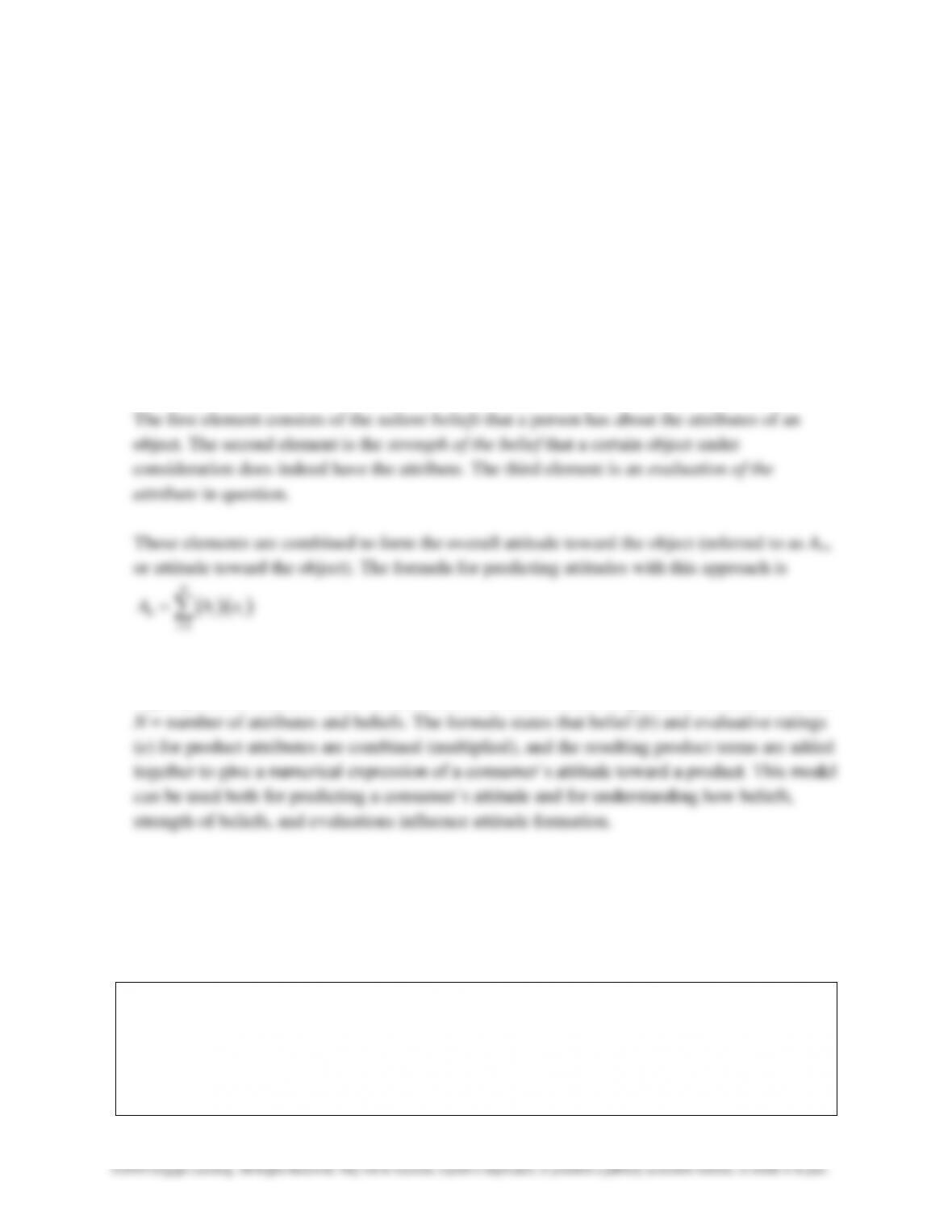
The attitude-toward-the-object (ATO) model (sometimes simply referred to as the Fishbein
model) proposes that three key elements must be assessed to understand and predict a
consumer’s attitude.
where A0 = attitude toward the object in question (or Abrand), bi = strength of belief that the
object possesses attribute i, ei = evaluation of the attractiveness or goodness of attribute i, and
Using the ATO Approach
To understand this model, first consider how the various elements are measured. The belief
ratings (b) can be measured on a 10–point scale, such as:
How likely is it that the Sony television will give you a clear picture?
1 2 3 4 5 6 7 8 9 10
Extremely unlikely Extremely likely
6
An example may help to clarify the use of this formula. Think of the situation that Jamal
faces selecting a new apartment. Jamal recently graduated from college and received a job
offer in a large city. He is now considering three different apartment complexes that
currently have vacancies. How could his attitude toward each one be predicted? This
information is presented in Exhibit 7.3.
Q: Have students imagine that they are marketers for a gym. How do members of their
target segment feel about the amenities offered in gyms? What is their opinion about the
equipment in the gym? What is their opinion about the trainers at the gym?
The ATO approach is known as a compensatory model. With compensatory models,
attitudes are formed holistically across a number of attributes, with poor ratings on one
attribute being compensated for by higher ratings on another attribute.
Implications of the ATO Approach
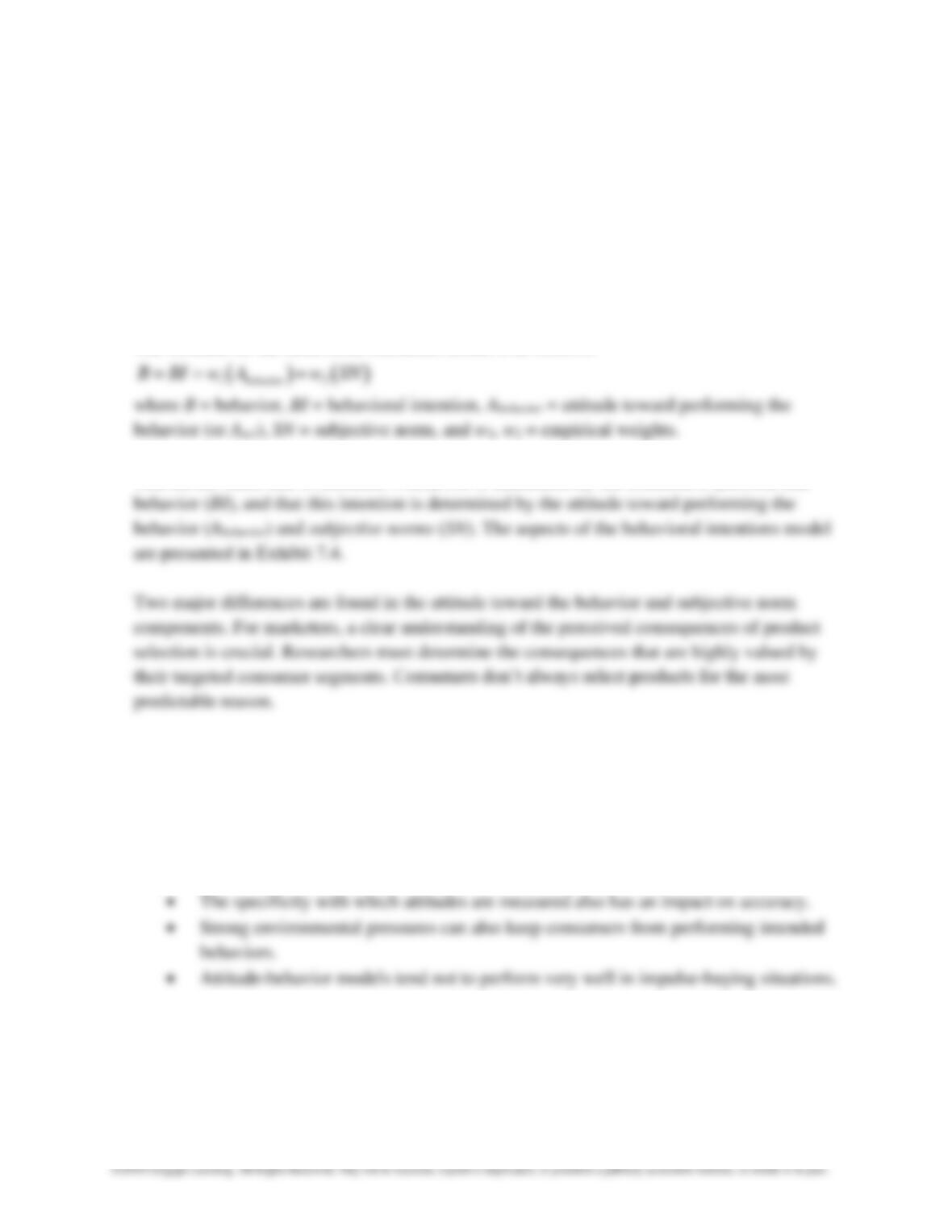
Information obtained from this model has important marketing implications. First, attitude
research is most often performed on entire market segments rather than on individuals. An
equally important issue for managers would be learning if consumers believe that products
Do Attitudes Always Predict Behavior?
Marketing managers and researchers alike realize that just because a consumer has a
positive attitude toward a product doesn’t mean that he will always purchase the product.
B. Behavioral Intentions Model [Instructor PPT Slides 13–16]
7
The behavioral intentions model, sometimes referred to as the theory of reasoned action, has
been offered as an improvement over the attitude-toward-the-object model. This model differs
from the attitude-toward-the-object model in a number of important ways.
First, rather than focusing explicitly on attitudes, the model focuses on intentions to act in
some way. Second, the model adds a component that assesses the consumer’s perceptions of
what other people think they should do. This is referred to as the subjective norm. Finally, the
model explicitly focuses on the consumer’s attitude toward the behavior of buying rather than
the attitude toward the object.
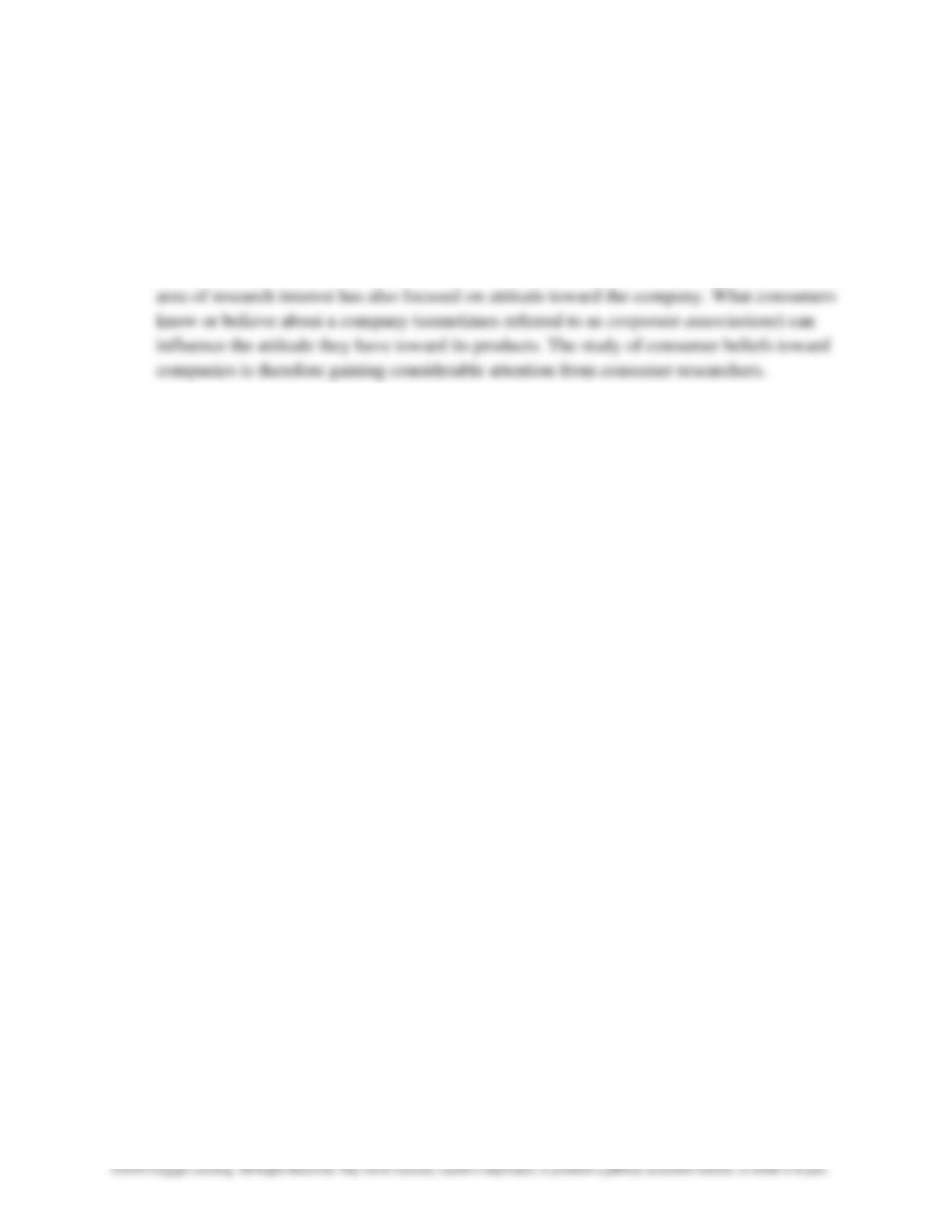
The formula for the behavioral intentions model is as follows:
( ) ( )
12behavior
B BI w A w SN = +
where B = behavior, BI = behavioral intention, Abehavior = attitude toward performing the
behavior (or Aact), SN = subjective norm, and w1, w2 = empirical weights.
This model states that a consumer’s behavior is influenced by the intention to perform that
Factors that Weaken Attitude-Behavior Relationship
Although consumer attitude models are very popular in consumer research, researchers
note that a number of factors can weaken the attitude-behavior relationship.
• As the length of time between attitude measurement and overt behavior grows, the
predictive ability of attitudinal models weakens.
Alternative Approaches to Attitude
One small variation of this theory is the theory of planned action, which expands upon
the behavioral intentions model by including a perceived control component. This
8
component assesses the difficulty involved in performing the behavior and the extent to
which the consumers perceive that they are in control of the product selection.
Expanding the Attitude Object
Research has shown that there is generally a positive relationship between a consumer’s
attitude toward an advertisement and her attitude toward a particular product. A growing
Attitude Tracking
Attitude tracking refers to the extent to which a company actively monitors its customers’
attitudes over time.
LO 7-5: Describe attitude change theories and their role in persuasion.
V. Attitude Change Theories and Persuasion [Instructor PPT Slides 17 and 18]
An important issue in the study of consumer behavior is how attitudes are changed. The term
persuasion refers to specific attempts to change attitudes. Usually, the hope is that by changing
beliefs or feelings, marketers can also change behavior. There are many different persuasive
techniques. These include the ATO approach, the behavioral influence approach, the schema-
based affect approach, the elaboration likelihood model, the balance theory approach, and the
social judgment theory approach.
A. Attitude-Toward-the-Object Approach
According to the ATO model, both beliefs about product attributes and evaluations of those
attributes play important roles in attitude formation. To change attitudes according to this
approach, marketers can attempt to change beliefs, create new beliefs about product features,
or change evaluations of product attributes.
Changing Beliefs
Marketers may attempt to change consumers’ beliefs. In this case, managers would need to
focus more on this attribute in advertisements. With each effort, the focus is on improving
the belief rating for an attribute that is evaluated positively. Another approach would be to
9
focus on decreasing the strength of belief regarding a negatively evaluated attribute.
Adding Beliefs about New Attributes
Another strategy for changing attitudes under the ATO approach is adding a salient
attribute to the product or service. Like the changing beliefs approach, this may require a
physical change to the product itself. At other times, the new beliefs may not be tied to an
actual new attribute. Rather, they may simply emphasize something that consumers had
previously not considered.
Changing Evaluations
Marketers may also attempt to change the evaluation of an attribute. Here, the marketer
tries to convince consumers that an attribute is not as positive (or negative) as they may
think. Changing evaluations of an attribute is usually more difficult than changing the
strength of a belief regarding that attribute. Quite simply, consumers know what they like,
and they make selections accordingly.
B. Behavioral Influence Approach
Another strategy commonly applied by marketers follows the Behavioral Influence hierarchy.
Marketers may use this approach in many ways. Behavioral conditioning can be very
effective. Consumers respond to marketing stimuli in certain ways, and behaviors frequently
result without either beliefs or affect changing first.
Q: The owner of Tracy’s Diner decided to revamp the entire place over a weekend. The
new décor included warm colors such as red, which are thought to increase hunger, and
softer lighting, which is thought to encourage customers to linger over their food and
thus buy more. The owner’s intention was to increase the volume of purchases by
regular customers who visited the diner on weekdays. In this scenario, which kind of
approach is the owner using? Explain.
C. Changing Schema-Based Affect
From an attitude perspective, schema-based affect refers to the idea that schemas contain
affective and emotional meanings. If the affect found in a schema can be changed, then the
10
attitude toward a brand or product will change as well.
D. The Elaboration Likelihood Model [Instructor PPT Slides 19–20]
Another popular approach for conceptualizing attitude change is found in the elaboration
likelihood model. The elaboration likelihood model (ELM) illustrates how attitudes are
changed based on differing levels of consumer involvement. Numerous research studies have
The Central Route
If consumers find that the incoming message is particularly relevant to their situation (and
thus highly involved), they will likely expend considerable effort in comprehending the
message. In this case, high-involvement processing occurs, and the central route to
persuasion is activated. Here, the consumer develops a number of thoughts (or cognitive
responses) regarding the incoming message that may either support or contradict the
information.
The Peripheral Route
If consumers are not involved with a message or lack either the motivation or ability to
process information, the peripheral route to persuasion will be followed. In this route,
consumers are unlikely to develop cognitive responses to the message (either supporting
11
©2018 Cengage Learning. All Rights Reserved. May not be scanned, copied or duplicated, or posted to a publicly accessible website, in whole or in part.
message. These elements of the message (that is, nonproduct-related information) are
referred to as peripheral cues.
Low-Involvement Processing in the Consumer Environment
Vast majority of advertisements to which consumers are exposed are processed with low-
involvement processing. Consumers are simply not motivated to carefully attend to the
E. Balance Theory [Instructor PPT Slides 21 and 22]
The balance theory approach was introduced by social psychologist Fritz Heider. The basic
premise of balance theory is that consumers are motivated to maintain perceived consistency
in the relations found in mental systems. Accordingly, this approach is based on the
consistency principle. This principle states that human beings prefer consistency among their
beliefs, attitudes, and behaviors. An example is shown in Exhibit 7.6.
F. Social Judgment Theory [Instructor PPT Slides 23 and 24]
Social judgment theory is yet another theory for explaining attitude change. This theory
proposes that consumers compare incoming information to their existing attitudes about a
particular object or issue. The initial attitude acts as a frame of reference, or standard, against
which the incoming message is compared. Around these initial reference points are latitudes
of acceptance and latitudes of rejection. For a message to fall within the latitude of
acceptance, the information presented must be perceived as being close to the original attitude
position. A message that is perceived as being far away from, or opposed to, the original
attitude position will fall within the latitude of rejection. These aspects of the theory are
presented in Exhibit 7.7.
©2018 Cengage Learning. All Rights Reserved. May not be scanned, copied or duplicated, or posted to a publicly accessible website, in whole or in part.
LO 7-6: Understand how message and source effects influence persuasion.
VI. Message and Source Effects and Persuasion [Instructor PPT Slide 25]
An important part of understanding persuasion is comprehending how communication occurs.
The term message effects is used to describe how the appeal of a message and its construction
affect persuasion. Source effects refer to the characteristics of the person or character delivering
a message that influence persuasion. A basic communication model is shown in Exhibit 7.8.
A. Interactive Communications
The one-to-many communications model works well when examining personal
communications or traditional advertising media such as television, newspapers, or radio.
However, interactive communications have radically changed the communication paradigm.
Importantly, information flow is no longer considered a “one–way street,” in which consumers
B. Message Appeal
There are several ways to conceptualize how a message may impact the persuasiveness of an
advertisement. A number of appeals are used by advertisers including sex appeals, humor
appeals, and fear appeals.
Sex Appeals
Using sexual imagery in advertisements certainly is popular in many parts of the world.
Moderate levels of nudity appear to be most preferred, as highly explicit content tends to
13
©2018 Cengage Learning. All Rights Reserved. May not be scanned, copied or duplicated, or posted to a publicly accessible website, in whole or in part.
direct attention away from the product. Gender plays a role in advertising effectiveness
regarding nudity. Finally, research also reveals that including a romantic theme (rather than
focusing on the explicit pleasure of sex) may have positive benefits for marketers.
Humor Appeals
Marketers also frequently use humorous ads. One recent study confirmed that humorous
ads can attract attention, create a positive mood, and enhance both attitude toward a brand
and purchase intentions. However, humor appeals can also decrease the credibility of a
Fear Appeals
In addition to using sexual and humor appeals, advertisers also frequently attempt to evoke
some level of fear in their target audiences as a means of changing attitudes and behaviors.
These ads often rely on the relationship between a threat (an undesirable consequence of
behavior) and fear (an emotional response). The product being advertised is often
promoted as a type of a solution that will remove the threat. As an overall statement, fear
appeals appear to be effective when they:
Violence Appeals
One trend that has been growing over the last few decades is the use of violent scenes in
advertisements. The effects on viewers often go beyond marketing-related reactions. It is
interesting to note that many violent ads also use elements of humor, seemingly in an
attempt to lessen the degree to which the ad is disturbing.
Q: Ask students to review ten current advertisements on TV and identify the kind of
appeal each ad uses.
14
C. Message Construction
Advertisers must consider a number of issues when constructing a message. Listed below are
a number of questions that marketers must answer.
• Should an ad present a conclusion or should the consumer be allowed to reach his own
conclusion?
Advertisements that allow consumers to arrive at their own conclusions tend to be more
persuasive when the audience has a high level of involvement with the product.
• Should comparative ads that directly compare one brand against another be developed?
Advertisers generally have three alternatives when developing an ad.
• Where should important information be placed?
The placement of information in a specific message at the beginning, middle, or end of
the message impacts the recall of the information. This is a basic tenet of what is known
as the serial position effect.
• Should the message be straightforward and simple, or complex?
D. Source Effects [Instructor PPT Slide 26]
Another important issue in the study of persuasion is how the source of a message (a
spokesperson or model, for example) influences consumers’ attitudes.
Source Credibility
Source credibility plays an important role in advertising effectiveness. In general, credible
sources tend to be more persuasive than less credible sources. However, credible sources
15
Credibility consists of two elements: expertise and trustworthiness.
• Expertise refers to the amount of knowledge that a spokesperson is perceived to have
about the product or issue in question.
• Trustworthiness refers to a perception of the extent to which a spokesperson is
presenting a message that he or she truly believes, with no reason to present false
information.
Source Attractiveness
Source attractiveness is another quality that has received a great deal of attention.
Attractive models are often thought to possess desirable qualities and personalities. They
also tend to be more persuasive than unattractive spokespeople. Much like the research
Source Likeability
Source likeability also affects a spokesperson’s effectiveness. Likeable sources tend to be
persuasive. Interestingly, it has been found that source likeability affects persuasion more
for consumers with low need for cognition than for those with a high degree of this trait.
This again highlights the importance of individual difference variables in persuasion.
Source Meaningfulness
The dominant characteristics of a source should match the characteristics of the product.
This is a key concept that is found in the matchup hypothesis, which states that a source
feature is most effective when it is matched with relevant products.
Q: Ask students to identify a few ads for brands that have been endorsed by celebrities.
What is the effect of the celebrity’s attractiveness, likeability, and meaningfulness on the
customer perception of the brand?
16
Video material for this chapter is starting on page 24 of the IM
End of Chapter Material
Review Questions
(*) Indicates material on prep cards.
1. What is meant by the term “consumer attitudes”? Why do you think attitudes play such an
important role in consumer behavior?
2. *Describe the ABC approach to consumer attitudes. How do the various components apply
to your daily life as a consumer?
©2018 Cengage Learning. All Rights Reserved. May not be scanned, copied or duplicated, or posted to a publicly accessible website, in whole or in part.
3. Using your own examples, explain the four functions of attitudes that are presented in this
chapter.
4. Why do you think the functions of attitudes are important to consumer researchers?
Provide examples of the ways in which you have used each function.
©2018 Cengage Learning. All Rights Reserved. May not be scanned, copied or duplicated, or posted to a publicly accessible website, in whole or in part.
7. Describe the components of the ATO model. How would you apply the model to your
attitude formation process? Give an example.
8. Describe the theory of reasoned action. In what situations do you think the approach would
apply most effectively to a consumer situation?
9. What are the major attitude change theories? Using an example of your own, discuss the
following attitude change theories and how they have applied to a purchase or consumer
situation that you have faced: the elaboration likelihood model, balance theory, and social
20
judgment theory.
10. *How can marketers attempt to change beliefs or evaluations directly? How effective do
you think these attempts can be?
11. Summarize the major types of message appeals and source effects. Describe products that
are often advertised using the various message appeals.