CHAPTER 6
THE AMERICAN SOCIETY:
FAMILIES AND HOUSEHOLDS
LEARNING OBJECTIVES
LO1: Explain the concept of household types of households and their influence on
consumption
LO2: Summarize the household life cycle’s various stages and marketing implications
LO3: Understand the family decision process
SUMMARY
LO1: Explain the concept of household types of households and their influence on consumption
The household is the basic purchasing and consuming unit and is, therefore, of great importance to
marketing managers of most products. The family household consists of two or more related persons
LO2: Summarize the household life cycle’s various stages and marketing implications
The household life cycle is the classification of the household into stages through which it passes over
time based on the age and marital status of the adults and the presence and age of children. The
LO3: Understand the family decision process
Family decision making involves consideration of questions such as who buys, who decides, and who
uses. Family decision making is complex and involves emotion and interpersonal relations as well as
LO4: Describe the role that households play in child socialization
Consumer socialization deals with the processes by which young people (from birth until 18 years of
age) learn how to become consumers. Children’s learning abilities are limited at birth, then slowly
LO5: Explain the sources of ethical concern associated with marketing to children
Marketing to children is fraught with ethical issues. The main source of ethical concern is the limited
ability of children to process information and make sound purchase decisions or requests. There are
LECTURE TIPS AND AIDS
1) One good way to start the lecture on the household is to drive home the basic importance of the
household to marketing managers. Although it seems to be completely obvious, students need to
2) The use of the HLC, particularly in conjunction with other variables, should be emphasized in
lecture. Work through an example with students using Table 6–2.
3) It may be helpful to start this lecture off by asking students for examples of products where the
4) Table 6-2 is very powerful. I had a colleague who ran most of his course in consumer behavior
5) Use Student Handout 1 to direct a discussion of consumer socialization.
Student Handout 1: Consumer Socialization and Birthday Parties
A study of birthday parties for children aged three to five revealed that the mothers used the situation
to (1) teach children how to plan a party, (2) indicate approval or disapproval of certain themes (e.g.,
Barbie, Ninja Turtles), (3) teach sharing and other positive values, and (4) instill social skills. The
following examples indicate the instrumental nature of the process.
Planning Skills
Theme Approval
• [Explaining why she would not let her son have a commercial theme at his party.] It is not so
much the money but the values I have about it …but I have to explain to Carl that we decided to do
it this way because we think birthdays are very special, but we celebrate them differently than
other people . . . that’s what we think is important that is the lesson we try to show.
Positive Values
• [I use] outdoor games . . . something where everybody wins. [In a treasure hunt] they all got in
like one big cohort, and they all helped each other ….It was really nice, they really liked it, and
everyone got a prize in the end.
Social Skills
• I am petrified they are going to say something like, “Hey, I already have this.” My eight-year-old
would never do this because he knows I’ll take all his toys and give them to the Salvation Army if
I find out….With the four-year-old, I worry.
REVIEW QUESTIONS
1) The household is described as “the basic consumption unit for consumer goods.’’ Why?
Household units, not individuals, consume most consumer products. Additionally, the consumption
patterns of individual household members are seldom independent of the other household members.
2) What is a traditional family? Can a single-parent family be a nuclear family?
3) How does a nonfamily household differ from a family household?
A family household consists of at least two members related by birth, marriage, or adoption, one of
who is the householder (householder owns or rents the residence). A nonfamily household is a
householder living alone or exclusively with others to whom he or she is not related.
4) How has the distribution of household types in the United States been changing? What are the
implications of these shifts?
Table 6-1 provides a good breakdown of the types of households. There is a trend toward smaller
5) What is meant by the household life cycle?
The HLC is the classification of a household into stages over time based on adult age, marital status,
and the presence and age of children.
6) What is meant by the following statement: “Each stage in the household life cycle poses a series of
7) Describe the general characteristics of each of the stages in the household life cycle.
a. Single I: (Under 35) live alone or, more typically, with parents or with others they are not
related to. The younger members of this group have limited incomes but limited expenses;
those who are older tend to have more disposable income.
b. Young Couples, No Children: young couples (under 35) both generally working and are
relatively affluent.
f. Empty Nest I: middle-aged (35-64) couples with no children living at home. Most have dual
careers with busy lifestyles, but have free time and the money to spend on expensive
vacations, second homes, luxury care, and time-saving services.
i. Single Parent II: middle-aged (35-64) single parents with child/children living with them.
This group often faces serious financial pressures. However, choosing to have children
(adoption or conception) is increasingly viewed as a lifestyle choice for older, more
financially secure women.
j. Empty Nest II: older couples over 64 without children living in their household. This group
has ample time on their hands.
8) Describe the HLC/Occupational Category matrix. What is the logic for this matrix?
Table 6-2 outlines the different stages of the household life cycle and different occupational
9) What is meant by family decision making? How can different members of the household be
involved with different stages of the decision process?
Decision making about consumption that involves all or part of the household (i.e., more than one
household member). Different members become involved at different stages because of degree of
10) How does family decision making differ from most organizational decision making?
Organizations have relatively objective criteria such as profit maximization which guide purchases.
Families lack such explicit, over-arching goals. Most industrial purchases are made by strangers or
have little impact on those not involved in the purchase. Most family purchases directly impact the
11) The text states that the marketing manager must analyze the family decision-making process
separately within each target market and for each product. Why?
12) What factors influence involvement of a household member in a purchase decision?
How family members interact in a purchase decision is largely dependent on the culture and
13) How do family members attempt to resolve conflict over purchase decisions?
A recent study revealed six basic approaches that individuals use to resolve purchase conflicts after
they have arisen (most couples generally seek to avoid open conflicts): (1) Bargaining: trying reach
14) What is consumer socialization? How is knowledge of it useful to marketing managers?
Consumer socialization is the process by which young people acquire skills, knowledge, and
attitudes relevant to their functioning as consumers in the marketplace. The role marketing plays in
15) What are Piaget’s stages of cognitive development?
There are four stages: (1) the period of sensori-motor intelligence (ages 0-2) – primarily motor
16) What do we mean when we say that children learn consumer skills, consumption-related attitudes,
and consumptions-related preferences?
Consumer skills are those capabilities necessary for purchases to occur such as understanding
money, budgeting, product evaluation, etc.
17) What processes do parents use to teach children to be consumers?
Children learn about becoming consumers from their parents, friends, classmates, and the media.
While many parents provide explicit instructions to the children related to consumption
18) Describe each of the five stages children go through as they learn to shop at stores.
Stage I: Observing. Parents begin taking children to the store with them at a median age of 2 months.
During this stage, children make sensory contact with the market place and begin forming mental
images of marketplace objects and symbols. In the early months, only sights and sounds are being
processed. However, by 12 to 15 months, most children can begin to recall some of these items. This
stage ends when children understand that a visit to the market may produce rewards beyond the
stimulation caused by the environment.
Stage III: Making Selections. Actually getting an item off the shelf without assistance is the first
act of an independent consumer (median age is three and a half years). At its simplest level, a
child’s desire is triggered by an item in his or her immediate presence and this item is selected.
Soon, however, children begin to remember the store location of desirable items, and they are
allowed to go to those areas independently or to lead the parent there.
Stage V: Making a purchase without a parent to oversee it requires a fairly sophisticated
understanding of value as well as the ability to visit a store, or a section of a store, safely without a
parent. Most children remain in stage IV a long time before their parents allow them to move into
stage V (median age is eight years).
19) What ethical issues arise in marketing to children?
The major issue focuses on the limited ability of younger children to process information and to
DISCUSSION QUESTIONS
20) Respond to the questions in Consumer Insight 6–1.
a) What are some possible reasons for the dropping average number of children in households
today?
There are several good possible answers for this question, including but not limited to:
increasing educational attainment, labor force participation, improvements in contraception,
and higher divorce rates.
b) Multi-partner fertility is increasing. What are some reasons that you suppose could be driving
this shift?
The increase in divorces, separations, remarriages, and serial cohabitations has likely
contributed to an increase in multi-partner fertility. Further, alternative family structures are
c) What new challenges might marketing managers face in targeting various types of consumer
households today versus several years ago?
21) Canada has legislation giving cohabiting couples who have been living together for one year or
more the same federal rights and responsibilities as married couples. Should the United States
have similar legislation?
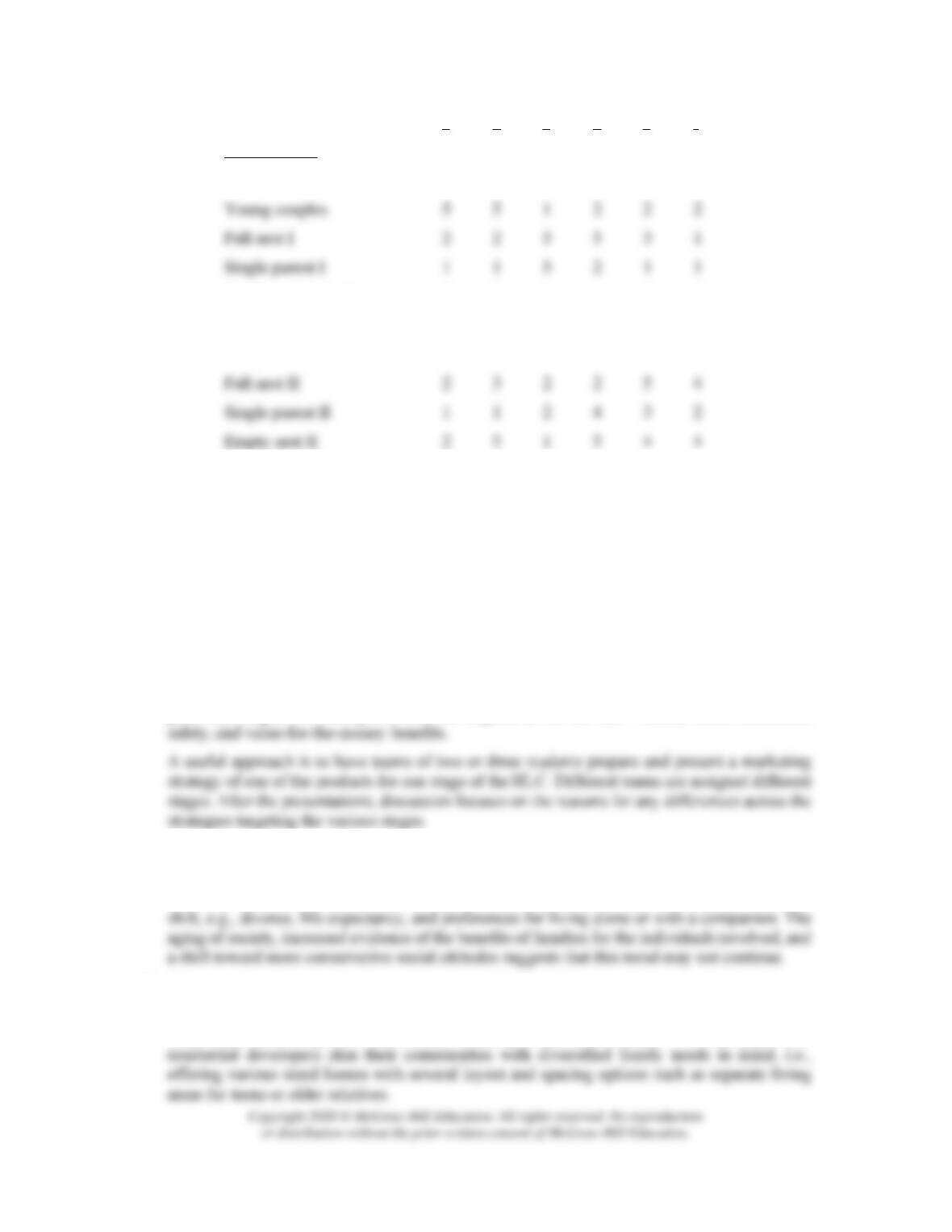
22) Rate the stages of the household life cycle in terms of their probable purchase of the following.
Justify your answers.
a) Designer jeans
d) Breakfast bars
a
b
c
d
e
f
Stage of HLC
Single I
5
5
1
5
1
3
Full nest I
2
2
5
5
3
1
Single parent I
1
1
5
2
1
1
Middle-aged single
5
2
1
5
5
5
Empty nest I
3
5
1
4
5
4
Delayed full nest I
2
1
4
3
3
2
Full nest II
2
3
2
2
5
4
Single parent II
1
1
2
4
3
2
Empty nest II
2
5
1
5
4
4
Older Single
1
2
1
5
4
5
1 = Very low probability of buying item, to 5 = Very high probability.
These are the subjective feelings of the authors; and your class should challenge them.
23) Pick two stages in the household life cycle. Describe how your marketing strategy for the
following would differ depending on which group was your primary target market.
a) Minivan
b) Razors
c) Broadway show
d) Casino
For each product and HLC stage mentioned, the marketer would have to stress the benefits
generally sought. For example, a minivan targeted at the full nest I should stress roominess,
24) Do you think the trend toward nonfamily households will continue? Justify your response.
Table 6-1 summarizes the size of the family and nonfamily households. As indicated in the text
the traditional family has declined over time. The class can discuss the various causes for this
25) What are the primary marketing implications of Table 6–1?
Both family and non-family households are important considerations for marketers, which in
some instances changes the demand for many products and services. For example, many
26) How would the marketing strategies for the following differ by stage of the HLC (assume
each stage is the target market)?
a) Cell phone
b) Scuba gear
d) Children’s toys
e) Detergent
27) What are the marketing implications of Figure 6-4?
Women are increasingly the more educated and higher-earning partner in marriages. This is
28) What type of the following would be best suited for each cell in Table 6–2?
a) Hotel
c) Restaurant for the entire household
29) Name two products for which the horizontal axis in Table 6-2 should be the following. Justify
your response.
a) Occupational category
c) Education
30) How can a marketer use knowledge of how family members seek to resolve conflicts?
Understanding what causes conflicts can lead to products and communications strategies that are
31) Describe a recent family purchase in which you were involved. Use this as a basis for completing
Table 6-3 for a marketer attempting to influence that decision.
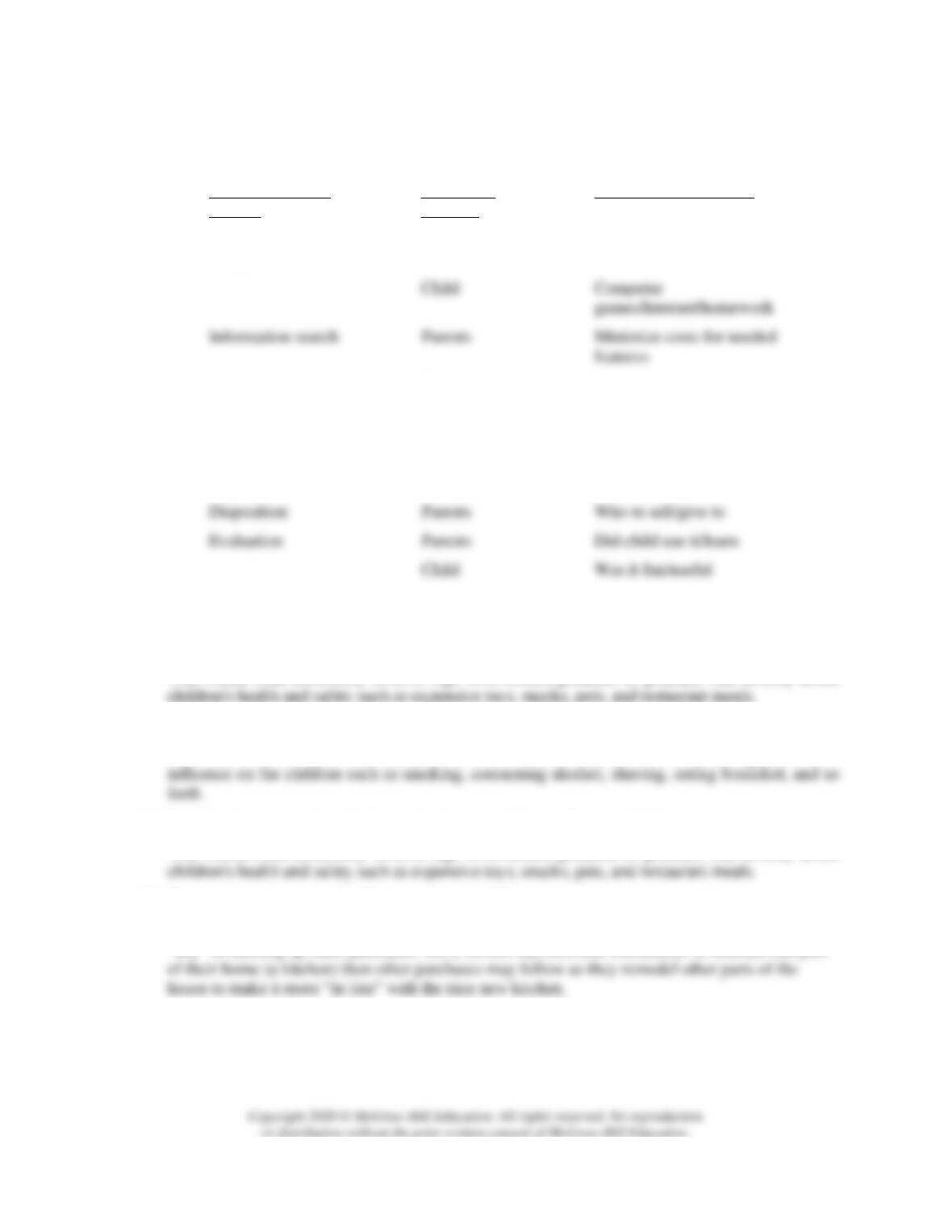
Students should recognize and discuss the key household influences and their motivation at
different stages of the decision process. For example, consider the decision to purchase a personal
computer for a child:
Stage of Decision
Process
Household
Member
Motivation and Interest
Problem
recognition
Parents
Help children educationally
games/Internet/homework
Information search
Parents
Minimize costs for needed
features
Alternative
evaluation
Family
Cost versus features
Purchase
Parents
Price and terms
Use/consumption
Child
Play computer games, access
Internet, do homework
Disposition
Parents
Who to sell/give to
Child
Was it fun/useful
32) Describe four types of activities or situations in which direct instrumental training is likely to
occur.
33) Describe four types of activities or situations in which modeling is likely to occur.
This would involve activities adults perform in front of children without thinking about their
34) Describe four types of activities or situations in which mediation is likely to occur.
35) Respond to the questions in Consumer Insight 6–2.
Q1 – Students will have different answers. One focus may be on how one decision becomes the
Q2 – Individual answers will vary. They key is that students link changes associated with the
lifecycle phase to changes in needs and wants and requirements and thus decisions to remodel.
Q3 – Here it is worth pointing out that we mean not that consumers know the name of the effect,
36) Are Piaget’s stages of cognitive development consistent with the five stages of learning to shop
that McNeal identified?