Chapter 6: Consumer Behavior
CHAPTER SUMMARY AND LEARNING OBJECTIVES
LO 6.1 Identify the three types of influences that affect the consumer decision process.
A variety of influences affect individuals when making purchase decisions, including social
factors, psychological factors, and situational factors. It’s important for marketers to understand
the needs and wants of consumers as well as the factors that influence purchasing behavior.
LO 6.2 Outline the six steps in the consumer decision process.
Consumers complete a step-by-step process in making purchase decisions. The process begins
LO 6.3 Distinguish between high-involvement and low-involvement purchase decisions.
Involvement indicates the degree of interest an individual may have with a product or purchase
decision, and the time and level of problem solving they’ll apply to the purchase process.
LO 6.4 Describe the five social factors that influence consumer behavior.
LO 6.5 Describe the five psychological factors that influence consumer behavior.
LO 6.6 Describe the four situational factors that influence consumer behavior.
LO 6.7 Given a consumer purchase scenario, identify the primary influences affecting the
consumer decision process.
The ability to identify various influences on consumer behavior helps marketers assemble
marketing mixes most likely to reach their target customers.
Chapter 6: Consumer Behavior
ACTIVATOR EXERCISE: Why do we buy?
Purpose: For students to evaluate the influences on their purchasing behavior.
Format: Individual journaling, then group discussion.
Time: 20–30 minutes, depending on format.
Activity: Individually, have students journal about a purchase over $300 from the last year
(can’t be textbooks or tuition). Have them consider the following questions:
• What was the product?
• What prompted you to believe you needed the product?
• How did you initially research the product?
After students journal this individually, have them share in pairs or groups of 3–4.
Then, as a class have some students share. Ask them to look for common themes in the
purchase decision process of their fellow students.
Result: Students will more intentionally evaluate what drove their purchase decisions, which
Chapter 6: Consumer Behavior
LECTURE OUTLINE
6-1 Influences Affecting Consumer Behavior
Consumer behavior is the process through which the ultimate buyer or household consumer
makes purchase decisions. Companies who market products ranging from toothbrushes to
automobiles to vacations must understand the core needs and wants of their customers, as well
as the many factors that influence their purchasing behavior.
Social factors include external influences such as culture, social class, reference groups,
family, and opinion leaders.
Example: A finance major may wear a dark suit, white dress shirt, and blue tie for a job
Psychological factors include needs and motives, perceptions, attitudes, learning, and self-
concept.
Example: If a consumer is concerned about environmental issues and wants to decrease
Contextual or situational factors may also influence consumer behavior and may change the
products they typically purchase.
Example: A woman getting married may be willing to spend much more on a wedding
Much of the remainder of this chapter is a deep-dive into these factors.
Estimated time: 5–10 minutes
6-2 The Consumer Decision Process
Chapter 6: Consumer Behavior
PRESENTATION VISUAL: MindTap Exhibit 6.1 showing the consumer decision process
Problem or Opportunity Recognition
The first stage in the consumer decision process is when the consumer becomes aware of a
gap between their existing situation and a desired or an ideal situation. The desired situation
may form as a result of unmet needs or wants.
Discussion questions: Have you recently seen or heard an ad that sparked your interest in a
product? Is it because you were manipulated into wanting a product you don’t really need? Or
did it address some sort of problem or need that you already had and needed (or wanted) to
address at some point?
Information Search
During the second step in the decision process, a consumer gathers information about different
ways to solve a problem or achieve the desired state.
Problem-
Opportunity
Recognition
•Consumer becomes aware of a gap between an existing situation and a desired
situation.
Information
Search
•Consumer conducts internal or external information search to acquire information to
assist in the attainment of the desired state.
Chapter 6: Consumer Behavior
How much time and effort a consumer spends gathering information varies according to their
level of experience and knowledge with the product as well as the risk involved in making a
decision.
Evaluation of Alternatives
The third step in the consumer decision process is to evaluate the evoked set of options.
Actually, it is difficult to completely separate the second and third steps because some
Classroom activity: Divide students into small groups and assign each group a major life
decision, such as buying a car, buying a house, choosing a college, and even choosing a
spouse.
Purchase Decision and Purchase Act
The information search and evaluation stages of the decision process result in the purchase
Post-Purchase Evaluation
The final step of the consumer decision process is to evaluate the purchase, which leads to two
outcomes. The buyer may feel satisfaction that their desired state has been achieved or
experience dissatisfaction with the purchase.
Estimated time: 20–30 minutes
Chapter 6: Consumer Behavior
6-3 How Involvement Level Affects Consumer Decisions
The amount of time and effort a purchaser might spend varies according to their level of
involvement with the product and/or purchase decision. Involvement indicates the degree of
interest an individual has in the product, as well as how important that product is to them.
Involvement may be classified as either “high” or “low” depending upon the financial or social
risk associated with the product.
• Financial risk relates to the price of the product; more expensive products such as
furniture, appliances, and automobiles would be considered high-involvement products.
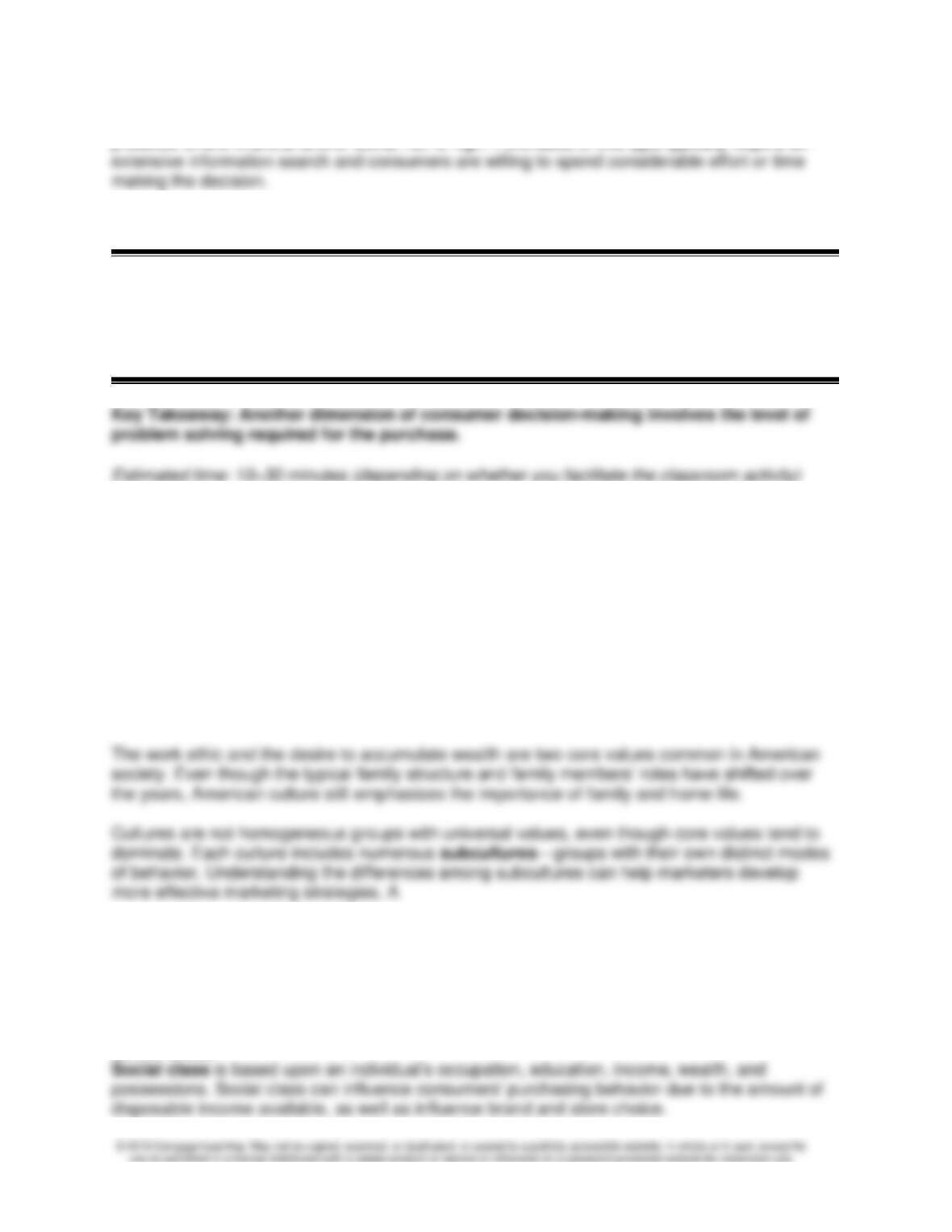
Consumer Decision Making Styles
Another dimension of consumer decision making involves the level of problem solving required
for the purchase. These styles, which correlate to the concept of high or low involvement, are
termed routinized response behavior, limited problem solving, and extended problem solving.
PRESENTATION VISUAL: MindTap Exhibit 6.2 showing decision making styles
Routinized response behavior occurs for low-involvement products that consumers purchase
on a frequent basis. These items are low price and often consumed in private, so both financial
Chapter 6: Consumer Behavior
Extended problem solving is the most complex decision style and occurs for high involvement
Classroom activity: Have students choose a partner and select a low-involvement, routinized
consumer product such as toothpaste, shampoo, bottled water, and so on.
Create an ad you think could stimulate consumers to change their preferred brand to the one
you are advertising. What will you say or offer to spark consumer interest and get them out of
their routine?
6-4 Social Factors Influencing Consumer Behavior
Social factors and group membership influence individual consumer purchase decisions in both
overt and subtle ways. The five social factors include culture, social class, reference groups,
family, and opinion leaders.
Cultural Influences
Culture can be defined as the values, beliefs, preferences, and tastes handed down from one
generation to the next. Culture is the broadest environmental determinant of consumer
behavior. Some cultural values change over time, but basic core values do not.
Example: America’s population is more diverse and the three largest and fastest-growing
U.S. ethnic subcultures—Hispanics, Black or African Americans, and Asians—are
expected to become the majority by the year 2060. Marketers need to be sensitive to
these shifts in population composition and to the differences in shopping patterns and
buying habits of the members of different subcultures.
Social Class
Chapter 6: Consumer Behavior
Example: Research indicates that, comparatively, consumers who shop at KMart and
Reference Groups
Reference groups are people or institutions whose opinions are valued and to whom a person
looks for guidance in his or her own behavior, values, and conduct.
Example: Reference groups include one’s religious, social (e.g., fraternity, sorority,
country club), leisure (e.g., golf), and occupation-related groups.
1. The visibility of the product to others. A car or workplace outfit is a highly visible
Opinion Leaders
In nearly every reference group, a few members act as opinion leaders, trendsetters who
purchase new products before others in a group, and then influence others in their purchases.
Celebrities such as actors, musicians, and sports figures may also serve as opinion leaders
through their endorsement of products or their lifestyle.
Classroom activity: In pairs or small groups, have students select a person they believe is a
Family
The family is perhaps the most important determinant of consumer behavior because of the
close, continuing interactions among family members. Most people will be members of at least
Discussion question: Consider your own participation in family purchases. How much
influence did you have on your family’s decision as a child? As a teenager? Over what types of
products did you have an influence—or not?
Chapter 6: Consumer Behavior
Note: Can be done as a classroom activity where students first journal these answers, then
share with a classmate.
Estimated time: 20–40 minutes
6-5 Psychological Factors Influencing Consumer Behavior
Factors internal to an individual influence consumer behavior; these factors include needs and
motives, perceptions, attitudes, learned responses, and self-concepts.
Needs and Motives
As discussed previously, individual purchase behavior is first driven by the motivation to fill a
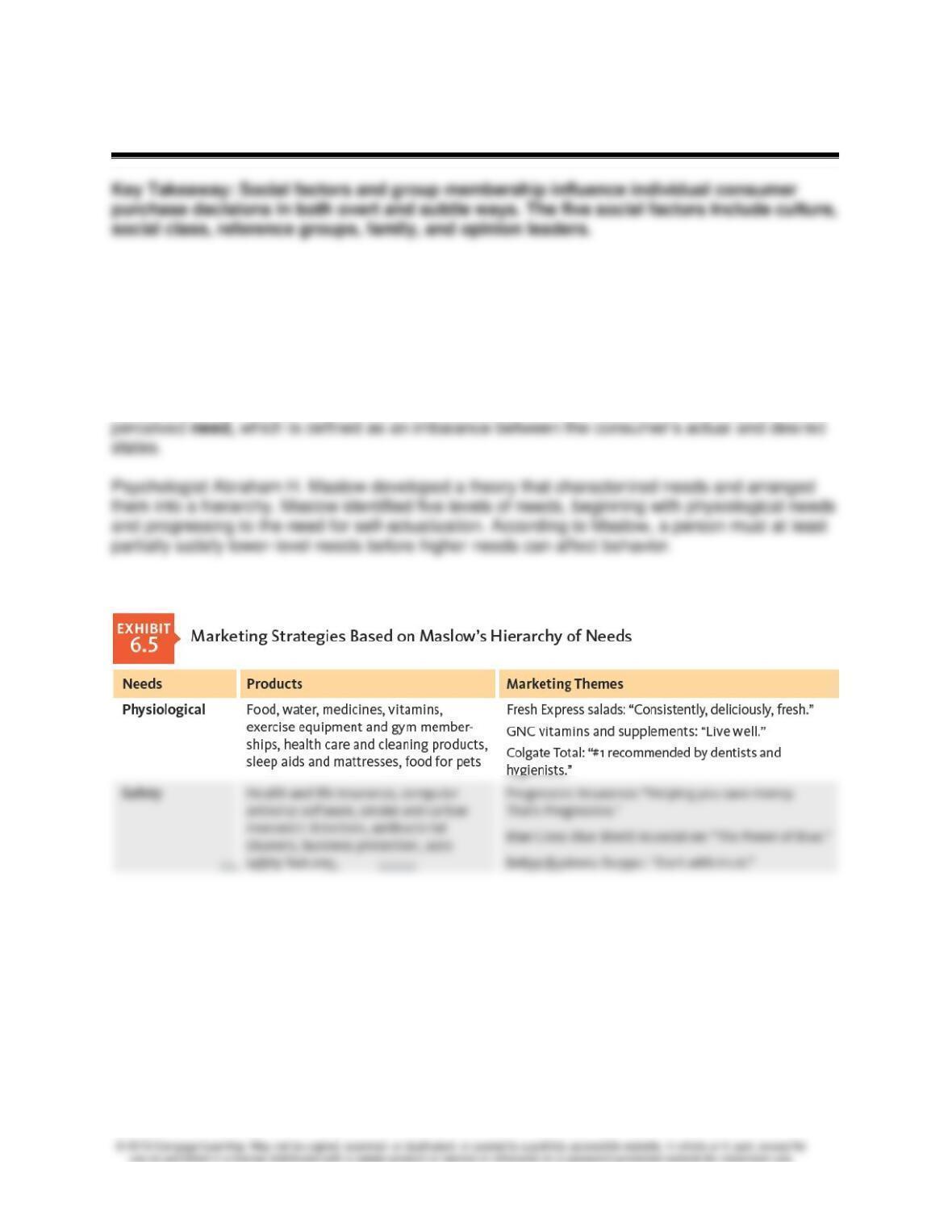
PRESENTATION VISUAL: MindTap Exhibit 6.5 showing Maslow’s Hierarchy
Chapter 6: Consumer Behavior
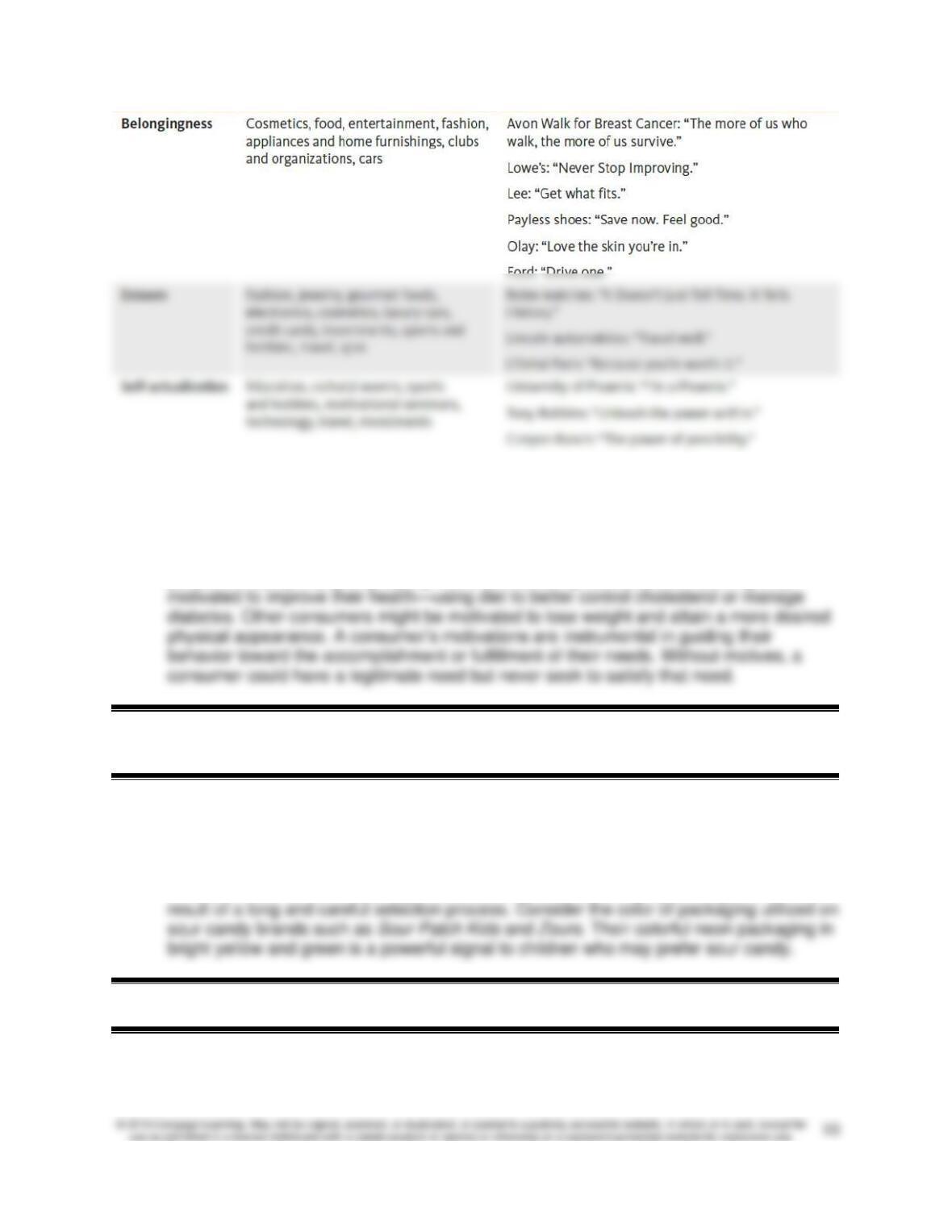
Motives are inner states that direct a person toward the goal of satisfying a need.
Example: We know that a large portion of consumers set New Year’s resolutions to
pursue a healthy lifestyle by eating well and exercising. Some consumers might be
Discussion question: What are the needs and motives that are drove you to attend college?
What are the needs and motives that are influencing your choice of (or interest in) a particular
career?
Perception
Perception is the meaning a person attributes to incoming stimuli gathered through the five
senses—sight, hearing, touch, taste, and smell.
Example: Color is so compelling that its use on product packaging and logos often is the
Discussion question: What are some examples of brands that you associate with a particular
color? Why do you think they chose that color and what does it represent to that brand?
Chapter 6: Consumer Behavior
Attitudes
Perception of incoming stimuli is greatly affected by attitudes. In fact, a consumer’s decision to
purchase an item is strongly based on his or her attitudes about the product, store, or
salesperson.
Learning
Learning, in the marketing context, refers to immediate or expected changes in consumer
behavior as a result of experience. A positive initial experience with a product is the foundation
for repeat purchases and positive word-of–mouth, which provides incentive for others to
Discussion question: What are products that you’ve had past, positive experience with that
you now prefer or purchase without questioning or evaluating alternatives?
How valuable is this consumer preference to that brand or company?
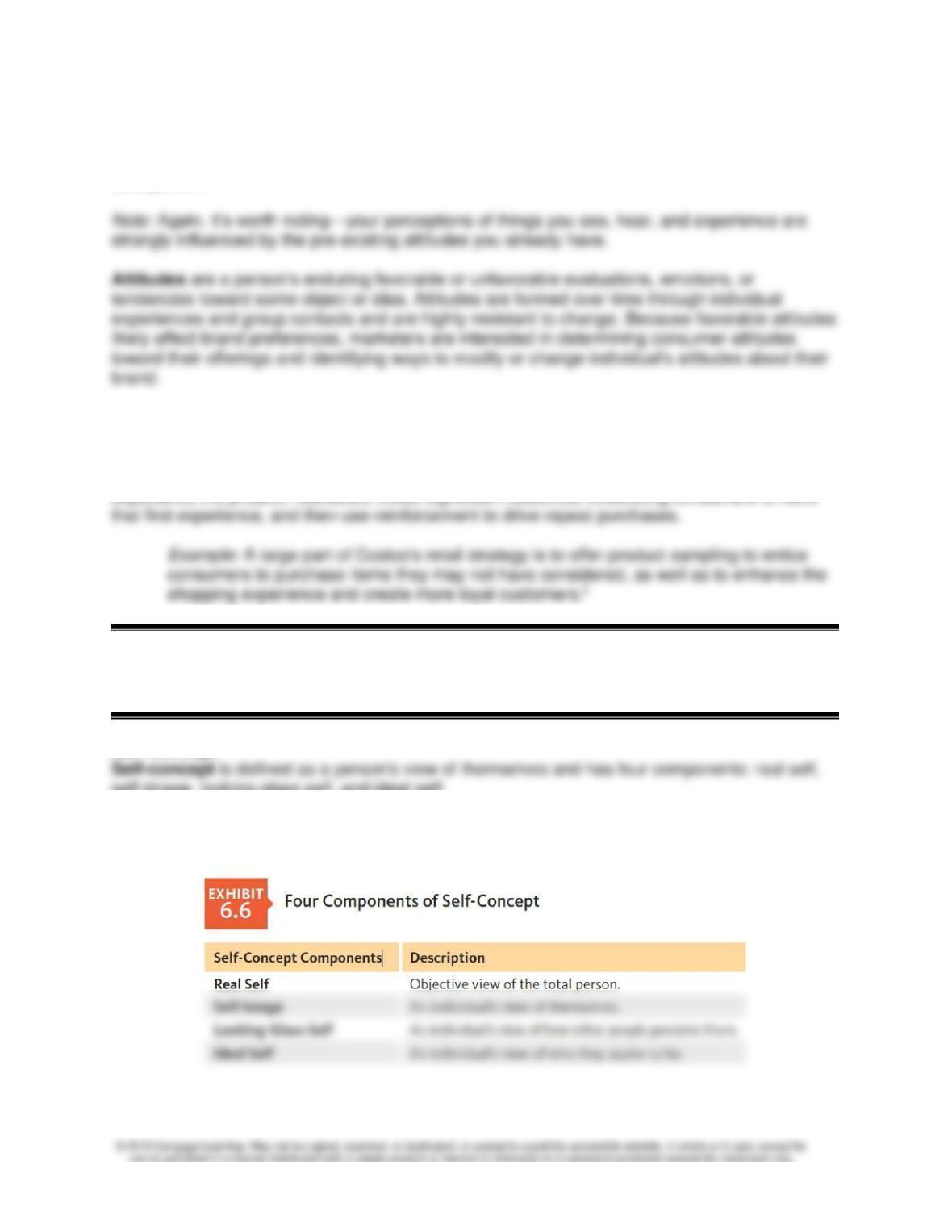
self-image, looking-glass self, and ideal self.
PRESENTATION VISUAL: MindTap Exhibit 6.6 describing the four components of self-
concept