Chapter 6: Consumer Behavior
Classroom activity: Ask students to journal 3–5 aspects of their self-image as it really is. Then
ask them to think of 3–5 aspects of their ideal self (the self they aspire to be)?
How does this ideal self affect your goals, motives, and purchase decisions?
Key Takeaway: Factors internal to an individual influence consumer behavior; these
factors include needs and motives, perceptions, attitudes, learned responses, and self-
concepts.
Estimated time: 20–30 minutes
6-6 Situational Factors Influencing Consumer Behavior
In addition to social and psychological factors, situational factors impact behavior in known and
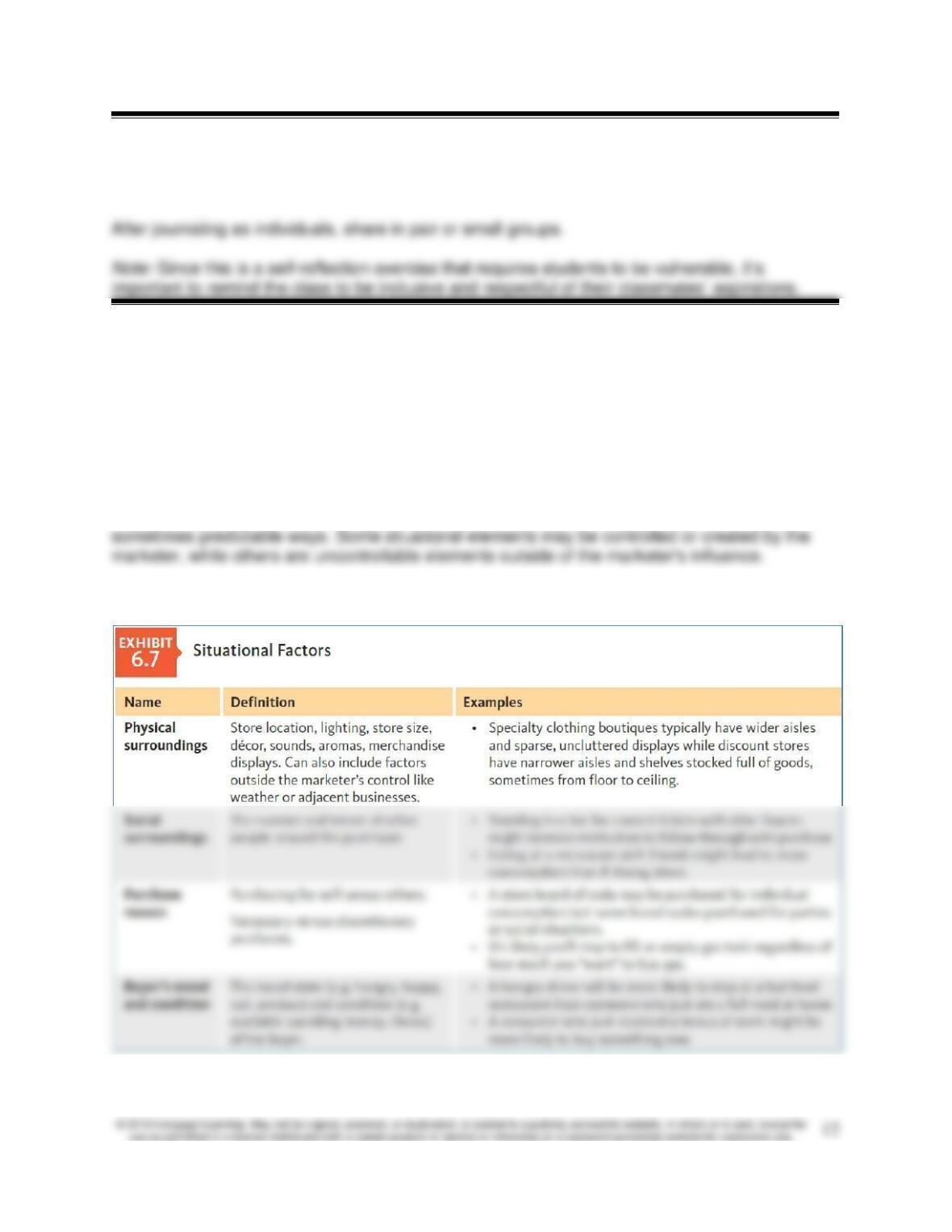
PRESENTATION VISUAL: MindTap Exhibit 6.7 providing examples of situational factors
Chapter 6: Consumer Behavior
Classroom activity: In small groups, ask students to brainstorm 2–3 real world examples they
have observed or experienced for each of the above situational factors.
Then discuss as a class.
Question: Which of these factors could be controlled or influenced by the marketer?
6-7 Identifying Influences on Consumer Behavior
Note: This learning objective provides practical application of several concepts from this
chapter. Reviewing these examples (which are in the text) in class can help reinforce how these
concepts are integrated.
Application exercise
As the marketing team at Butternut contemplates future marketing decisions, they look beyond
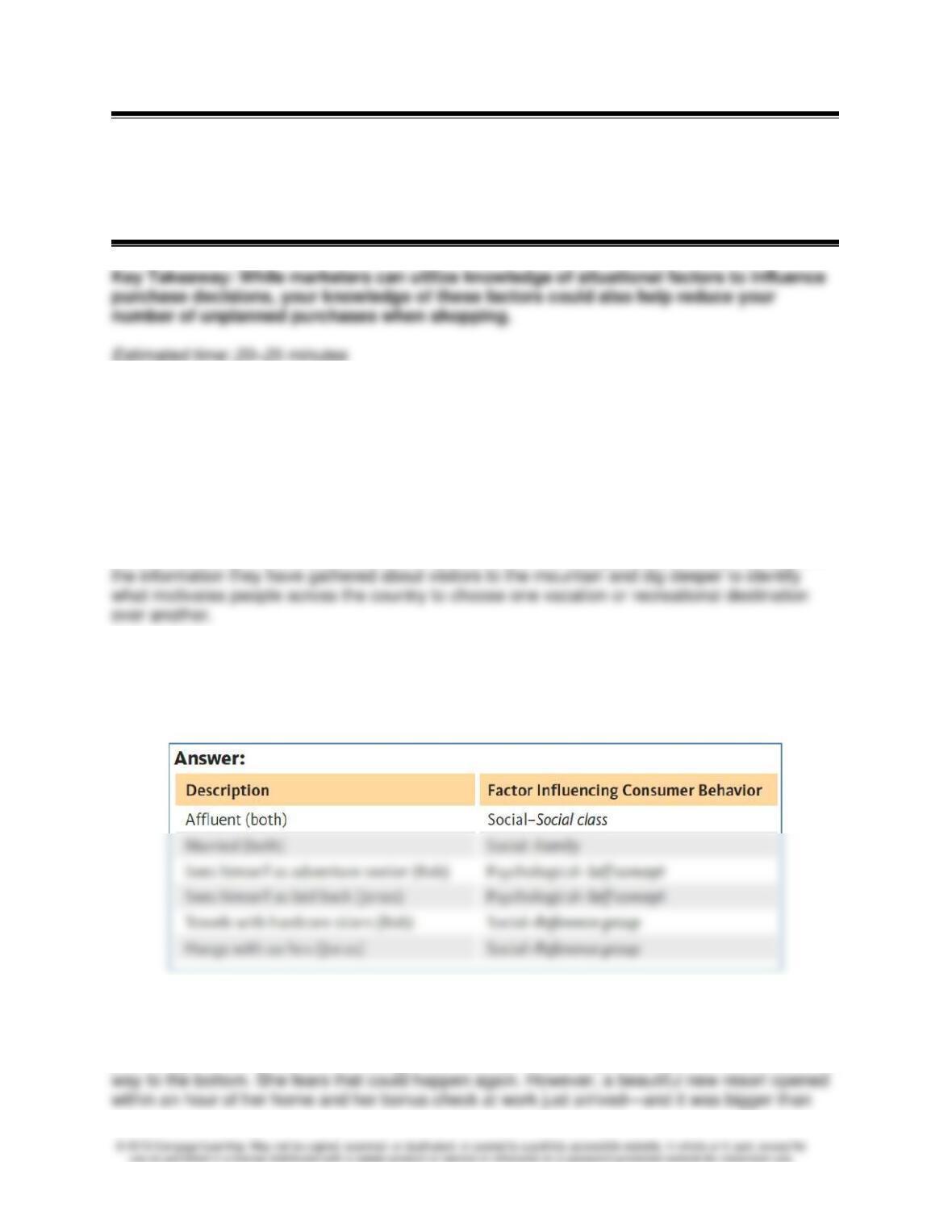
Example #1: Rob and Jonas are both affluent and married with kids. Rob sees himself as an
adventure seeker and travels around the world with other hardcore skiers. Jonas sees himself
as laid back and has actually never skied, instead opting to hang with fellow surfers whenever
possible. Can you spot the influences on their behavior?
Example #2: Veronica fears skiing because she broke her arm last time on the slopes. She was
just a beginner then, but a friend brought her to an advanced slope and Veronica tumbled all the
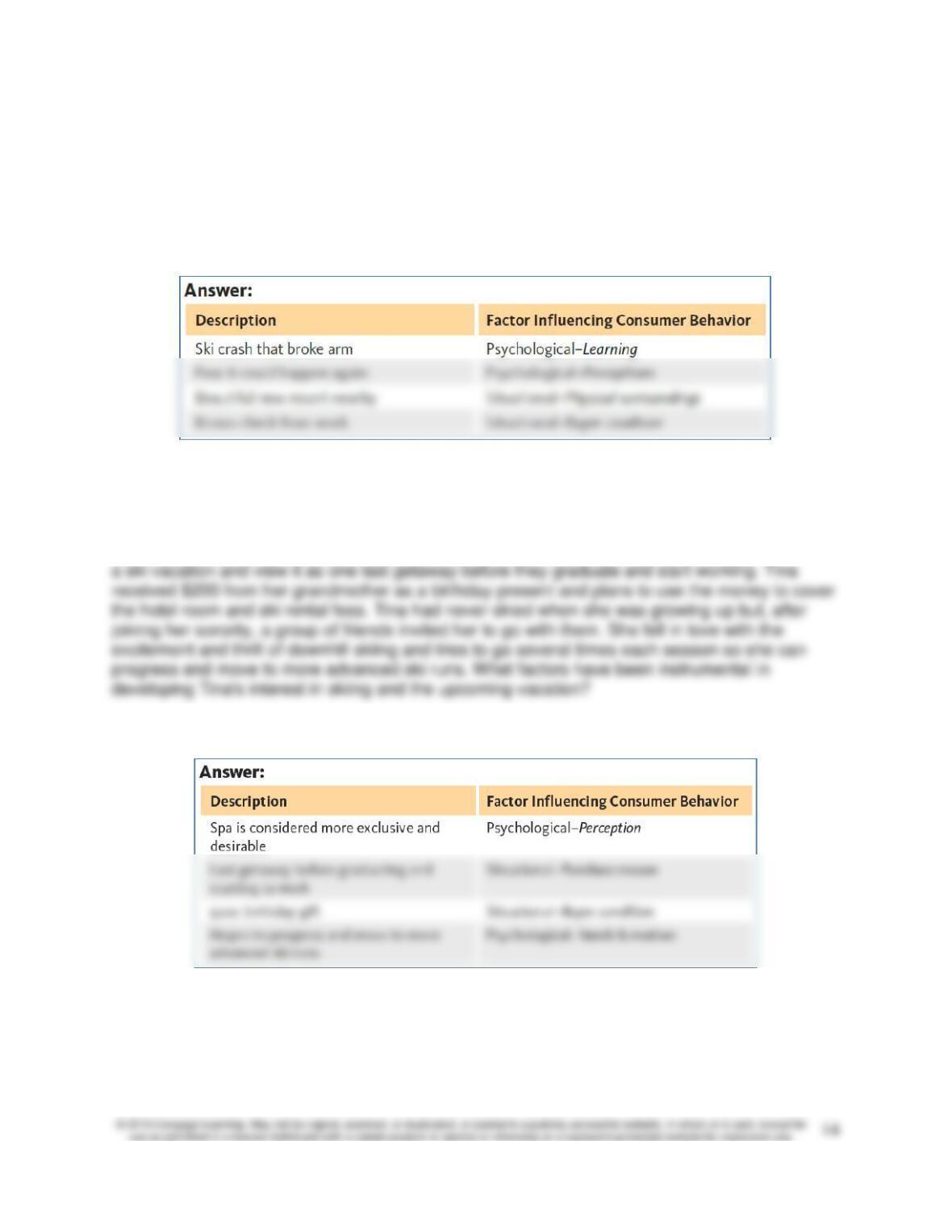
Chapter 6: Consumer Behavior
she expected. Now she’s considering whether to give skiing another try. Veronica’s decision
about whether to ski or not is most affected by which influences?
Answer:
The table is titled, Answer. The table has 2 columns and 6 rows. The column headings, from left
to right, are as follows: Description, Factor influencing Consumer Behavior. The row entries are
as follows. Row 1. Description,
Example #3: Tina and a group from her sorority are planning a three-day weekend ski vacation
and want to stay at a resort that also offers spa services. There are two different ski resorts that
offer spa services, but one is considered more exclusive and desirable. They are excited to take
Answer:
Key Takeaway: By looking at customer influences, the team at Ski Butternut can best
identify the best new prospects for their resort, and how to persuade them to visit.
Estimated time: 20 minutes
Chapter 6: Consumer Behavior
LEARN IT TODAY . . . USE IT TOMORROW
VIGNETTE AND ACTIVITY
The opening vignette for Chapter 6 introduces students to Ski Butternut, a ski and
snowboarding resort in Massachusetts. The intro teases a few aspects of consumer behavior
that Ski Butternut must consider when marketing their resorts.
Note: Answers to the chapter-ending activity can be discussed in class after the activity
due date.
Ski Butternut
As a marketing intern at Ski Butternut, you’ve just spent the day shadowing their team to learn
[Questions are from the Ski Butternut video in MindTap)
Question #1
When Matt says Ski Butternut appeals to families, he is referring to which of the three influences
on consumer behavior?
• Social (answer)
Question #2
Since Ski Butternut is described as affordable, what two influences does this most relate to?
• Social—reference group
Question #3
Luke’s friends are mainly skateboarders and snowboarders who would rather ride the rails at a
terrain park than ski downhill. Luke also saw Sean White on a YouTube video snowboarding on
rails and thought it was cool. Now Luke spends most of his time going off to jumps and riding
rails at Ski Butternut. Luke is most influenced by which two factors?
• Social—family
• Social—reference group (answer)
• Social—influencers (answer)
Chapter 6: Consumer Behavior
Question #4
When Matt Sawyer talks about giving kids a good experience early so they are more likely to
come back when they “get wheels” (meaning they are old enough to drive), he is referring to the
influence of:
• Social—social class
Question #5
If a parent brings their children to Ski Butternut because they see the gentle slopes and kids-
oriented ski runs as safer and more family-friendly, this relates to which influences?
• Social—influencers and reference groups
Question #6
Teenagers and college students arrive “in packs” to Ski Butternut. This relates to which two
influences?
Social—social class
Social—reference groups (answer)
Chapter 6: Consumer Behavior
ADDITIONAL HOMEWORK/CLASSROOM ACTIVITIES
Cultural Values and Consumer Behavior
Purpose: To help students explore their perceptions of U.S. cultural values.
Background: Culture clearly influences consumer behavior in both obvious and subtle ways,
Relationship to Text: Social factors that influence consumer behavior
Estimated Class Time: About 10 minutes
Exercise: Spend a few moments reviewing with your class the idea of core values. Once they
fully understand the concept, divide your students into small groups and give each group a few
minutes to quickly brainstorm a list of core values in U.S. culture (and tell them to base their list
on their own perceptions, not from any other source). When their lists are complete, ask them to
prioritize their values from most important to least important.
Questions for Reflection:
• Why is it important to explore the core values of national culture?
• How does this information impact marketing?
Attitudes and Consumer Behavior
Purpose: To emphasize the role of attitudes in consumer behavior.
Background: While everyone knows what it means to “have an attitude,” the marketing
implications are less apparent for many students. This exercise is designed to clarify the
relationship between attitudes and consumer behavior.
Chapter 6: Consumer Behavior
Exercise: Divide your students into small groups. Challenge each group to choose an existing
ad that appeals to a particular type of attitude and ask them to develop an alternate ad for the
Questions for Reflection:
• How important are attitudes relative to the other influences on consumer behavior?
• How easy or hard is it to change consumer attitudes? Why?
Self-Concept and Consumer Behavior
Purpose: To illustrate the close links between who we are and how we consume.
Background: The study of consumer behavior suggests that many of our purchases reflect
recognizable elements of who we are in terms of gender, personality, individual style, hobbies,
and so on. This exercise is designed to highlight those links.
Exercise: Direct your students to think for a moment about goods or services that they
particularly enjoy in any category, from shoes to bands, cars, and restaurants. Ask them to write
down their five favorites, including the brand name (e.g., Nike running shoes, Levi’s blue jeans),
Questions for Reflection:
• In what categories are our purchases most likely to reflect our personalities?
• Do brands themselves have personalities?
• How can a marketer create a personality for a brand? What is the value in doing so?
Chapter 6: Consumer Behavior
Internet Research Activities
Marketing to children
Advertising and other marketing efforts directed toward children have long been controversial.
Visit the website of Children’s Advertising Review Unit (CARU)—an organization created by the
Consumer decision making
Assume you’re in the market for both a new cell phone and cell phone provider. Follow the
beginning stages in the consumer decision model described in the chapter—recognition of
problem or opportunity, search, and evaluation of alternatives. Use the Internet to aid in your
consumer decision process. Prepare a report summarizing your experience. Compare and
contrast your experience with an actual consumer purchase decision you recently made.
Chapter 6: Consumer Behavior
KEY TERMS
Consumer behavior: The process through which the ultimate buyer or household consumer
makes purchase decisions.
Evoked set: The collection of alternatives a consumer considers when making a decision.
Involvement: The degree of interest an individual has in the product, as well as how important
that product is to them.
Routinized response: Behavior that occurs for low-involvement products that consumers
purchase on a frequent basis.
Limited problem solving: Behavior that occurs for purchases that consumers make less
frequently and when their knowledge or experience is limited.
Reference groups: People or institutions whose opinions are valued and to whom a person
looks for guidance in his or her own behavior, values, and conduct.
Opinion leaders: Trendsetters who purchase new products before others in a group, and then
influence others in their purchases.
Need: An imbalance between the consumer’s actual and desired states.
Motives: Inner states that direct a person toward the goal of satisfying a need.
Chapter 6: Consumer Behavior
Attitudes: A person’s enduring favorable or unfavorable evaluations, emotions, or tendencies
toward some object or idea.
Learning: Immediate or expected changes in consumer behavior as a result of experience.
Self-concept: A person’s view of themselves.