
Instructor Manual
Lamb/Hair/McDaniel, MKTG 13E, 9780357127810; Chapter 6: Consumer Decision Making
Table of Contents
Purpose and Perspective of the Chapter …………………………………………………………………………. 2
Cengage Supplements …………………………………………………………………………………………………… 2
Learning Outcomes ……………………………………………………………………………………………………….. 3
Complete List of Chapter Activities and Assessments ……………………………………………………… 3
Key Terms ……………………………………………………………………………………………………………………… 5
What’s New in This Chapter ……………………………………………………………………………………………. 8
Chapter Outline …………………………………………………………………………………………………………….. 9
Discussion Questions …………………………………………………………………………………………………… 22
Additional Activities and Assignments …………………………………………………………………………… 23
Additional Resources ……………………………………………………………………………………………………. 30
External Videos or Playlist ……………………………………………………………………………………………………….. 30
Appendix …………………………………………………………………………………………………………………….. 31
Generic Rubrics ……………………………………………………………………………………………………………………… 31
Standard Writing Rubric …………………………..……………………………………………………………………………… 31
Standard Discussion Rubric ……………………………………………………………………………………………………… 32
Purpose and Perspective of the Chapter
The purpose of this chapter is to explain why marketing managers should understand
consumer behavior. An understanding of consumer behavior reduces marketing managers’
uncertainty when they are defining a target market and designing a marketing mix. The
Consumer decision making falls into three broad categories: routine response behavior,
limited decision making, and extensive decision making. High-involvement decisions
usually include an extensive information search and a thorough evaluation of alternatives.
By contrast, low-involvement decisions are characterized by brand loyalty and a lack of
personal identification with the product. In order to minimize the “consider and evaluate”
phases of the consumer journey, a company must have four distinct but interconnected
capabilities: automation, proactive personalization, contextual interaction, and journey
innovation.
Cengage Supplements
The following product-level supplements provide additional information that may help you
in preparing your course. They are available in the Instructor Resource Center.
• Transition Guide (provides information about what’s new from edition to edition)
• Educator’s Guide (describes assets in the platform with a detailed breakdown of
Learning Outcomes
The following learning outcomes are addressed in this chapter:
6-1 Explain why marketing managers should understand consumer behavior.
6-2 Analyze the components of the consumer decision-making process.
6-3 Explain the consumer’s postpurchase evaluation process.
6-4 Identify the types of consumer buying decisions and discuss the significance of
consumer involvement.
Complete List of Chapter Activities and Assessments
For additional guidance refer to the Teaching Online Guide.
Chapter
Learning
Objective
PPT slide
Activity/Assessment
Duration
Certification
Standard
N/A
MindTap: Why Does
Consumer Involvement
Matter to Me?
5 minutes
BUSPROG:
Reflective
Thinking
DISC:
Customer
6-2 – 6-3
MindTap: Learn It 6-2 and
6-3: Traditional Consumer
Decision-Making Process
and Postpurchase
6-4
MindTap: Learn It 6-4:
Types of Consumer
Buying Decisions and
Consumer Involvement
5 minutes
BUSPROG:
Analytic
DISC:
Customer
6-5
MindTap: Learn It 6-5:
5 minutes
BUSPROG:
10 minutes
BUSPROG:
Analytic
DISC:
Customer
6-6
MindTap: Learn It 6-6:
Cultural Influences on
Consumer Buying
Decisions
5 minutes
BUSPROG:
Analytic
DISC:
Customer
6-7
MindTap: Learn It 6-7:
Social Influences on
Consumer Buying
6-9
MindTap: Learn It 6-9:
Psychological Influences
on Consumer Buying
5 minutes
BUSPROG:
Analytic
DISC:
5 minutes
BUSPROG:
Analytic
DISC:
6-1 – 6-9
MindTap: Assignment
25 minutes
BUSPROG:
Analytic
DISC:
Marketing
MindTap: Case Activity
15 minutes
BUSPROG:
Analytic
DISC:
Strategy
6-2
Knowledge Check 1 in PPT
5 minutes
BUSPROG:
Analytic
DISC:
Customer
6-3
20
Discussion 1 in PPT
10-20 minutes
BUSPROG:
Analytic
DISC:
Strategy
DISC:
Customer
6-7
51
Knowledge Check 2 in PPT
5-10 minutes
BUSPROG:
Analytic
DISC:
Customer
6-9
63
Knowledge Check 3 in PPT
5 minutes
BUSPROG:
Analytic
DISC:
Customer
[return to top]
Key Terms
aspirational reference group: a group that someone would like to join.
churning: when a significant number of customers are switching brands.
consumer decision- making process: a five-step process used by consumers when buying
goods or services.
culture: the set of values, norms, attitudes, and other meaningful symbols that shape
human behavior and the artifacts, or products, of that behavior as they are transmitted
from one generation to the next.
evoked set (consideration set): a group of brands resulting from an information search
from which a buyer can choose.
ideal self-image: the way an individual would like to be perceived.
internal information search: the process of recalling information stored in the memory.
involvement: the amount of time and effort a buyer invests in the search, evaluation, and
decision processes of consumer behavior.
jilting effect: anticipation of receiving a highly desirable option only to have it become
inaccessible.
motive: a driving force that causes a person to take action to satisfy specific needs.
need recognition: result of an imbalance between actual and desired states.
nonaspirational reference group: a group with which an individual does not want to
associate.
primary membership group: a reference group with which people interact regularly in an
informal, face-to-face manner, such as family, friends, and coworkers.
real self-image: the way an individual actually perceives himself or herself.
reference group: all of the formal and informal groups in society that influence an
individual’s purchasing behavior.
selective retention: a process whereby a consumer remembers only that information that
supports his or her personal beliefs.
self-concept: how consumers perceive themselves in terms of attitudes, perceptions,
beliefs, and self-evaluations.
separated self-schema: a perspective whereby a consumer sees himself or herself as
a second stimulus similar to the first.
stimulus: any unit of input affecting one or more of the five senses: sight, smell, taste,
touch, hearing.
subculture: a homogeneous group of people who share elements of the overall culture as
well as unique elements of their own group.
[return to top]
What’s New in This Chapter
The following elements are improvements in this chapter from the previous edition:
• New discussion of use of smartphones when shopping in brick and mortar stores.
• New example of consumer information search.
• New discussion of the concept of a “nudge” in consumer shopping.
• New discussion of theory of the “jilting effect” in consumer buying.
Chapter Outline
In the outline below, each element includes references (in parentheses) to related content. “LO
CH–##” refers to the chapter learning outcome; “PPT Slide #” refers to the slide number in the
PowerPoint deck for this chapter (provided in the PowerPoints section of the Instructor Resource
Center); and, as applicable for each discipline, accreditation or certification standards (“DISC”).
Introduce Chapter 6 and review the learning outcomes. (PPT Slide 2).
1. The Importance of Understanding Consumer Behavior (LO 6-1, PPT Slide 3, DISC:
Customer)
a. To create a proper marketing mix, marketers must understand that consumer
preferences are constantly changing. They must also understand consumer
behavior, which involves processes a consumer uses to make purchase
decisions, as well as to use and dispose of purchased goods or services; also
to an end
2. The Traditional Consumer Decision-Making Process (LO 6-2, PPT Slide 6, DISC:
Customer)
PRESENTATION VISUAL: Exhibit 6.1 The Consumer Decision-Making Process
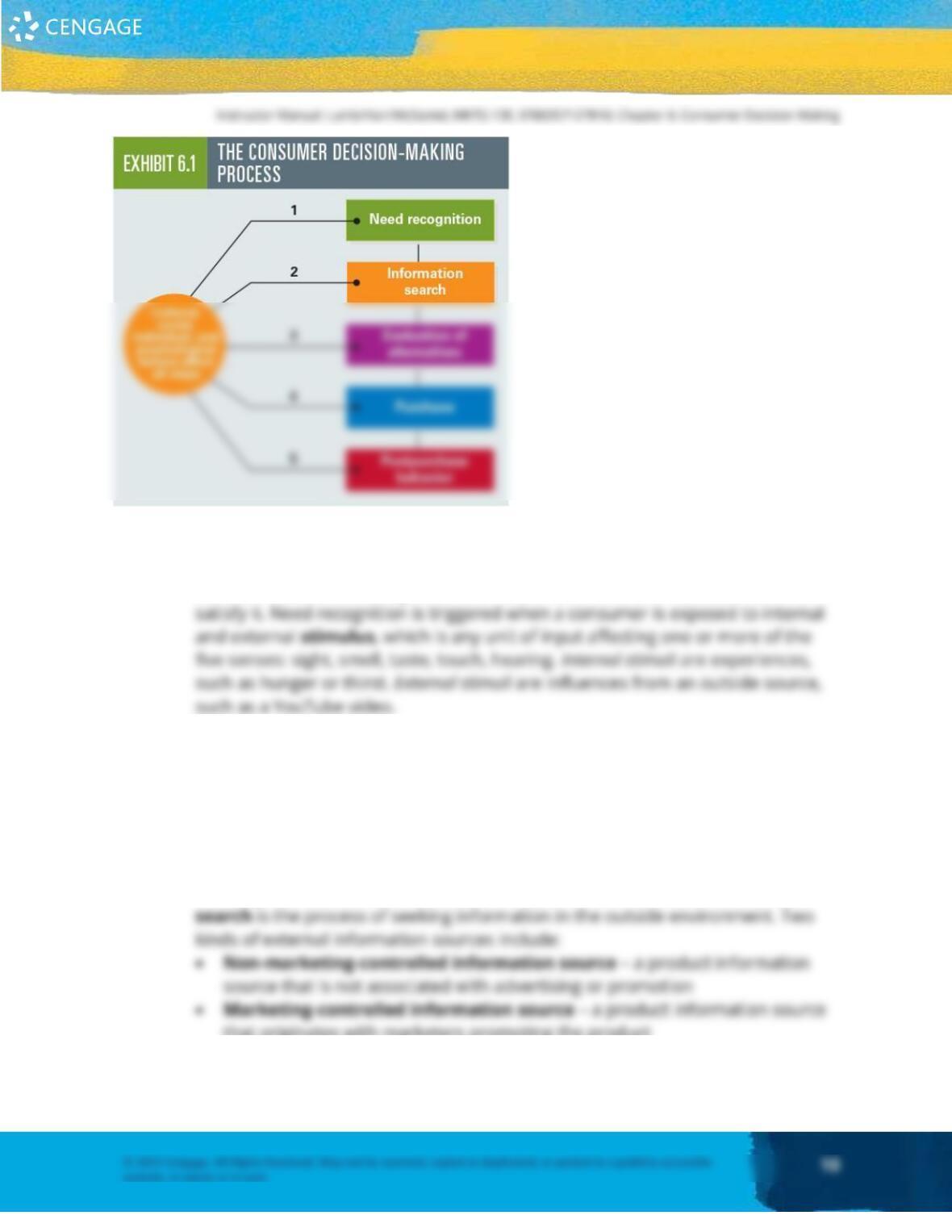
b. Need Recognition: The first stage in the decision-making process is need
recognition, which is the result of an imbalance between actual and desired
states. A want is the recognition of an unfulfilled need and a product that will
c. The imbalance between actual and desired states is referred to as the want-got
gap. This is the difference between what a customer has and what he or she
would like to have. A marketing manager’s objective is to get consumers to
recognize the “want–got gap.” Marketing managers can create wants on the part
of the consumer through advertising, sales promotion, and social media.
d. Information Search: The second stage in the decision-making process involves
an information search. An internal information search is the process of
recalling information stored in the memory, while an external information
that originates with marketers promoting the product
e. Social media are playing an increasingly important role in consumer information
searches. Consumers’ purchasing decisions are influenced by posts made by
family, friends, and companies.
• The Extent of Information Search: The extent to which an individual conducts
an external search depends on his or her:
o Perceived risk – As the perceived risk of the purchase increases, the
consumer enlarges the search and considers more alternative brands.
o Prior experience – Consumers who have had a positive experience with a
product are more likely to limit their search to items related to the
positive experience.
o Level of interest in the good or service – A consumer who is more interested
• Searching yields an evoked set (consideration set), which is a group of
brands resulting from an information search from which a buyer can choose.
f. Evaluation of Alternatives and Purchase: The third stage in the decision-
making process is the evaluation of alternatives, and the fourth stage is making
the purchase. A consumer will use the information stored in memory and
obtained from outside sources to develop a set of criteria. The environment,
internal information, and external information help consumers evaluate and
compare alternatives. Different ways consumers can evaluate products include
the following:
• Narrow the number of choices in the evoked set by picking a product
g. The evaluation process is not always rational. Sometimes, companies may nudge
the consumer. A nudge is a small intervention that can change a person’s
behavior.
Example: If computer analytics identifies your smartphone while you are in an
o Whether to buy
o When to buy
o How to pay
• Planned Versus Impulse Purchase: There are three types of purchases:
• Planned purchase – typically made after the consumer has collected a large
amount of information (e.g., home, car)
• Partially planned purchase – typically made when the consumer knows the
product category but waits until shopping to choose a specific style or brand
(e.g., clothing, furniture)
Example: When customers of Threadless T-Shirts were given the opportunity
to vote on upcoming shirt designs, their willingness to pay more for the shirts
increased because they felt a greater sense of ownership of them.
3. Postpurchase Behavior (LO 6-3, PPT Slide 16, DISC: Customer)
a. How well consumers’ expectations of a purchase are met determines whether
the consumer is satisfied or dissatisfied with the purchase. Some consumers
may experience the jilting effect, which is the anticipation of receiving a highly
desirable option only to have it become inaccessible. This effect can reduce
consumer preferences for the product and increase preferences for alternatives
sold by competitors.
• Data Breaches: Data breaches in online retailers often result in a significant
o Providing excellent postpurchase customer service
4. Types of Consumer Buying Decisions and Consumer Involvement (LO 6-4, PPT Slide
22, DISC: Customer)
a. All consumer buying decisions generally fall along a continuum of three broad
categories: routine response behavior, limited decision making, and extensive
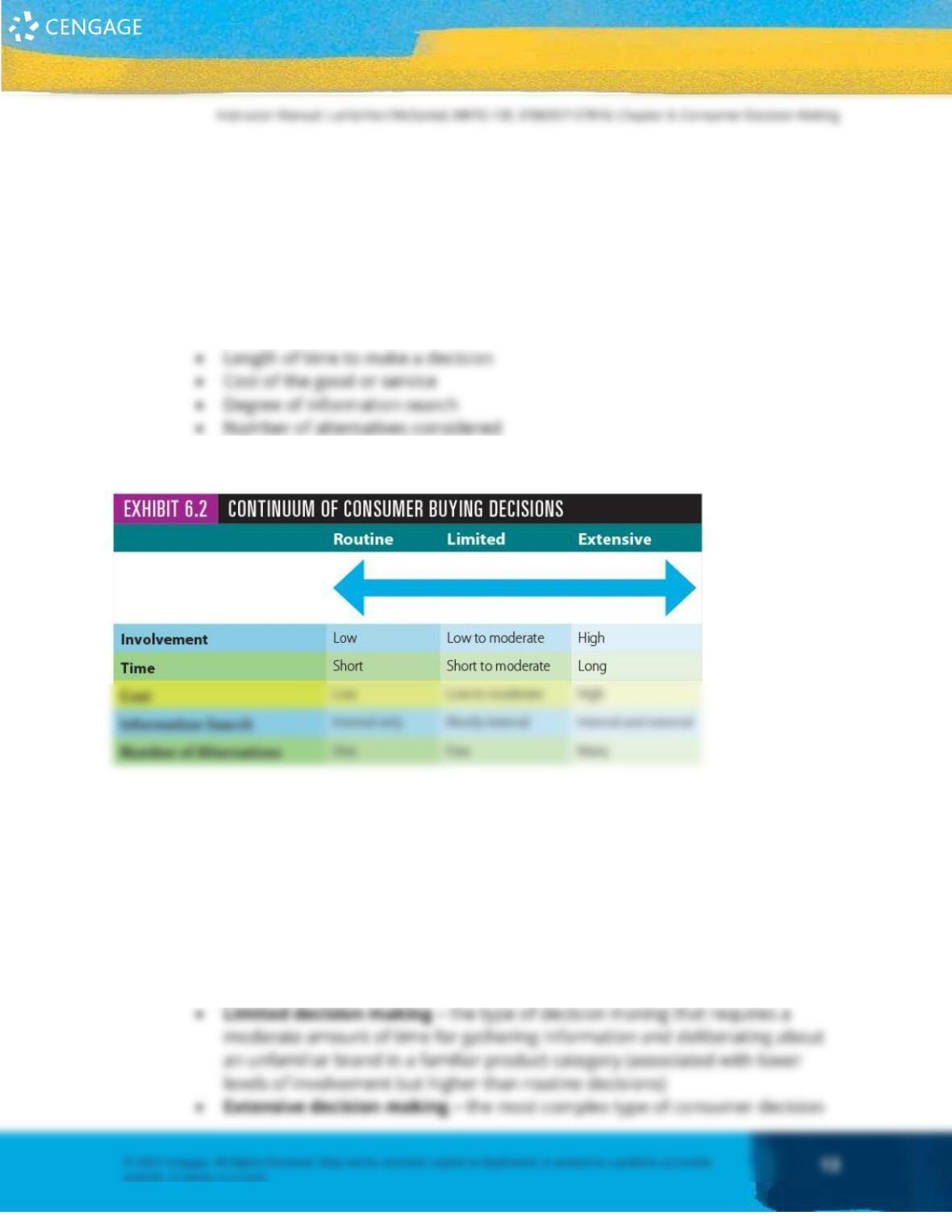
decision making. These three categories can be described in terms of five
factors, as shown in Exhibit 6.2:
• Level of consumer involvement
PRESENTATION VISUAL: Exhibit 6.2 Continuum of Consumer Buying Decisions
b. The level of consumer involvement is usually the most significant determinant in
classifying buying decisions. Involvement is the amount of time and effort a
buyer invests in the search, evaluation, and decision processes of consumer
behavior.
• Routine response behavior – the type of decision making exhibited by
consumers buying frequently purchased, low-cost goods and services;
requires little search and decision time (associated with low-involvement
products)
c. Factors Determining the Level of Consumer Involvement: The level of
involvement in a purchase depends on the following factors:
• Previous experience – When consumers have had previous experience with a
good or service, the level of involvement typically decreases.
• Interest – Involvement is directly related to consumer interests and the
d. High involvement means that a specific good or service is relevant and
important to the buyer. High involvement can take a number of different forms:
• Product – a product category has high personal relevance
• Situational – the circumstances of a purchase may temporarily transform a
consumption activity
e. Marketing Implications of Involvement: For high-involvement product
purchases, marketing managers should engage in extensive and informative
promotions. For low-involvement product purchases, in-store promotion and
5. Reconceptualizing the Consumer Decision-Making Process (LO 6-5, PPT Slide 31,
DISC: Customer)
a. Rapid changes in digital technology have given consumers unprecedented
power to express likes and dislikes, compare prices, find the best deals, sift
through huge numbers of recommendations, and have items delivered quickly.
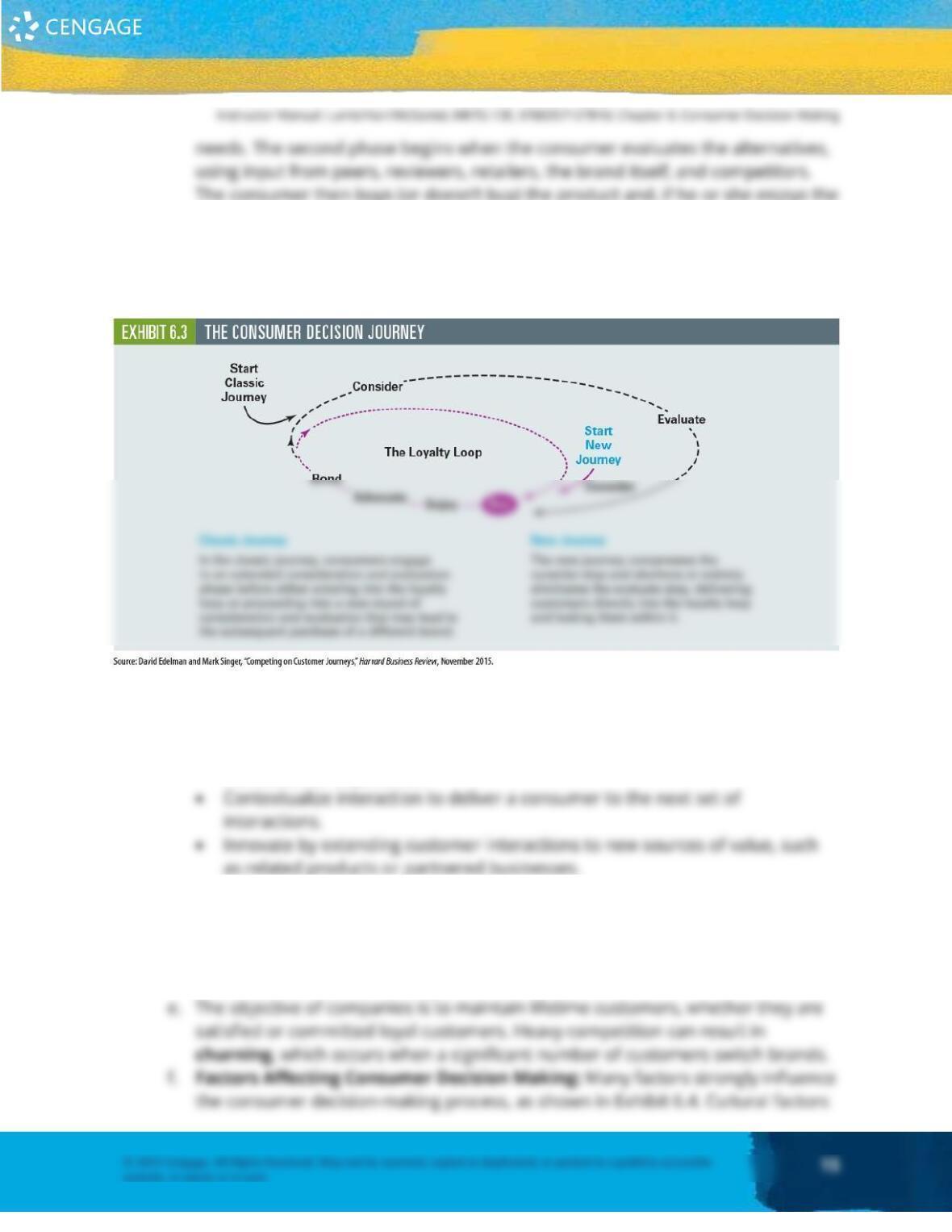
purchase, may advocate and bond with the brand. The feedback loop of ratings,
rankings, and referrals pressures brands to deliver a superior experience on an
ongoing basis.
PRESENTATION VISUAL: Exhibit 6.3 The Consumer Decision Journey
c. To minimize or eliminate the “consider and evaluate” phases, a company must:
• Automate to streamline journey steps, including reordering.
• Proactively personalize by using information to instantaneously customize
the customer experience.
d. Researchers have found two loyalty levels among customers:
• The “satisfied” are those who buy regularly, often out of habit, because they
are satisfied with the brand’s performance over a long period.
• The “committed” have a more intense, involved, emotional relationship with
the brand, often becoming brand ambassadors.

exert a broad influence over consumer decision making. Social factors sum up
the social interactions between a consumer and influential groups of people.
Individual factors are unique to each individual and play a major role in the type