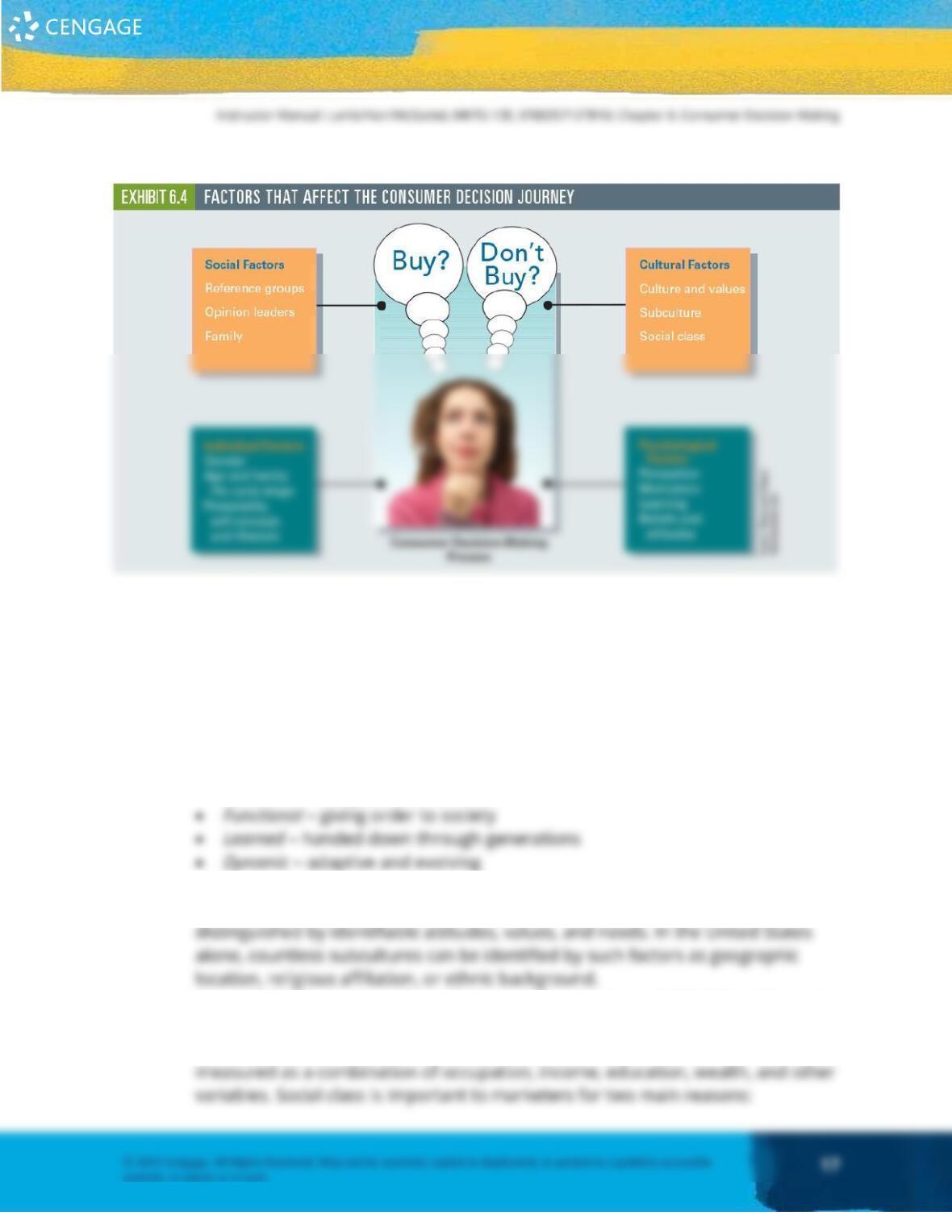
PRESENTATION VISUAL: Exhibit 6.4 Factors that Affect the Consumer Decision
Journey
6. Cultural Influences on Consumer Buying Decisions (LO 6-6, PPT Slide 37, DISC:
Customer)
a. Culture is the set of values, norms, attitudes, and other meaningful symbols
that shape human behavior and the artifacts, or products, of that behavior as
they are transmitted from one generation to the next. Cultural factors exert the
broadest and deepest influence on purchase decisions. Underlying elements of
culture are the values, language, myths, customs, rituals, and laws that guide
consumer behavior. Culture is:
• Pervasive – so ingrained that we are unaware of it
b. A subculture is a homogeneous group of people who share elements of the
overall culture as well as unique elements of their own group. Subcultures are
c. A social class is a group of people in a society who are considered nearly equal
in status or community esteem, who regularly socialize among themselves both
formally and informally, and who share behavioral norms. Social class is typically
• Often indicates which medium to use for promotion
• Helps determine where to best distribute products
d. In the United States, the upper and upper middle classes are the smallest groups
7. Social Influences on Consumer Buying Decisions (LO 6-7, PPT Slide 44, DISC:
Customer)
a. Reference Groups: Many consumers seek out the opinions of direct reference
an individual’s purchasing behavior.
b. Direct reference groups include:
• Primary membership group – a reference group with which people interact
regularly in an informal, face-to-face manner, such as family, friends, and
coworkers
group, such as a club, professional group, or religious group
c. Indirect reference groups include:
• Aspirational reference group – a group that someone would like to join;
members must conform to the norms (the values and attitudes deemed
Example: For middle- and upper-middle-class professionals who take an
interest in Harley-Davidson motorcycles, biker gangs serve as both an
d. For marketers, reference groups have three important implications:
• They serve as information sources and influence perceptions.
e. Opinion Leaders: An opinion leader is an individual who influences the
opinions of others. People often rely on each other’s opinions more than
leaders.
f. Family: For many consumers, the family projects the strongest influence on
g. Marketers should consider family purchase situations along with the distribution
of consumer and decision-maker roles among family members:
• Initiator – suggests or initiates the purchase process
h. Individual Differences in Susceptibility to Social Influences: Not all persons
are equally influenced in their purchase decisions due to differences in their
feelings of connectedness to other consumers. A consumer with a separated
8. Individual Influences on Consumer Buying Decisions (LO 6-8, PPT Slide 52, DISC:
Customer)
a. Gender: Distinct cultural, social, and economic roles played by men and women
often affect their decision-making processes. Statistics show that women are
b. Age and Family Life-Cycle Stage: How old a consumer is generally indicates
what products he or she may be interested in purchasing. Related to a person’s
married couples with children,” and “middle-aged married couples without
children.” Marketers should be aware of special situations.
• Nontraditional Life Cycles: Many nontraditional life-cycle paths are common
today, such as divorced parents, lifelong singles, and childless couples.
c. Personality, Self-Concept, and Lifestyle: By influencing the degree to which
consumers perceive a good or service to be self-relevant, marketers can affect
consumers’ motivation to learn about, shop for, and buy a certain brand. Factors
to consider include the following:
• Personality is a way of organizing and grouping the consistencies of an
9. Psychological Influences on Consumer Buying Decisions (LO 6-9, PPT Slide 57, DISC:
Customer)
a. A consumer’s buying decisions are influenced by psychological factors, including
perception, motivation, and learning.
b. Perception is the process by which people select, organize, and interpret stimuli
into a meaningful and coherent picture. Selective exposure is a process
c. Consumers use cues like familiarity of an object, contrast, movement, intensity,
and smell to identify and define products and brands. Which stimuli will be
perceived often depends on the individual. People can be exposed to the same
stimuli under identical conditions but perceive them very differently.
Example: Double Tree hotels always have fresh chocolate chip cookies at the
d. Marketing Implications of Perception: Marketers must:
• Recognize the importance of cues, or signals, in consumers’ perception of
products.
e. Motivation: Needs become motives when they are aroused sufficiently. A
motive is a driving force that causes a person to take action to satisfy specific
needs. By studying motivation, marketers can analyze the major forces
influencing consumers to buy or not buy products.
f. One theory tries to determine why people are driven by particular needs at
particular times. Maslow’s hierarchy of needs is a method of classifying human
g. Learning is a process that creates changes in behavior, immediate or expected,
through experience and practice. There are two types of learning:
• Experiential learning occurs when an experience changes your behavior.
• Conceptual learning is based on reasoning and is not acquired through direct
experience.
h. Reinforcement and repetition boost learning. Reinforcement can be positive or
j. The Future of Consumer Behavior—Mega Shopping Bots? We already have
shopping bots such as 5Gifts4Her, Waylo, PenneyCat, Magic, Kayak, Snaptravel,
Hipmunk, and PricingCentral. Future shopping bots will have even greater
[return to top]
Discussion Questions
You can assign these questions several ways: in a discussion forum in your LMS; as whole-
class discussions in person; or as a partner or group activity in class. A generic discussion
rubric is provided in the Appendix.
1. Discussion: (LO 6-3, PPT Slides 20-21) Duration: 10-20 minutes
a. Nearly everyone has experienced the feeling of cognitive dissonance after
making a purchase of some kind. After asking one or two students to share
personal experiences of cognitive dissonance, guide the class on a group
discussion of the topic with the following questions:
• What were some of the common feelings and reactions related to
cognitive dissonance?
i. Lead the class through a discussion of the common feelings of
cognitive dissonance (anger, frustration, disappointment, etc.). Then
help students summarize some of the best practices in terms of
postpurchase communications and customer service.
2. Discussion: (LO 6-4, PPT Slides 29-30) Duration: 10-20 minutes
a. Guide the class on a group discussion of consumer decision making with the
following questions:
• How would you define or describe the three categories of consumer
decision-making behavior: routine response behavior, limited decision
making, and extensive decision making?
• What types of products are typically associated with each of the three
categories?
i. Although students’ answers will vary, they should address some of
the following points. Consumers engage in routine response
[return to top]
Additional Activities and Assignments
A generic discussion and writing rubric is provided in the Appendix.
1. Activator Exercise: Why Do We Buy? (LO 6-2)
Purpose: For students to evaluate the influences on their purchasing behavior.
Classroom Format: Individual journaling and class discussion (Estimated Time: 15-25
minutes)
1. Individually, have students journal about a $150+ purchase they’ve made
during the last year (can’t be textbooks or tuition). Have them consider the
following questions:
2. What was the product?
6. What were some of your purchase criteria? What did you base your
evaluation on?
Online Format: Discussion board with posted response from each student
(Estimated Time: 15-25 minutes)
1. Use the following prompt to facilitate this activity in a discussion board:
Write a post about a $150+ purchase you’ve made sometime during the last
year (can’t be textbooks or tuition). Be sure to answer the following
questions:
• What was the product?
• What prompted you to believe you needed the product?
• How did you initially research the product?
2. Have students respond to their classmates’ posts by asking questions and
discussing what some of the common themes and factors were among
purchase decisions.
Additional questions for a classroom or discussion board: Does it appear that
some people make logical (researched) decisions while others make intuitive
decisions? How frequently are people influenced by external factors?
Result: Students will more intentionally evaluate what drove their purchase
2. Class activity (LO 6-1)
Format: This activity can be facilitated in both a classroom and an online
environment. Instructions for how to facilitate the activity in the classroom and
online are provided below. (Estimated time: 15-25 minutes)
Classroom Format: Divide the class into groups of three or four. Have each group
Online Format: If you’re delivering your course online, you can have students do
this on their own and have them post their answers in a discussion board. Use the
following prompt to facilitate this activity:
Search the Internet for ads that appeal to consumers’ values. Locate one ad that appeals
3. Class activity (LO 6-2)
Format: This activity can be facilitated in both a classroom and an online
environment. Instructions for how to facilitate the activity in the classroom and
online are provided below. (Estimated time: 20-30 minutes)
Classroom Format: Divide students into small groups and ask each group to focus
on a major life decision, such as buying a car, buying a house, choosing a college, or
Online Format: If you’re delivering your course online, you can have students do
this on their own and have them post their answers in a discussion board. Use the
following prompt to facilitate this activity:
Think about a major life decision, such as buying a car, buying a house, choosing a
4. Class activity (LO 6-5)
Format: This activity can be facilitated in both a classroom and an online
environment. Instructions for how to facilitate the activity in the classroom and
online are provided below. (Estimated time: 15-25 minutes)
Classroom Format: Divide the class into groups of three or four. Ask them to
choose a consumer product of interest to them, such as a clothing item, food item,
Online Format: If you’re delivering your course online, you can have students do
this on their own and have them post their answers in a discussion board. Use the
following prompt to facilitate this activity:
5. Class activity (LO 6-6)
Classroom Format: Divide the class into groups of three or four. Ask them to
choose a product they would like to market and a subculture they would like to
target. Have them imagine that they are the marketing managers for that product,
and then complete the following three steps:
Online Format: If you’re delivering your course online, you can have students do
this on their own and have them post their answers in a discussion board. Use the
following prompt to facilitate this activity:
Choose a product you would like to market and a subculture you would like to target.
Imagine that you are the marketing manager for that product, and then complete the
following three steps:
1. List some product attributes that might appeal to the target subculture.
6. Class activity (LO 6-7)
Format: This activity can be facilitated in both a classroom and an online
environment. Instructions for how to facilitate the activity in the classroom and
online are provided below. (Estimated time: 10-20 minutes)
Classroom Format: Have students pair up. Each student should think of a recent
Online Format: If you’re delivering your course online, you can have students do
this on their own and have them post their answers in a discussion board. Use the
following prompt to facilitate this activity:
Think of a recent purchasing decision you’ve made with your family, domestic partner, or
7. Class activity (LO 6-8)
Format: This activity can be facilitated in both a classroom and an online
environment. Instructions for how to facilitate the activity in the classroom and
online are provided below. (Estimated time: 15-25 minutes)
Classroom Format: Ask students to journal three to five aspects of their self-image
Note: Since this is a self-reflection exercise, it’s important to remind the class to be
inclusive and respectful of their classmates’ aspirations.
Online Format: If you’re delivering your course online, you can have students do
8. Class activity (LO 6-9)
Format: This activity can be facilitated in both a classroom and an online
environment. Instructions for how to facilitate the activity in the classroom and
online are provided below. (Estimated time: 20-30 minutes)
Classroom Format: Have students work in pairs for this exercise. Each student
Online Format: If you’re delivering your course online, you can have students do
this on their own and have them post their answers in a discussion board. Use the
following prompt to facilitate this activity:
This activity will require you to make two posts of your own in addition to your responses
9. Additional activity: Cultural Values and Consumer Behavior (LO 6-6)
Purpose: To help students explore their perceptions of U.S. cultural values.
Background: Culture clearly influences consumer behavior in both obvious and
perceptions of core values in U.S. culture.
Relationship to Text: Cultural Influences on Consumer Buying Decisions
Estimated Class Time: About 10 minutes
Format: This activity can be facilitated in both a classroom and an online
Classroom Format: Have students divide into groups of three or four to complete
the following steps:
1. Spend a few moments reviewing with your class the idea of core values.
2. Once they fully understand the concept, divide your students into small
3. Then reconvene as a class and ask a representative from each group to share
each list. As the volunteers read the values, determine (via a show of hands)
4. The three lists will spark an interesting discussion. What values seem to be
universal (at least among the small sample size)? Why isn’t there more
Online Format: Discussion board with posted response from each student
(Estimated Time: 10 minutes)
1. Use the following prompt to facilitate this activity in a discussion board.
Quickly brainstorm a list of core values in U.S. culture. Base your list on your
2. Have students respond to their classmates’ posts and discuss the following:
What values seem to be universal (at least among the small sample size)?
Why isn’t there more complete agreement among individuals? How do
subculture, gender, age, and lifestyle all play a role in the differing
perceptions?
Instructor Manual: Lamb/Hair/McDaniel, MKTG 13E, 9780357127810; Chapter 6: Consumer Decision Making
Additional Questions for Reflection:
• Why is it important to explore the core values of national culture?
10. Online Research Activity: Consumer Decision Making (LO 6–2)
Assume you’re in the market for both a new cell phone and cell phone provider.
Follow the beginning stages in the consumer decision-making process described in
the chapter—need recognition, information search, and evaluation of alternatives.
[return to top]
Additional Resources
External Videos or Playlist
Appendix
Generic Rubrics
Providing students with rubrics helps them understand expectations and components of
assignments. Rubrics help students become more aware of their learning process and
progress, and they improve students’ work through timely and detailed feedback.
Customize these rubrics as you wish. The writing rubric indicates 40 points and the
discussion rubric indicates 30 points.
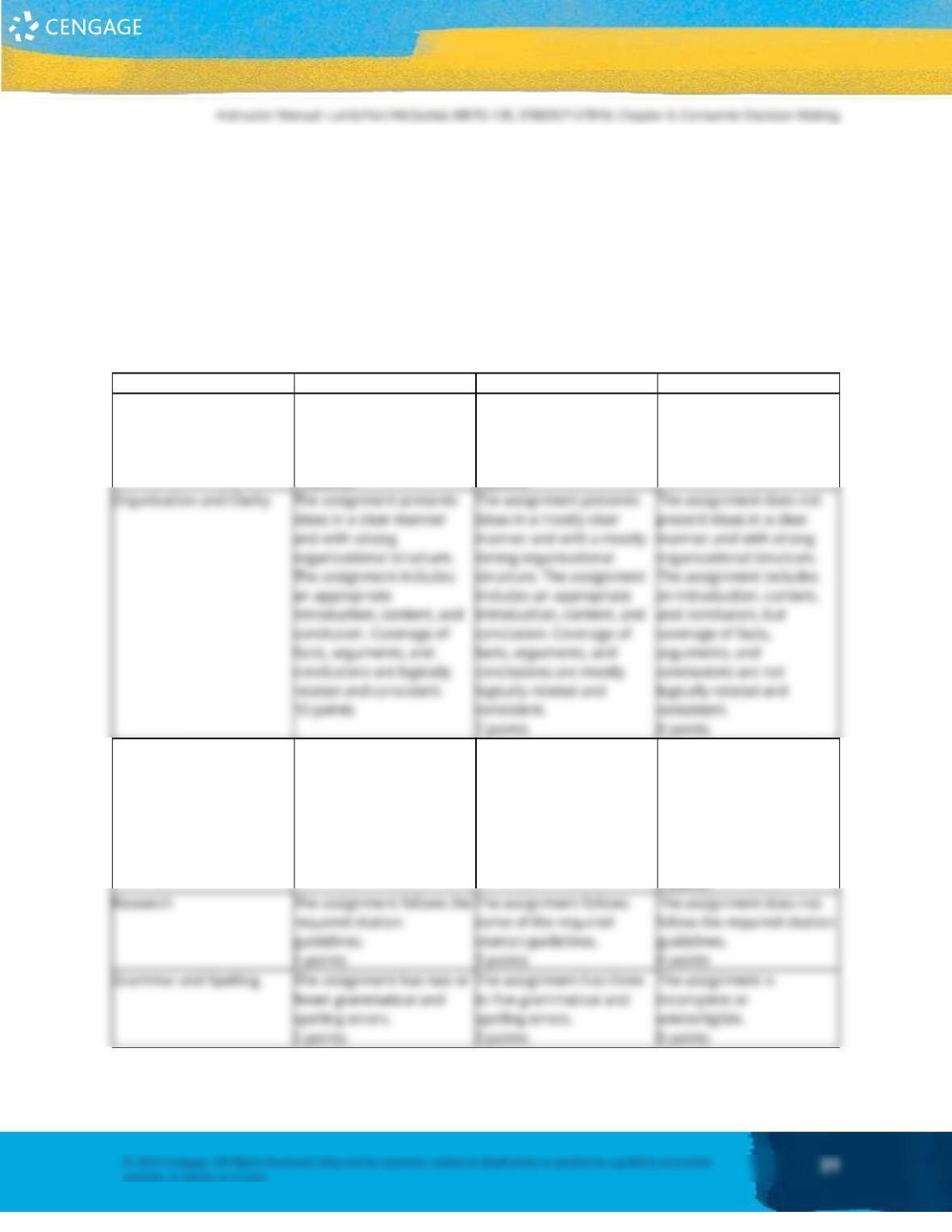
Standard Writing Rubric
Criteria
Meets Requirements
Needs Improvement
Incomplete
Content
The assignment clearly and
comprehensively
addresses all questions in
the assignment.
The assignment partially
addresses some or all
questions in the
assignment.
The assignment does not
address the questions in
the assignment.
0 points
Research
The assignment is based
upon appropriate and
adequate academic
literature, including peer
reviewed journals and
other scholarly work.
5 points
The assignment is based
upon adequate academic
literature but does not
include peer reviewed
journals and other
scholarly work.
3 points
The assignment is not
based upon appropriate
and adequate academic
literature and does not
include peer reviewed
journals and other
scholarly work.
Instructor Manual: Lamb/Hair/McDaniel, MKTG 13E, 9780357127810; Chapter 6: Consumer Decision Making
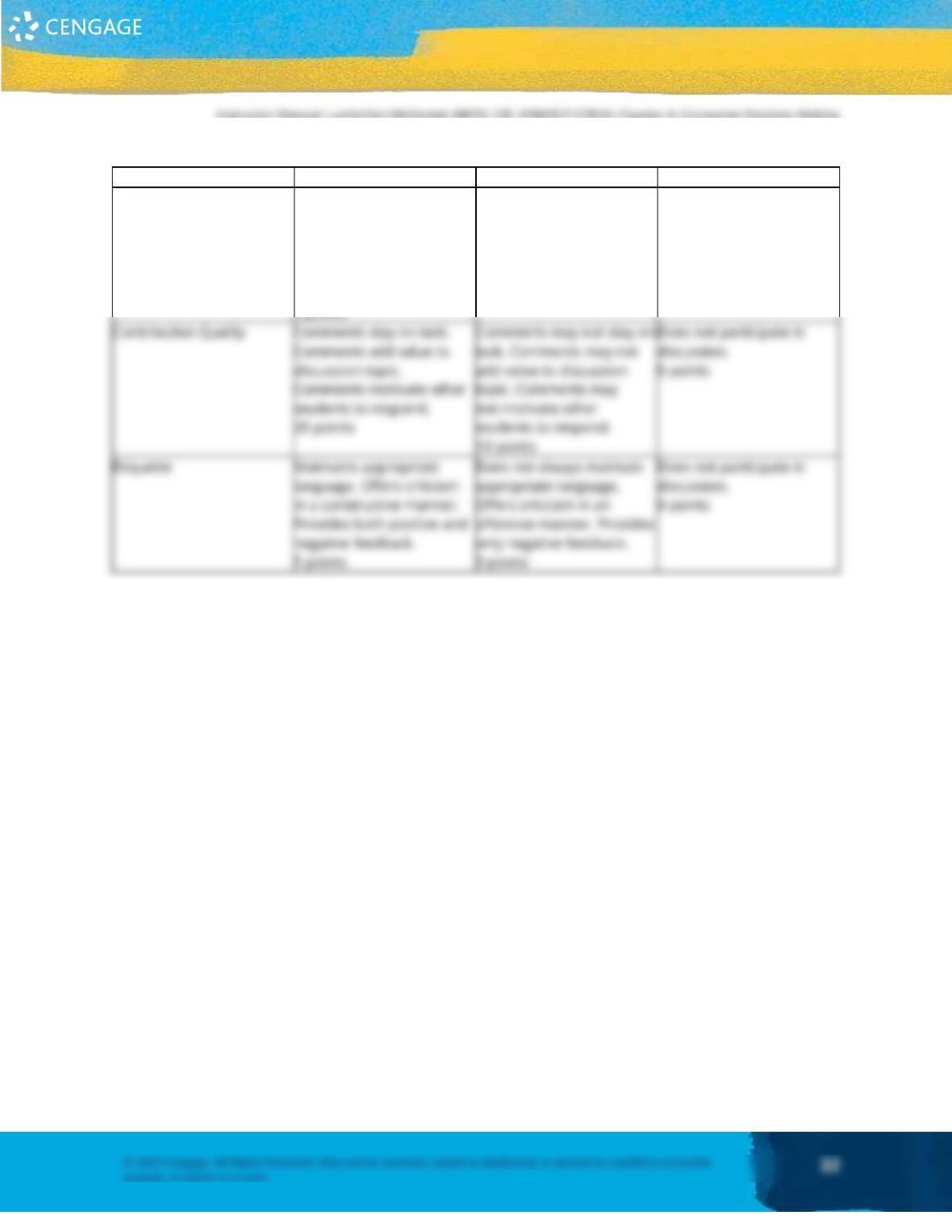
Standard Discussion Rubric
Criteria
Meets Requirements
Needs Improvement
Incomplete
Participation
Submits or participates in
discussion by the posted
deadlines. Follows all
assignment. instructions
for initial post and
responses.
Does not participate or
submit discussion by the
posted deadlines. Does not
follow instructions for
initial post and responses.
3 points
Does not participate in
discussion.
0 points