Chapter 5
Online Branding and Video Marketing
Learning Objectives:
By the time students complete this chapter they should be able to:
• Describe ways in which consumer media habits are changing.
• Discuss how and why online advertising and promotion is effective.
• Define major branding concepts.
Chapter Perspective
In the third edition the organization of the chapters has been changed to focus on the tools of
Internet marketing instead of customer acquisition and retention per se. The chapters in this
section cover a wide variety of tools. In each discussion we will illustrate examples of using the
tool for acquisition, lead management and conversion (new to this edition), and retention. Some
tools are best used in one or more strategies—display advertising and search for acquisition, and
email for conversion and retention, for example, and that is emphasized in the respective
chapters.
There is a great deal in the video section that makes great live classroom material; that’s one
reason it is so hard to get through. There is less in the branding section, but there are good
assignments you can make that will lead to good classroom discussion of media and branding.
You can also make good use of Interactive Exercise 5.1 in the classroom.
Marketing Effectiveness in the Age of New Media
This is a short but important section. It should be used to consider the drumbeat of the
Customer Media Habits in the Internet Age
This is a great place for discussion on the media habits of the students themselves—where do
they get their news, how do they communicate with friends and family, do they create content on
The current media environment includes:
• Video on multiple screens
BRANDING SECTION
The Effectiveness of Online Advertising and Promotion
This section summarizes the Ford F-150 case history from the IAB XMOS project. Continued
focus on this data has pros and cons. Yes, it is old. But that alone says something positive; even
in 2003-2004, Internet advertising and promotion had a powerful impact. The impact would have
been greater if marketers had used the optimal amount of Internet marketing. The reach and
power of the Internet has only increased since then.
Figure 5.2 is a rather complex presentation of the effectiveness of different media in different
states of the branding process. Note that a second slide highlights the main findings, although it
is worth focusing students on the data.
The MSLO digital magazine project is worth spending some time on:
Students need to understand that creating a brand—offline or online—is a demanding, time-
consuming and expensive process. Figure 5.4 helps make that point by showing some of the
many types of marketing effort that are possible and the effect they have on what McKinsey calls
the consumer decision journey. The brand development process is also one that can be severely
They need to understand the stages of developing a brand, described in Figure 5.5 as awareness,
familiarity, positive imagery, and completed transaction. You will also note that these stages are
not exactly the same as those used in Figure 5.2 but they seem to make good sense from a
marketing management standpoint
The branding considerations (best practices?) listed give an opportunity to talk about the
importance of disciplined marketing/marketing planning in general. They are:
• Ensure best possible customer experience (May be the first mention of customer
experience which is obviously broader than the Internet. It will be discussed in other
contexts throughout the text.

In November 2011 my students attended an in-store event that was an
This is a great example of integration.
• Create and disseminate relevant content. We will discuss content marketing in various
contexts in other chapters.
• Engage with customers and prospects. Does your school have blogs or social media
Brand community is one tool for brand development. Many observers have noted the number of
inactive communities across the web, testimony to the effort required to have a viable marketer–
mediated brand community. The HOG community is a great example in several respects. Links
are given in the PPT.
VIDEO MARKETING SECTION
Video Marketing
Students are intimately familiar with video, so it is probably a good idea to point out at the very
beginning that this is about video marketing, not video as a past time. You can take a few
minutes to discuss the impact of video on political life around the world; that begins to make the
point about its critical role in modern life.
That role is growing rapidly, so you could consider updating the statistics given by looking on
eMarketer or Marketing Charts. Specific links are given in the end notes and especially
• Slideshows
• Product demonstrations
• Scribing (animated storytelling using cartoon-like graphics, also called RSA animation
and whiteboard animation.)
• Branching videos (essentially links embedded in videos that open new videos on
mouseover).
Most are pretty straightforward. I love Robert Reich’s 2 minute whiteboard explanation of
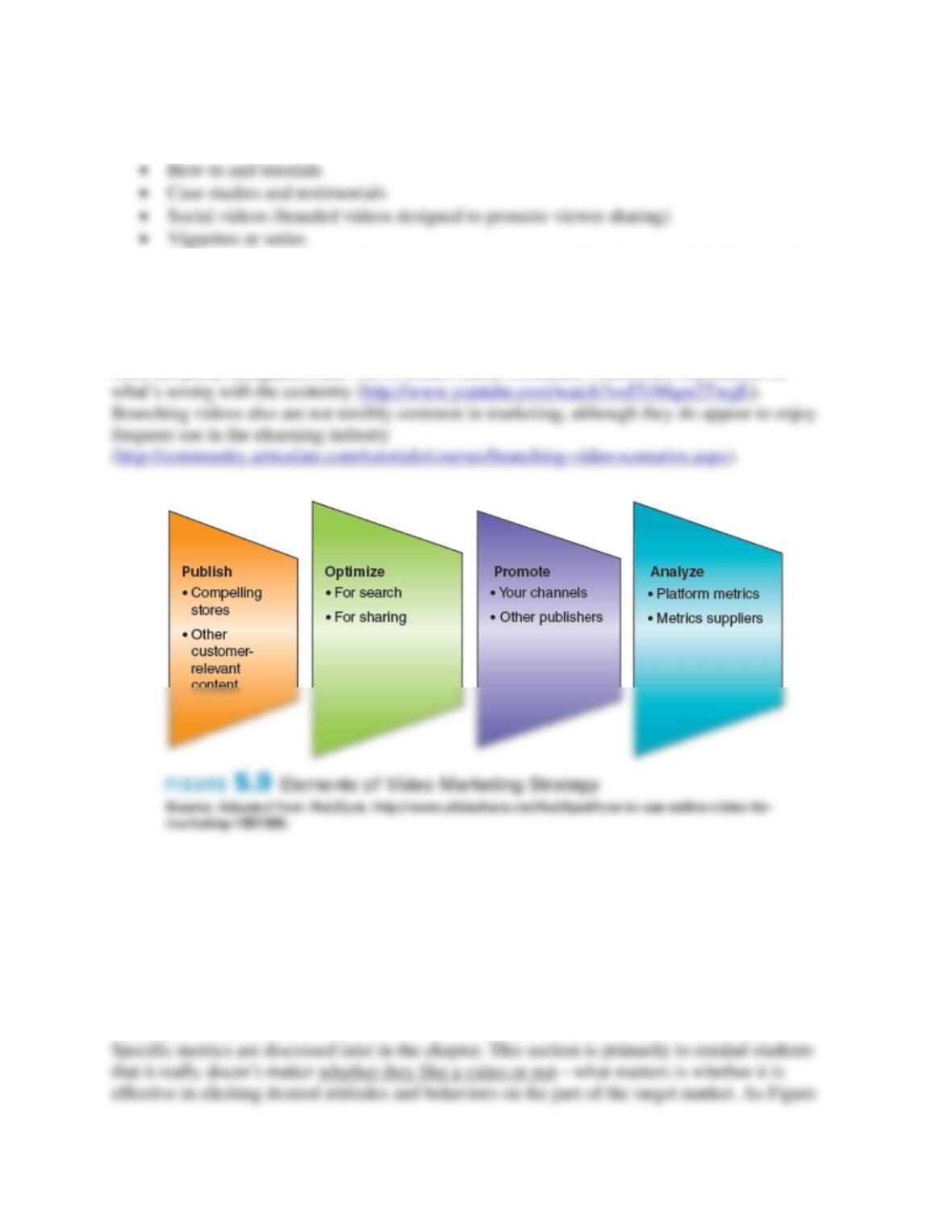
The discussion of video marketing strategy is necessarily lengthy. One way to help students keep
it straight is to duplicate the strategy elements slide and put it before each section.
Publishing
Effectiveness is always a thorny marketing question. However, remind students that Internet
marketing permits tracking of behaviors, and marketers can certainly look at basic metrics like
the number of views and monitor the number of referrals to the website from video material.

5.9 demonstrates, marketers do believe that videos do work, along with other types of social
media marketing.
The content grid shown in Figure 5.10 is the first specific discussion of content marketing. There
are suggestions for using it on the PPT slide. It does make clear that there are several kinds of
videos that are particularly useful in B2B marketing. It’s not clear that the types would differ
greatly in B2C applications, but it is a question you might want to ask your students.
Optimizing for Search and Sharing
You will quickly recognize that the basics of optimizing for search follow general optimization
guidelines. One thing that surprised me in dealing with this material was the recommendation
that the marketer post the entire text of the video. Who would want to read that? Answer: the
search engine spiders. Remember that the spiders cannot see, and therefore cannot index, video
content.
Sharing is, of course, getting viewers to email, post on Facebook, tweet, and so on in an almost
endless list. It is necessary to include the sharing icons, but probably not sufficient. People have
These data certainly make the point about the importance of encouraging sharing.
Promote
This refers to paid promotion, which may or may not be less valuable than the type of promotion
achieved by optimization. Any marketer who uses many videos should have a channel, if only to
organize them and make them easier to find. Videos should also be posted on all other relevant
Analyze
This section makes the point that owners of a YouTube channel now have Google Analytics
available for their channel. That puts powerful metrics in their hands. The platforms also provide
Video Marketing for Small Business
We often say that Internet marketing creates a more level playing field for all types of business,
but specifics are too rarely discussed. Video marketing provided a good opportunity and the
incredible success of Gary Vaynerchuk (he’s now a corporation) a great example. He’s all over
the web so you can add as much to what is in the chapter and the suggested links on the PPT
slide as you wish.
Video Marketing Best Practices
Once again, this list of best practices highlights the importance of disciplined marketing,
whatever the channel. They are:
• Set social goals, not financial ones. Videos are one part of a content marketing strategy
and, as such, are impossible to link to specific financial goals like sales; this is, of course,
the age-old dilemma of communications objectives vs. sales objectives. Internet
marketers do have a better chance of tracking behaviors like referrals from a video
• Include sharing options in your video posts and marketing campaign activities like
emails.
• Encourage commentary and respond as needed.
• Measure results.
• Look at video as a relationship building tool more than as a direct sales generation tool.

Discussion Questions
1. Think about your own Internet use habits. Have you changed your use of other media?
Why or why not? How do your own habits fit the media use attitudes and patterns
described in the chapter?
The answers are usually, “Yes,” “Convenience,” and “Pretty Closely.” Most of our students
watch little TV, although that may not represent a change for them. Few read newspapers in–
2. A businessperson who is not an Internet expert asks you whether the Internet is useful
for branding. What answer would you give and how could you support it with
examples?
It makes sense to start with the concept of awareness. The Internet may not be the best medium
for building awareness, TV is probably still that, but exposure does create and strengthen
3. What are the special tools and techniques that enterprises can use in their brand-
building process on the web?
The branding tools are:
• Brand awareness
4. Do you believe that online advertising has more potential to engage viewers than mass
media advertising? Why or why not?
5. What is a branded community? If you are a member or one or more branded
communities, what has your experience been? If you are not, why have you not joined
communities for products or services that you like?
6. Think about your own consumption of video. What kinds of entertainment and
informational videos are you most likely to view? Why? Do you often find yourself
viewing marketing videos? Why or why not?
9. What is meant by “branded content?” Are you aware of recently seeing branded
content on the Internet? How much and what kinds?
10. What makes a marketing video effective?
marketing videos?
Internet Exercises
1. Internet Career Builder Exercise.
2. Visit one or more of the websites you have been following. Think about the nature of
their brand, whether it is a tangible product, a services product or a nonprofit
organization, in which case the brand is likely the organization itself. How are they
going about brand-building on the site itself?
3. Do several searches on YouTube, some using very popular topics of products, some
using more unusual, even esoteric, ones. Do you ever fail to come up with videos? What
do you see in terms or promoted videos in these searches?
Key Terms
ad format the way an ad is displayed on the publisher’s site; the specifications that cause an ad
to be displayed properly.
brand recognition/brand awareness advertising metric that measures the ability of target
consumers to identify the brand under different questioning scenarios.
branded content any type of content over which the business has total control of production and
distribution; the corporate identification may be highly visible or low key, depending on purpose
and audience.

roadblock the purchase of all ad units on a page for a specific period of time.