Chapter 4
Time Value of Money
Chapter Overview
I. Introduction
II. Inflation
a. Inflation rate
b. Consumer price index
c. Present and past prices (exhibits)
III. Risk
a. Deferred salaries: Team and player risk
IV. Future value
a. Simple interest
b. Compound interest
V. Annuities and perpetuities
VI. Future value of an annuity
Key Concepts
When reading this chapter, students should focus on the following key concepts:
1. How present value and future value concepts impact the financial operation of sport
organizations.
2. How inflation, liquidity and risk impact the financial operations of sport
organizations.
Concept Check Responses
1. Explain the concept of inflation. How does inflation affect saving and investing?
Inflation is the gradual increase in prices for goods and services. Any investment must
2. How does a preference for liquidity influence an individual or organization’s financial
decisions?
Liquidity is the ability to turn assets into cash. Liquidity is important, as cash may be
3. Explain the difference between simple and compound interest.
4. What aspects of the time value of money must professional sport organizations and
athletes consider when negotiating contracts?
Players and teams must investigate the projected rate of inflation, risks (such as
5. What mistake did the NBA make in its dealings with the owners of the St. Louis Spirits?
6. What are some advantages and disadvantages of deferring salaries (from both the
players’ and the team’s perspectives)?
Players may defer salary if they do not have a need for the money immediately. They
may also do this to potentially impact the timing of their tax payments. In some cases,
7. What concerns should a sport organization contemplate when negotiating future
payments from sponsorships or other long-term agreements?
The sport organization should first evaluate the likelihood that the sponsor will be in
business in the future. Even some prominent organizations (e.g., Enron) have
encountered financial hardship that impacted their financial viability. The sport
Responses to Practice Problems
1. What is the real increase in value if $1,500 is invested for one year at 5% interest and
the rate of inflation during that time is 1.79%?
$1,500 x .05 = $75
2. A sport organization has a commitment from a sponsor for a $17,000 payment in three
years. What is the present value of that money if it is discounted at (a) 3%, (b) 5%, and
(c) 9%?
$17,000 in three years discounted at
a. 3% = $17,000 x .9151 = $15,556.70
3. You are the financial manager for a recreation center that has signed an option to
purchase new elliptical machines for $22,000 in two years. If you have an investment
opportunity that guarantees 7% interest, how much must you invest to have the
necessary funds to purchase the elliptical machines?
$22,000 x .8734 = $19,214.80 needed to invest
4. An athlete signs a five-year endorsement deal with a prominent sponsor. Under this
deal, the athlete will receive $5,000 each year for the first three years and $6,500 each
year for the final two years. What is the present value of the total deal if the payments
are discounted 6%?
Add the present value of each year
1―$5,000 x .9434 = $4,717.00
2―$5,000 x .8900 = $4,450.00
5. What is the future value of $12,000 invested at 8% interest, compounded yearly for ten
years?
$12,000 x 14.4866 = $25,906.80
Use the Future Value table; see Appendix A.1. (Note potential rounding differences.)
6. If an investor commits $4,500 to an IRA each year for 30 years and receives 6% interest,
what will their total investment be worth at the end of the 30 years?
7. A bank offers customers the option of receiving interest compounded quarterly, semi–
annually, or annually. If the rate of interest is the same, which is the best option for the
customer?
See page 101–102 for an explanation of why compounding in the shorter period of
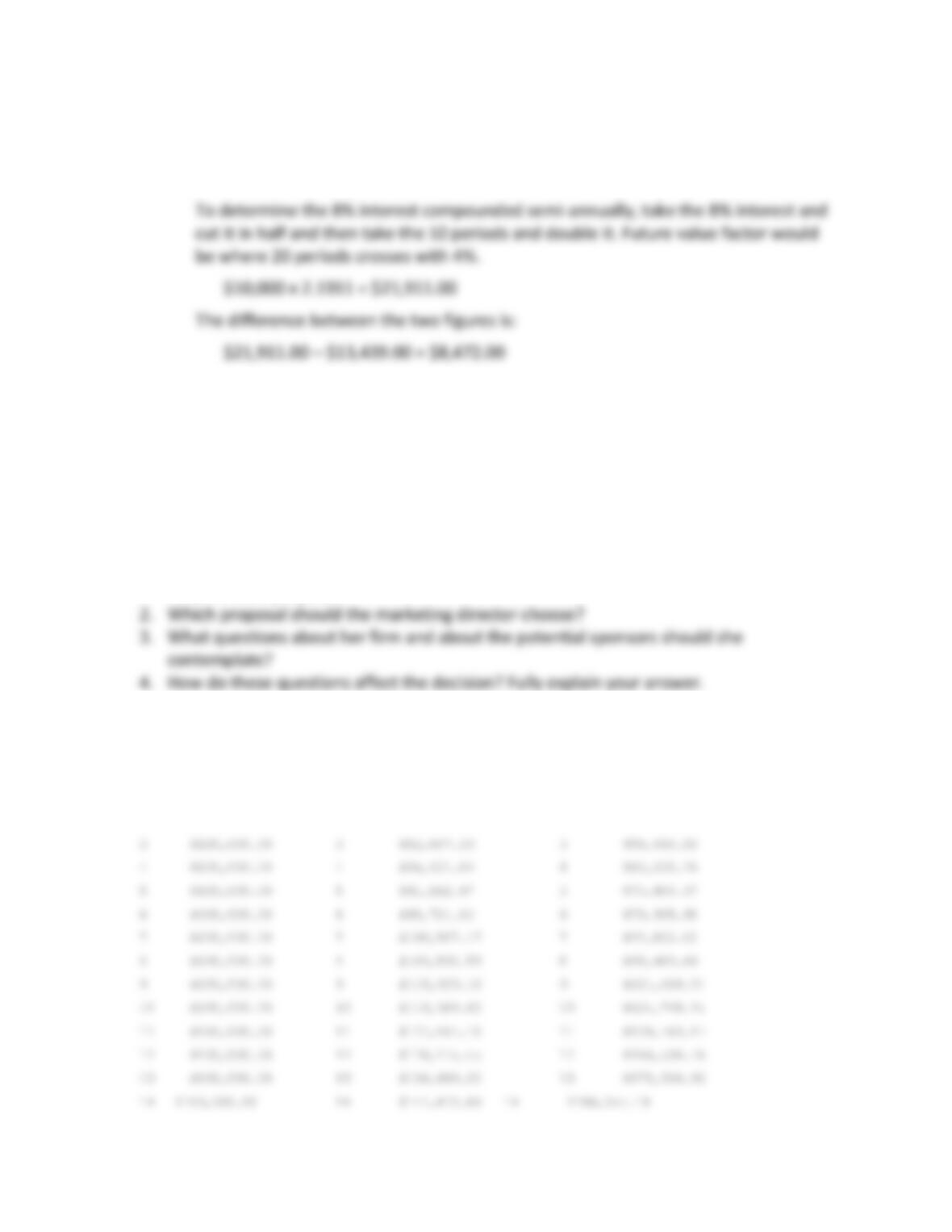
8. What is the difference between $10,000 invested for ten years at 3% interest,
compounded yearly, and at 8% interest, compounded semi-annually?
$10,000 x 1.3439 = $13,439.00
Responses to Case Analysis Questions
The director of marketing of your organization asks for your advice regarding sponsorship
deals she is contemplating. She has to choose between the following: a 15-year sponsorship
paying $100,000 per year; a 15-year sponsorship initially paying $75,000 per year and
increasing 5% each year; and a 15-year sponsorship initially paying $45,000 per year but
increasing 12% each year.
1. Determine the present value of each year for each proposal, as well as the total present
value of each proposal.
To complete the case, the first thing to do is determine the nominal value of each year in
each scenario.
Year Option 1 Year Option 2 Year Option 3
1 $100,000.00 1 $75,000.00 1 $45,000.00
2 $100,000.00 2 $78,750.00 2 $50,400.00

Then you must assign a present value factor (or factors if you want the students to do a
comparison). In this case, if you choose a 5% discount rate (a good one since students can
see how the interest and the discount rate counteract each other), the results will be:
For option 1, you can simply use the Present Value of an Annuity, since each payment is
the same. $100,000 10.3797 = $1,037,970.
For option 2 and 3 the results are:
Option 2 Option 3
Yearly Payment Factor Discounted $ Yearly Payment Factor Discounted $
$75,000.00 0.9524 $71,430.00 $45,000.00 0.9524 $42,858.00
$78,750.00 0.907 $71,426.25 $50,400.00 0.907 $45,712.80
$82,687.50 0.8638 $71,425.46 $56,448.00 0.8638 $48,759.78
$86,821.88 0.8227 $71,428.36 $63,221.76 0.8227 $52,012.54
Total Present Value Option 2 @ 5% discount―$1,071,412.54
Total Present Value Option 3 @ 5% discount―$1,049,692.69
In this case, the highest present value of the options is Option 2 as it is greater than Option
1 or Option 3.
If we change the discount rate to 10%, then adjustments must be made.
Option 1 can still be computed with the Present Value of an Annuity
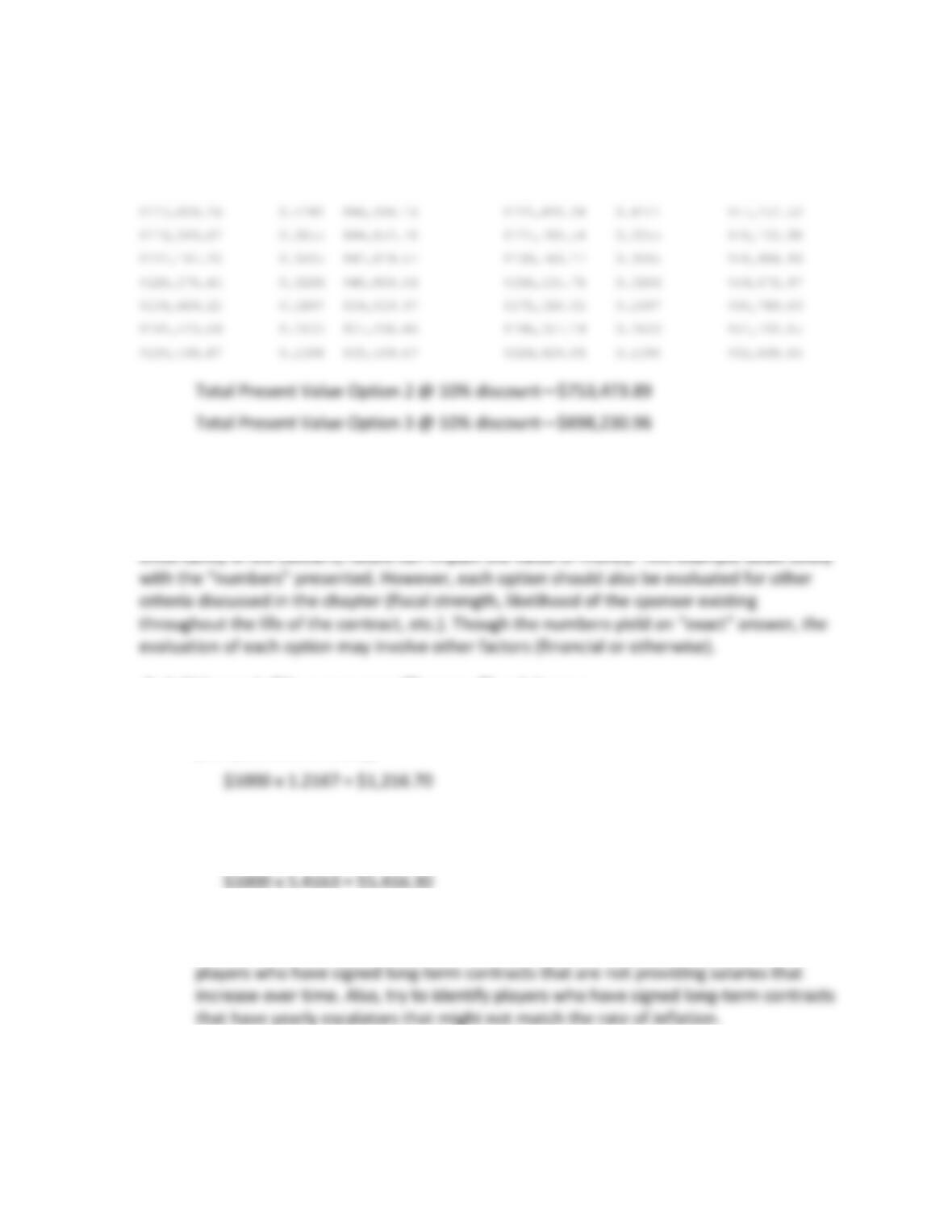
$91,162.97 0.6209 $56,603.09 $70,808.37 0.6209 $43,964.92
$95,721.12 0.5645 $54,034.57 $79,305.38 0.5645 $44,767.88
$100,507.17 0.5132 $51,580.28 $88,822.02 0.5132 $45,583.46
$105,532.53 0.4665 $49,230.93 $99,480.66 0.4665 $46,407.73
In this case, Option 1 yields the highest return after applying a 10% discount rate.
In each scenario, choosing the option that yields the highest result is advisable. The
differences in the final results are dramatically impacted by the discount rate applied. This is
important for students to understand, as the timing of the payment and the potential
Additional Classroom/Exam Problems
1. What is the future value of $1000 invested that accumulates 4% interest for 5 years?
(compounded annually)
2. What is the future value of a yearly investment of $1000 that accumulates 4%
interest for 5 years?
3. Have students research player salaries in Major League Baseball or another North
American professional team sport (USA Today has an available database). Identify
4. Explain why the Silna brothers decided to sell a significant portion of their NBA TV
perpetuity back to the NBA.