Chapter 4: E-Business – Managing the Customer Experience
Classroom activity: Provide a number of example situations and have students calculate the
conversion rate.
Problem 1: REI ran an ad campaign that drove 1,000 visitors to their site. Of those visitors, 10
people purchased. What is the conversion rate? Answer: .01 or 1%
Problem 2: Nike ran an ad campaign that drove 5,000 visitors to their site. Of those visitors, 100
people purchased. What is the conversion rate? Answer: .02 or 2%
Note: One option is to have students record their answer first, then share with a neighbor to see
what they got. Then you reveal the answer to the class. Another option is to have small groups
calculate the answer and write it big on a piece of paper. Have all groups hold up their answer
at once before you reveal the answer.
Since many online purchases are the result of an advertisement, it’s important to account for
An impression is any time the ad is shown to a user. Most online ad platforms, such as Google
and Facebook, look closely at click-through rates before deciding which ads to show users. If
users aren’t clicking an ad, Google and Facebook will typically stop showing that ad and replace
it with one that has higher click-through rates.
Classroom activity: This is similar to the previous activity, but this time we’re calculating
conversion cost using the conversion rates we calculated previously. Provide a number of
example situations and have students calculate the conversion rate.
Problem 1: REI ran an ad campaign with a 1% conversion rate. Their CPC was $1. What is the
conversion cost? Answer: $100
Chapter 4: E-Business – Managing the Customer Experience
Problem 2: Nike ran an ad campaign with a 2% conversion rate. Their CPC was $0.50. What is
the conversion cost? Answer: $25
Note: One option is to have students record their answer first, then share with a neighbor to see
what they got. Then you reveal the answer to the class. Another option is to have small groups
calculate the answer and write it big on a piece of paper. Have all groups hold up their answer
at once before you reveal the answer.
Estimated time: 15–30 minutes
4-7 Optimizing the Effectiveness of an E-Commerce Website
To properly track results, it’s important to accurately calculate results. Measuring increases in
unique visitors, time on website, and pages viewed is easy, since those are based on raw
numbers. However, calculating click-through rates, conversion rates, and conversion cost
require some (simple) math.
Example—Click-through rate: Pure Paleo Meals ran Google ads last week that received a
total of 100,000 impressions and 2,000 clicks. What was their click-through rate?
Answer: Click-through rate = Ad clicks/Ad impressions
Example—Conversion rate: Of the 2,000 people that visited the Pure Paleo Meals website as
a result of the Google ads, 50 signed up to become customers. What was their conversion rate?
Answer: Conversion rate = Number of purchases/Number of visitors to site
Chapter 4: E-Business – Managing the Customer Experience
Example—Conversion cost: While you’re happy with the conversion rates, you want to make
sure these conversions are actually profitable. On your Google ad account, you see that your
average cost-per-click was $1. What is your conversion cost?
Answer: Conversion cost = Cost per click/conversion rate
Key Takeaway: To properly track results, it’s important to accurately calculate results.
Estimated time: 10–15 minutes
Chapter 4: E-Business – Managing the Customer Experience
LEARN IT TODAY . . . USE IT TOMORROW
VIGNETTE AND ACTIVITY
Unlike most opening vignettes, Chapter 4 does not begin by introducing a company profile.
Rather it asks students to consider the incredible impact of the Internet on our lives, provides
some stats about Internet use worldwide, and defines some basic terms.
Later in the chapter, we introduce students to Pure Paleo Meals, a hypothetical online company
Note: Answers to the chapter-ending activity can be discussed in class after the activity
due date.
Measuring website effectiveness
With a firm grasp of how you plan to measure success for the Pure Paleo Meals website and ad
Decision #1
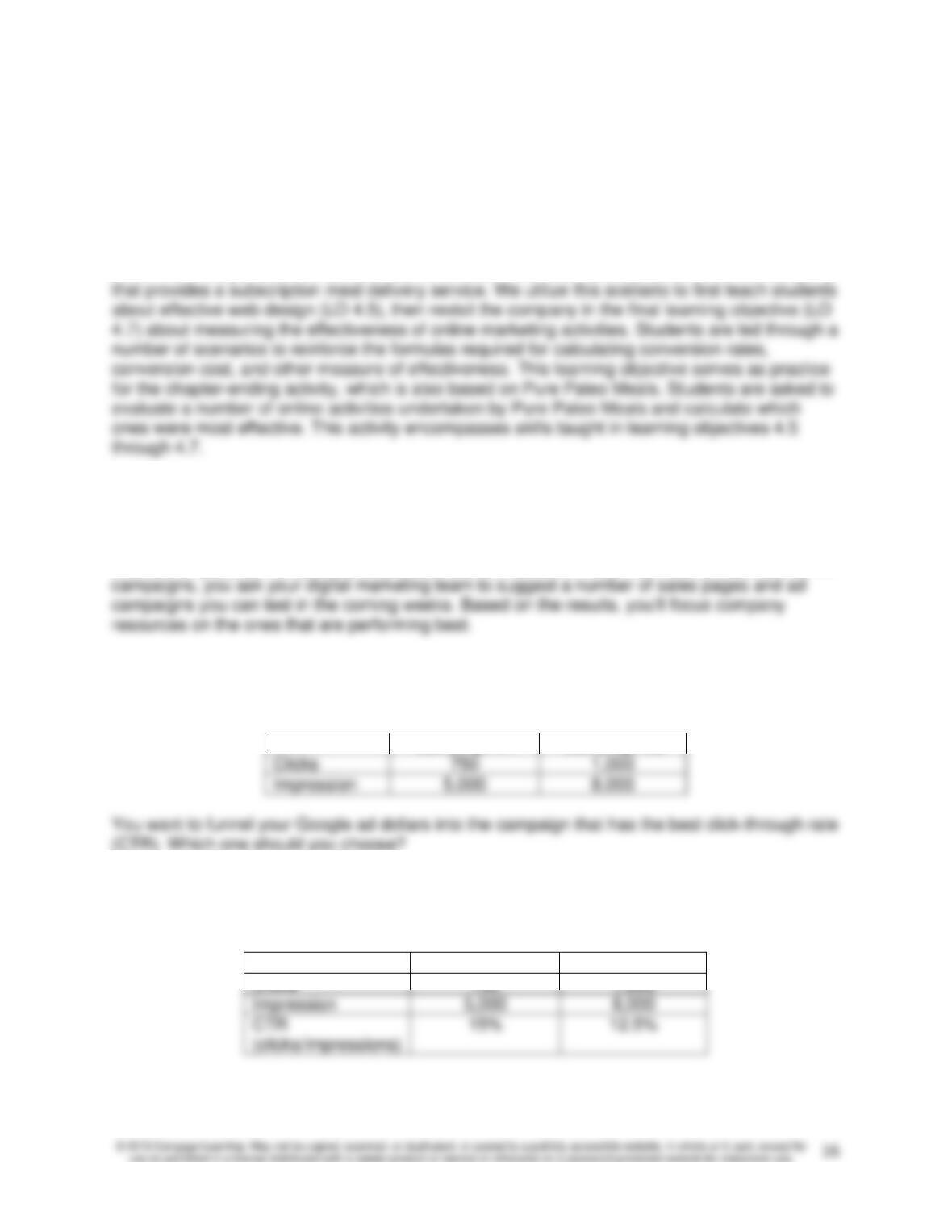
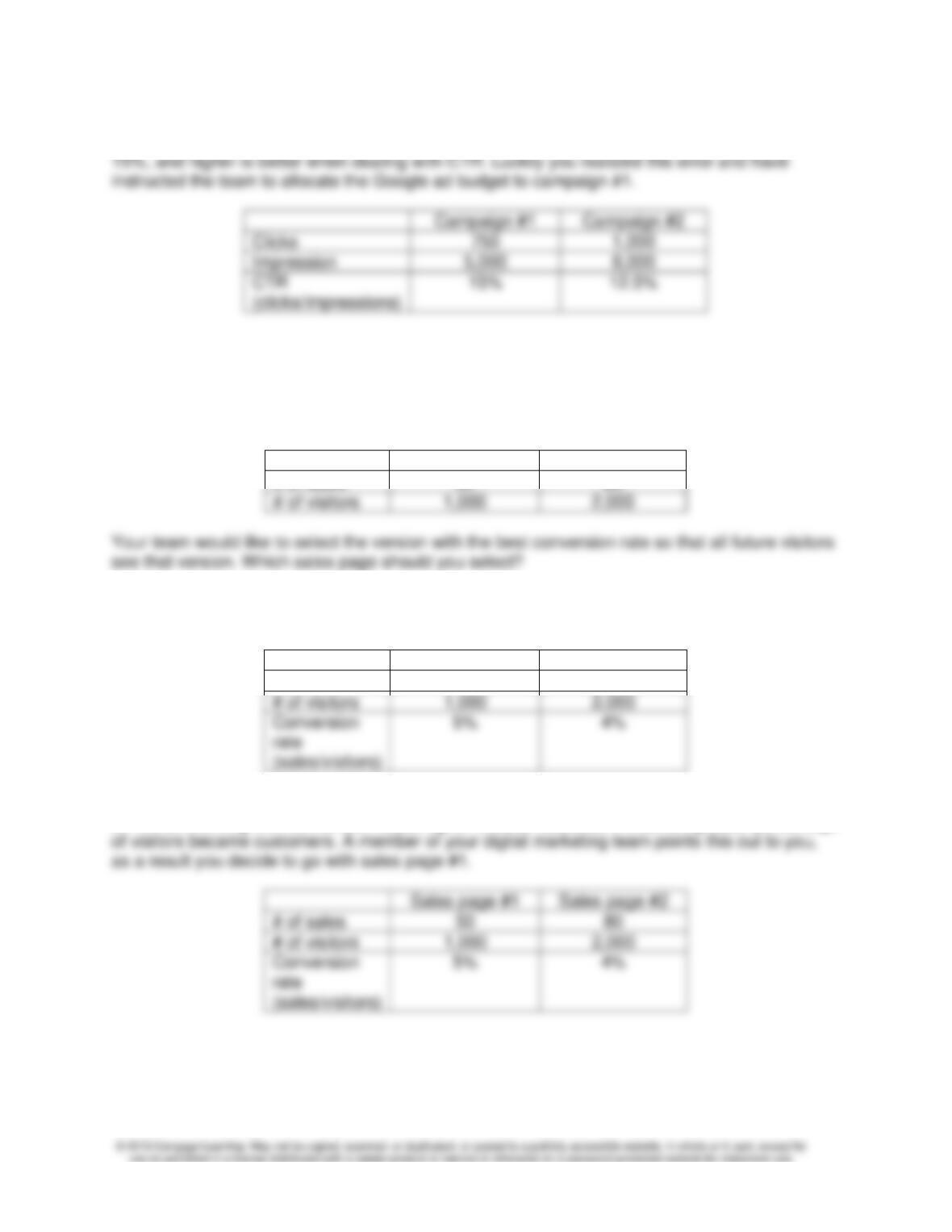
After running two different Google ad campaigns last month, your marketing teams reports the
following results:
Campaign #1
Campaign #2
Impression
CORRECT—Campaign #1: Yes, this campaign had the highest CTR. By dividing clicks by
impressions, you found this campaign had a CTR of 15%. Campaign #2 had a lower CTR of
12.5%.
Campaign #1
Campaign #2
Chapter 4: E-Business – Managing the Customer Experience
INCORRECT—Campaign #2: Unfortunately, this campaign has the lower CTR. By dividing
clicks by impressions, you’ll find this campaign has 12.5% CTR. Campaign #1 was higher at
Clicks
Impression
(clicks/impressions)
Decision #2
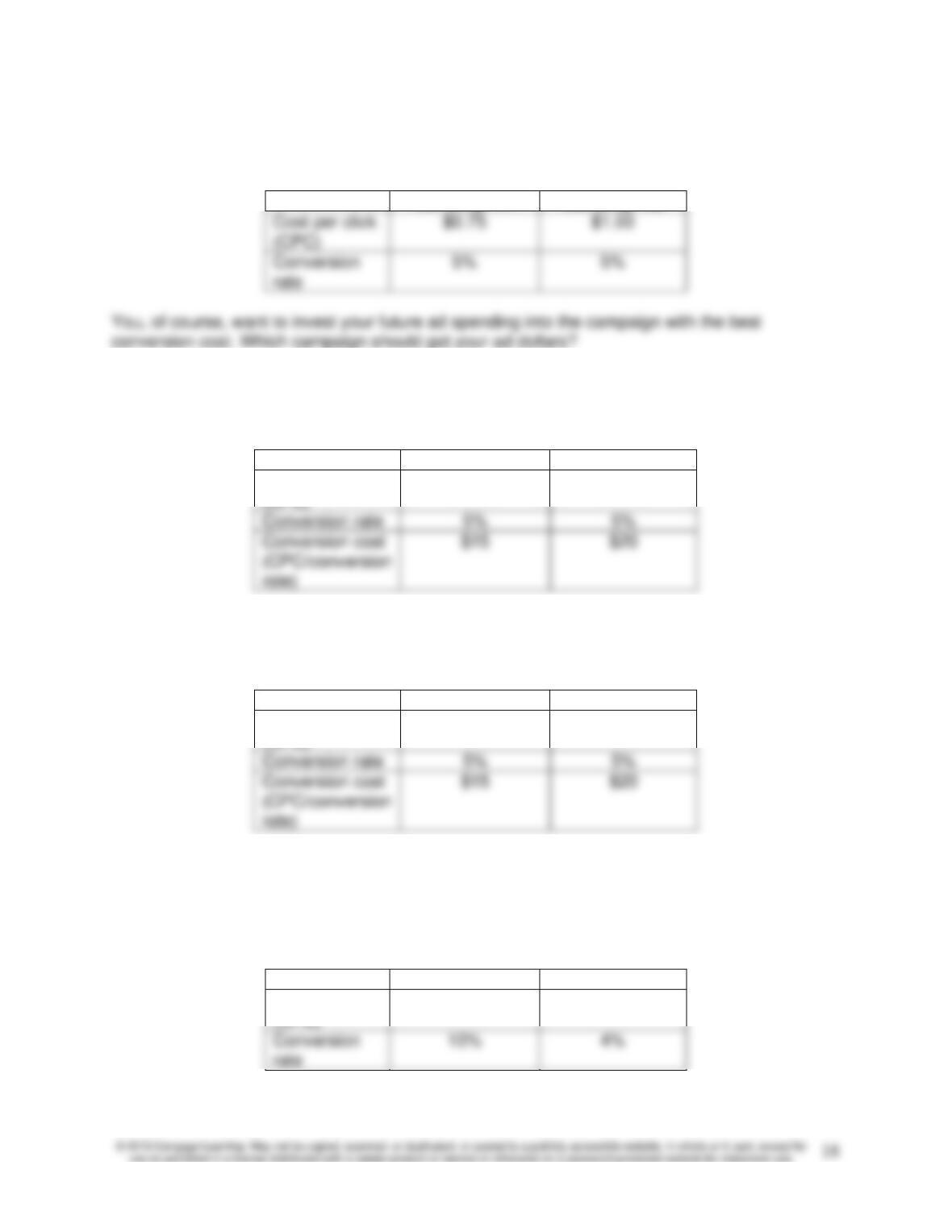
Your web team created two different versions of the main sales pages for your subscription box.
Using something called A/B testing, they were able to alternate which version visitors saw when
viewing your website. After a month of testing, the results were:
Sales page #1
Sales page #2
# of sales
# of visitors
CORRECT—Sales page #1: Yes, this page had the highest conversion rate at 5%. You’ll show
all future visitors this page because it performs the best.
Sales page #1
Sales page #2
# of sales
50
80
# of visitors
INCORRECT—Sales page #2: Actually, this page had a lower conversion rate than sales page
#1. When working with conversion rates, higher is better because it means a greater percentage
# of sales
# of visitors
Decision #3
Chapter 4: E-Business – Managing the Customer Experience
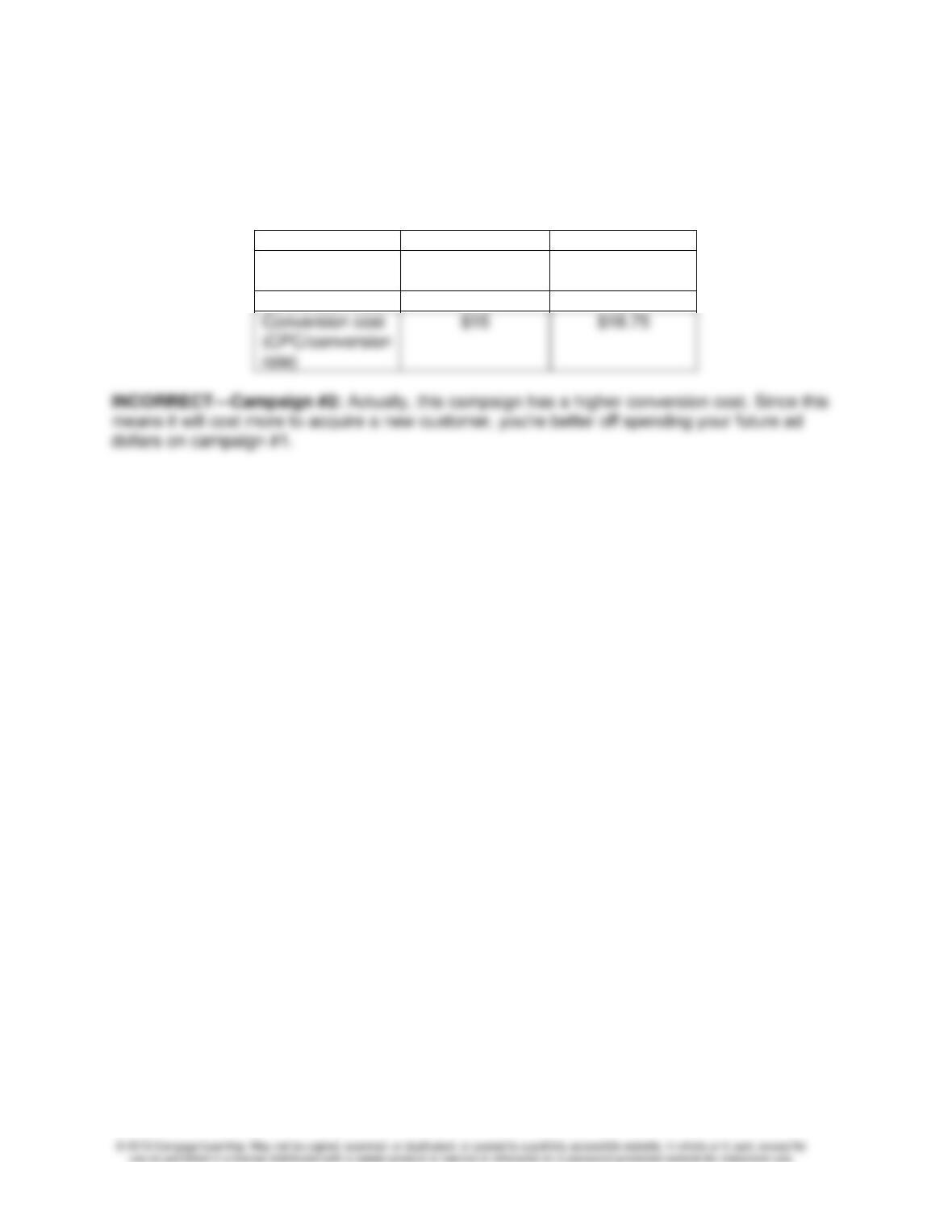
Now that you have settled on which sales page performs the best, you’d like to ramp up the
advertising spending to drive more traffic to the site. First, you run two different Google
campaigns and get the following results:
Campaign #1
Campaign #2
Cost per click
$0.75
$1.00
Conversion
CORRECT—Google Campaign #1: Yes, this campaign had the lowest conversion cost. Since
lower conversion cost means you are acquiring a customer for less money, this is the right
choice.
Campaign #1
Campaign #2
Cost per click
Conversion rate
$0.75
$1.00
INCORRECT—Google Campaign #2: Actually, this campaign has a higher conversion cost.
Since this means it would cost more to acquire a new customer, you’re better off spending your
future ad dollars on campaign #1.
Campaign #1
Campaign #2
Cost per click
(CPC)
Conversion rate
(CPC/conversion
rate)
$0.75
$1.00
Decision #4
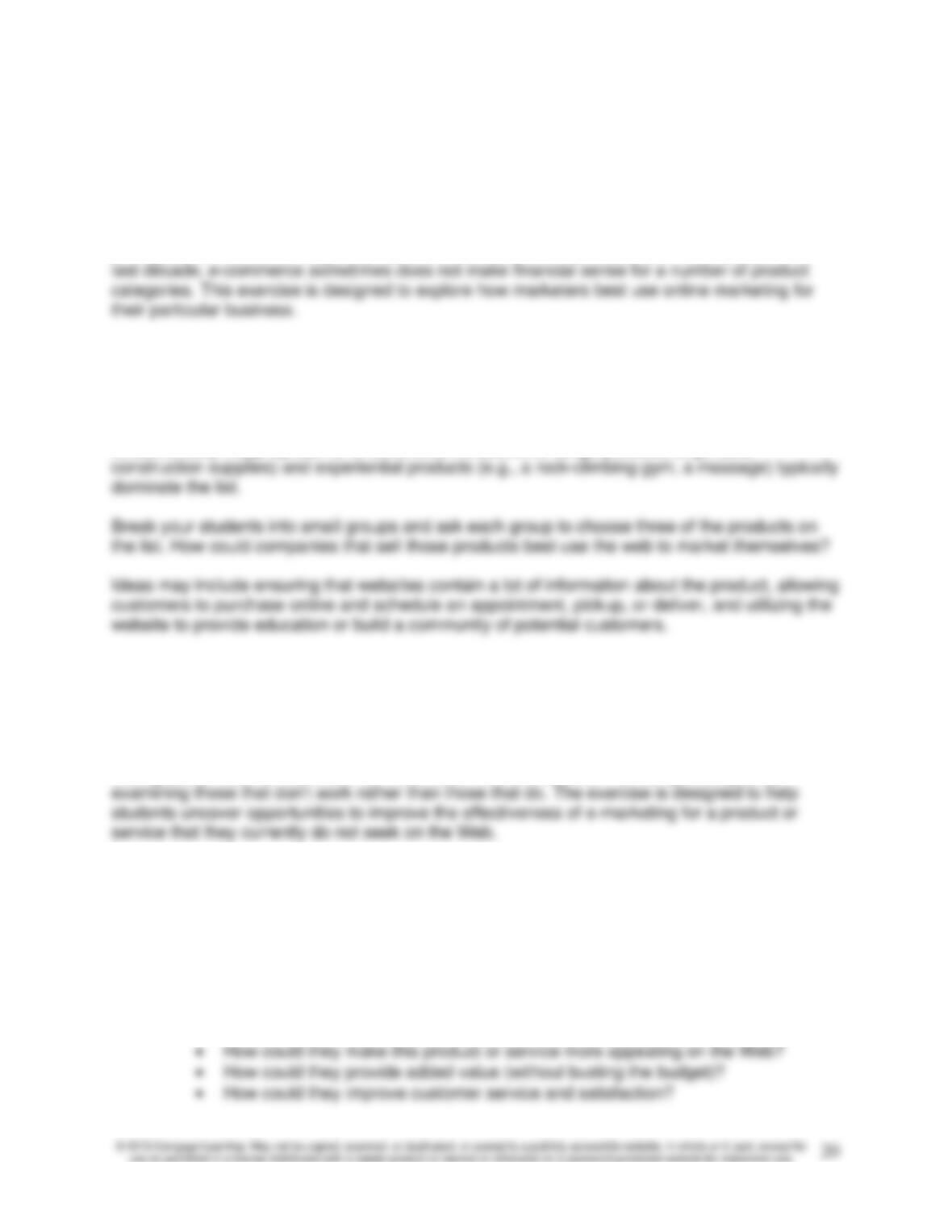
With your Google ad campaign in full swing, you shift focus to running ads on Facebook. Since
each campaign targeted a different group of potential customers, you notice that conversion
rates varied between campaigns. After a few weeks of running ads, here are your results:
Campaign #1
Campaign #2
Cost per click
(CPC)
Conversion
rate
$1.50
$0.75
Chapter 4: E-Business – Managing the Customer Experience
Like before, you want to invest your future ad spending into the campaign with the best
conversion cost. Which campaign should you choose?
CORRECT—FB Campaign #1: Yes, this campaign had the lowest conversion cost. Since lower
conversion cost means you are acquiring a customer for less money, this is the right choice.
Campaign #1
Campaign #2
Cost per click
(CPC)
$1.50
$0.75
Conversion rate
10%
4%
rate)
Chapter 4: E-Business – Managing the Customer Experience
ADDITIONAL HOMEWORK/CLASSROOM ACTIVITIES
Online Sellers
Purpose: To explore the brand-building potential of the Internet.
Background: While the range of product availability online has expanded dramatically in the
Relationship to Text: Advantages of e-business and online marketing
Estimated Class Time: About 10–15 minutes
Exercise: As a class, brainstorm with your students a list of products that they believe are
fundamentally inappropriate for e-commerce transactions. Large products (e.g., cars,
E-Marketing
Purpose: To help students understand how to increase e-marketing effectiveness.
Background: Sometimes students find it easier to understand e-marketing strategies by
Relationship to Text: E-business
Estimated Class Time: About 20 minutes
Exercise: Divide your students into small groups and ask each group to choose a product or
service that most or all of them would not currently purchase via the Web. Give them about 10
minutes to answer the following questions:
• Why wouldn’t they purchase this product or service on the Web?
Chapter 4: E-Business – Managing the Customer Experience
Ask each group to share their product and their marketing ideas with the class. Encourage them
to recognize the huge opportunities yet to be tapped in B2C e-commerce.
Questions for Reflection:
• What B2B products could be better marketed on the Web?
Challenges of Online Marketing
Purpose: To help students understand the challenges faced while using e-marketing strategies.
Background: Students will be able to understand e-marketing strategies better by examining its
Relationship to Text: Challenges in e-business and e-marketing
Estimated Class Time: About 20 minutes
Preparation/Materials: Develop a list of business types for your students to analyze in small
on.
Exercise: Divide your students into small groups. Ask each group to choose a business and
strategy to tackle the problems in question.
Questions for Reflection:
• How do firms build customer trust in their website or online experience?
• How can firms avoid channel conflicts?
Ethics Exercise
Purpose: To help students understand the challenges faced while using e-marketing strategies.
Background: Students will contemplate decisions that e-marketers must make with regards to
privacy.
Chapter 4: E-Business – Managing the Customer Experience
users go on the Web and store that information. Search engines keep detailed data on Internet
searches by users. Those arguing that additional privacy laws and regulations are needed claim
that users never know exactly what information is collected, nor when it is collected. Moreover,
there is no means for determining whether websites follow their own privacy policies.
1. Is this policy, in your opinion, appropriate and adequate? What ethical issues does your
company’s policy raise?
2. How would you change the privacy policy to reflect your ethical concerns?
3. From strictly an economic perspective, is the company’s existing policy adequate and
appropriate?
Internet Research Activity—Online Shopping
Assume you’re in the market for a new notebook computer. Visit at least two of the websites
listed below and review shopping suggestions and model ratings. Next, list your top two models
and, using a shopping site such as Shopping.com (http://www.shopping.com), search for online
retailers offering the best combination of price, user ratings, shipping, and other relevant criteria.
Prepare a report summarizing your experience. What did this exercise teach you about the
benefits and challenges of online retailing?
Chapter 4: E-Business – Managing the Customer Experience
KEY TERMS
E–business: Using the Internet to provide services to customers and communicate with
employees and business partners.
E-commerce: The buying and selling of products online.
Extranets: Secure networks used for e-business and accessible through the firm’s website by
external customers, suppliers, or other authorized users.
Intranets: Secure internal networks that help companies share information among employees,
no matter the number or location.
Private exchange: A secure website where a company and its suppliers share all types of data,
from product design through order delivery.
Business-to-consumer (B2C): Business conducted directly between the business and a
consumer.
Unique visitors: The number of individuals who visit a website.
Engagement: How much time users spend on site and which pages they visit.
Conversion rate: The percentage of visitors to a website who make a purchase.
Click-through rate (CTR): The percentage of users that click on an ad.
Conversion cost: The total cost of each sale.

Chapter 4: E-Business – Managing the Customer Experience