15
© 2022 Cengage. All Rights Reserved. May not be scanned, copied or duplicated, or posted to a publicly accessible
website, in whole or in part.
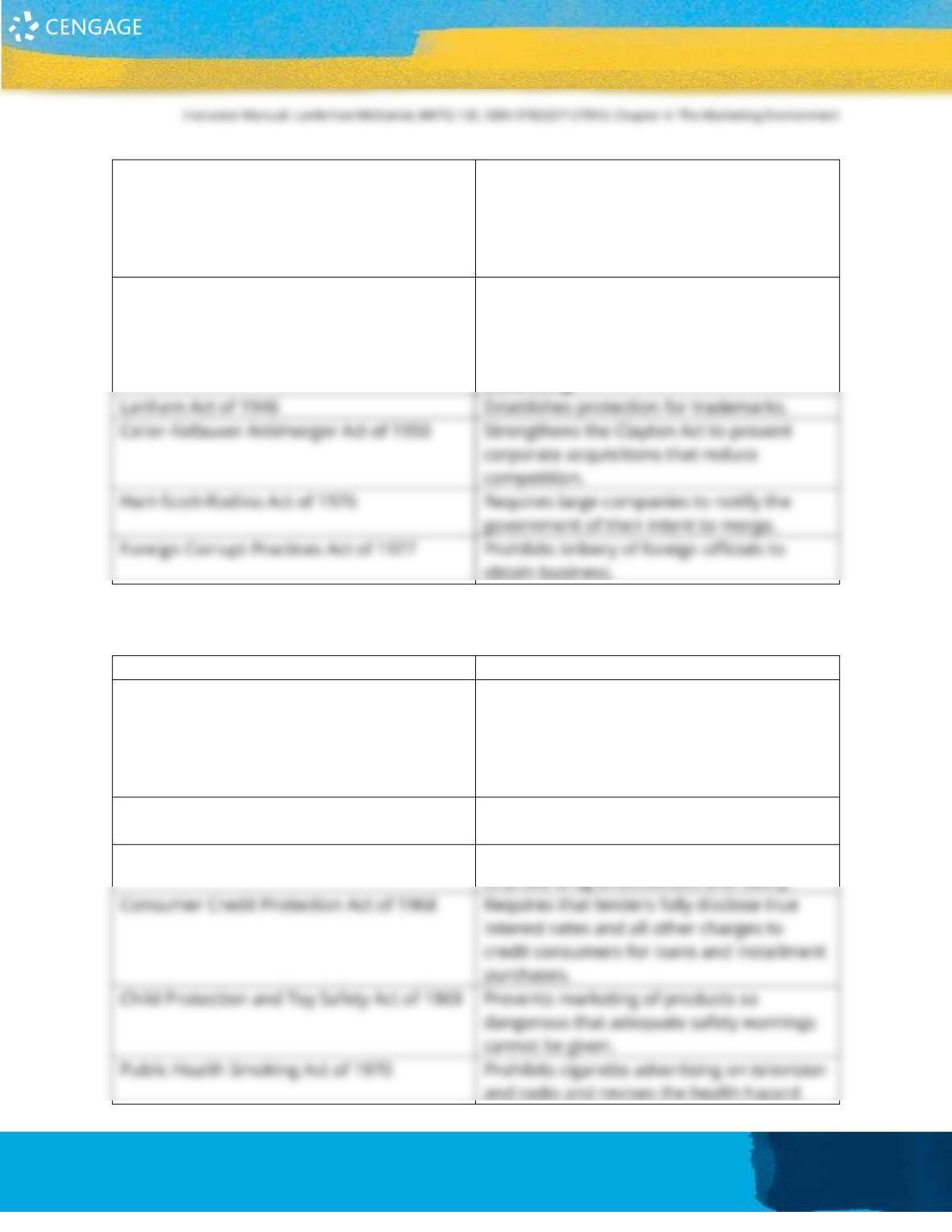
different buyers of merchandise of like
grade and quantity; requires sellers to
make any supplementary services or
allowances available to all purchasers on a
proportionately equal basis.
Wheeler-Lea Amendments to
FTC Act of 1938
Broadens the Federal Trade Commission’s
power to prohibit practices that might
injure the public without affecting
competition; outlaws false and deceptive
Lanham Act of 1946
Establishes protection for trademarks.
corporate acquisitions that reduce
competition.
Hart-Scott-Rodino Act of 1976
Requires large companies to notify the
government of their intent to merge.
Foreign Corrupt Practices Act of 1977
Prohibits bribery of foreign officials to
obtain business.
PRESENTATION VISUAL: Exhibit 4.2 Primary U.S. Laws Protecting Consumers
Legislation
Impact on Marketing
Federal Food and Drug Act of 1906
Prohibits adulteration and misbranding of
foods and drugs involved in interstate
commerce; strengthened by the Food,
Drug, and Cosmetic Act (1938) and the
Kefauver-Harris Drug Amendment (1962).
Federal Hazardous Substances Act of 1960
Requires warning labels on hazardous
household chemicals.
Kefauver-Harris Drug Amendment of 1962
Requires that manufacturers conduct tests
to prove drug effectiveness and safety.
Consumer Credit Protection Act of 1968
Requires that lenders fully disclose true
dangerous that adequate safety warnings
cannot be given.
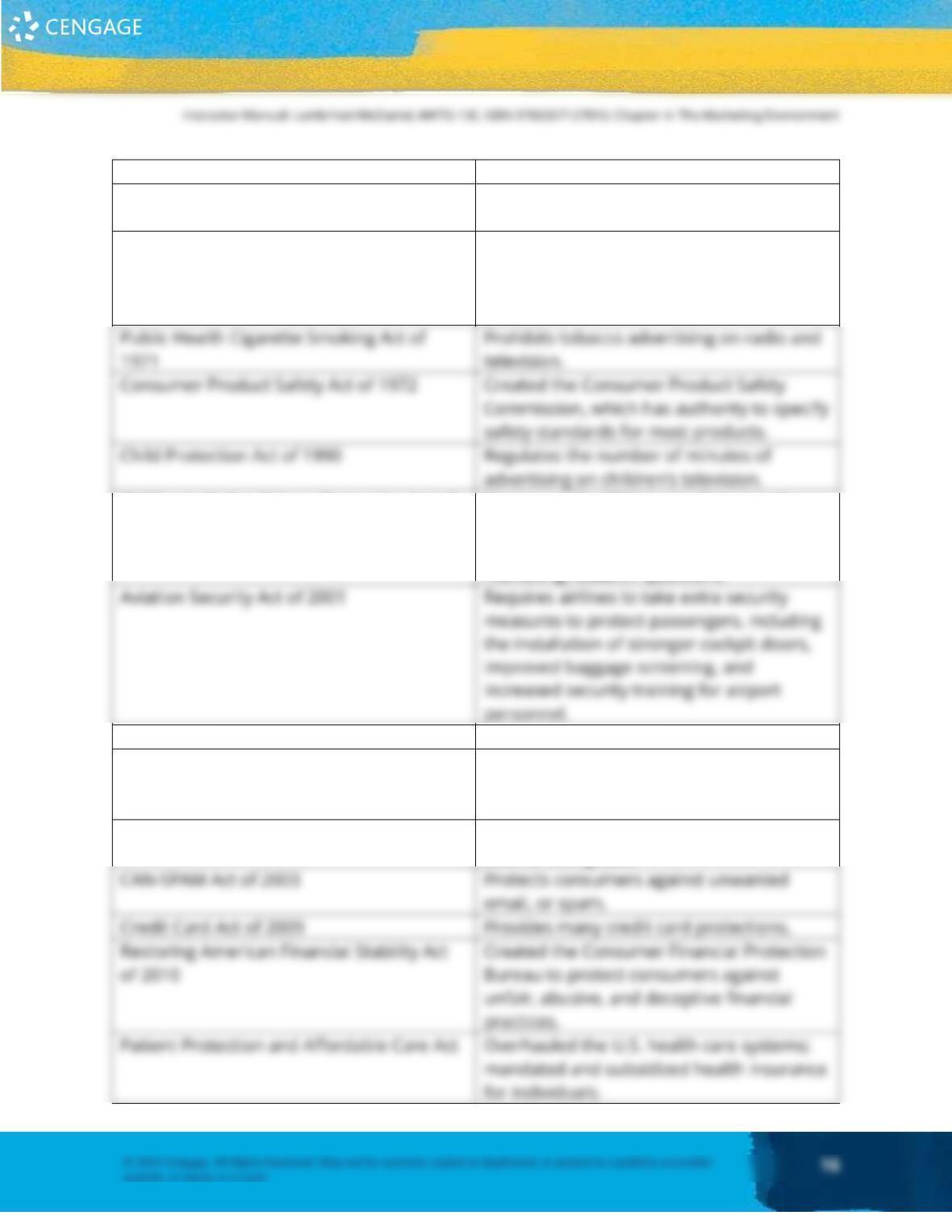
warning on cigarette packages.
Poison Prevention Labeling Act of 1970
Requires safety packaging for products that
may be harmful to children.
National Environmental Policy Act of 1970
Established the Environmental Protection
Agency to deal with various types of
pollution and organizations that create
pollution.
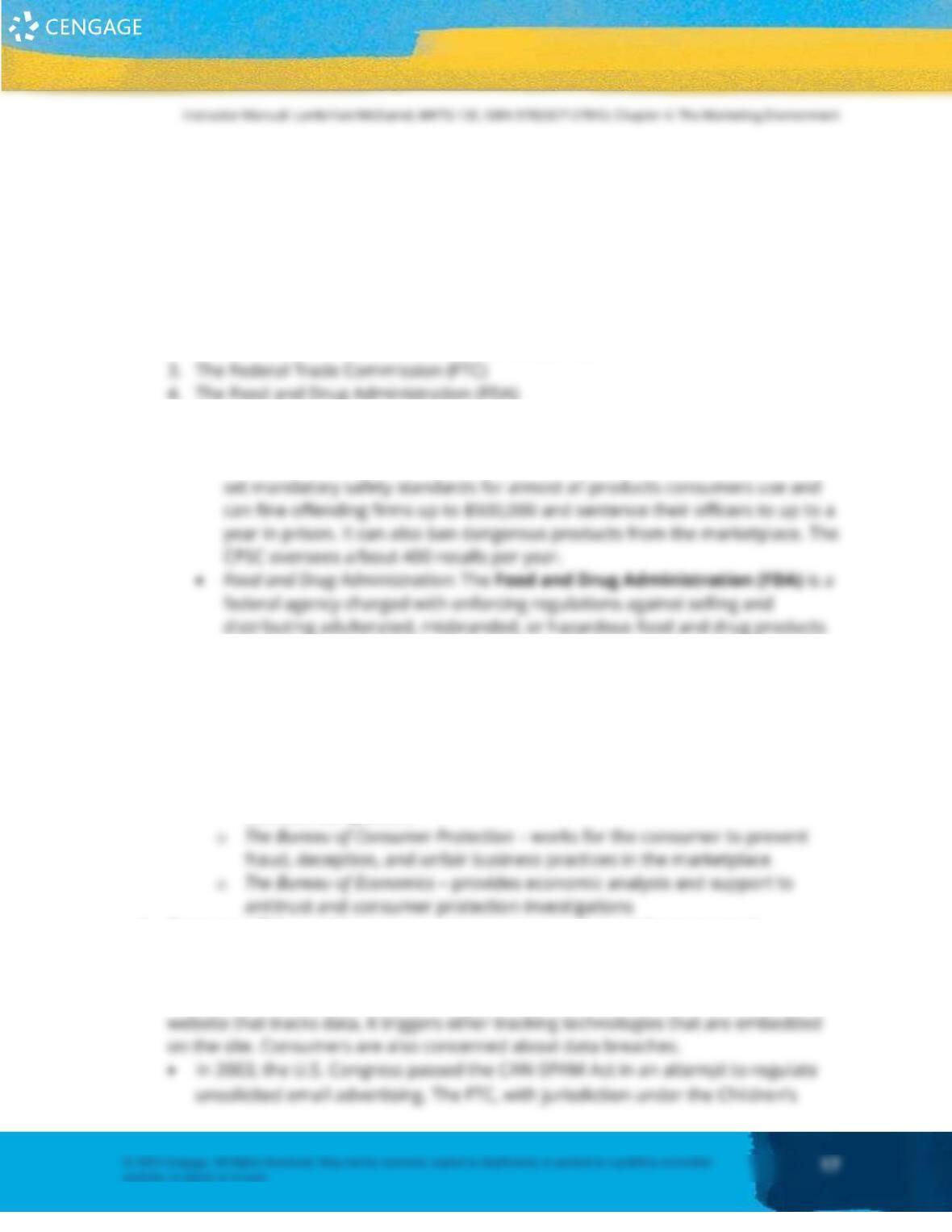
Public Health Cigarette Smoking Act of
1971
Prohibits tobacco advertising on radio and
television.
Commission, which has authority to specify
safety standards for most products.
Child Protection Act of 1990
Regulates the number of minutes of
Children’s Online Privacy Protection Act of
1998
Empowers the FTC to set rules regarding
how and when marketers must obtain
parental permission before asking children
marketing research questions.
improved baggage screening, and
increased security training for airport
personnel.
Legislation
Impact on Marketing
Homeland Security Act of 2002
Protects consumers against terrorist acts;
created the Department of Homeland
Security.
Do Not Call Law of 2003
Protects consumers against unwanted
telemarketing calls.
Credit Card Act of 2009
Provides many credit card protections.
Restoring American Financial Stability Act
of 2010
Created the Consumer Financial Protection
Bureau to protect consumers against
unfair, abusive, and deceptive financial
practices.
d. State and Local Laws: Legislation that affects marketing varies from state by state.
Several states, including California and North Carolina, are considering levying a tax
on all in-state commercial advertising.
e. Regulatory Agencies: The four federal agencies most directly and actively involved
in marketing affairs are:
1. The Consumer Product Safety Commission (CPSC)
2. The Consumer Financial Protection Bureau (CFPB)
• Consumer Product Safety Commission: The Consumer Product Safety
Commission (CPSC) is a federal agency established to protect the health and
safety of consumers in and around their homes. The CPSC has the power to
• Federal Trade Commission: The Federal Trade Commission (FTC) is a federal
agency empowered to prevent persons or corporations from using unfair
methods of competition in commerce. Over the years, the FTC’s
responsibilities have grown so large that it has created several bureaus to
better organize its operations. Among the most important are the following:
o The Bureau of Competition – seeks out and challenges anticompetitive
conduct in the marketplace, including monopolization and agreements
between competitors
f. Consumer Privacy: Many consumers are concerned about the amount of
information marketers collect about them when they use the Internet or visit
various websites and apps. There are more than 300 companies collecting data
about users. Often, data collectors piggyback on each other. When a user visits a
Online Privacy Protection Act, requires website operators to post a privacy policy
on their home page and a link to the policy on every page where personal
information is collected. In the United States, there is no single, comprehensive
8. Competitive Factors (LO 4-8, PPT Slide 68, DISC: Strategy)
a. The competitive environment encompasses:
• The number of competitors a firm must face
• The relative size of the competitors
• The degree of interdependence within the industry
b. Competition for Market Share and Profits: As U.S. population growth slows,
technology rapidly changes, global competition increases, costs rise, and available
c. Global Competition: U.S. marketing managers can no longer focus only on
[return to top]
Discussion Questions
You can assign these questions several ways: in a discussion forum in your LMS; as whole-
class discussions in person; or as a partner or group activity in class.
1. Discussion: (LO 4-6, PPT Slides 65 – 66) Duration 5-10 minutes.
a. Guide students on a discussion of the impact of technology on marketing by asking
the following:
• How has technology benefited marketers? Can you offer several examples?
i. Students’ answers will vary. For example, they may mention the new
2. Discussion: (LO 4-7, PPT Slides 80–81) Duration: 10-15 minutes
a. Lead students on a discussion of U.S. law that impacts marketing by asking the
following:
• How do the laws listed in Exhibit 4.1 both positively and negatively impact
business organizations?
[return to top]
Additional Activities and Assignments
A generic discussion and writing rubric is provided in the Appendix.
1. Activator Exercise: Bring on the Baby Boomers (LO 4-3)
Purpose: To start to understand the importance and implications of marketing to
specific demographic trends.
Classroom Format: Group presentations in the form of a skit/commercial
(Estimated Time: 30-40 minutes)
1. Have the class divide up into groups of three to five students.
2. Explain that although Baby Boomers (born between 1946 and 1964) are
aging, they see themselves as physically active and intellectually curious.
4. Have each group develop a short commercial utilizing their ideas on
marketing to Baby Boomers, which they should perform in front of the
class.
Online Format: Video presentation submitted by each student
(Estimated Time: 20-30 minutes)
What features and benefits would appeal to them?
3. Create and record a short commercial utilizing your ideas on marketing to
Baby Boomers.
4. Have each student upload their video presentation to Bongo in MindTap.
5. Grade the video presentation using the Rubric provided with the
Instructor’s Manual on the Instructor Companion Site.
Additional questions for a classroom or discussion board: How did your
understanding of Baby Boomers influence your appeal and marketing message?
How would you have changed your approach in marketing to younger age groups?
Did you have any ethical or social concerns about marketing to this age group?
Result: Students will be encouraged to think about the external environment of a
2. Class activity (LO 4-1)
Format: This activity can be facilitated in both a classroom and an online
environment. Instructions for how to facilitate the activity in the classroom and
online are provided below. (Estimated time: 10-20 minutes)
Classroom Format: Have students break into groups of three or four to discuss the
Instructor Manual: Lamb/Hair/McDaniel, MKTG 13E, ISBN 9780357127810; Chapter 4: The Marketing Environment
Online Format: If you’re delivering your course online, you can have students do
this on their own and have them post their answers in a discussion board. Use the
following prompt to facilitate this activity:
Brainstorm examples of new companies that are creating challenges for traditional
3. Class activity (LO 4-2)
Format: This activity can be facilitated in both a classroom and an online
environment. Instructions for how to facilitate the activity in the classroom and
online are provided below. (Estimated time: 15-20 minutes)
Classroom Format: Have students break into groups of three or four to discuss the
concept of social factors. First, have them discuss and choose five core values that
Online Format: If you’re delivering your course online, you can have students do
this on their own and have them post their answers in a discussion board. Use the
following prompt to facilitate this activity:
Write a post describing five core values that you associate with the region of the country
4. Class activity (LO 4-3)
Format: This activity can be facilitated in both a classroom and an online
environment. Instructions for how to facilitate the activity in the classroom and
online are provided below. (Estimated time: 15-25 minutes)
Classroom Format: Ask students to break up into pairs or groups of three. Using
the Internet, ask them to locate an ad that is clearly aimed at one of the major
demonstrate their own sensitivity to cultural differences (including age) when
dealing with various market segments.
Online Format: If you’re delivering your course online, you can have students do
this on their own and have them post their answers in a discussion board. Use the
following prompt to facilitate this activity:
Using the Internet, locate an ad or commercial that is clearly aimed at one of the major
5. Class activity (LO 4-4)
Format: This activity can be facilitated in both a classroom and an online
environment. Instructions for how to facilitate the activity in the classroom and
online are provided below. (Estimated time: 15-25 minutes)
Classroom Format: Divide students into groups of three or four. Ask students to
use the Internet to identify an organization that has developed a marketing mix for
Online Format: If you’re delivering your course online, you can have students do
this on their own and have them post their answers in a discussion board. Use the
following prompt to facilitate this activity:
Use the Internet to identify an organization that has developed a marketing mix for one
6. Class activity (LO 4-5)
Format: This activity can be facilitated in both a classroom and an online
environment. Instructions for how to facilitate the activity in the classroom and
online are provided below. (Estimated time: 10-20 minutes)
Classroom Format: Ask students to break up into groups of three or four. Explain
that periods of recession, with their accompanying reduction in demand for goods
Online Format: If you’re delivering your course online, you can have students do
this on their own and have them post their answers in a discussion board. Use the
following prompt to facilitate this activity:
Periods of recession, with their accompanying reduction in demand for goods and
7. Class activity (LO 4-8)
Format: This activity can be facilitated in both a classroom and an online
environment. Instructions for how to facilitate the activity in the classroom and
online are provided below. (Estimated time: 10-20 minutes)
Classroom Format: Have students divide up into pairs or groups of three. Ask them
Online Format: If you’re delivering your course online, you can have students do
this on their own and have them post their answers in a discussion board. Use the
following prompt to facilitate this activity:
Choose a particular product from a manufacturer that interests you. Then use the
8. Additional activity: Scanning the External Environment (LO 4-1)
Purpose: To demonstrate the process of scanning the external environment in a
practical, hands-on exercise.
Background: To avoid losing their competitive advantage, all organizations should
Relationship to Text: The External Marketing Environment
Estimated Class Time: About 25 to 35 minutes
Classroom Format: Have students divide into groups of three or four to complete
the following steps:
1. Choose a familiar product manufacturer of interest to the group.
2. Have students use the Internet to conduct research and determine potential
opportunities and threats in that manufacturer’s external environment by
looking at the following six factors:
• Social trends (such as changes in buying behaviors and the
demand for time-saving goods and services)
3. Have students present their findings to the class.
Online Format: Discussion board with posted response from each student
1. Use the following prompt to facilitate this activity in a discussion board:
Choose a familiar product manufacturer that interests you. Use the Internet to
conduct research and determine potential opportunities and threats in that
manufacturer’s external environment by studying any THREE of the following six
factors:
• Social trends (such as changes in buying behaviors and the demand for time-
saving goods and services)
2. Have students respond to classmates’ posts by addressing additional factors,
challenging assumptions, and offering constructive feedback on their
scanning of the external environment.
Additional Questions for Reflection:
• What were some of the most common trends and factors that will influence
many manufacturers in the future?
9. Online Research activity (LO 4-4)
Certain demographic groups within our society are considered to be particularly
vulnerable to intensive advertising. These groups include children, the elderly,
individuals seeking weight loss options, and people with addictions, such as
cigarette smokers. Choose one of these groups to research in this exercise.
Instructor Manual: Lamb/Hair/McDaniel, MKTG 13E, ISBN 9780357127810; Chapter 4: The Marketing Environment
Additional Resources
External Videos or Playlist
Appendix
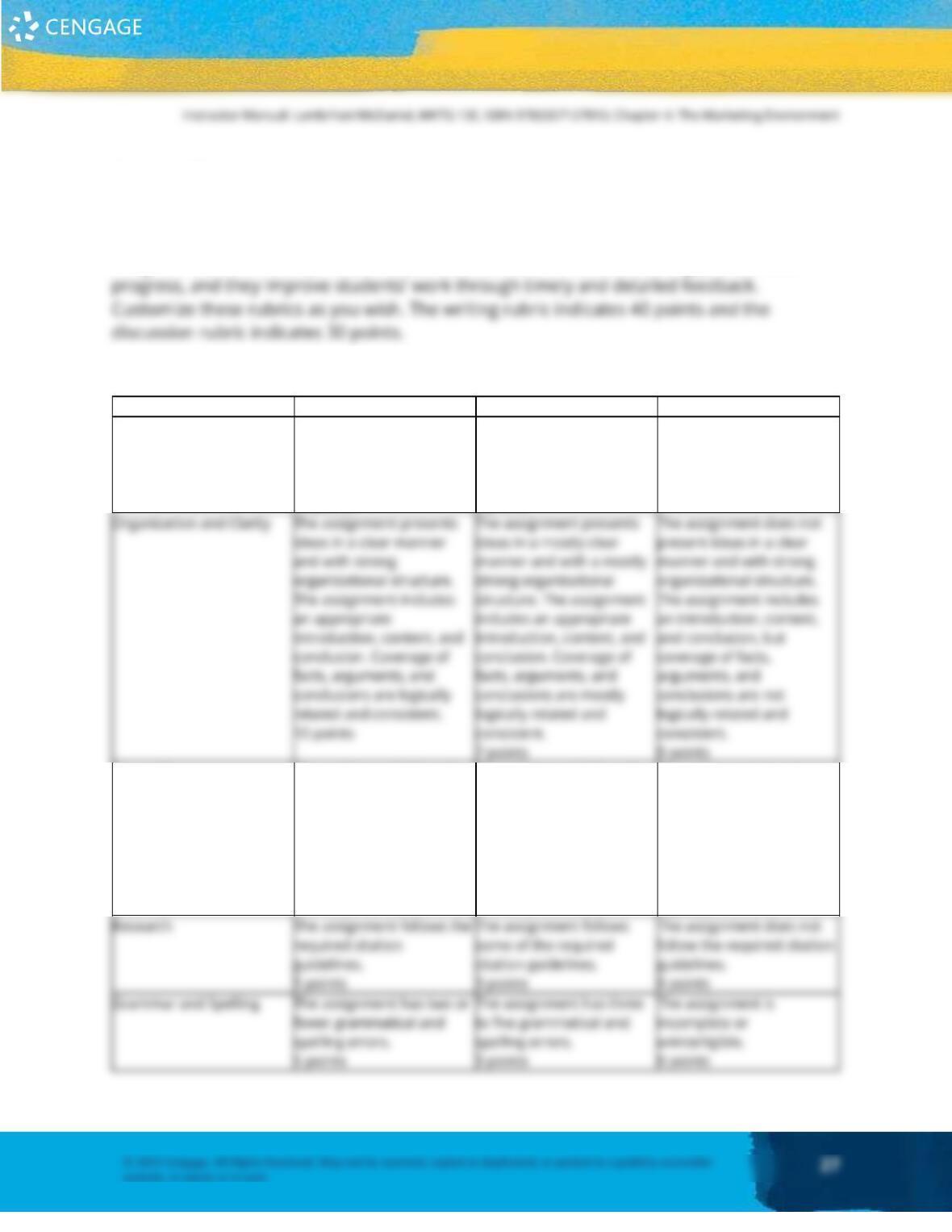
Generic Rubrics
Providing students with rubrics helps them understand expectations and components of
assignments. Rubrics help students become more aware of their learning process and
Standard Writing Rubric
Criteria
Meets Requirements
Needs Improvement
Incomplete
Content
The assignment clearly and
comprehensively
addresses all questions in
the assignment.
15 points
The assignment partially
addresses some or all
questions in the
assignment.
8 points
The assignment does not
address the questions in
the assignment.
0 points
facts, arguments, and
conclusions are logically
related and consistent.
10 points
facts, arguments, and
conclusions are mostly
logically related and
consistent.
7 points
arguments, and
conclusions are not
logically related and
consistent.
0 points
Research
The assignment is based
upon appropriate and
adequate academic
literature, including peer
reviewed journals and
other scholarly work.
5 points
The assignment is based
upon adequate academic
literature but does not
include peer reviewed
journals and other
scholarly work.
3 points
The assignment is not
based upon appropriate
and adequate academic
literature and does not
include peer reviewed
journals and other
scholarly work.
0 points
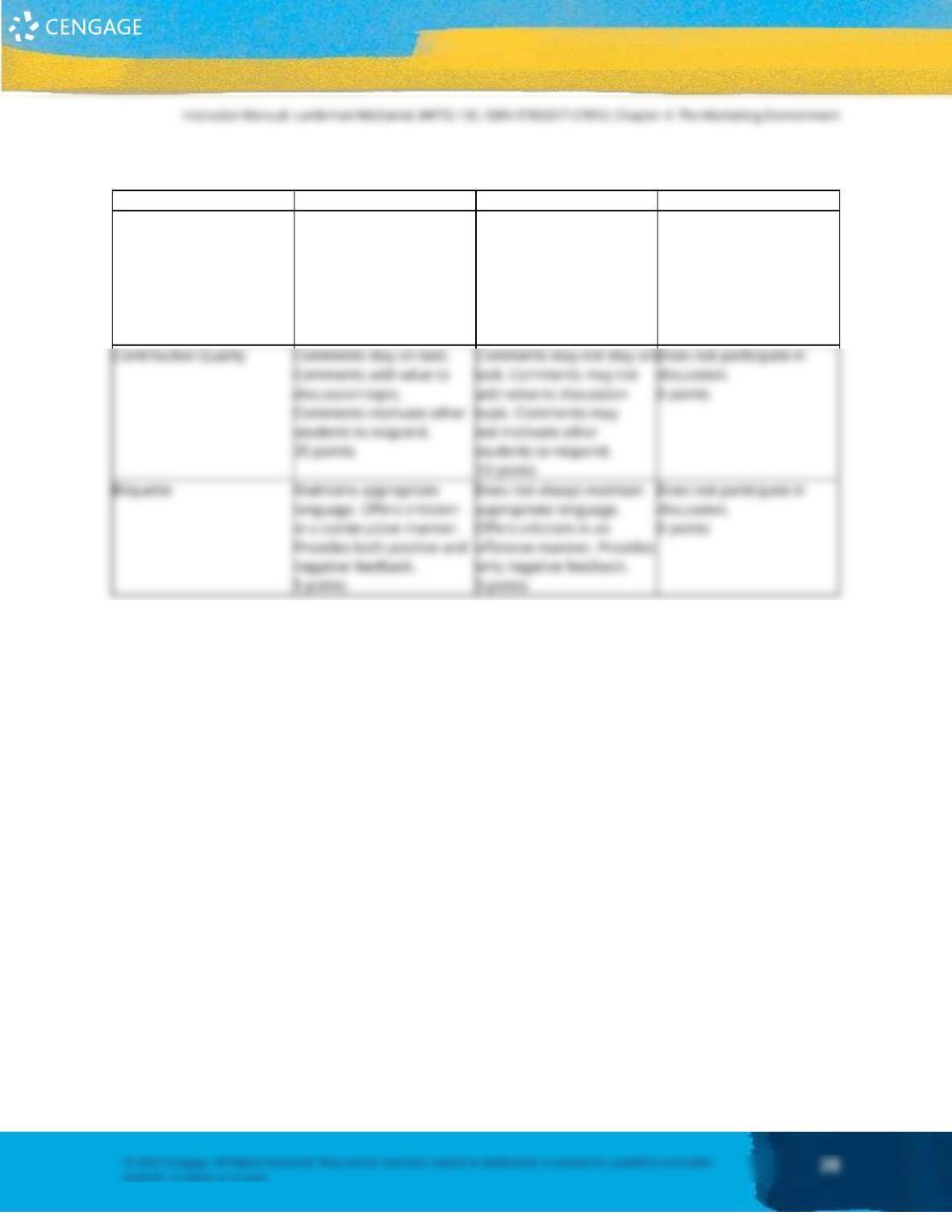
Standard Discussion Rubric
Criteria
Meets Requirements
Needs Improvement
Incomplete
Participation
Submits or participates in
discussion by the posted
deadlines. Follows all
assignment. instructions
for initial post and
responses.
5 points
Does not participate or
submit discussion by the
posted deadlines. Does not
follow instructions for
initial post and responses.
3 points
Does not participate in
discussion.
0 points