Chapter 04
Market Research Essentials
4-1
LEARNING OBJECTIVES
LO 4-2 Identify how critical internal (inside the firm) information is collected and used in
making marketing decisions.
LO 4-4 Recognize the value of market research and its role in marketing.
LO 4-6 Illustrate current research technologies and how they are used in market research.
CHAPTER OUTLINE
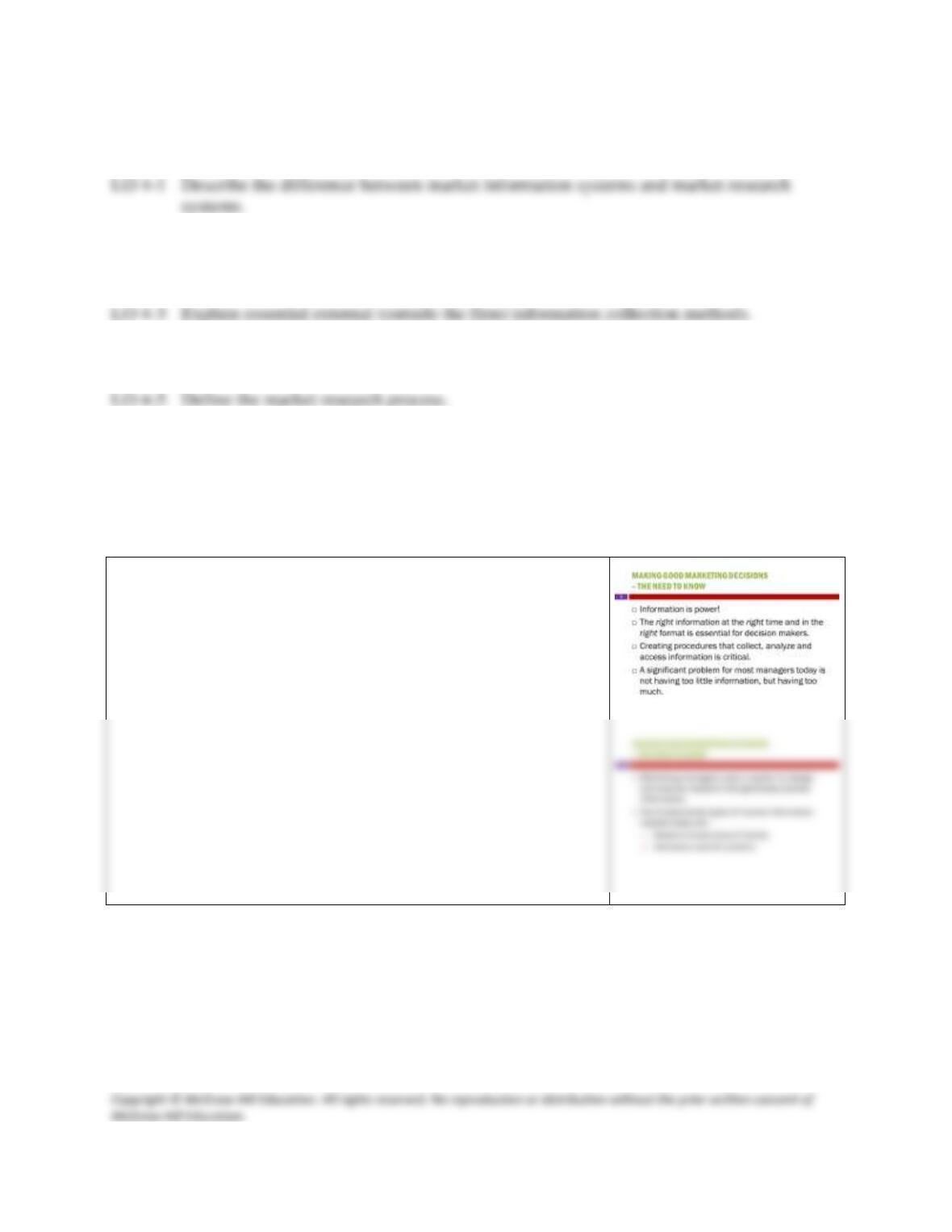
I. MAKING GOOD MARKETING DECISIONS – THE
NEED TO KNOW
Chapter 04
Market Research Essentials
4-2
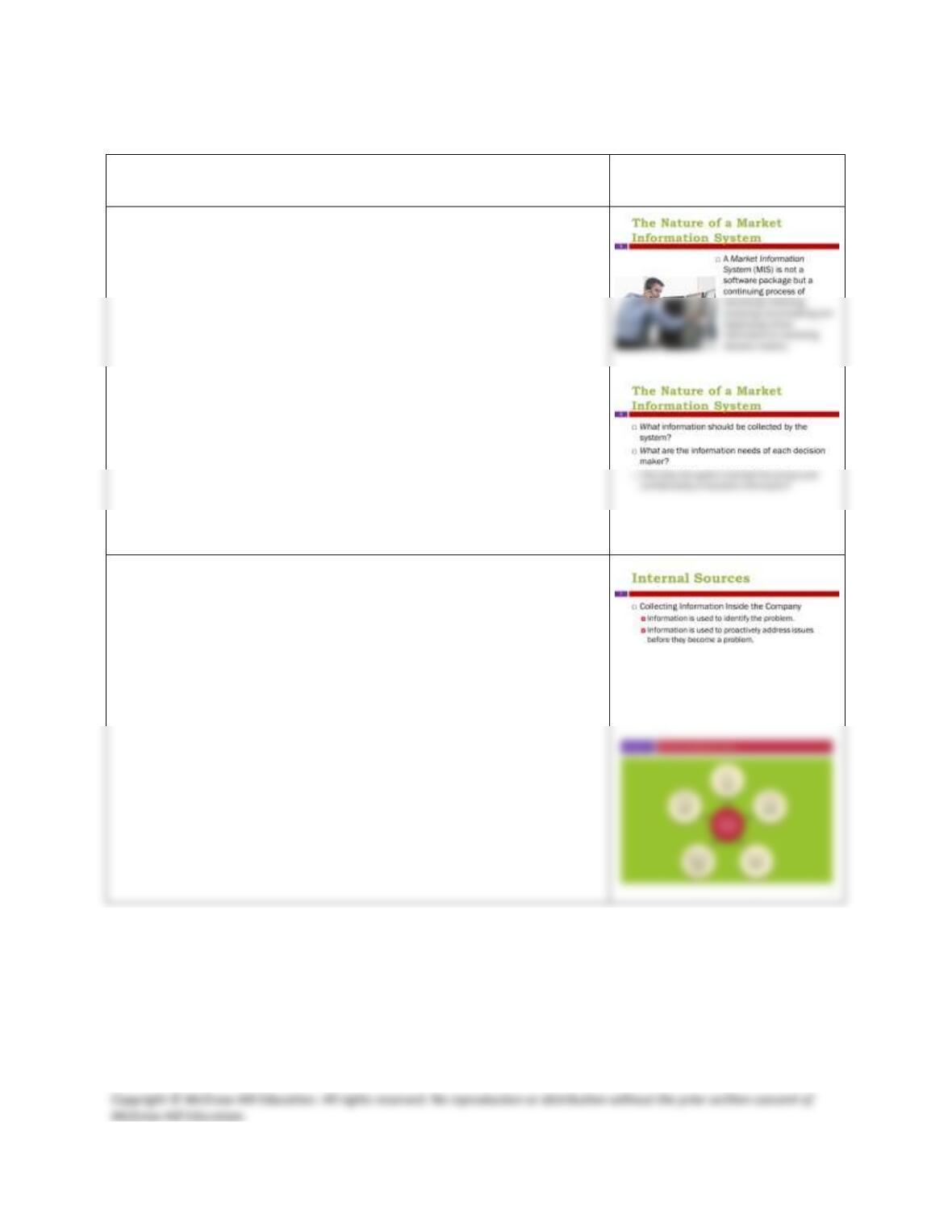
II. MARKET INFORMATION SYSTEM
A. The nature of a Market Information System
B. Internal Sources – Collecting Information inside the
Company
Chapter 04
Market Research Essentials
4-3
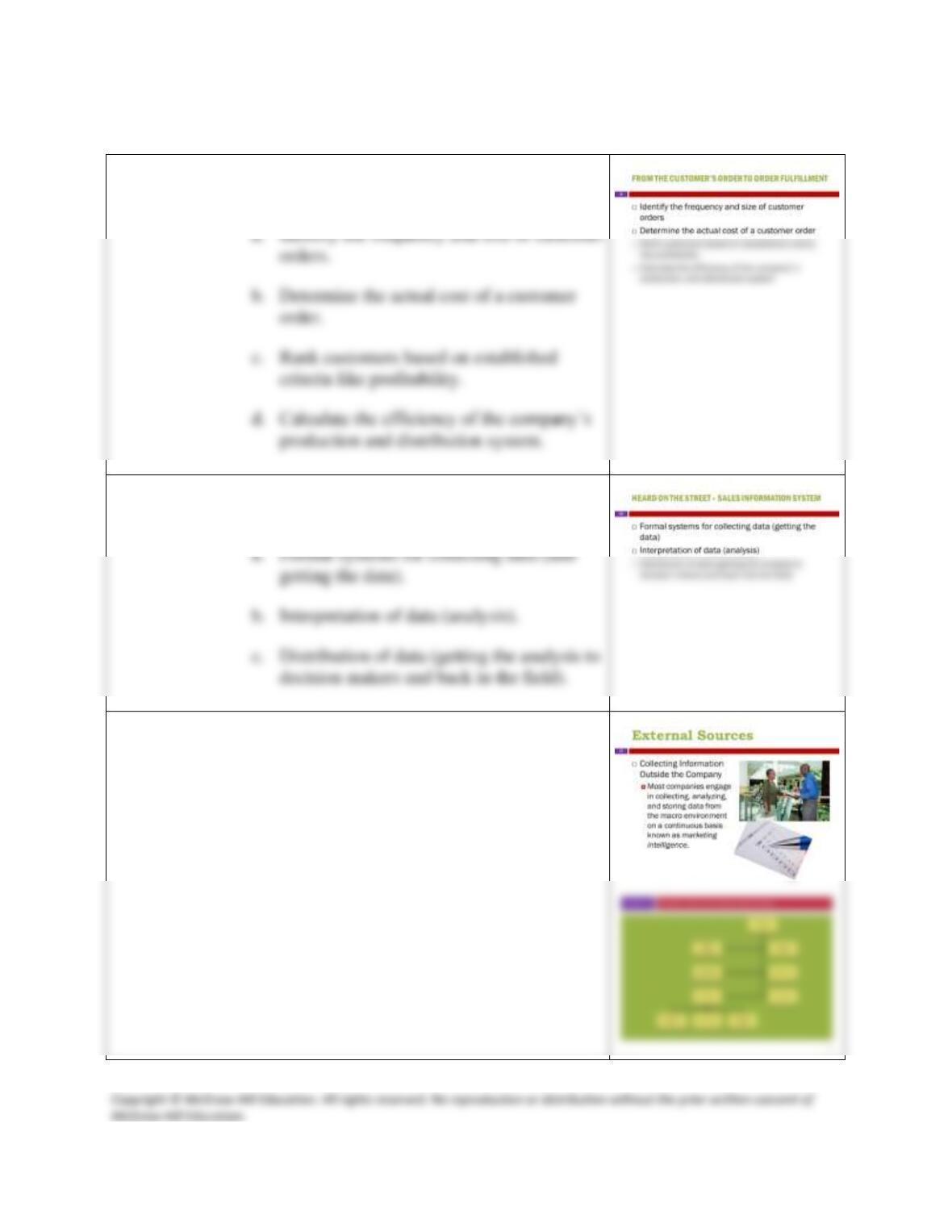
i. From the Customer’s Order to Order
Fulfillment
ii. Heard on the Street – Sales Information
System
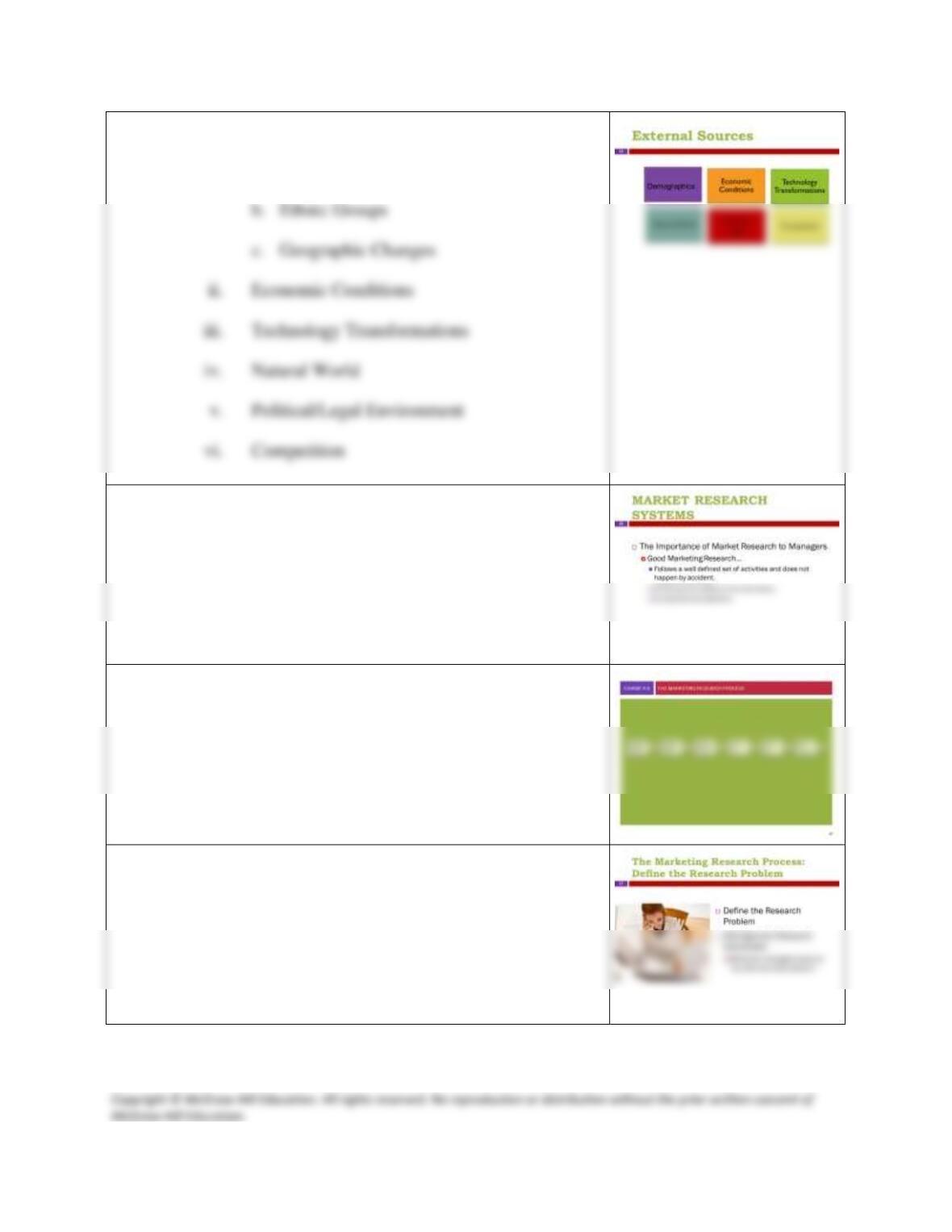
C. External Sources – Collecting Information outside the
Company
Chapter 04
Market Research Essentials
4-4
i. Demographics
a. Populations of Interest
III. MARKET RESEARCH SYSTEMS
A. The Importance of Market Research to Managers
B. The Market Research Process
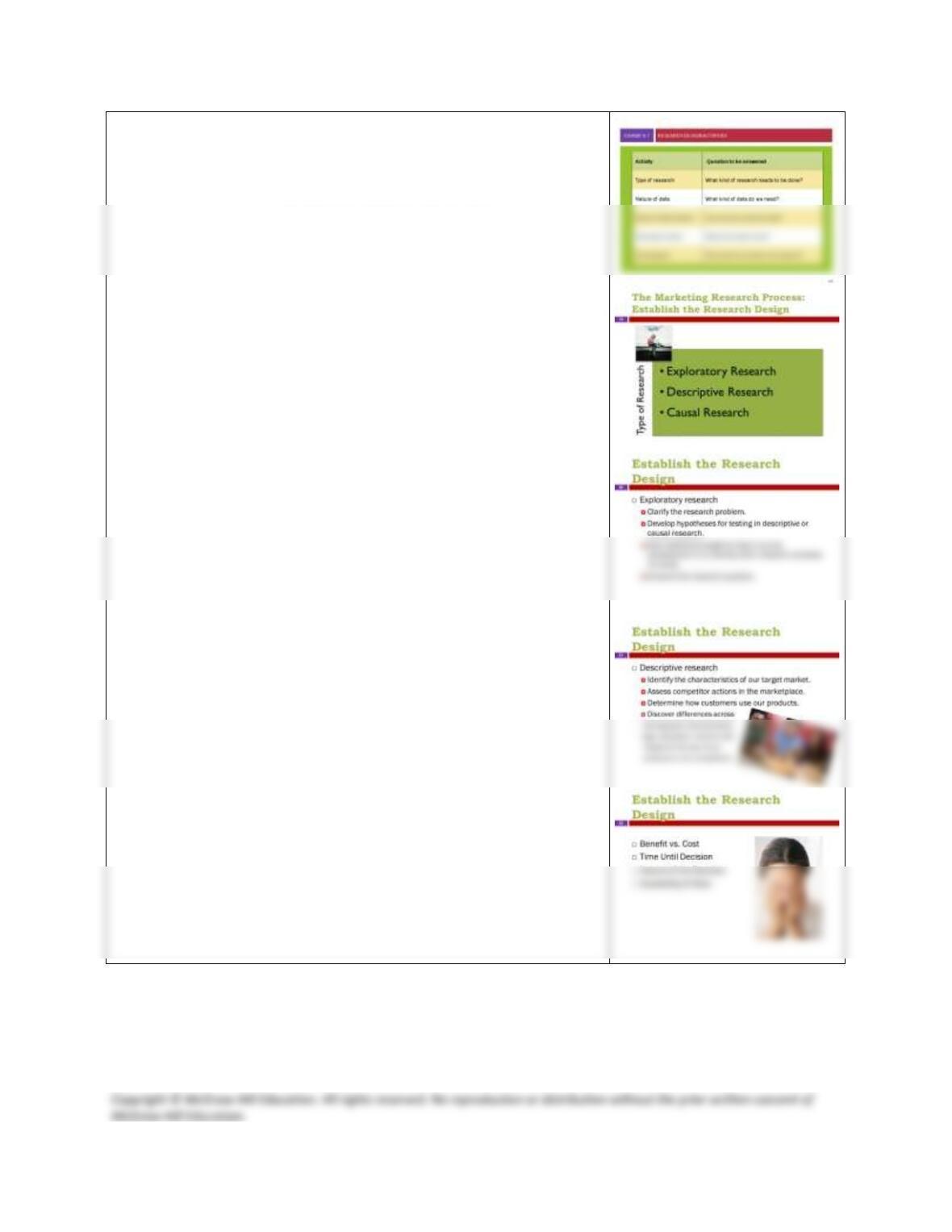
i. Define the Research Problem
Chapter 04
Market Research Essentials
4-5
ii. Establish the Research Design
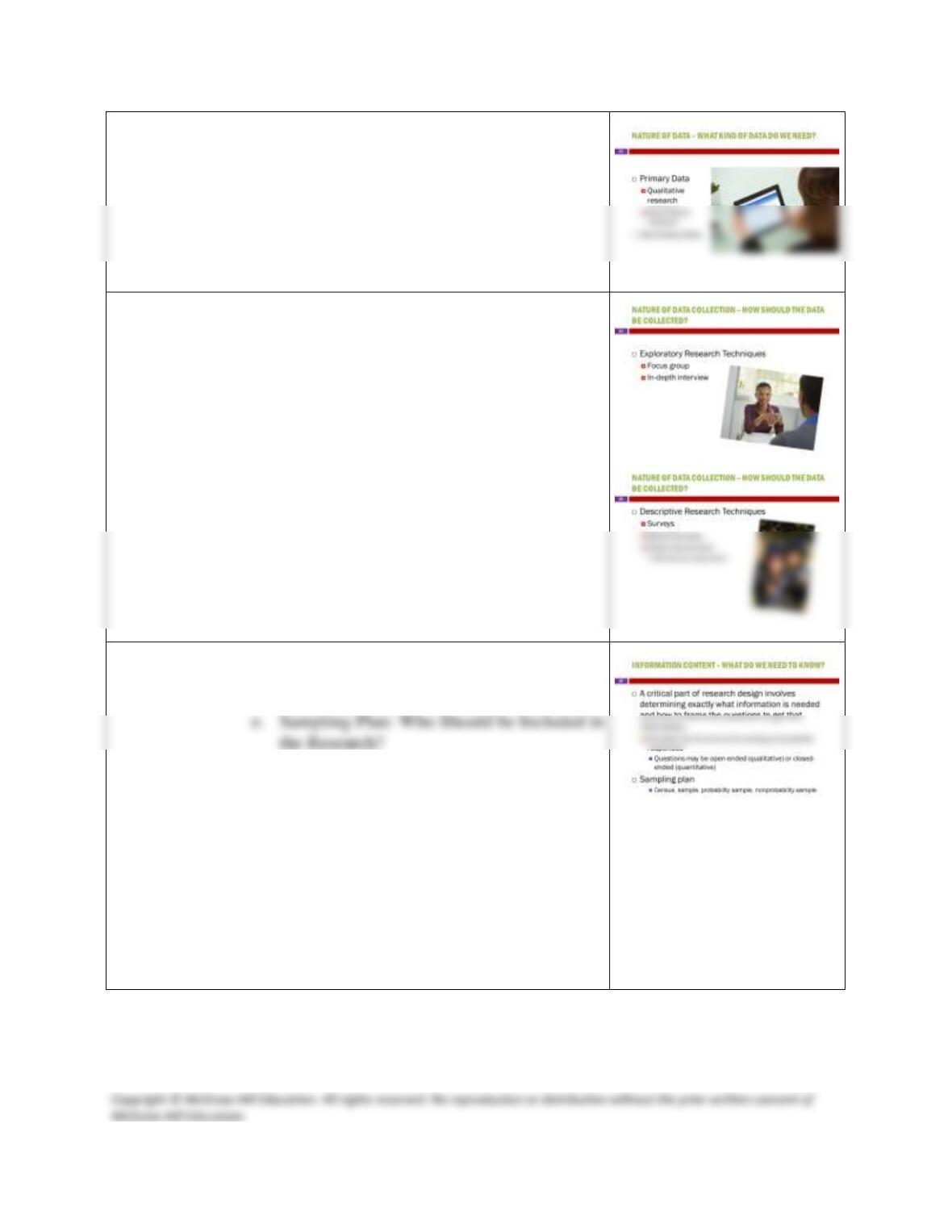
a. Type of Research – What Kind of
Research Needs to be Done?
Chapter 04
Market Research Essentials
4-6
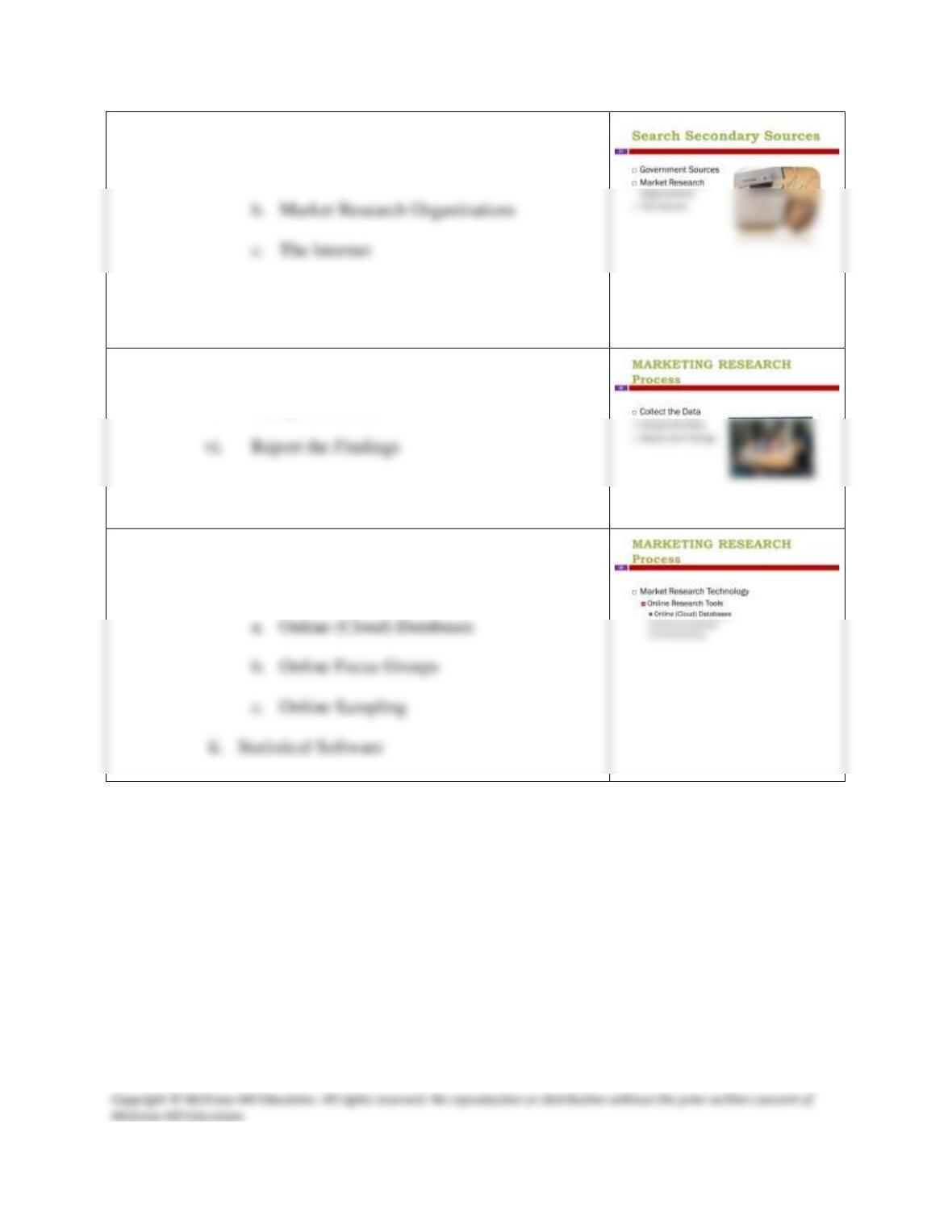
b. Nature of Data – What Kind of Data do
We Need?
c. Nature of Data Collection – How Should
the Data be Collected?
d. Information Content – What do We Need
to Know?
Chapter 04
Market Research Essentials
4-7
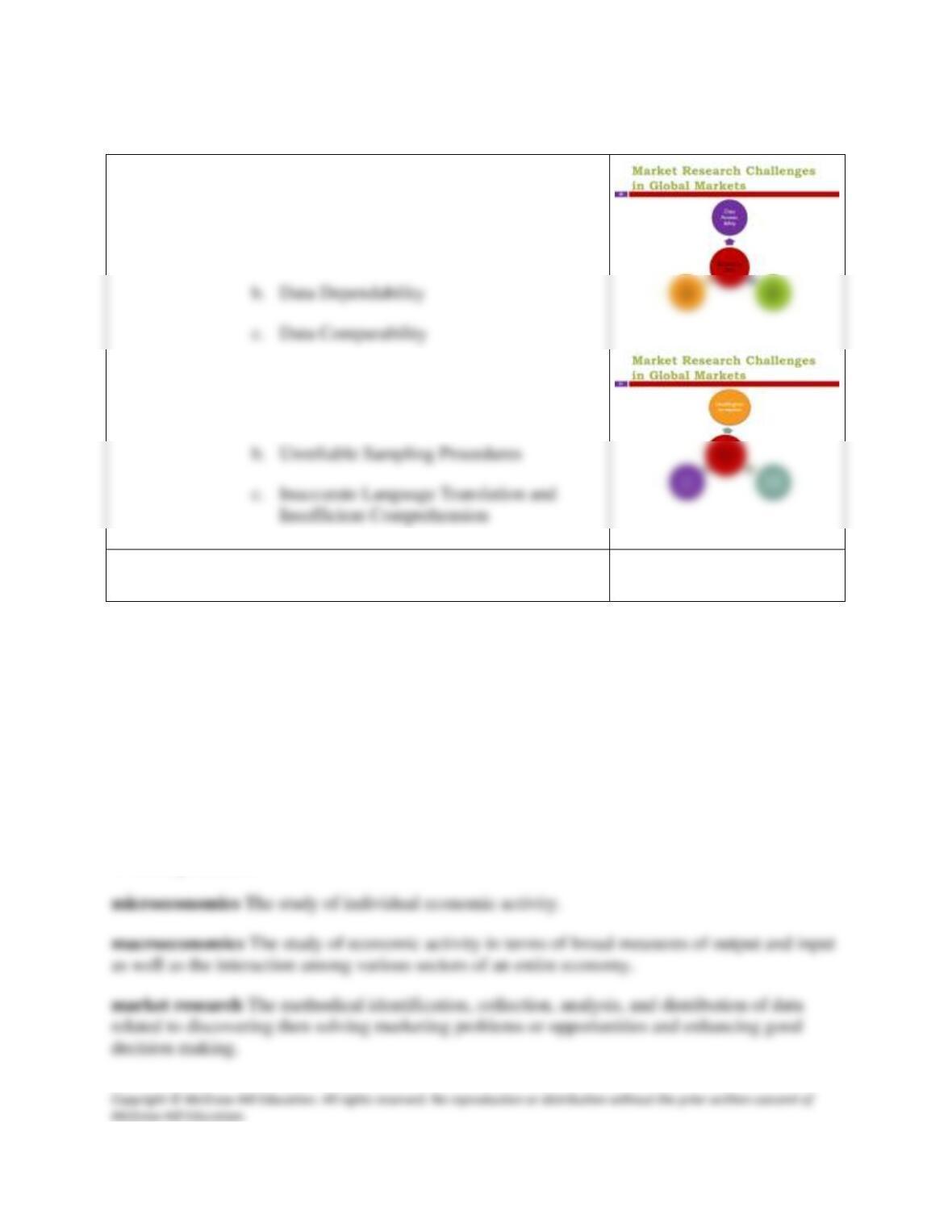
iii. Search Secondary Sources
a. Government Sources
d. Advantages and Disadvantages of
Secondary Data Sources
iv. Collect the Data
v. Analyze the Data
C. Market Research Technology
i. Online Research Tools
Chapter 04
Market Research Essentials
4-8
D. Market Research Challenges in Global Markets
i. Secondary Data
a. Data Accessibility
ii. Primary Data
a. Unwillingness to Respond
IV. SUMMARY
KEY TERMS
market information system (MIS) A continuing process of identifying, collecting, analyzing,
accumulating and dispensing critical information to marketing decision makers.
marketing intelligence The collecting, analyzing, and storing of data from the macro
environment on a continuous basis.
demographics The statistical characteristics of human populations, such as age or income, used
to identify markets.

Chapter 04
Market Research Essentials
4-9
management research deliverable The definition of what management wants to do with
marketing research.
research problem The definition of what information is needed to help management in a
particular situation.
exploratory research Research geared toward discovery that can either answer the research
question or identify other research variables for further study. It is generally the first step in the
market research process.
qualitative research Less structured research not meant to be used for statistical analysis that
can employ methods such as surveys and interviews to collect data.
quantitative research Research used to develop a measured understanding using statistical
analysis to assess and quantify the results.
focus group A qualitative research method that consists of a meeting (either in person or
increasingly online) of 6 to 10 people that is moderated by a professional who carefully moves
the conversation through a defined agenda in an unstructured, open format.
in-depth interview A qualitative research method that consists of an unstructured (or loosely
structured) interview with an individual who has been chosen based on some characteristic of
interest, often a demographic attribute.
open-ended questions Question format that encourages respondents to be expressive and offer
the opportunity to provide more detailed, qualitative responses

Chapter 04
Market Research Essentials
4-10
closed-ended questions Question format that encourages respondents to provide specific
responses.
census A comprehensive record of each individual in the population.
sample A subgroup of the population selected for participation in research.
APPLICATION QUESTIONS
1. Imagine you are the Vice President of Sales for a large security company and you have been
asked to put together a sales information system that collects, analyzes, interprets, and
distributes information from the sales force. How would you do it? What information would
you ask salespeople to collect?
2. As a market manager at Lenovo, what key information from outside the company would be
important to help in the design of a new laptop for small and medium-sized businesses
The following are examples:
Economic Conditions – Companies are keenly interested in the ability of their customers to
purchase products and services.
4-11
3. The marketing manager for Disney Cruise Line wants to know what demographic trends will
affect the cruise line business over the next five years. What kind of research is needed to
address this question? Conduct some secondary research and try to you identify two or three
important demographic trends that might affect the Cruise line business?
Exploratory Research – As the name implies, exploratory research is really about discovery.
There is are a variety of reasons for conducting exploratory research, including developing
4. The market research director for John Deere has just received a call from the marketing
manager in the company’s lawn tractor division. The manager wants to know how the new
advertising campaign is being received by current customers. Design a research study for
this research. Be sure to include a problem definition and research design.
Research problem – How is the new advertising campaign being received by current
customers?
5. The alumni director at your institution wants to know how to serve the alumni better. Design
a survey of no more than 10 questions that the alumni director can use to ask alumni about
their interest in getting more involved with their school.
The following are examples of a few questions:
Are you a current member of the alumni association?

Chapter 04
Market Research Essentials
4-12
BMW’s Road to Higher Customer Satisfaction: Just Tell Me What You Think!
Marketing research is often looked at by students (and by some professional managers) as a dull,
“academic” exercise that takes too much time, costs too much money, and doesn’t tell us
anything that we don’t already know. However, as this case illustrates, BMW saw an opportunity
to differentiate itself by more deeply understanding what service customers truly valued. It might
Questions for Consideration
1. Assuming BMW wanted to learn more about what customers value in their luxury driving
experience and then make decisions from that research, what kind(s) of market research
would you recommend that may improve their understanding?
As discussed in this chapter, there are several ways to categorize methods of market research
and a discussion of these using BMW’s case as an example may help students better
conceptualize the categories. Following are three categories discussed in the chapter and
discussion points for each related to the BMW case. As we’ll discuss across all three
questions, BMW applied a mix of descriptive and exploratory research, with primary and
secondary data, using qualitative and quantitate questions.
a. Descriptive, Exploratory, and Causal Research Categories.
i. Descriptive research, designed to help managers describe some
phenomenon, is often used in situations like BMWs. BMW was concerned
about two possible market changes 1) are there demographic changes in
who is buying luxury cars and 2) are the needs of our current customers
Chapter 04
Market Research Essentials
4-13
ii. Exploratory research is most helpful when not enough is known about a
topic to create a deep research plan. Often exploratory research helps
answer the question, “what are we missing?” In BMW’s case, the market
was shifting and, since no manufacturer had yet discovered what the new
needs were (remember, all luxury manufacturers’ satisfaction scores were
falling), it was an unknown what the needs were. Asking closed-ended
b. Secondary vs Primary Data Gathering.
i. Secondary data. While it’s conceivable BMW could have gathered some
data from secondary sources, for example the American Consumer
Satisfaction Index was already gathering data on consumer automotive
satisfaction, it is unlikely that such data would address underlying needs
that consumers have, but be more of evaluation of the consumers’
opinions of existing product features. If existing brand promises were not
being met, one would imagine BMW’s ongoing measurement of their

Chapter 04
Market Research Essentials
4-14
primary data also requires a much longer lead-time (months for primary
data vs. days for secondary data). But, with primary data gathering, BMW
had ultimate control over exactly what was asked, how it was asked, to
whom it was asked, and how the results are compiled and analyzed. Often
c. Quantitative vs. Qualitative.
i. Quantitative Questions. As discussed elsewhere in the book, consumers
are seeking value by addressing their needs and wants. When using
quantitative questions, market researchers are often forced to presume a
research plan that already is aware of the consumer’s needs. That is, the
quantitative question most often takes the form of a question about a
use a product or what problems (needs) they have. And, calculating out
the mean response to each question can be done in (or even performing t-
test or regressions on the data) seconds. However, as noted above, the
market researcher must already have a hypothesis about what the
quantitative question should ask in order to write an effective question.
BMW reduced the number of quantitative questions (shortening their
survey) in favor of a new technique of analyzing qualitative responses.
More discussion on this in question #3, below.
ii. Qualitative questions are a bit more forgiving in that the market
researcher can describe a scenario (e.g., driving to the grocery store) and
have the consumer respond about needs they have of their vehicle when
they shop for groceries. A classic example of this is the car cup holder. In
the 1980’s small plastic holders were sold that hung inside the car door.

Chapter 04
Market Research Essentials
4-15
coffee with them along for the drive. Discovering and addressing
2. BMW is facing the classic quality-quantity-cost tradeoff; the higher information quality they
seek (represented by more questions), the fewer responses they get or the higher their
research costs. Since BMW’s executives each have 25–to-30 years’ experience in the
automotive market, what would be the advantages and disadvantages of trusting their own
experience vs. spending more on market research?
When fielding a market research study, there are always tradeoffs that marketers must deal
with. Executives usually want answers quickly, so they can make decisions and move the
company forward, and often there is a wide range of topics/questions that could be covered
in a survey. This is especially true in BMW’s case as consumers’ needs and wants in the

Chapter 04
Market Research Essentials
4-16
especially if the reward is substantial, may introduce a bias where respondents may be more
likely to be lower income, or have more free time, or may even see rewards for surveys as a
form of gambling. While incentives can increase response rates, if improperly conceived they
may do so at the cost of validity.
Finally, one significant caution should be discussed. Many times, experienced executives feel
they are already familiar with what the customer needs. This is often due to executives,
having been successful so far, feeling that they know the market. BMW’s executives certainly
3. Often when problems develop like BMW is experiencing in their research data gathering, a
new (often technological) solution is developed to address the problem. What might be some
innovative ways to approach gaining both statistical significance (through higher response
rate) and deeper context (through open-ended qualitative data)?
As the case title–Just Tell Me What You Think–suggests, if we stepped outside of the general
limitations of data gathering, coding, analysis, and reporting to a concept where we could
just ask customers about their opinions and listen to what they say, we’d have a pretty
effective market research method. As discussed, BMW faced tradeoffs of needing to a lot of
a. BMW gathered both quantitative data (e.g., demographics, satisfaction levels,
products and services used, etc.) and combined those data with the free-from
opinions of the same customers. Doing so effectively mixed different types of
market research and offered many advantages. For example, the survey produced
descriptive information about the customers and allowed BWM to categorized

Chapter 04
Market Research Essentials
done on small samples due to the extensive effort of analyzing and interpreting
the qualitative data. However, in BMW’s case they were able to gather qualitative
SUGGESTED VIDEO
Dole: Analyzing the Marketing Environment (4:25 minutes)
Description: Dole is constantly analyzing the environment to make sure their marketing message
is on target.
1. What are the long-term consequences for Dole’s decision not to focus primarily on taste?
As Dole responds to the current consumer trends, it needs to keep its focus on what made the
company successful in the first place. Many times companies will lose focus on their