
Chapter 4: E-Business – Managing the Customer Experience
CHAPTER SUMMARY AND LEARNING OBJECTIVES
LO 4.1 Summarize the five opportunities offered by digital marketing.
Digital marketing offers many benefits to companies, such as global reach, personalization,
interactive marketing, right-time marketing, and integrated marketing.
LO 4.2 List the four major forms of e-business in the business-to-business market.
The four major forms of e-business in the B2B market are EDI, extranets, intranets, and private
exchanges.
LO 4.3 Explain three reasons consumers prefer to shop online.
LO 4.4 Summarize five challenges faced by online marketers and consumers.
LO 4.5 Summarize four factors that influence the success of an e-commerce website.
An e-commerce site must attract visitors to the website and eventually convert them to buyers.
Factors that influence the success of an e-commerce site include user experience, product offering,
checkout process, and revenue maximization strategies.
LO 4.6 Describe the various methods for measuring the effectiveness of an e-commerce
LO 4.7 Given an example of an online marketing activity, calculate the activity’s
effectiveness.
The ability to properly calculate and track measurements of e-commerce website effectiveness
allows digital marketers to optimize their websites and online advertising campaigns.
Chapter 4: E-Business – Managing the Customer Experience
ACTIVATOR EXERCISE: The influence of e-business
Purpose: To orient students to the impact and importance of e-business as a component of
marketing.
Time: 20–40 minutes, depending on format.
Activity: Ask students to journal the following questions:
Without the Internet, how would you go about simple activities such as:
• Viewing a video of your favorite musical artist
Now, have students discuss their answers in small groups.
Possible discussion questions for class: How much extra time and energy would be required
to do these activities without the Internet (if you could do them at all)? Imagine a world before
we all had online access, how much would you pay just for the ability to handle the above
activities online—so that you could save all that time and energy?
Result: Students will have to contemplate the obvious hassles of handling these tasks without
Key takeaway: Internet technology has changed our lives in many positive ways. E-business
can be built around those positive impacts to better serve customers in the future.
Chapter 4: E-Business – Managing the Customer Experience
LECTURE OUTLINE
4-1 Opportunities Offered by Digital Marketing
Digital marketing offers countless opportunities to reach consumers. This radical departure from
traditional brick-and-mortar stores provides the following five benefits to contemporary
Global Reach
The Internet eliminates the geographic limitations of local business and gives smaller firms a
wider audience.
Discussion question: Has anyone watched a film or show by purchasing from a nontraditional
outlet?
Example: Purchasing Daniel Tosh’s stand-up comedy through CC:Stand-Up|Direct.
Personalization
Web pages can be tailored for each individual customer.
Example: Netflix makes viewing recommendations by using a customer’s past orders, as
Interactive Marketing
Marketers use a concept called interactive marketing to deliver more relevant marketing
messages to customers based on event triggers.
Discussion question: Who uses an app that sends them push notifications based on your
location, a particular time of day, or some other trigger?
Right-time Marketing
Marketers want to reach the right person, through the right channel, at the right moment.
Chapter 4: E-Business – Managing the Customer Experience
Integrated Marketing
The Internet amplifies a company’s offline promotional activities to create a consistent,
customer-oriented promotional message.
PRESENTATION VISUAL: MindTap exhibit 4.2 showing the opportunities offered by
online marketing
Capability
Description
Example
Global reach
The ability to reach anyone
connected to the Internet
anywhere in the world.
A local retailer of antiques can now market and sell its
goods worldwide.
events.
Classroom activity: In groups, have students brainstorm two additional (and specific)
examples of each of the five opportunities offered by online marketing.
Key Takeaway: Businesses taking advantage of digital marketing opportunities enhance
options for their customers and increase sales for themselves.
Estimated time: 20–30 minutes
4-2 E-Business in the B2B Market
Business-to-business (B2B) transactions are those that happen between organizations, and
increasingly technology is used to facilitate these transactions. Although most people are
There are four major forms of e-business in the B2B market.
Chapter 4: E-Business – Managing the Customer Experience
Electronic Data Interchange (EDI)
EDI is one of the oldest applications of technology for business transactions. It includes direct,
computer-to–computer exchanges of price quotations, purchase orders, invoices, and other
Extranets are secure networks used for e-business and accessible through the firm’s website
by external customers, suppliers, or other authorized users.
Intranet
Intranets are secure internal networks that help companies share information among
employees, no matter the number or location. This allows employees across the globe the
ability to:
• View and share documents stored on company servers.
Discussion question: Has anyone used an intranet at work? What type of things could you
work on using that intranet that you cannot work on when not logged in to the company
network?
Private Exchanges
Private exchange is a secure website where a company and its suppliers share all types of
data, from product design through order delivery.
Note: Students might initially be confused at how this differs from the previous forms of
business. The key difference is that a private exchange integrates aspects of the company
extranet and intranet, putting them together on one specialized site.
Key Takeaway: Business-to-business transactions, which typically involve more steps
than consumer purchases, can be much more efficient when using the Internet.
Estimated time: 10–15 minutes
Chapter 4: E-Business – Managing the Customer Experience
4-3 Benefits of Online Shopping
Business-to-consumer (B2C) online shopping continues to grow quickly. In 2015, online sales
in the United States totaled $335 billion, and that number is expected to grow to $523 billion by
2020.v
Classroom activity: First, have students individually list all of the online purchases they have
made in the last 2–3 months. Then have them think about why they purchased those items
online as opposed to at a physical store.
Then have students share their answers in a small group.
Competitive Pricing
Many of the best deals on products, such as airfares and hotels, can be found on the Internet.
The web is an ideal method for savvy shoppers to compare prices from dozens—even
hundreds—of sellers.
Example: At PriceGrabber.com, you can specify the type and size of monitor you’re
Classroom activity: Divide students into groups and assign them a specific product. Example
might be:
The latest iPhone
Chapter 4: E-Business – Managing the Customer Experience
Access and Convenience
A second important factor is shopper convenience. Cybershoppers can search for and order
Discussion question: How many people have an account—including stored payment
information—with:
On what other e-commerce sites do you have accounts with stored payment information for
easy checkout?
Personalized Service
Although online shopping transactions often operate with little or no human interaction,
successful B2C companies know how important personalization is to a quality shopping
experience.
Example: When you buy a product at Amazon and register with the site. The site welcomes
Discussion question: Who has ever been at an e-commerce website where the chat box
popped up in the corner. Who has utilized that to get a question answered? What site was it?
Key Takeaway: Online shopping provides several advantages over shopping in
traditional brick–and-mortar stores, including competitive pricing, access and
convenience, and personalized service.
Estimated time: 25–35 minutes
4-4 Challenges Faced by Online Marketers and Consumers
E-business poses some challenges, including safety of online payment, privacy issues, frauds
and scams, site design and customer service, and channel conflicts.
Safety of Online Payment
Chapter 4: E-Business – Managing the Customer Experience
that indicates they are at a protected website. In addition, the beginning of the web address will
usually change from HTTP to HTTPS.
Classroom activity: Go to a site like Amazon or Walmart, then show how the URL has “https”
Many online shoppers are switching to payment services such as PayPal to speed checkout
Discussion question: Who has a PayPal account? Who has a Venmo account?
What other types of payment service accounts do you have that allow you to pay in multiple
places with that one account?
Why do you trust the provider of that payment service?
Privacy Issues
Marketing research indicates privacy as one of the top concerns of many Internet users. Most
consumers want assurances that any information they provide won’t be sold to others without
Classroom activity: In small groups, have students visit a number of e-commerce sites. In this
case, they can skip the major sites such as Amazon, Target, and Walmart. They should look for
sites from smaller brands or even local businesses.
Ask students to look for the various logos or badges on the website that may indicate security.
Which ones seem to be most common?
Fraud and Scams
Fraud is another impediment to the growth of e-business and digital marketing.
Chapter 4: E-Business – Managing the Customer Experience
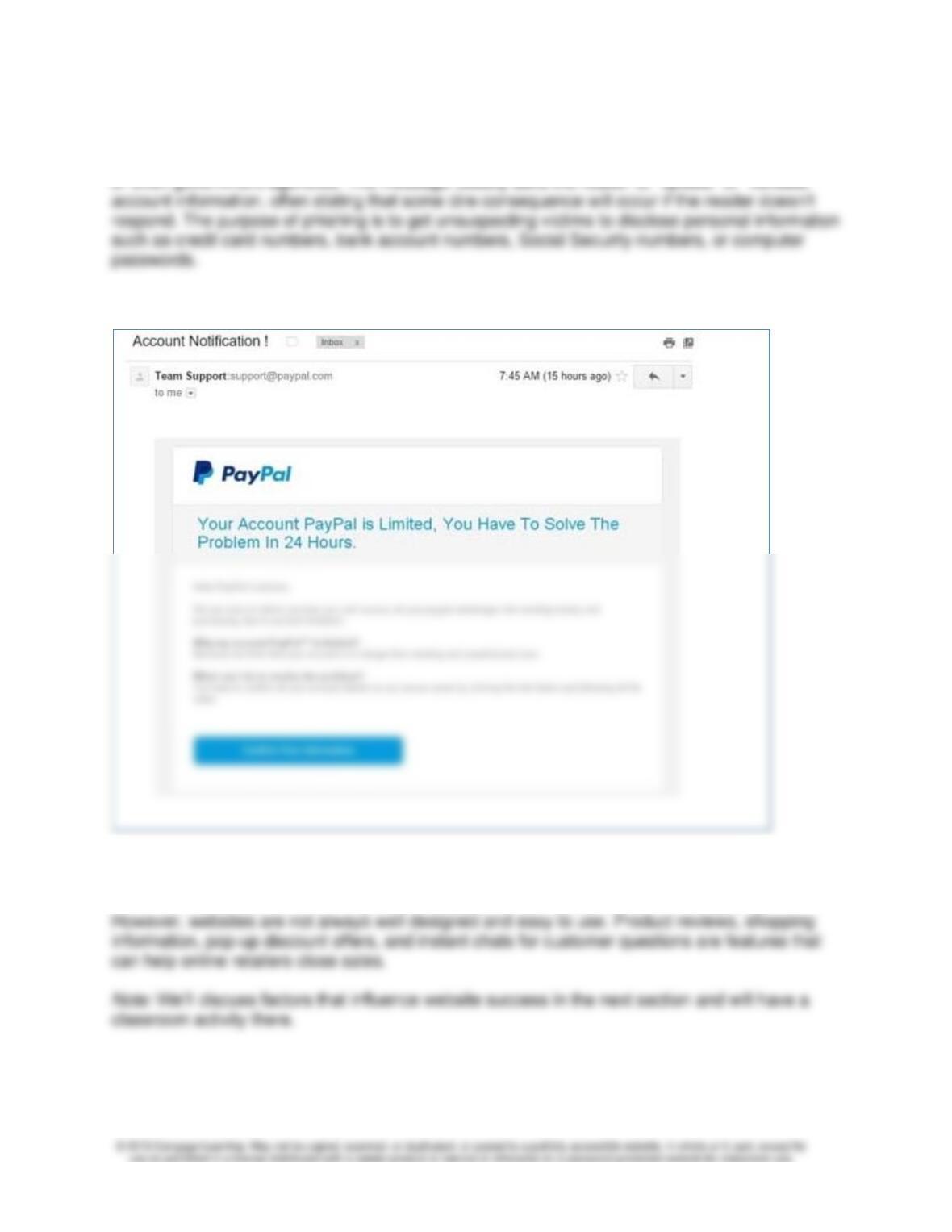
One type of Internet fraud is called phishing. It is a high-tech scam that uses e-mail or pop-up
messages that claim to be from familiar businesses such as banks, Internet service providers,
PRESENTATION VISUAL: MindTap Photo of PayPal phishing e-mail
Site Design and Customer Service
For firms to attract and keep customers, digital marketers must meet buyer expectations. For
instance, customers want to find products easily and have questions answered quickly.
Channel Conflicts
Conflicts between producers, wholesalers, and retailers are called channel conflicts.
Manufacturing companies spend time and money nurturing relationships with their distribution
Chapter 4: E-Business – Managing the Customer Experience
partners. But when a manufacturer uses the Internet to sell directly to consumers, it can create
Classroom activity: In small groups, have students use Expedia to search for a hotel room in
Maui for a particular date. Have them search for rooms offered by one of the major brands
(Hyatt, Sheraton, Marriott, etc.) and note the prices for each type of room.
Then, have them search for the same dates and location on that hotel’s corporate website.
Key Takeaway: Both businesses and consumers can help address the key challenges
caused by today’s technology.
Estimated time: 25–35 minutes
4-5 Factors That Influence E-Commerce Success
An e-business website can serve many purposes. It can provide information and news,
entertain, and/or sell goods and services.
An e-commerce site can get thousands, or even millions, of visitors and still fail if those visitors
never become customers. To increase their chance of success, e-commerce marketers often
focus on four factors that influence their ability to get conversions and grow a profitable site.
User Experience
User experience (UX) is the overall experience customers have when visiting a website. It
includes the look and feel of the site, the ease of finding what visitors want, and even the
loading speed of the pages.
Product Offering
Chapter 4: E-Business – Managing the Customer Experience
Example: A general e-commerce site such as Amazon.com carries millions of items and
aims to be the primary destination for just about any online shopper.
Checkout Process
Once a customer has browsed your site and added a product to their shopping cart, the
conversion process has just begun. A number of research studies indicate that 55–80% of
customers abandon their shopping cart before actually checking out. Reasons include:
1. Checkout process was too long or complicated
2. Website required creation of an account
Revenue Maximization
It can be hard for an e-commerce website to be profitable if most customers only purchase one
item and perhaps never return to the website. Revenue maximization strategies are designed
to:
• Increase the size of each customer transaction
Classroom activity: Divide students into groups and assign them an e-commerce website to
analyze. Options include Apple, Gap, Sephora, Reef, and other major brands.
Ask students to do an audit of the site according to the four success factors discussed in this
section. They should describe what the site does well and what could be improved.
Questions to consider:
Is the site simple to navigate?
Chapter 4: E-Business – Managing the Customer Experience
When you arrive at the page, is it clear where you are, what is offered, and what you should
likely do next?
Are product descriptions clear and detailed?
Are there reviews or other testimonials that increase credibility?
Does the checkout process seem simple and transparent? Or does it have many steps, require
After students have analyzed the site, have each group present their findings in six minutes or
less. If possible, allow them to project the live site in class so they can show classmates their
findings.
Key Takeaway: To increase their chance of success, e-commerce marketers often focus
Estimated time: 10–50 minutes (depending on whether you facilitate the classroom activity)
4-6 Assessing the Effectiveness of an E-Commerce Website
Measuring the effectiveness of an e-commerce website is tricky and requires various methods
to provide a complete picture of site performance. The very definition of success for a particular
online retailer will depend on their industry, target audience, company size, and a host of other
factors. With that said, there are some measurements that are consistently used by online
marketers across industries.
Once visitors are on the site, it’s important to track engagement, or how much time users spend
on a site and which pages they visit. Google Analytics is a tool for tracking these and other site
usage statistics, which provide valuable information for web designers looking for opportunities
to upgrade the site.vii