Chapter 3: The Marketing Environment, Ethics, and Social Responsibility
Ethics in Distribution
Two ethical issues influence a firm’s decisions regarding distribution strategy:
1. What is the appropriate degree of control over the distribution channel?
2. Should a company distribute its products in marginally profitable outlets that have no
alternative source of supply?
Example: Should marketers build retail stores in low-income areas or continue to
operate in a declining rural market?
Discussion question: Pose this ethical question to students . . .
What do you believe are the ethical considerations in this case?
Ethics in Promotion
Promotion raises many ethical questions because it is the most direct link between a firm and its
Discussion question: While the FTC is tasked with oversight of false claims in advertisements,
many marketers might still try to push the envelope in their claims.
What are some advertisements you’ve seen recently that might push the ethical boundaries of
truth in advertising?
Key Takeaway: Understanding ethical issues as they relate to the marketing mix is
Estimated time: 15–25 minutes
Chapter 3: The Marketing Environment, Ethics, and Social Responsibility
3-9 Social Responsibility
While ethical business practices are vital to a firm’s long–term survival and growth, social
responsibility raises the bar even higher. In marketing, social responsibility involves accepting
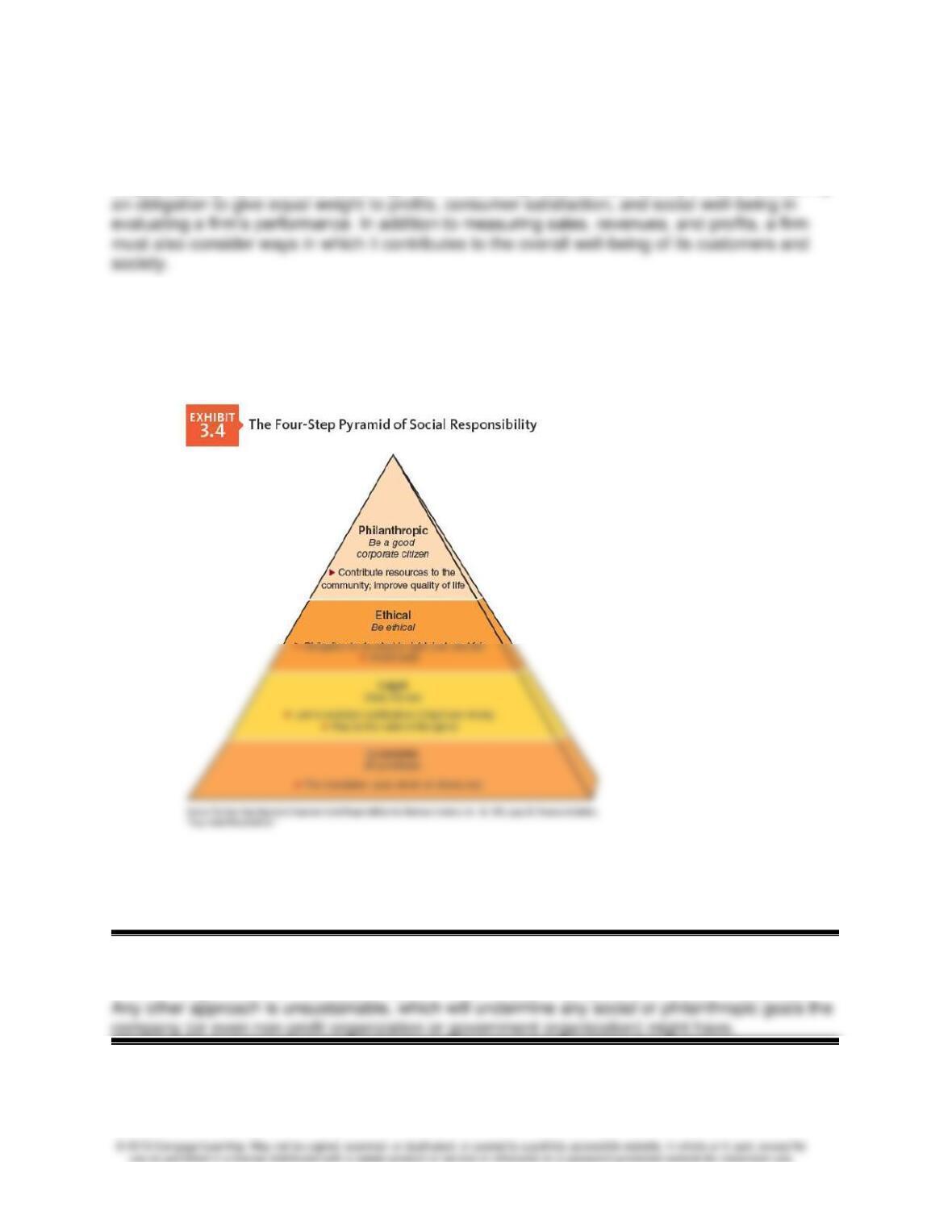
The four dimensions of social responsibility are economic, legal, ethical, and philanthropic.
PRESENTATION VISUAL: MindTap Exhibit 3.4 showing the four-step pyramid of social
responsibility
The first dimension of social responsibility is for companies to be economically responsible. This
economic responsibility serves as the foundation for the company before it can consider any
social responsibilities.
Discussion question: Why must a company first be economically responsible?
Answer: Organizations must be profitable in order to pay employees and remain in business.
Legal responsibility is the organization’s obligation to fulfill its economic goals by operating
within the legal requirements imposed by local, state, and federal governments.
Chapter 3: The Marketing Environment, Ethics, and Social Responsibility
Ethical responsibilities involve doing what is right, for example, paying fair wages, using
sustainable resources, and treating others fairly.
Discussion question: What companies do you purchase from specifically because of their
stance on social responsibility? What is it, specifically, that appeals to you about their stance
and/or activities in this area?
Key Takeaway: Organizations that sponsor socially responsible programs not only help
society but may also develop goodwill, which helps the bottom line in the long run.
Estimated time: 10–25 minutes
Chapter 3: The Marketing Environment, Ethics, and Social Responsibility
LEARN IT TODAY . . . USE IT TOMORROW
VIGNETTE AND ACTIVITY
The opening vignette for Chapter 3 discusses Progressive Insurance, a company that’s
continually forced to innovate because of the fast-changing marketing environment in which
they operate. The vignette also introduces students to Progressive’s approach to transparency
and focus on ethics.
Note: Answers to the chapter-ending activity can be discussed in class after the activity
due date.
Progressive Insurance
As Progressive Insurance continues to monitor its external environment, they must make
Decision 1
Over the last six months, Progressive has noticed a decline in applications for new policies. The
Option #1—Progressive Value. This is full coverage auto insurance, but excludes items like
rental car reimbursement and roadside assistance. This basic level insurance includes
comprehensive, collision, and liability coverage, but at lower limits than most insurance plans.
This plan appeals to cost-conscious buyers looking for a basic auto insurance policy.
Answer to Decision 1
#1—Correct. Unemployment rises during recessions and affects the way consumers behave.
Consumers may eliminate expensive gym memberships, cable TV, and eating out at
restaurants. During recessions, consumers focus on basic, functional products and marketers
Chapter 3: The Marketing Environment, Ethics, and Social Responsibility
Decision 2
As the baby boom generation reaches retirement age, their driving habits are likely to change.
Once retired, they will no longer be driving to work every day and the number of miles they drive
will probably decrease when compared to younger drivers. In addition, most retirees find
themselves on a fixed income and actively seek discounts to help them spend less. Progressive
executives are looking at offering a product targeted specifically toward retired drivers. Which
one of the following products would be best?
Option #1 Pay-As-You-Drive (PAYD) pricing model. Much like pay-as-you-go or prepaid cell
Answer to Decision 2
#1—Correct. The Pay-As-You-Drive (PAYD) pricing model offers consumers more control over
their insurance costs, which is helpful for retirees on a budget. In addition, less driving will lead
to less accidents and a reduction in claims. This model is already in use by several insurance
companies.
Decision 3
Progressive has seen a recent increase in claims in a high crime area of St. Louis, Missouri. A
majority of the claims were car break-ins that occurred while policy holders were at work. What
is troubling about many of the claims is that none of the policy holders had indicated working in
the high crime area when they applied for auto coverage through Progressive. As a result, the
insurance application. Progressive executives would like to determine an accurate and efficient
Chapter 3: The Marketing Environment, Ethics, and Social Responsibility
way to determine which policy holders’ premiums to raise. Which of the following is the best
option?
Option #1—Survey policy holders, asking for updated policy information including home
address, work address, and contact phone numbers. Depending on customers’ responses,
Progressive could then raise the insurance premiums of customers working in the high crime
area.
Answer to Decision 3
#1—Correct. Although not highly efficient, this method is ethical. It is still possible for policy
holders to be dishonest about where they work; however, with this method, Progressive remains
open and honest about their intentions.
Decision 4
Progressive has long been involved with socially responsible efforts, such as donating to
charities and implementing energy conservation measures within their offices. However,
Progressive has recently received criticism. While their recent profits were about $1.3 billion,
some believe its social responsibility efforts are weak compared to those of competitors. As a
result, Progressive’s CEO is debating between two social responsibility campaigns. Which of
the following should she choose?
Option #1—Recent flooding in California has resulted in an estimated $1 billion price tag to
repair roads, dams, and other critical infrastructure. Further, California’s governor says this is on
Answer to Decision 4
Chapter 3: The Marketing Environment, Ethics, and Social Responsibility
#1—Incorrect. Although donating $2 billion to California’s road, dam, and infrastructure repair is
a virtuous cause, the donation would leave Progressive unprofitable. Progressive’s profit was
$1.3 billion and committing $2 billion would leave Progressive $700 million in the red. In thinking
Chapter 3: The Marketing Environment, Ethics, and Social Responsibility
ADDITIONAL HOMEWORK/CLASSROOM ACTIVITIES
Types of Competition
Purpose: To help students better understand different sources of competition.
Background: The ability to understand and identify direct and indirect competition can give
students a key competitive advantage in the job market. This exercise is designed to help them
develop that skill.
Estimated Class Time: About 10 minutes
Exercise: Divide your students into small teams. Provide the students a product, company, or
category.
Examples might be energy drinks, Ford trucks, Facebook Messenger, and Target.
Challenge the teams to brainstorm examples of direct and indirect competition, with a two-
minute time limit on each category. After you call time, ask one person from each group to bring
Questions for Reflection:
• Why does the source of competition matter?
Government Regulation
Purpose: To provide context for the current debate regarding governmental regulation on
outsourcing.
Background: Most U.S. citizens do not like the idea of American jobs crossing their borders,
Relationship to Text: Government Regulation, Ethical Issues in Marketing
Estimated Class Time: About 10 minutes
Chapter 3: The Marketing Environment, Ethics, and Social Responsibility
Exercise: Divide the students into two groups. One group can discuss the need for legislation
on outsourcing while the other group can elaborate on the disadvantages of government
intervention in this matter.
Question for Reflection:
• Given that outsourcing is global, who should be responsible for fair trade practices?
Why?
Ethics and Legality
Purpose: To clarify the difference between ethical and legal behavior.
Background: Many students have never thought about laws as the “floor” for ethical behavior;
Relationship to Text: Ethical Issues in Marketing
Estimated Class Time: About 10 minutes
Exercise: Ask your class to identify examples of the following behaviors that they have read or
heard about in the news. You might find it helpful to present the categories on the board as
quadrants, and to fill each quadrant with the examples that your students surface.
• Illegal and unethical behavior (e.g., embezzling money, price discrimination,
sexual harassment)
Questions for Reflection:
• What tools could companies use to ensure that they market in an ethical manner?
• How involved should the government be in this arena? Are there limits to the
Chapter 3: The Marketing Environment, Ethics, and Social Responsibility
Internet Research Activity—Economic and Social–Cultural Changes
The U.S. Census Bureau projects what the U.S. population will look like in the next 15–25
years. Visit the Census Bureau’s website and compare its projections of the U.S. population to
current figures. What will the U.S. population look like in the future? How is it different from the
current population? List two or three products or industries you feel will benefit from future
Chapter 3: The Marketing Environment, Ethics, and Social Responsibility
KEY TERMS
Competitive environment: Where marketers of directly competitive products and marketers of
substitute products compete for consumer purchases.
Economic environment: Factors that influence consumer buying power and marketing
strategies.
Gross domestic product (GDP): The sum of all goods and services produced by a nation in a
year.
Inflation: Rising prices caused by some combination of excess demand and the increasing cost
of raw materials, labor, and/or other factors of production.
Unemployment: The proportion of people in the economy who are actively seeking work but do
not have jobs.
Discretionary income: The amount of money people have to spend after buying necessities
such as food, clothing, and housing.