Chapter 03
Elements of Marketing Strategy, Planning and Competition
3-1
LEARNING OBJECTIVES
LO 3-2 Understand the conditions required for successful marketing planning, that marketing
LO 3-3 Identify various types of organizational strategies.
LO 3-5 Use the framework provided for marketing planning, along with the content in future
chapters, to build a marketing plan.
CHAPTER OUTLINE
I. VALUE IS AT THE CORE OF MARKETING
Chapter 03
Elements of Marketing Strategy, Planning and Competition
3-2
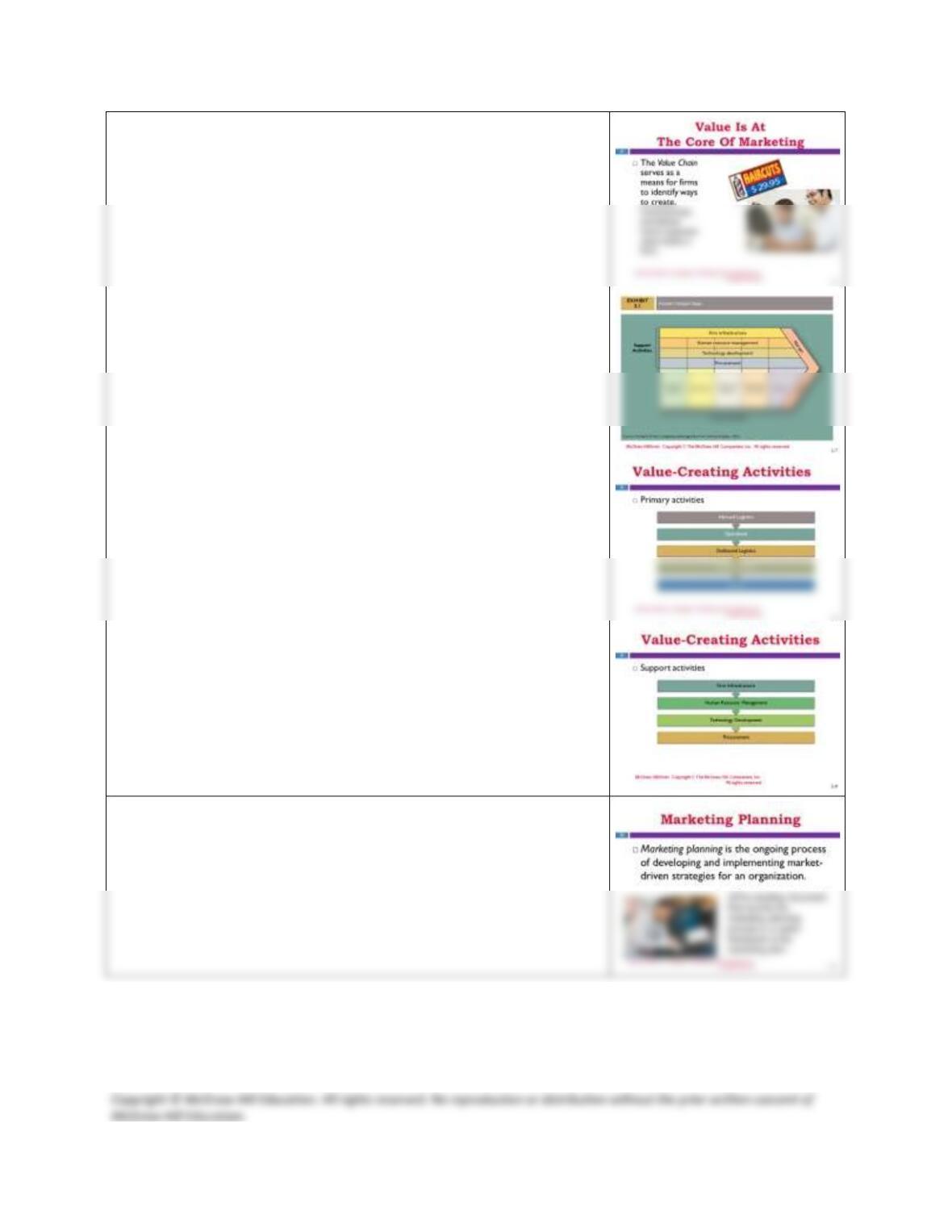
A. The Value Chain
B. Planning for the Value Offering
Chapter 03
Elements of Marketing Strategy, Planning and Competition
3-3
II. MARKETING PLANNING IS BOTH STRATEGIC AND
TACTICAL
III. ELEMENTS OF MARKETING PLANNING
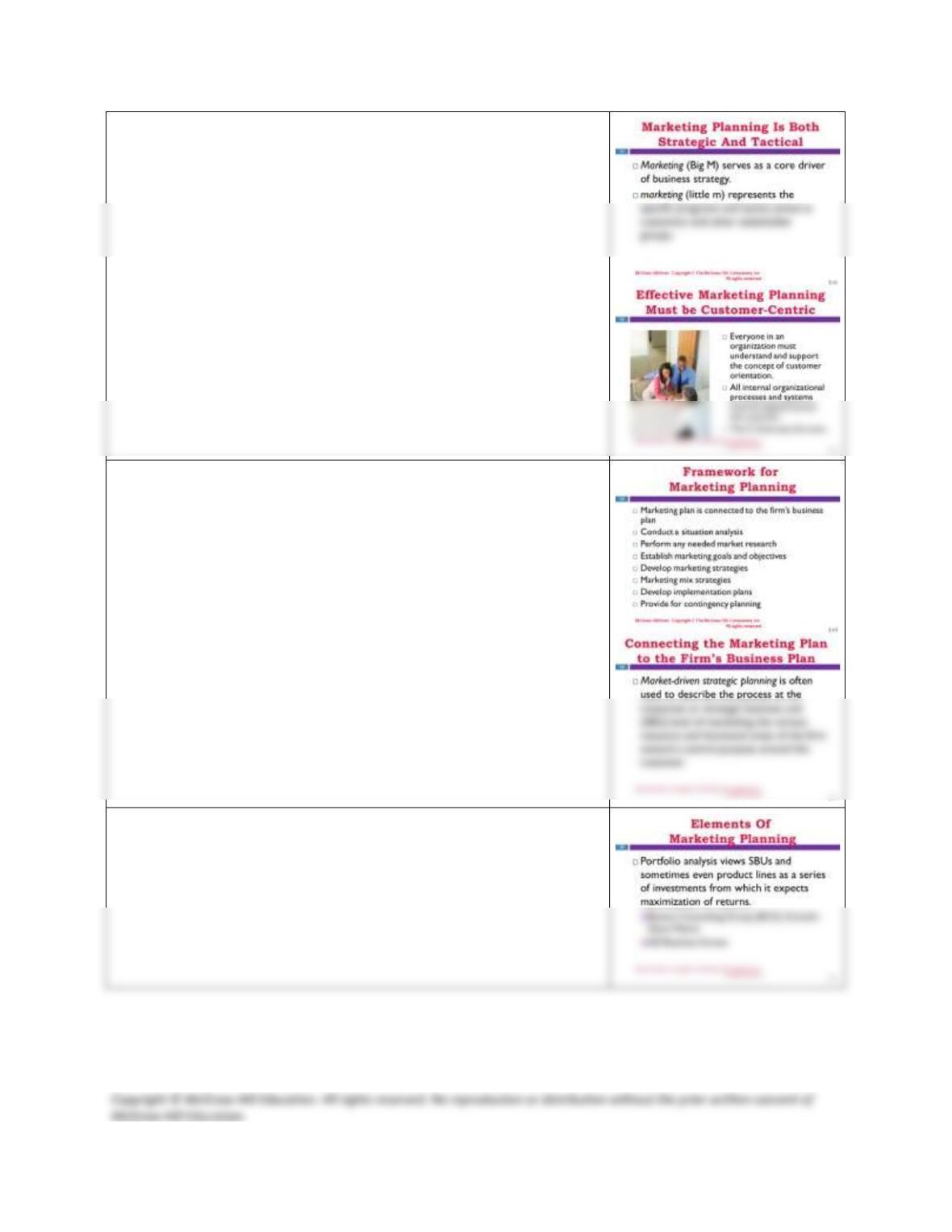
A. Connecting the Marketing Plan to the Firm’s Business
Plan
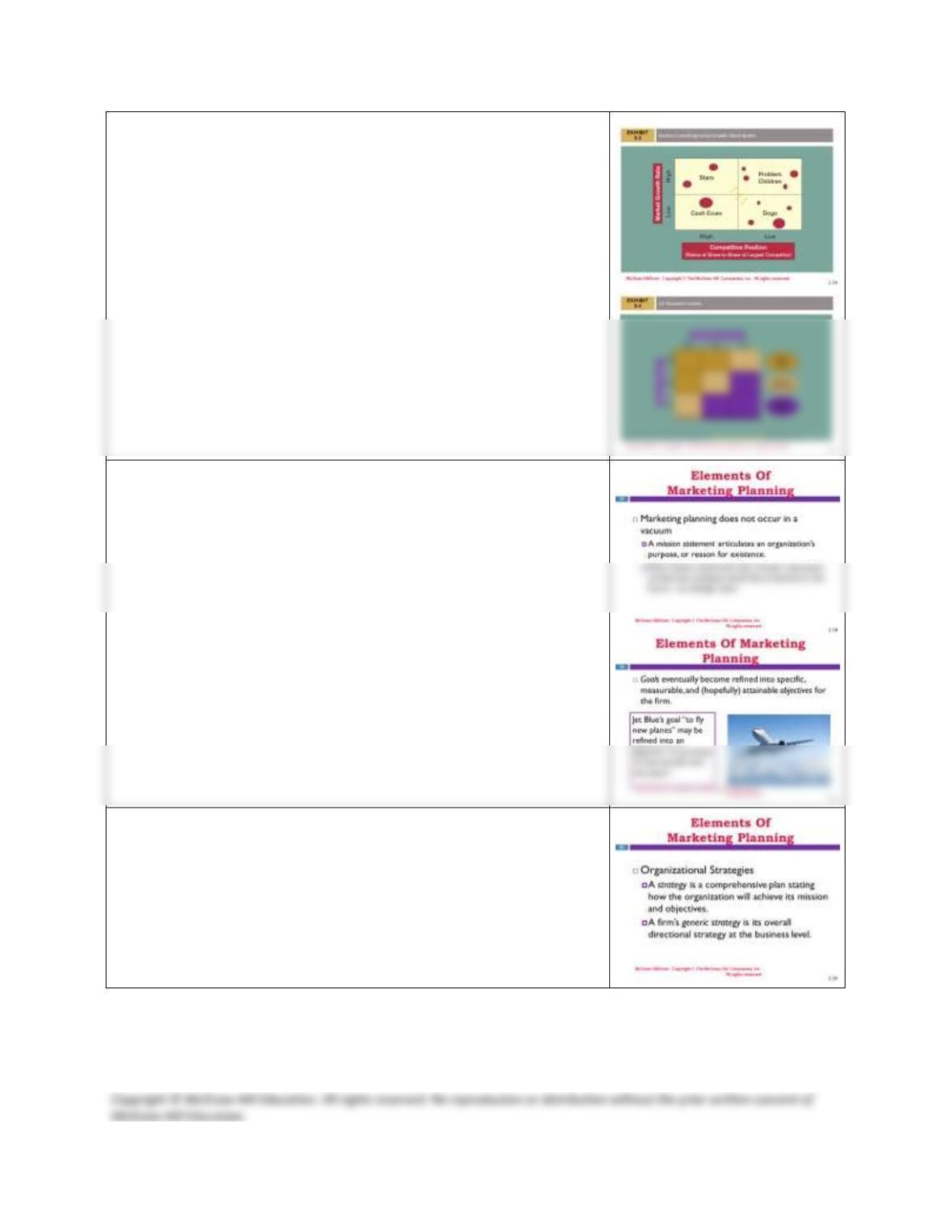
i. Portfolio Analysis
ii. Functional Level Plans
Chapter 03
Elements of Marketing Strategy, Planning and Competition
3-4
B. Organizational Mission, Vision, Goals, and Objectives
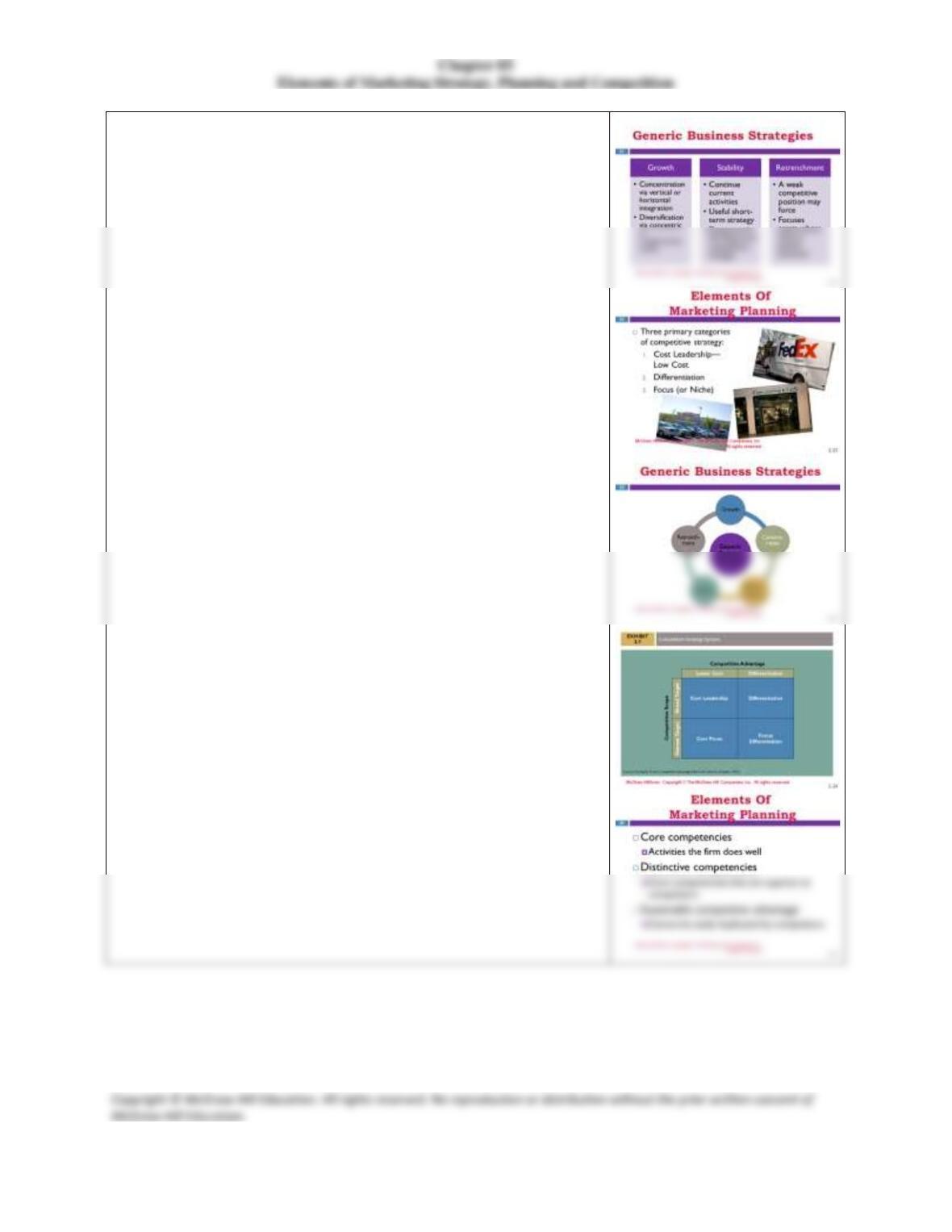
C. Organizational Strategies
3-5
Chapter 03
Elements of Marketing Strategy, Planning and Competition
3-6
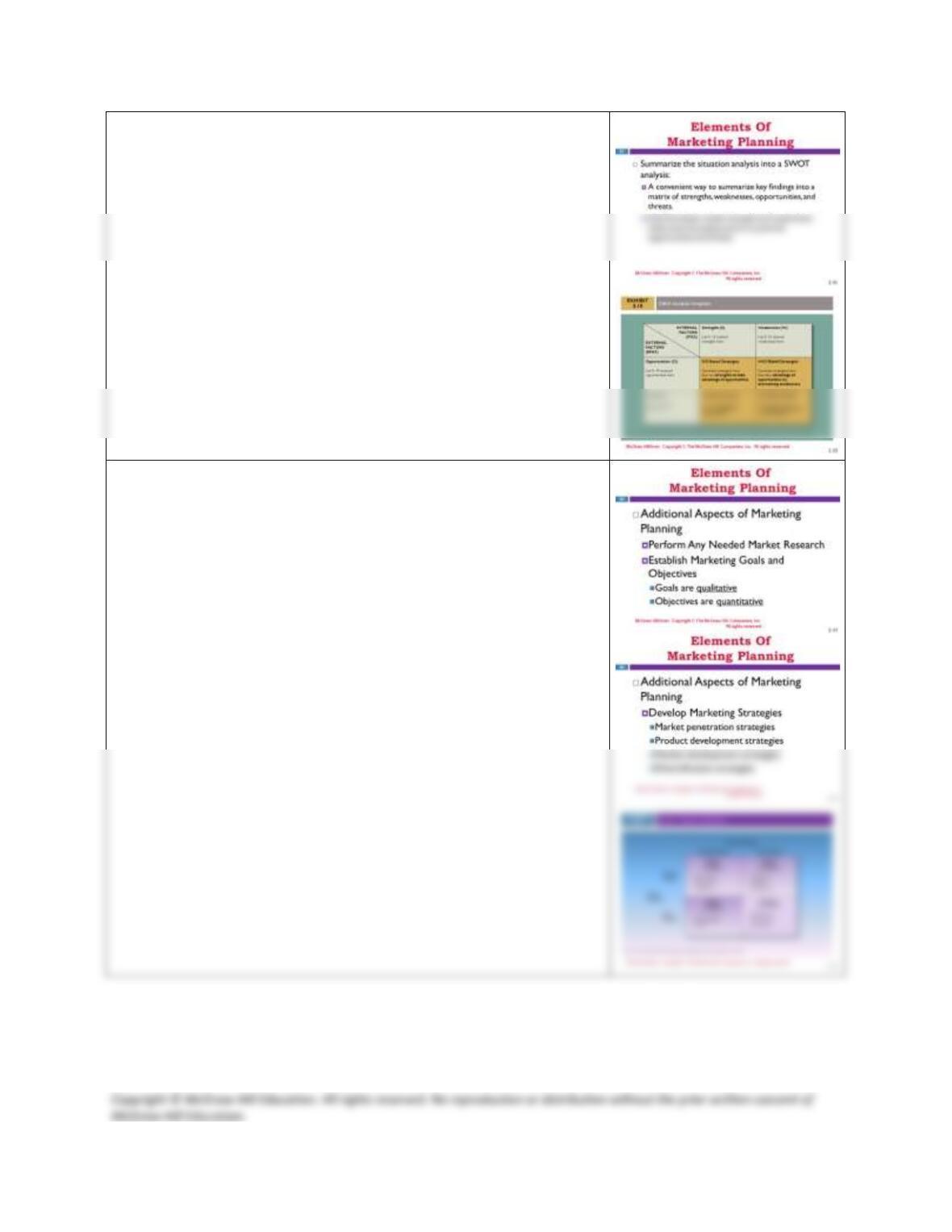
D. Situation Analysis
i. Macro-Level External Environmental Factors
ii. Competitive Environmental Factors
iii. Internal Environmental Factors
Chapter 03
Elements of Marketing Strategy, Planning and Competition
3-7
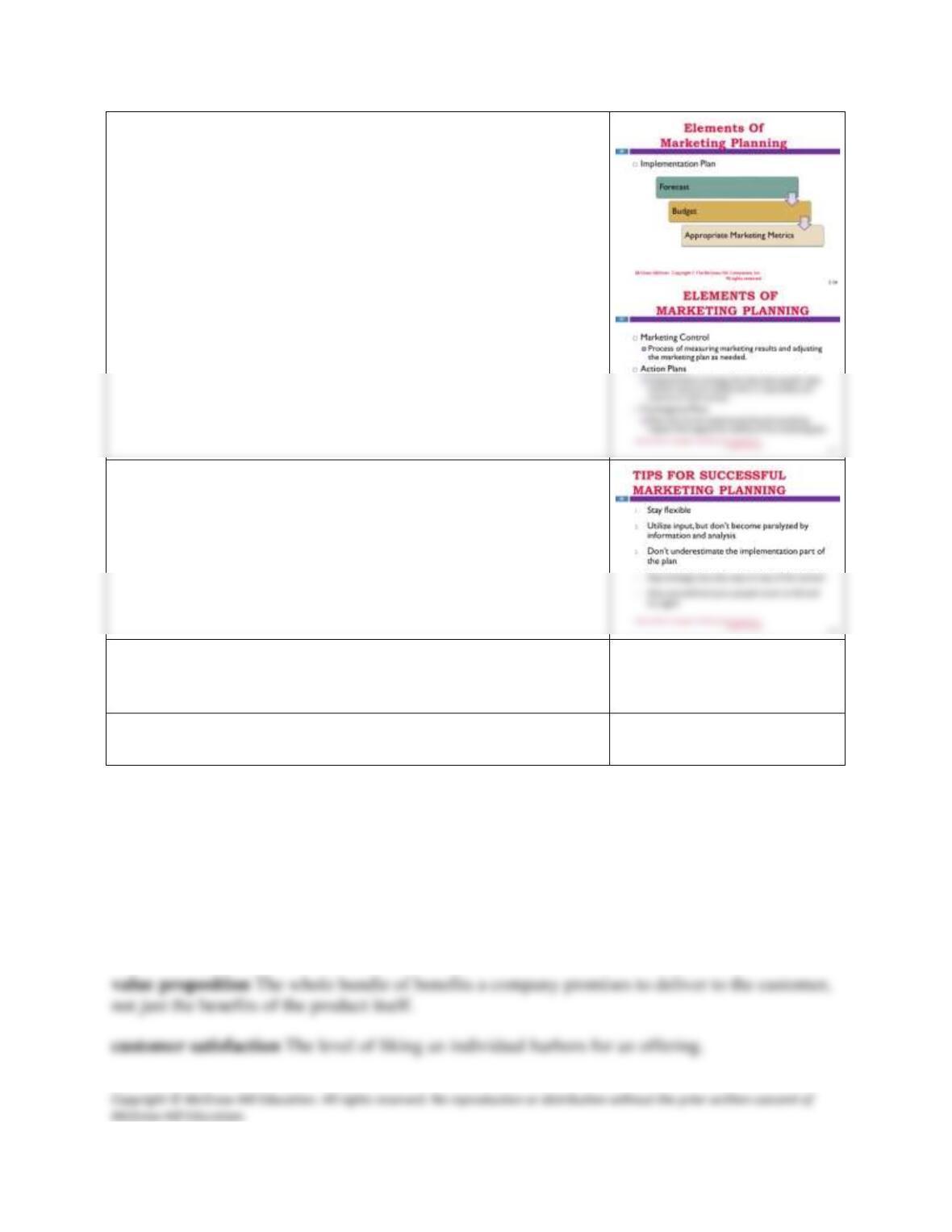
iv. Summarize the Situation Analysis into a
SWOT
E. Additional Aspects of Marketing Planning
i. Perform Any Needed Market Research
ii. Establish Marketing Goals and Objectives
iii. Develop Marketing Strategies
Chapter 03
Elements of Marketing Strategy, Planning and Competition
3-8
iv. Create an Implementation Plan Including
Forecast, Budget, and Appropriate Marketing
Metrics
v. Develop Contingency Plans
IV. Tips for Successful Marketing Planning
V. VISIT THE APPENDIX FOR A MARKETING PLAN
EXAMPLE
VI. SUMMARY
KEY TERMS
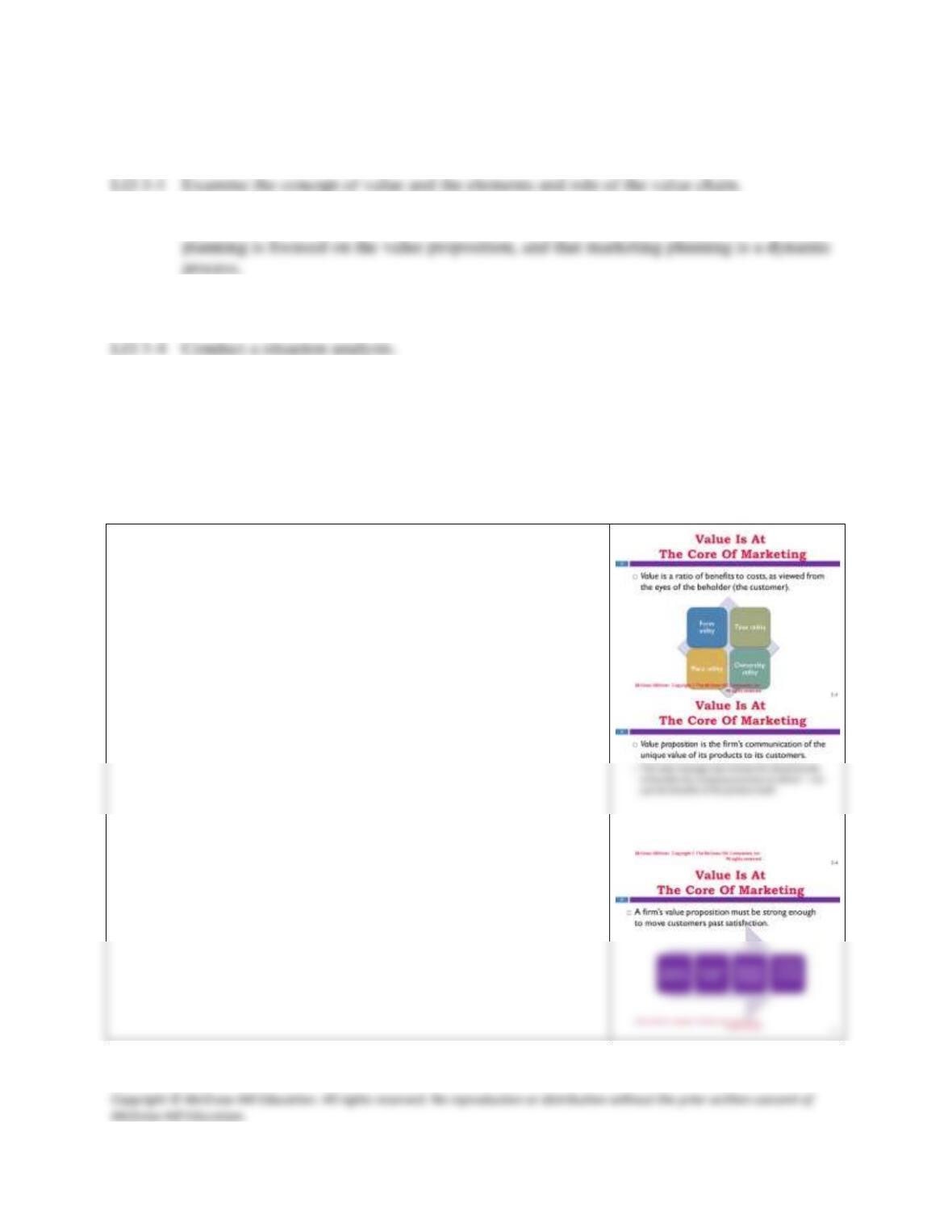
benefit The advantageous outcome from the advantage found in a product feature.
utility The want-satisfying power of a good or service. There are four types of utility: form
utility, time utility, place utility, and ownership utility.
Chapter 03
Elements of Marketing Strategy, Planning and Competition
3-9
customer loyalty A customer’s commitment to a company and its products and brands for the
long run.
marketing plan The resulting document that records the marketing planning process in a useful
framework.
market-driven strategic planning The process at the corporate or strategic business unit (SBU)
level of a firm that acts to marshal the various resource and functional areas toward a central
purpose around the customer.
maximization of returns.
Boston Consulting Group (BCG) Growth-Share Matrix A popular approach for in-firm
portfolio analysis that categorizes business units’ level of contribution to the overall firm based
on two factors: market growth rate and competitive position.
GE business screen A popular approach for in-firm portfolio analysis that categorizes business
Chapter 03
Elements of Marketing Strategy, Planning and Competition
3-10
functional-level plans Plans for each business function that makes up one of the firm’s strategic
business units (SBUs). These include core business functions within each SBU such as
operations, marketing, finance, as well as other pertinent operational areas.
mission statement The verbal articulation of an organization’s purpose, or reason for existence.
strategy A comprehensive plan stating how the organization will achieve its mission and
objectives.
generic strategy An overall directional strategy at the business level.
competitive strategy An organization-wide strategy designed to increase a firm’s performance
within the marketplace in relation to its competitors.
core competencies The activities a firm can do exceedingly well.
distinctive competencies A firm’s core competencies that are superior to those of their
Chapter 03
Elements of Marketing Strategy, Planning and Competition
3-11
product development strategies Strategies designed to recognize the opportunity to invest in
new products that will increase usage from the current customer base.
market development strategies Strategies designed to allow for expansion of the firm’s product
line into heretofore untapped markets, often internationally.
diversification strategies Strategies designed to seize on opportunities to serve new markets
with new products.
marketing control The process of measuring marketing results and adjusting the firm’s
marketing plan as needed.
APPLICATION QUESTIONS
1. What is a value proposition? For each of these brands, articulate your perception of their key
value proposition:
A company’s value proposition consists of the sum total of benefits that the firm promises
that a customer will receive in return for the customer’s business. In other words, the value
proposition equals what the customer gets for what the customer pays.
a. Disney theme parks – A fun, interesting and exciting experience for enjoyment by the
whole family.
2. Consider the concept of the value chain. Identify a firm that you believe does an especially
good job of investing in elements in the value chain in order to gain higher profit margins
versus competition. Which two or three elements in the value chain does that firm handle
especially well? For each of those elements, what do they do that is better than their
competition?
The value chain concept holds that every organization represents a synthesis of activities
involved in designing, producing, promoting, delivering, and supporting its products.
Chapter 03
Elements of Marketing Strategy, Planning and Competition
3. Why is it so important for marketing managers, when engaged in marketing planning, to
successfully deal with both Marketing (Big M) and marketing (little m) elements? What
would be the likely negative outcome if a marketing plan paid a lot of attention to strategies
and little attention to tactics? What would be the likely negative outcome of the reverse?
Marketing managers must be able to grasp both the big picture of strategy formulation and
the details of tactical implementation. In fact, many a marketing plan has failed because
either the formulation of the strategies was flawed or their implementation was poorly
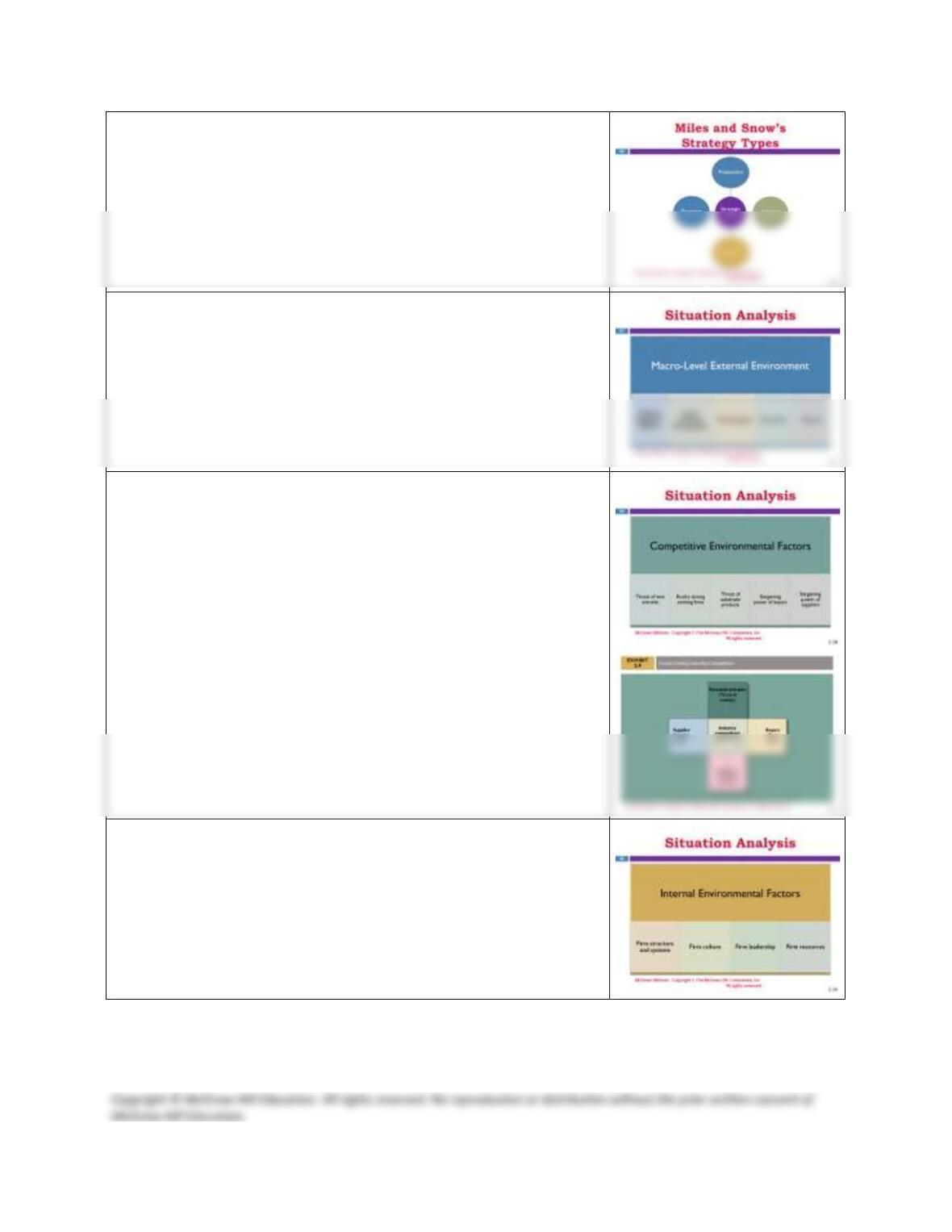
4. Select any industry of interest to you and identify several competing firms. Using Miles and
Snow’s Strategy Types, identify the following: (1) a firm that you believe is a prospector; (2)
a firm that you believe is an analyzer; (3) a firm that you believe is a defender; and (4) a firm
that you believe is a reactor. What characteristics of each led you to conclude they belong in
their respective strategy type?
Student answers will vary, depending on industries chosen. Examples follow in the auto
industry.
Chapter 03
Elements of Marketing Strategy, Planning and Competition
3-13
Analyzer – Example: General Motors, who typically lags behind market trends but
eventually offers alternatives to products created by prospector Toyota. Toyota introduced
the Prius in 1997
4
; GM introduced their first hybrid (the Chevy Siverado) in 2004.
5
Defender – Example: Porsche, rarely ventures outside of the high-end performance vehicle
market.
5. Historically, the theme park industry in Orlando is heavily impacted by a large number of
macro-level external environmental factors. From each of the five major categories of
macro-level external factors, identify a specific example of how some element within that
category might impact a theme park’s marketing planning for the next couple of years. Be
sure to explain why you believe each of your examples will be important for marketing
managers to consider as they develop their marketing plans.
Political, legal, and ethical – As traditional labor unions attempt to grow through the
recruitment of non-traditional workers, they may target the growing number of theme park
employees.
MANAGEMENT DECISION CASE
Marketing Planning Helps Dunkin’ Donuts Score Big in Coffee Customer Loyalty
The story of Dunkin’ Donuts is useful for class discussion as it is a brand that most students will
have experience with but one that might not readily come to mind as an example of skillful
Chapter 03
Elements of Marketing Strategy, Planning and Competition
3-14
vision/mission. This may involve getting to a deeper understanding of the fundamental value
proposition and defining it in a way that allows for un updated approach to delivering that
value.
One way to begin the discussion would be to ask which students are coffee customers of Dunkin’
Donuts and then to explore why they chose Dunkin’ over Starbucks or other coffee alternatives.
If any of these customers are also DD Perks Rewards members, you could ask how this program
affects their loyalty to the brand. This could lead to a discussion about the factors that
Questions for Consideration
1. Dunkin’ Donuts made a strategic decision to make their business about the coffee, not
just the donuts. What are the risks when a company that is so closely identified with one
product (it’s in their name!) decides to change their focus to a different product? What
marketing strategies can help reduce the risks and increase the probability of success?
These significant directional changes can have the negative effect of alienating customers
who have closely identified the brand with their traditional products. If the new strategic
direction is not successful, it can also leave customers wondering if the company has lost
their bearings or if they still stand for the same founding values. Potential mitigation
strategies include:
• Giving special attention (via promotional communications) to customers known to be
particularly loyal to the traditional products. For example, while promoting coffee
through national advertising, frequent donut purchasers could receive emails with
2. What are the key differences between the marketing strategy of Dunkin’ Donuts and their
chief competitor, Starbucks? What else could the company do from a marketing
Chapter 03
Elements of Marketing Strategy, Planning and Competition
3-15
manager’s standpoint to successfully compete with and clearly differentiate Dunkin’ from
Starbucks?
A comparison of key differences is covered well in:
Christine Champagne and Teresa Iezzio, “Dunkin’ Donuts and Starbucks: A Tale Of Two
The article also includes links to videos of old and more recent TV ads. Highlights from
the article:
Starbucks:
• One of the “Whole–experience” brands.
• Came of age after the digital revolution.
Dunkin’ Donuts
• A traditional advertiser
• Doing the work to evolve with the digital, social, mobile.
• Organizing its promo efforts around a central mission.
3. Loyalty programs like DD Perks can get customers engaged with the brand and
incentivize them to stay loyal. But loyalty programs alone are relatively easy for
competitors to match and top, thus they often aren’t sufficient alone to retain customers
and thwart switching. In addition to reward programs, what other factors drive loyalty to
a brand, and which of these do you presently see in play at Dunkin’ Donuts? Is there
more that they could do to increase customer loyalty?
Loyalty is earned based on a customer’s assessment of whether the brand consistently
provides value. In the case of Dunkin’ Donuts, this assessment will include an evaluation
Chapter 03
Elements of Marketing Strategy, Planning and Competition
3-16
students should be able to think of a number of ways that Dunkin’ could increase the
level of value:
• Additional price promotions focused on frequency of purchase that effectively
lower the cost to acquire the product.
• Expanded set of products that complement the core products now offered (lunch
options like sandwiches).
SUGGESTED VIDEO
BP: Transforming its Strategy “Beyond Petroleum” (7:52 minutes)
Description: Senior Vice President of BP Global Brand and Marketing & Innovation speaks on
one of their Brand Values “going green” and having a lower impact on the environment by
designing an innovative gas station and applying that concept to their other 25,000 sites.
1. Are people more likely to purchase gas from BP because of its commitment to the
environment?
Notwithstanding its environmental efforts, BP is still under pressure to create value for its
2. In light of the recent crisis in the Gulf of Mexico, how does BP convince the public that they
are sincere about caring about the environment?
BP has an uphill battle in this matter. BP needs not only to perform the activities to
demonstrate its sincerity, but also to have the patience to give the market time to adjust.

Chapter 03
Elements of Marketing Strategy, Planning and Competition
3-17