Chapter 3: The Marketing Environment, Ethics, and Social Responsibility
CHAPTER SUMMARY AND LEARNING OBJECTIVES
LO 3.1 Identify the five components of the marketing environment.
LO 3.2 Contrast the two types of competition that marketers face.
The two types of competition are: (1) direct competition among marketers of similar products
and (2) indirect competition among goods or services that can be substituted for one another.
LO 3.3 Summarize the four major types of government regulation that affect marketing
practices.
The four major types of government regulation are maintaining a competitive environment,
regulating competition, protecting consumers, and deregulating specific industries to increase
competition.
LO 3.4 Describe the regulatory forces that influence the marketing environment.
LO 3.5 Outline the economic factors that affect marketing decisions and consumer
buying power.
LO 3.6 Describe how a change in the technological environment can impact a firm’s
marketing activities.
LO 3.7 Determine an effective marketing response to a change in the social–cultural
environment.
The social–cultural environment is the relationship between marketing, society, and culture. To
remain competitive, marketers must be sensitive to society’s demographic shifts and changing
values, which affect consumers’ reactions to different products and marketing practices.
LO 3.8 Given a variable of the marketing mix, describe an ethical issue related to that
LO 3.9 Define the four dimensions of social responsibility.
The four dimensions of social responsibility are economic, legal, ethical, and philanthropic.
Chapter 3: The Marketing Environment, Ethics, and Social Responsibility
ACTIVATOR EXERCISE: The changing (marketing) environment
Purpose: For students to understand the importance of responding to changes in the marketing
environment.
Format: Small group discussion, then presentations to the class.
Time: 20–30 minutes, depending on format.
Activity: Divide students into groups and have them discuss the following questions:
• What jobs exist today that might not exist 50 years from now?
• What jobs might exist in 50 years that don’t exist today?
Possible discussion questions for class: How can you better prepare for possible changes to
the workplace and your career choices? How could you position yourself to be more successful
in that career, or even be a pioneer in a new field? In what ways could the world change in the
next few decades that could negatively affect your plans for a career and family? How can you
protect against those changes?
Chapter 3: The Marketing Environment, Ethics, and Social Responsibility
LECTURE OUTLINE
3-1 Marketing Planning—The Marketing Environment
Marketers do not make decisions about target markets and marketing mix variables in a vacuum.
They must take into account the dynamic nature of the five dimensions of the marketing
environment:
• competitive;
These forces provide the frame of reference for making all other marketing decisions.
It’s important to note that the five dimensions of the marketing environment influence one
another. For example, social concerns about the natural environment have led to tighter
Discussion questions: Thinking back in history, what are some key changes in the marketing
environment that happened between the late 1800s and the 1950s?
What are some products that don’t exist today because of those changes?
3-2 The Competitive Environment
Marketers face two types of competition. The most direct form occurs among marketers of
similar products:
Discussion question: For each of these companies or brands, ask students to identify 2–3
Chapter 3: The Marketing Environment, Ethics, and Social Responsibility
Chipotle
Walmart
A second type of competition is indirect, involving products that are easily substituted with
others.
Example: Both McDonald’s and Starbucks face the prospect that customers simply opt
to make coffee at home or consume energy drinks instead of coffee or tea.
Discussion question: For each of these companies or brands, ask students to identify 2–3
indirect competitors (i.e. substitutes or products in alternative categories):
Chipotle
The competitive environment is where marketers of directly competitive products and
marketers of substitute products compete for consumer purchases.
Competitive strategy involves answering the following three questions:
1. Should we compete?
2. If so, in what markets should we compete?
3. How should we compete?
Chapter 3: The Marketing Environment, Ethics, and Social Responsibility
Classroom activity: First, ask students what industries seem very competitive right now.
Examples might include mobile phones, wireless service, autos, airlines, online retail, fashion
and apparel, grocery, fast food, and so on.
Example: The text provides an example of how McDonald’s responded to Starbucks by
introducing premium coffee drinks. Another example might be T-Mobile responding to Verizon
and ATT by offering unlimited data plans that include the cost of taxes and fees.
Key Takeaway: Marketers must develop effective strategies for dealing with the
Estimated time: 20–30 minutes
3-3 The Political–Legal Environment
The political–legal environment is the component of the marketing environment consisting of
1. Maintaining a competitive environment
2. Regulating competition
PRESENTATION VISUAL: MindTap Exhibit 3.2 showing major federal laws affecting
marketing
Discussion question: Which of these laws do you believe have personally affected your
everyday life?
Chapter 3: The Marketing Environment, Ethics, and Social Responsibility
Example: Consumer protection laws have prompted a number of recalls in the auto industry,
keeping you from driving a vehicle with a known safety issue.
Key Takeaway: Marketers must abide by and adapt to laws and regulations that affect
their activities.
Estimated time: 10–15 minutes
3-4 Types of Regulatory Forces
Federal, state, and local governments have established regulatory agencies to enforce laws.
Example: At the federal level, the FTC wields the broadest powers of any agency to
influence marketing activities. The FTC enforces laws regulating unfair business
Public and private consumer interest groups and self-regulatory organizations are also part of
the political–legal environment.
Example: AARP (formerly known as the American Association of Retired Persons)
wields political and economic power, particularly as more and more people reach
retirement age.
Self-regulatory groups represent multiple industries’ attempts to set guidelines for responsible
business conduct.
Key Takeaway: Various regulatory agencies and organizations influence the political–
legal environment.
Estimated time: 5–10 minutes
Chapter 3: The Marketing Environment, Ethics, and Social Responsibility
3-5 The Economic Environment
The economic environment consists of factors that influence consumer buying power and
marketing strategies. These include stages of the business cycle, inflation and deflation,
unemployment, and income.
Stages of the business cycle
The overall health of the economy influences how much consumers spend and what they buy.
Classroom activity: In small groups, have students discuss the following:
What products and industries do particularly well when the economy is strong?
Discussion question: As a marketer of premium clothing, what changes might you make to
your marketing mix:
In times of strong economic growth?
In times of a struggling economy?
Changes in prices
A major constraint on consumer spending, which can occur during any stage of the business
cycle, is inflation—rising prices caused by some combination of excess demand and the
increasing cost of raw materials, labor, and/or other factors of production.
Chapter 3: The Marketing Environment, Ethics, and Social Responsibility
Discussion question: While inflation and deflation typically refer to price changes across the
entire economy, what are some products (goods and services) that have:
Decreased significantly in price over the last 20 years?
Increased significantly in price over the last 20 years?
Why is this?
Note: Examples for decrease include electronics, toys, and clothing. Example for increase
Unemployment and income
Unemployment is defined as the proportion of people in the economy who are actively seeking
work but do not have jobs. Unemployment rises during recessions and declines during
economic expansions. If more people have jobs, there is more income to be spent on goods
and services.
Estimated time: 20–30 minutes
3-6 The Technological Environment
The technological environment represents the application of knowledge based on discoveries
in science, inventions, and innovations. Technology leads to new goods and services for
Classroom activity: In small groups, have students identify five examples of new technology
that rendered a product or product category obsolete.
After small group discussion, discuss as a class.
Chapter 3: The Marketing Environment, Ethics, and Social Responsibility
Discussion questions: How has your life as a consumer improved because of technology?
What issues in your day-to-day life do you wish technology could still help you solve?
Note: The purpose of this discussion is to highlight not only how technology can be a threat to
marketers (as confirmed in the above classroom activity), but also how it creates opportunities
to better serve consumers.
Key Takeaway: By monitoring and responding to the technological environment,
marketers can gain a competitive edge, cut costs, improve customer service, and benefit
society.
Estimated time: 15–25 minutes
3-7 The Social–Cultural Environment
As a nation, the United States is becoming older, more affluent, and more culturally diverse.
To remain competitive, marketers must be sensitive to society’s demographic shifts and
changing values. These variables affect consumers’ reactions to different products and
marketing practices.
Example #1: The baby boom generation—the 78 million Americans born between 1946
and 1964—represents a $7 trillion market. As “boomers” approach and enter retirement,
marketers are scrambling to identify their needs and wants. With a longer life expectancy
and the hope of more time and money to spend, boomers now view retirement much
differently than earlier generations did.
Marketer response: Develop products related to health care, travel and leisure, and
financial management that might appeal to the needs of this generation.
Chapter 3: The Marketing Environment, Ethics, and Social Responsibility
Classroom activity: In small groups, have students identify three demographic or cultural
changes they expect in the United States.
Share those as a class and pick three of them for all of the groups to address.
Changing societal values have led to consumerism, a social force within the environment that
aids and protects the consumer by exerting legal, moral, and economic pressures on business
culture, and demographics.
Discussion questions: What is an example of consumer pressure causing a company to
change course regarding a product or promotional strategy?
What is an example of a product or company you don’t use because of your moral or cultural
values?
3-8 Ethical Issues in Marketing
Marketing ethics are marketers’ standards of conduct and values.
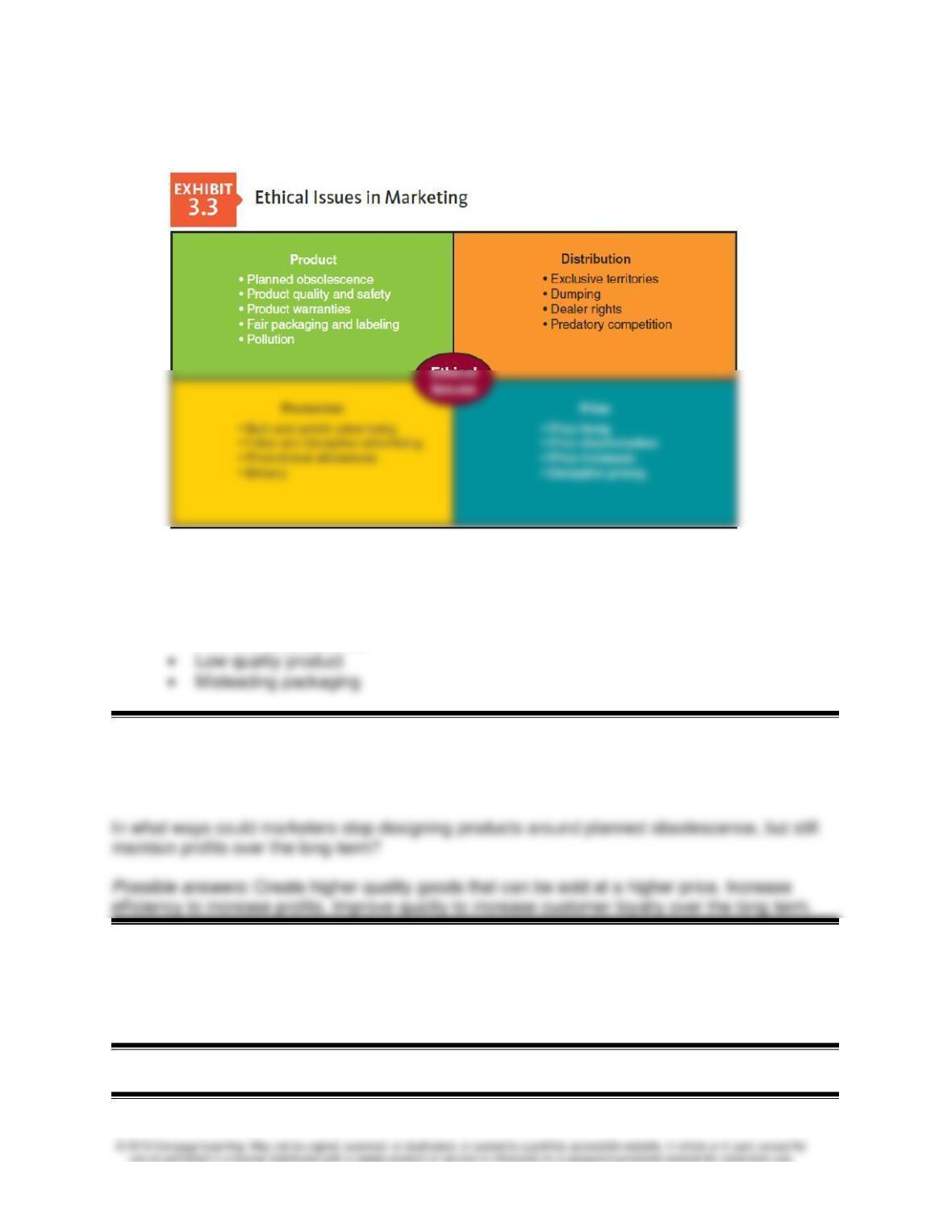
Each element of the marketing mix raises its own set of ethical issues.
Chapter 3: The Marketing Environment, Ethics, and Social Responsibility
PRESENTATION VISUAL: Exhibit 3.3 showing ethical issues in each of the elements of
the marketing mix
Ethics in product strategy
Ethical issues can be raised when considering decisions about product quality and lifespan.
Examples:
• Planned obsolescence
Discussion question: What are some examples of planned obsolescence—intentionally
designing a product to have a limited useful life in order to encourage a faster upgrade cycle?
Examples: Mobile phones, software programs, and inexpensive clothing.
Ethics in pricing
Pricing is probably the most regulated aspect of a firm’s marketing strategy. As a result, most
unethical price behavior is also illegal. Some aspects of pricing, however, are still open to ethics
abuses.
Discussion question: Airlines usually base their pricing on supply and demand for seats. Is
this ethical? Why or why not?