Chapter 3
Risk
Chapter Overview
I. Introduction
a. Definition of risk
II. Relationship between rate of return and risk
a. Rate of return
III. Measuring risk
a. Level of risk
i. Total risk
IV. Determinants of interest rates
a. Nominal interest rate
b. Risk premiums
i. Inflation premium
ii. Default risk premium
c. Reinvestment rate risk
V. Risk and investment returns
a. Investment risk
b. Stand-alone return and risk
i. Calculating expected rate of return
1. Probability distribution
ii. Calculating stand-alone risk
1. Coefficient of variation
c. Portfolio return and risk
i. Calculating portfolio expected rate of return
1. Expected return on portfolio
2. Beta coefficient
3. Security market line
VI. Sources of risk
a. Current economic conditions
i. Capital finance
1. Synthetic fixed-rate bonds
b. Political developments
c. Global issues
VII. Revenue sharing and risk
a. Revenue pools
Key Concepts
When reading this chapter, students should focus on the following key concepts:
1. The impact of risk on the financial management of sport organizations.
2. How to calculate and interpret stand-alone risk and portfolio risk.
Concept Check Responses
1. How does risk affect the financial management of sport organizations?
Risk affects the rate of interest, bond rates, estimates of cash flows, the cost of capital,
2. Describe the process of determining a nominal interest rate.
The nominal interest rate is the interest rate on a given debt security. It is calculated by
adding the real risk-free rate of interest to several risk premiums. These risk premiums
3. Of MLB, the NBA, or the NHL, which league has the most risk and which has the least?
Why?
According to Fitch Ratings, factors affecting risk as reflected in the firm’s credit ratings
include risk to cash flows. Specifically, the agency looks at player salary restraints,
4. What must players and agents understand about risk? How should agents structure a
player’s contract if it contains deferred compensation?
See Sidebar 3.A The risk of time must be understood; risk increases as the length of time
increases. As salary is deferred over time, risk increases proportionally to the amount of
time the salary is deferred. Importantly, although deferred salary may be guaranteed, if
5. What risk factors should a team consider when deciding whether to build and fund a
new venue? How are the risk factors different if a municipality is funding the
construction?
Teams must understand the sources of risk they face when building and funding a new
venue. For example, capital finance was impacted with the collapse of financial markets
in 2008. Variable rate bonds that looked good a few years earlier suddenly cost teams
additional millions of dollars as rates skyrocketed. For example, Dallas Cowboys owner
6. If you were advising an investor interested in purchasing a sport franchise, what advice
would you give?
See Concept Check 3. Generally, the recommendation, if financial resources were of no
concern and a team could be freely purchased, would be to purchase an NFL franchise.
Partly because of the low risk of ownership, these franchises are by far the most
7. Among NCAA men’s basketball teams, which team would you expect to have the highest
value? Why? How do you think conference affiliation affects value among these teams?
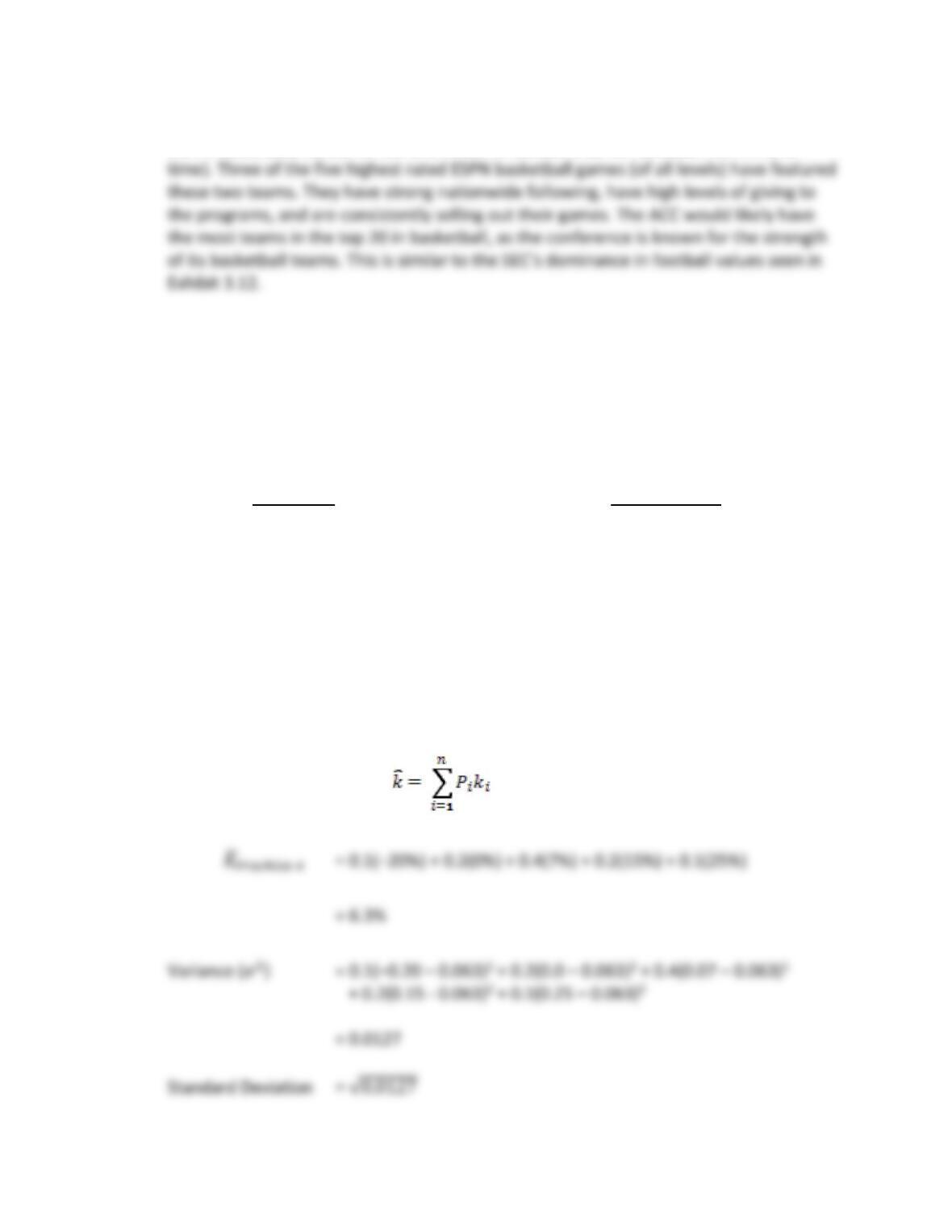
I’d expect North Carolina or Duke to have the highest value (Forbes publishes a list for
men’s basketball, similar to the one shown in Exhibit 3.12 for football, from time to
Responses to Practice Problems
1. You have the opportunity to purchase NFL Franchise A. The probability distribution of
expected returns for the franchise is as follows:
Probability
Rate of Return
0.1
–20%
0.2
0%
0.4
7%
0.2
15%
0.1
25$
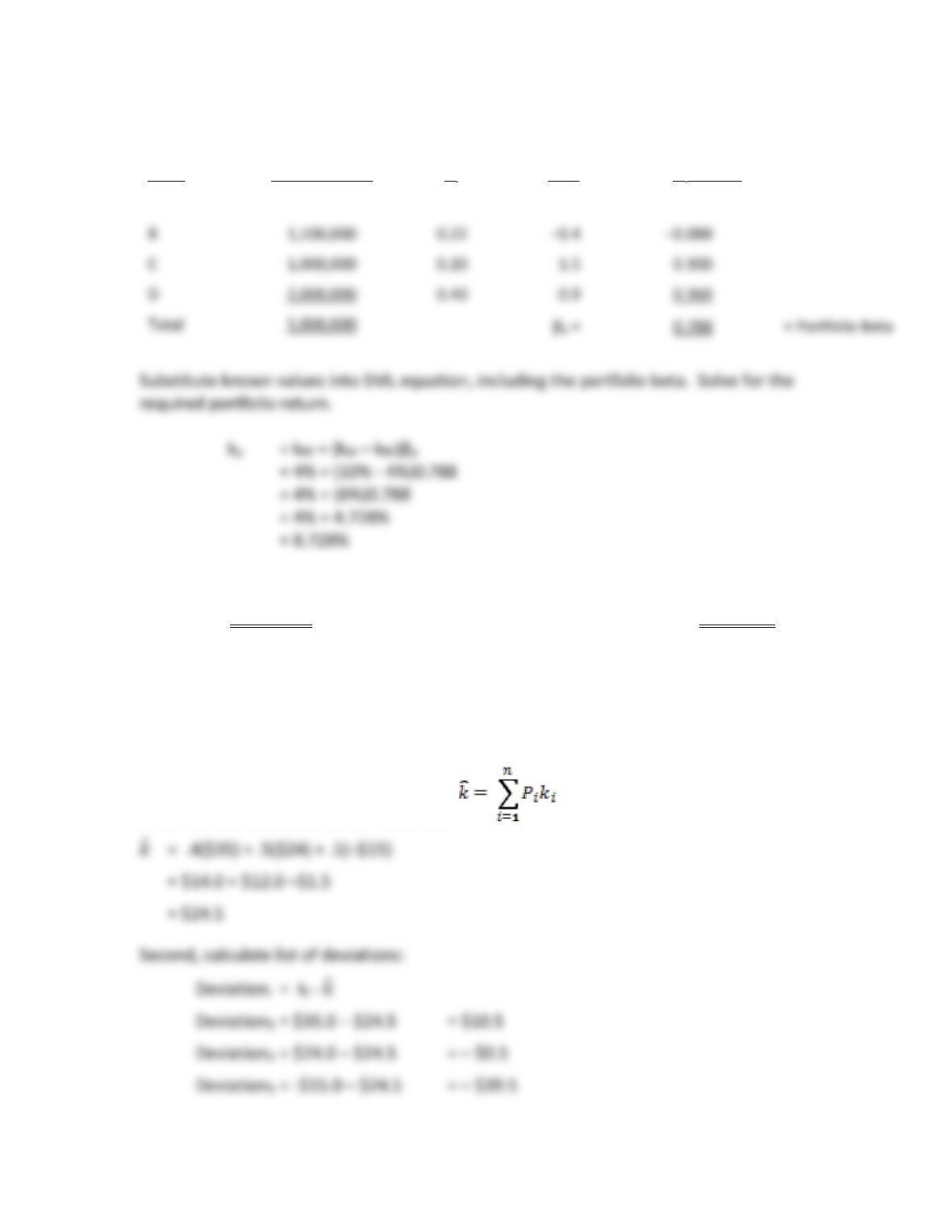
What is the expected rate of return for your investment in Franchise A? What is the
standard deviation?
Expected rate of return =

2. An owner of several sport assets holds the following portfolio:
Asset Investment Beta
Team A $100,000,000 0.5
Team B $100,000,000 1.0
Facility A $100,000,000 1.5
Total $300,000,000
What is the beta of this portfolio?
3. Boggs Sports Holdings has a total investment of $500 million in five companies:
Company
Investment ($MM)
Beta
A
130
0.3
B
160
1.5
C
70
3.2
D
90
2.0
E
50
1.0
Total
500
What is the beta of this portfolio?

4. For the portfolio described in Practice Problem 3, if the risk-free rate is 10% and the
market risk premium is 5%, what is Boggs’ required rate of return?
Note: market risk premium = kM – kRF, where kM is the expected average stock market
return and kRF is the risk free rate of interest (see page 62 for related discussion on total
5. You have been hired as the manager of a portfolio of ten sport assets that are held in
equal dollar amounts. The current beta of the portfolio is 1.9, and the beta of Asset A is
2.1. If Asset A is sold and the proceeds are used to replace a replacement asset, what
does the beta of the replacement asset have to be to lower the portfolio beta to 1.6?
First, find the beta of the remaining nine stocks:
1.90 = 0.9(𝛽𝑅) + 0.1(𝛽𝐴)
6. The Sports Investment Fund has a total investment of $5 million in the following
portfolio:
Asset Investment ($) Beta
A 900,000 1.2
B 1,100,000 –0.4
C 1,000,000 1.5
D 2,000,000 0.9
Total 5,000,000
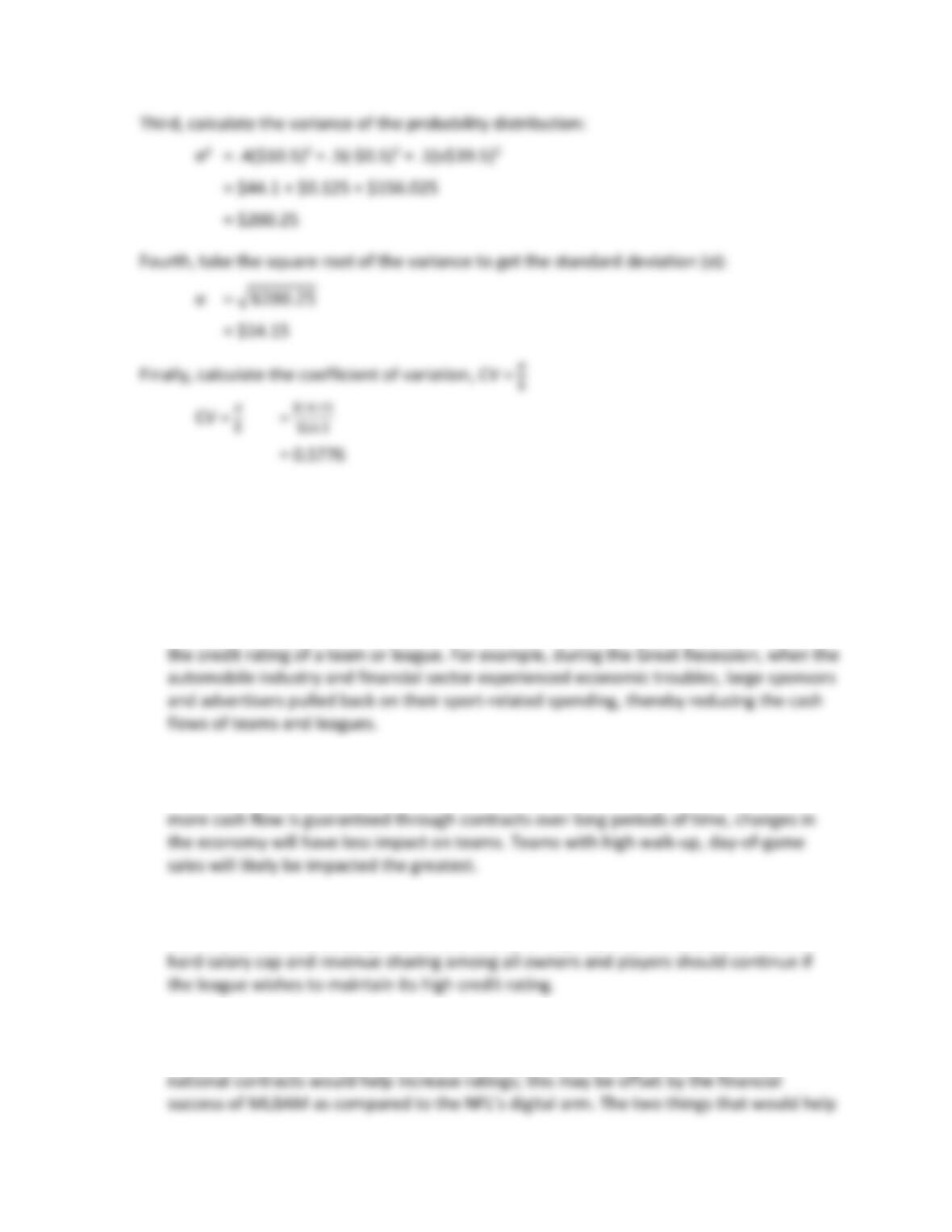
The market required rate of return is 10% percent, and the risk-free rate is 4%. What is the
required rate of return?
Determine the weight each stock represents in the portfolio:
Asset
Investment ($)
wi
Beta
wi Beta
A
900,000
0.18
1.2
0.216
7. Following is a distribution of returns:
Probability
Return ($)
0.4
35
0.5
24
0.1
–15
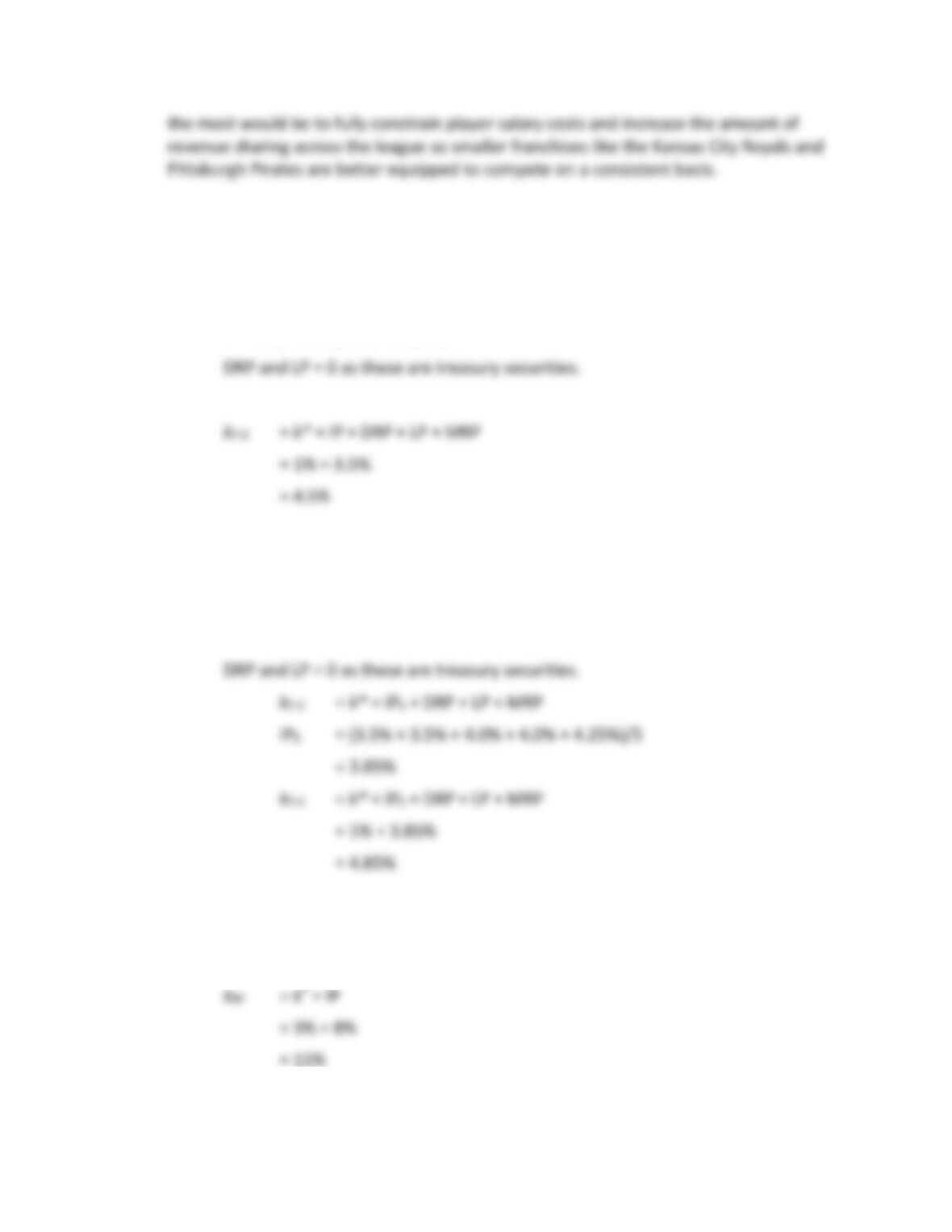
What is the coefficient of variation of the expected dollar returns?
First, find the expected rate of return (𝑘
̂):
B
0.22
C
0.20
1.5
0.300
D
0.40
0.9
0.360
0.788
Responses to Case Analysis Questions
1. What current economic conditions might impact the credit rating of a team or league?
Anything that might impact cash flows, or the consistency of cash flows could impact
2. Which teams’ credit ratings might be most negatively impacted during a recession?
Teams with little contractually obligated income will be most negatively impacted. As
3. What must the NFL do to maintain its high credit rating?
The NFL has controlled player costs and shared a majority of its revenue over time. A
4. What can MLB do to improve its credit rating?
MLB has lower national television revenues as compared to the NFL. Increases in
Additional Classroom/Exam Problems
1. What is the nominal interest rate (k) of a 5-year U.S. Treasury bond with a real risk-free
rate of interest of 1% and inflation expected to be at 3.5% per year? Assume that the
maturity risk premium is zero.
k* = 1%, I=3.5%, MRP=0%; kT-5=?
2. Refer to Additional Classroom Problem 1. What would kT-5 be if the inflation was
expected to be 3.5% over the next two years, 4.0% the two years after that, and 4.25%
in the fifth year?
k* = 1%, I1=3.5%, I2=3.5%, I3=4.0%, I4=4.0%, I5=4.25%, MRP=0%; kT-5=?
3. For a given bond, you have the following information: Real risk-free rate (k*)=3%,
inflation premium = 8%, default risk premium = 2%, liquidity premium = 2%, and
maturity risk premium = 1%. What is the nominal risk-free rate (kRF)?
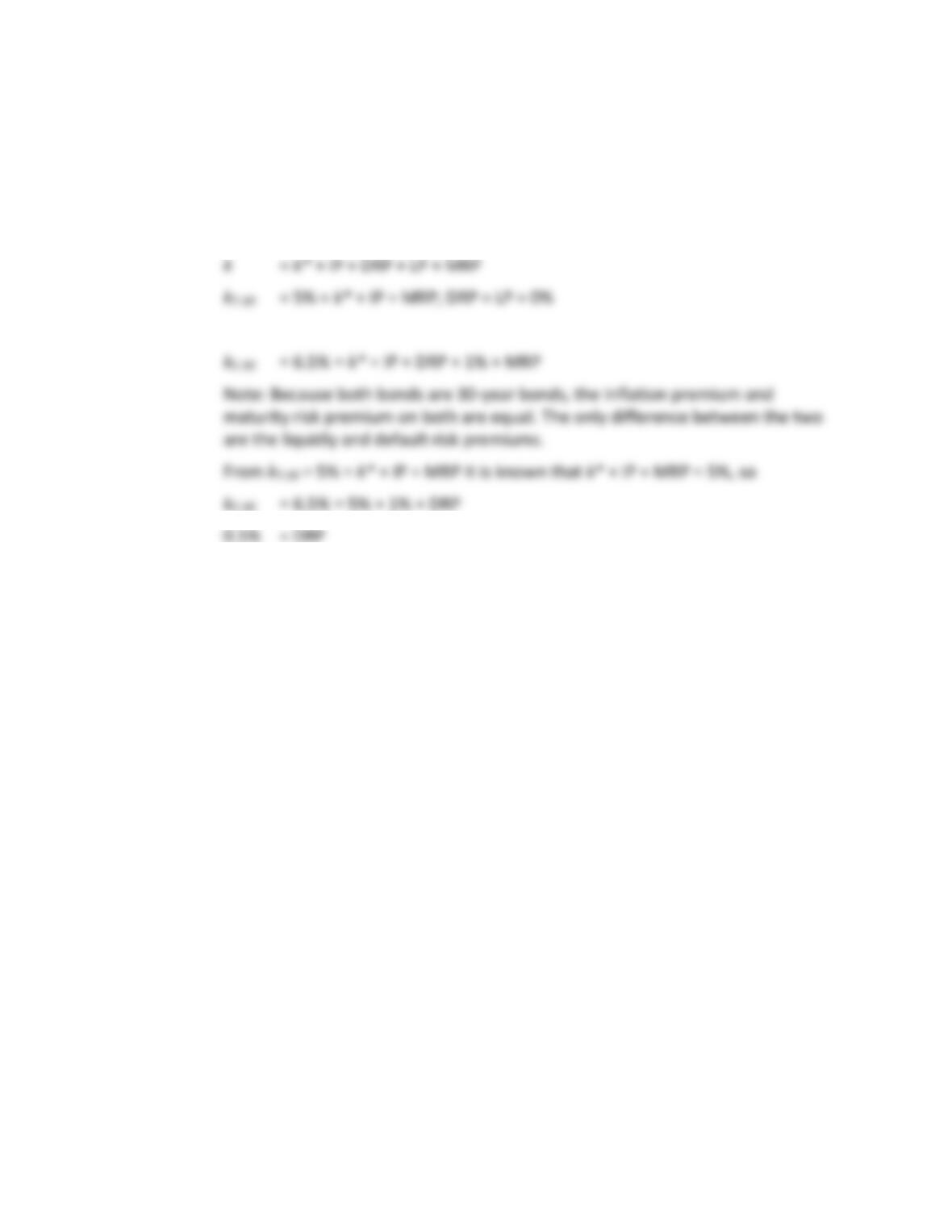
4. A 30-year Treasury bond has a yield of 5%. A 30-year corporate bond has a yield of 6.5%.
Assume the liquidity premium on the corporate bond is 1.0%. What is the default risk
premium on the corporate bond?
kT-30 = 5%; kC-30 = 6.5%; LP = 1.0%; DRP = ?