
website, in whole or in part.
Instructor Manual
Lamb/Hair/McDaniel, MKTG 13E, ISBN 9780357127810; Chapter 3: Ethics and Social
Responsibility
Table of Contents
Purpose and Perspective of the Chapter …………………………………………………………………………. 2
Cengage Supplements …………………………………………………………………………………………………… 2
Learning Outcomes ……………………………………………………………………………………………………….. 2
Complete List of Chapter Activities and Assessments ……………………………………………………… 3
Key Terms ……………………………………………………………………………………………………………………… 4
What’s New in This Chapter ……………………………………………………………………………………………. 6
Chapter Outline …………………………………………………………………………………………………………….. 6
Discussion Questions …………………………………………………………………………………………………… 13
Additional Activities and Assignments …………………………………………………………………………… 14
Additional Resources ……………………………………………………………………………………………………. 19
External Videos or Playlist ……………………………………………………………………………………………………….. 19
Appendix …………………………………………………………………………………………………………………….. 20
Generic Rubrics ……………………………………………………………………………………………………………………… 20
Standard Writing Rubric …………………………..……………………………………………………………………………… 20
Standard Discussion Rubric ……………………………………………………………………………………………………… 21
2
© 2022 Cengage. All Rights Reserved. May not be scanned, copied or duplicated, or posted to a publicly accessible
website, in whole or in part.
Purpose and Perspective of the Chapter
The purpose of this chapter is to learn about the factors that make up an ethical society,
including rules, laws, codes of conduct, and self-regulation. The chapter introduces the
Cengage Supplements
The following product-level supplements provide additional information that may help you
in preparing your course. They are available in the Instructor Resource Center.
• Transition Guide (provides information about what’s new from edition to edition)
• Educator’s Guide (describes assets in the platform with a detailed breakdown of
activities by chapter with seat time)
Learning Outcomes
The following learning outcomes are addressed in this chapter:
3-1 Explain the determinants of a civil society.
3-2 Explain the concept of ethical behavior.
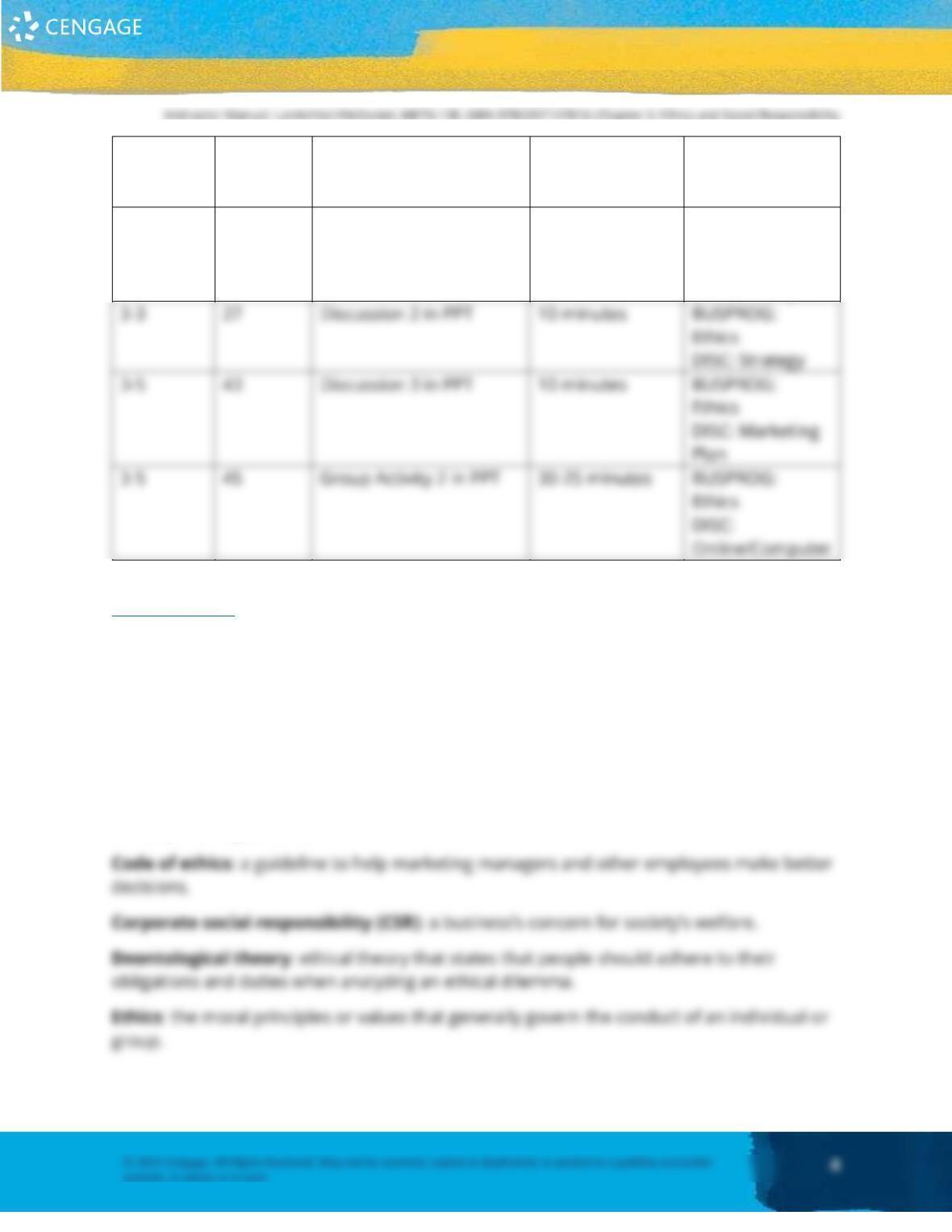
Complete List of Chapter Activities and Assessments
For additional guidance refer to the Teaching Online Guide.
Chapter
Learning
Outcome
PPT slide
Activity/Assessment
Duration
Certification
Standard
N/A
MindTap: Why Does the
Marketing Plan Matter to
Me?
5 minutes
BUSPROG:
Reflective
Thinking
DISC: Marketing
Plan
3-1
MindTap: Learn It 3-1:
Determinants of a Civil
Society
5 minutes
BUSPROG:
Ethics
DISC: Strategy
3-2
MindTap: Learn It 3-2:
The Concept of Ethical
Behavior
5-10 minutes
BUSPROG:
Ethics
DISC: Strategy
3-3
MindTap: Learn It 3-3:
Ethical Behavior in
Business
10 minutes
BUSPROG:
Ethics
DISC: Strategy
3-4
MindTap: Learn It 3-4:
Corporate Social
Responsibility
10 minutes
BUSPROG:
Ethics
DISC: Strategy
3-5 – 3-6
MindTap: Learn It 3-5
and 3-6: Arguments for
and Against Social
Responsibility and
Cause-Related Marketing
10 minutes
BUSPROG:
Ethics
DISC: Marketing
Plan
Analytic
DISC: Marketing
Plan
DISC: Strategy
3-1
3
Knowledge Check 1
5 minutes
BUSPROG:
DISC: Strategy
3-2
15
Discussion 1 in PPT
10 minutes
BUSPROG:
Ethics
DISC: Strategy
3-2
18
Poll in PPT
10 minutes
BUSPROG:
Ethics
DISC: Strategy
3-3
25
Group Activity 1 in PPT
30-35 minutes
BUSPROG:
Ethics
DISC:
Online/Computer
3-3
Discussion 2 in PPT
10 minutes
BUSPROG:
DISC: Strategy
3-5
45
Group Activity 2 in PPT
30-25 minutes
BUSPROG:
Ethics
DISC:
Online/Computer
[return to top]
Key Terms
Behavioral norms: standards of proper or acceptable behavior. Several modes of social
control are important to marketing.
Casuist ethical theory: ethical theory that compares a current ethical dilemma with
examples of similar ethical dilemmas and their outcomes.
Cause-related marketing: the cooperative marketing efforts between a for-profit firm and
an nonprofit organization.
Foreign Corrupt Practices Act (FCPA): a law that prohibits U.S. corporations from making
illegal payments to public officials of foreign governments to obtain business rights or
enhance their business dealings in those countries.
Pyramid of corporate social responsibility: a model that suggests corporate social
responsibility is composed of economic, legal, ethical, and philanthropic responsibilities
and that a firm’s economic performance supports the entire structure.
Social control: any means used to maintain behavioral norms and regulate conflict.
Stakeholder theory: ethical theory stating that social responsibility is paying attention to
the interest of every affected stakeholder in every aspect of a firm’s operation.
What’s New in This Chapter
The following elements are improvements in this chapter from the previous edition:
• New discussion of AI to make ethical decisions when applied to marketing
applications.
• New list of the world’s most ethical companies.
• New discussion of consumer trust.
[return to top]
Chapter Outline
In the outline below, each element includes references (in parentheses) to related content. “LO
CH–##” refers to the chapter learning outcome; “PPT Slide #” refers to the slide number in the
1. Determinants of A Civil Society (LO 3-1, PPT Slide 3, DISC: Strategy)
a. Social control is any means used to maintain behavioral norms and regulate
conflict.
b. Behavioral norms are standards of proper or acceptable behavior. Several
modes of social control are important to marketing:
• Ethics: Ethics are the moral principles or values that generally govern the
conduct of an individual or a group. Ethical rules and guidelines, along with
customs and traditions, provide principles of right action.
2. The Concept of Ethical Behavior (LO 3-2, PPT Slide 7, DISC: Strategy)
a. Ethics can be viewed as the standard of behavior by which conduct is judged.
Standards that are legal may not always be ethical, and vice versa. Laws are the
values and standards enforceable by the courts. Ethics consists of those unwritten
rules we have developed for our interactions with one another.
Example: The concept of ethics can be explained by using line-cutting as an
b. Many ethical dilemmas develop from conflicts between the differing interests of
company owners and their workers, customers, and the surrounding community.
Managers must produce a reasonable profit for the company’s shareholders while
maintaining honesty in business practices and concern for environmental and
social issues. While the boundaries of what is legal and what is not are often fairly
clear (e.g., do not run a red light, do not steal money from a bank, and do not kill
anyone), the boundaries of ethical decision making are predicated on which
ethical theory one is following.
c. Ethical Theories: There are several ethical theories that apply to marketing.
• Deontological theory states that people should adhere to their obligations
o Act utilitarianism. A person performs the acts that benefit the most people,
regardless of personal feelings or societal constraints such as laws.
o Rule utilitarianism. A rule utilitarian seeks to benefit the most people but
through the fairest and most just means available.
• Casuist ethical theory compares a current ethical dilemma with examples of
3. Ethical Behavior in Business (LO 3-3, PPT Slide 1-9, DISC: Strategy)
a. Morals are the rules people develop as a result of cultural values and norms.
Culture is a socializing force that dictates what is right and wrong. Moral standards
may also reflect the laws and regulations that affect social and economic behavior.
Thus, morals can be considered a foundation of ethical behavior.
c. “Good” and “bad” can also refer to “conforming” and “deviant” behaviors. A doctor
who runs large ads offering discounts on open-heart surgery would be considered
bad, or unprofessional, because he or she is not conforming to the norms of the
medical profession. “Good” and “bad” also express the distinction between law-
abiding and criminal behavior.
• Potential magnitude of the consequences: The greater the harm done to
victims, the more likely that marketing professionals will recognize a problem as
unethical.
• Social consensus: The greater the degree of agreement among managerial
peers that an action is harmful, the more likely that marketers will recognize a
problem as unethical.
• Probability of a harmful outcome: The greater the likelihood that an action will
result in a harmful outcome, the more likely that marketers will recognize a
problem as unethical.
as unethical.
f. Ethical Guidelines and Training: A code of ethics is a guideline to help marketing
managers and other employees make better decisions. Creating ethics guidelines
has several advantages:
• A code of ethics helps employees identify what their firm recognizes as
acceptable business practices.
g. Ethics in Other Countries: Ethical beliefs often vary between cultures. Certain
practices, such as the use of illegal payments and bribes, are far more acceptable in
some places than in others, though enforced laws are increasingly making this
4. Corporate Social Responsibility (LO 3-4, PPT Slide 29, DISC: Marketing Plan)
a. Corporate social responsibility (CSR) is a business’s concern for society’s welfare.
This concern is demonstrated by managers who consider both the long-range best
interests of the company and the company’s relationship to the society within
which it operates.
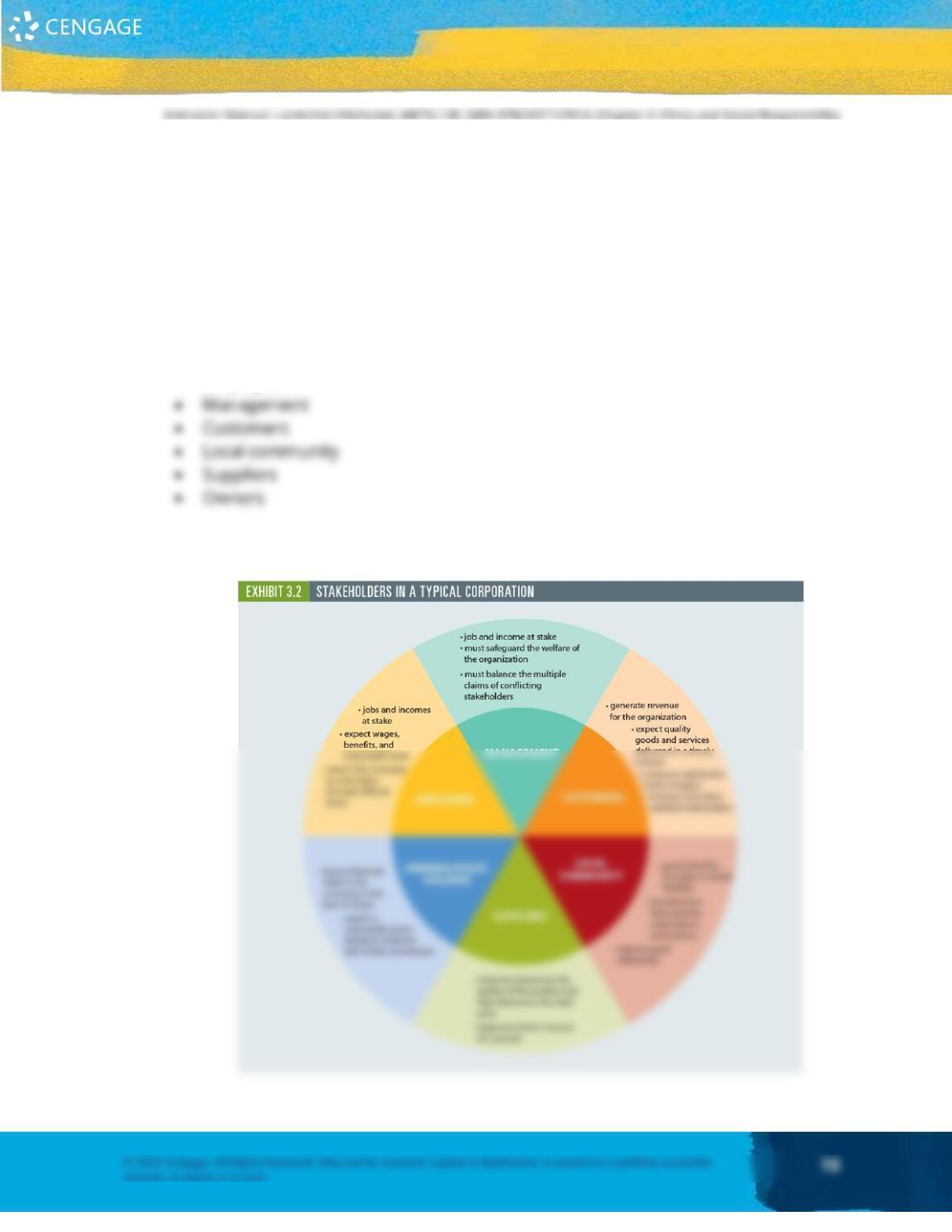
b. Stakeholders and Social Responsibility: Stakeholder theory is an ethical theory
stating that social responsibility is paying attention to the interest of every affected
stakeholder in every aspect of a firm’s operation. As shown in Exhibit 3.2, the
stakeholders in a typical corporation include the following:
• Employees
PRESENTATION VISUAL: Exhibit 3.2 Stakeholders in a Typical Corporation
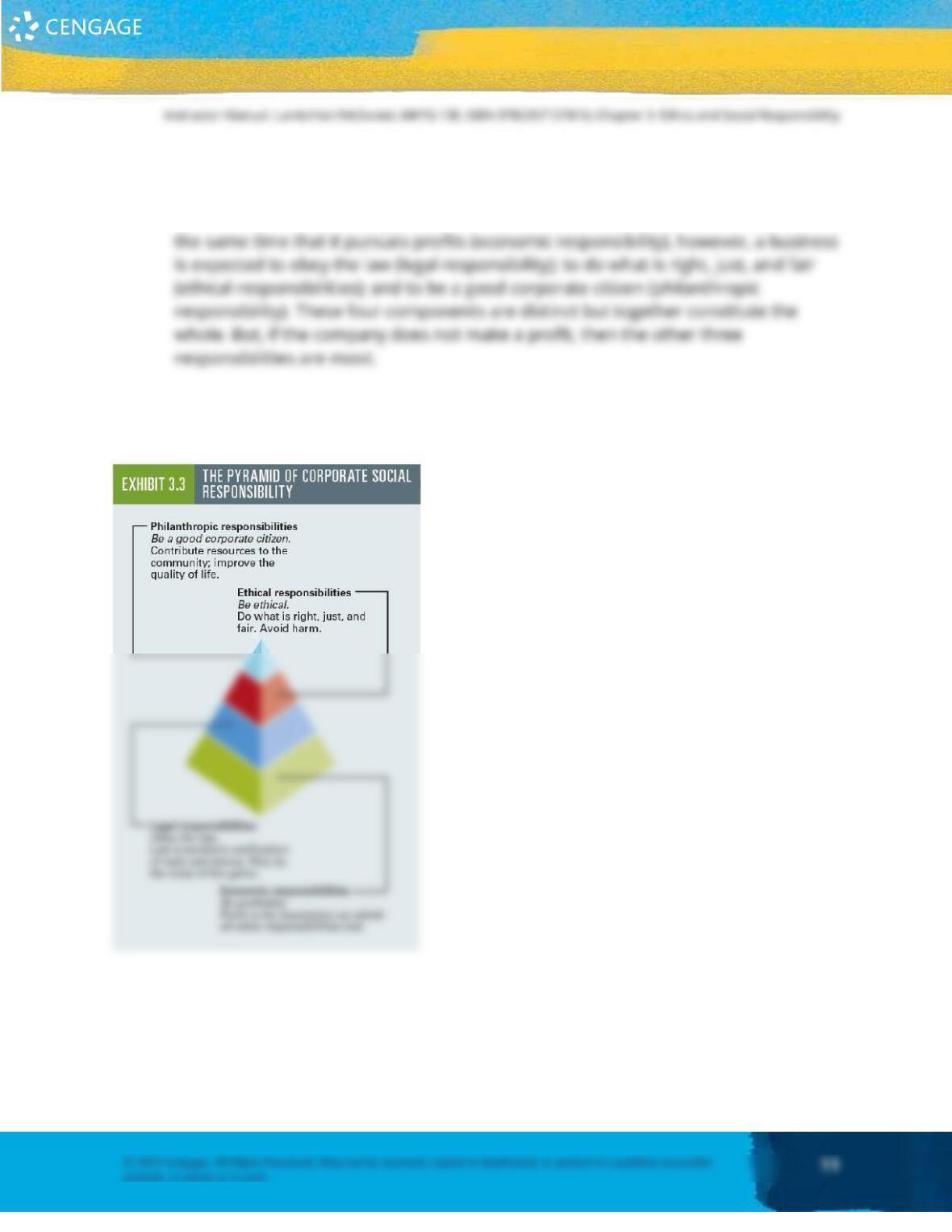
c. Pyramid of Corporate Social Responsibility: The pyramid of corporate social
responsibility is a model that suggests corporate social responsibility is composed
of economic, legal, ethical, and philanthropic responsibilities and that a firm’s
economic performance supports the entire structure, as illustrated in Exhibit 3.3. At
PRESENTATION VISUAL: Exhibit 3.3 The Pyramid of Corporate Social
Responsibility
5. Arguments For and Against Corporate Responsibility (LO 3-5, PPT Slide 33, DISC:
Strategy)
a. CSR can be a divisive issue. Some analysts believe that a business should focus on
making a profit and leave social and environmental problems to nonprofit