organizations and government. Others claim that societal problems, such as
pollution and poverty-level wages, have been brought on by corporations’ actions,
and it is the responsibility of business to right these wrongs. Reasons for being
socially responsible include the following:
• Being socially responsible can raise customer trust and identification with the
firm, which in turn, builds customer loyalty, often leading to higher profits.
b. Growth of Social Responsibility: Companies are coming under increasing
pressure from governments, advocacy groups, investors, prospective employees,
current employees, and consumers to make their organizations more socially
responsible. One way firms can do this is by joining the United Nations Global
Compact (UNGC), which is the world’s largest global corporate citizenship initiative.
d. A big part of the B Impact Assessment is measuring a firm’s sustainability.
Sustainability is the idea that socially responsible companies will outperform their
peers by focusing on the world’s social problems and viewing them as
opportunities to build profits and help the world at the same time.
• Environmental sustainability is concerned with minimizing or eliminating
threats to the physical environment.
e. Green Marketing: Green marketing is the development and marketing of products
designed to minimize negative effects on the physical environment or to improve
the environment. One approach that firms use to indicate that they are part of the
green movement is to use third-party eco-logos.
Examples: Eco-logos include the chasing-arrows recycling logo (the product is
f. Green purchasing is driven by young adults (ages 18 to 34) and Hispanics. Because
many consumers are willing to pay more for green products, some companies are
6. Cause-Related Marketing (LO 3-6, PPT Slide 47, DISC: Promotion)
a. Cause-related marketing refers to the cooperative marketing efforts between a
for-profit firm and a nonprofit organization. The for-profit firm hopes to generate
[return to top]
Discussion Questions
You can assign these questions several ways: in a discussion forum in your LMS; as whole-
class discussions in person; or as a partner or group activity in class.
1. Discussion: Guide students through a discussion of ethics. (LO 3-2, PPT Slide 16)
Duration: 5-10 minutes
a. It is sometimes said that ethics hold a person to higher standards than laws.
What does this mean to you?
b. Which of the ethical theories presented makes the most sense to you, and
why?
c. When you’re presented with an ethical dilemma, which theory do you tend to
employ, even if it’s intuitively done?
i. Students’ answers will vary. Ethics refer to the moral principles or
2. Discussion: (LO 3-3, PPT Slide 27) Duration: 5-10 minutes
a. Many businesspeople contend that bribery is an unpleasant but necessary
part of international business, especially in countries such as China, where
business gift giving is widely accepted and expected.
b. How do you feel about bribery?
c. If bribery is acceptable in a country where a U.S.-based company is doing
business, is it okay for the business to participate in it?
i. Students’ answers will vary. Groups should provide support of their
3. Discussion: (LO 3-5, PPT Slide 43) Duration: 5-10 minutes
a. Do you believe that sustainability is a viable concept for U.S. businesses?
Explain your position.
i. Students’ answers will vary. Sustainability refers to the idea that
Additional Activities and Assignments
A generic discussion and writing rubric is provided in the Appendix.
1. Activator Exercise: Ethics Vs. Legality (LO 3-1)
Purpose: To clarify the difference between ethical and legal behavior.
Format: This activity can be facilitated in both a classroom and an online environment.
Instructions for how to facilitate the activity in the classroom and online are provided
below.
Classroom Format: Class discussion (Estimated Time: 10-20 minutes)
1. Ask your class to identify examples of the following behaviors that they have
read or heard about in the news.
• Illegal and unethical behavior (e.g., embezzling money, price
discrimination, sexual harassment)
local community, protecting whistleblowers)
2. Lead students in a discussion of the key concepts of legality and ethics as
demonstrated by these news items.
Instructor Manual: Lamb/Hair/McDaniel, MKTG 13E, ISBN 9780357127810; Chapter 3: Ethics and Social Responsibility
Online Format: Discussion board with posted response from each student (Estimated
Time: 10-20 minutes)
Use the following prompt to facilitate this activity in a discussion board:
Choose one of the following behaviors and find a current (within the last twelve
months) news story that exemplifies the behavior you’ve chosen. Write a post
explaining your rationale in choosing your news item as an example. Be sure to
include a link to your news article. In responding to your classmates’ posts,
discuss the key concepts of ethics and legality as demonstrated by the news
articles.
• Illegal and unethical behavior (e.g., embezzling money, price discrimination,
sexual harassment)
Additional questions for a classroom or discussion board: What tools could
companies use to ensure that they market in an ethical manner? How involved should
the government be in this arena? Are there limits to the effectiveness of government
regulation? What are examples of self-regulation (e.g., the movie rating system, alcohol
advertising limits in network TV)? How effective are these efforts? Why?
Result: Students have most likely learned about ethics and legality in earlier courses, so
2. Class activity: (LO 3-1)
Format: This activity can be facilitated in both a classroom and an online environment.
Instructions for how to facilitate the activity in the classroom and online are provided
below. (Estimated time: 10-20 minutes)
Classroom Format: Have students break into groups of three or four to discuss the
Instructor Manual: Lamb/Hair/McDaniel, MKTG 13E, ISBN 9780357127810; Chapter 3: Ethics and Social Responsibility
Online Format: If you’re delivering your course online, you can have students do this
on their own and have them post their answers in a discussion board. Use the following
prompt to facilitate this activity:
3. Class activity: (LO 3-3)
Format: This activity can be facilitated in both a classroom and an online environment.
Instructions for how to facilitate the activity in the classroom and online are provided
below. (Estimated time: 15-25 minutes)
Classroom Format: Ask students to break up into pairs or groups of three. Have them
brainstorm a couple of ethical dilemmas that might arise in a business setting, perhaps
Online Format: If you’re delivering your course online, you can have students do this
on their own and have them post their answers in a discussion board. Use the following
prompt to facilitate this activity:
Brainstorm a couple of ethical dilemmas that might arise in a business setting, perhaps even
4. Class activity: (LO 3-4)
Format: This activity can be facilitated in both a classroom and an online environment.
Instructions for how to facilitate the activity in the classroom and online are provided
below. (Estimated time: 15-25 minutes)
Classroom Format: Divide students into groups of four or five. Have them conduct an
efforts impact the six key groups of stakeholders? Have groups share some of their
findings with the class.
Online Format: If you’re delivering your course online, you can have students do this
on their own and have them post their answers in a discussion board. Use the following
prompt to facilitate this activity:
Conduct an Internet search for Forbes most recent list of “The World’s Most Reputable
5. Class activity: (LO 3-5)
Format: This activity can be facilitated in both a classroom and an online environment.
Instructions for how to facilitate the activity in the classroom and online are provided
below. (Estimated time: 20-30 minutes)
Classroom Format: Divide the class in half and, if necessary, have them further divide
into smaller groups of three to five students. Assign half the class to take the “for” side
Online Format: If you’re delivering your course online, you can have students do this
on their own and have them post their answers in a discussion board. Use the following
prompt to facilitate this activity:
6. Additional activity: Going Green (LO 3–5)
Purpose: To encourage students to think about the ramifications of corporate social
responsibility and the green movement.
Background: Green marketing refers to the development and marketing of products
Relationship to Text: Arguments For and Against Corporate Responsibility
This activity can be facilitated in both a classroom and an online environment.
Instructions for how to facilitate the activity in the classroom and online are provided
below.
Estimated Class Time: 20-40 minutes
Classroom Format: Have students divide into groups of three or four to complete the
following steps:
1. Choose a familiar product that currently is not environmentally friendly and
brainstorm ways to make it more “green.”
Online Format: Video presentation with posted response from each student Create this
assignment in the Bongo app in MindTap or your LMS. Click here for instructions on how
to create this video assignment in Bongo:
1. Choose a familiar product that currently is not environmentally friendly and
brainstorm ways to make it more “green.”
2. Once you’ve settled on one specific way to improve the product, revise the
Additional Questions for Reflection:
• Did you feel that going green with your product opened up new marketing
opportunities or placed unnecessary restrictions on marketing the product?
7. Online Research Activity (LO 3-6)
For a product to be labeled “green,” it must meet regulatory guidelines issued by the
Federal Trade Commission (FTC). Retailers Bed Bath and Beyond, Nordstrom, JCPenney,
and Backcountry.com have were fined $1.3 million by the FTC for misleading
environmental claims. These and other companies are now barred from labeling and
[return to top]
Additional Resources
External Videos or Playlist
Instructor Manual: Lamb/Hair/McDaniel, MKTG 13E, ISBN 9780357127810; Chapter 3: Ethics and Social Responsibility
Appendix
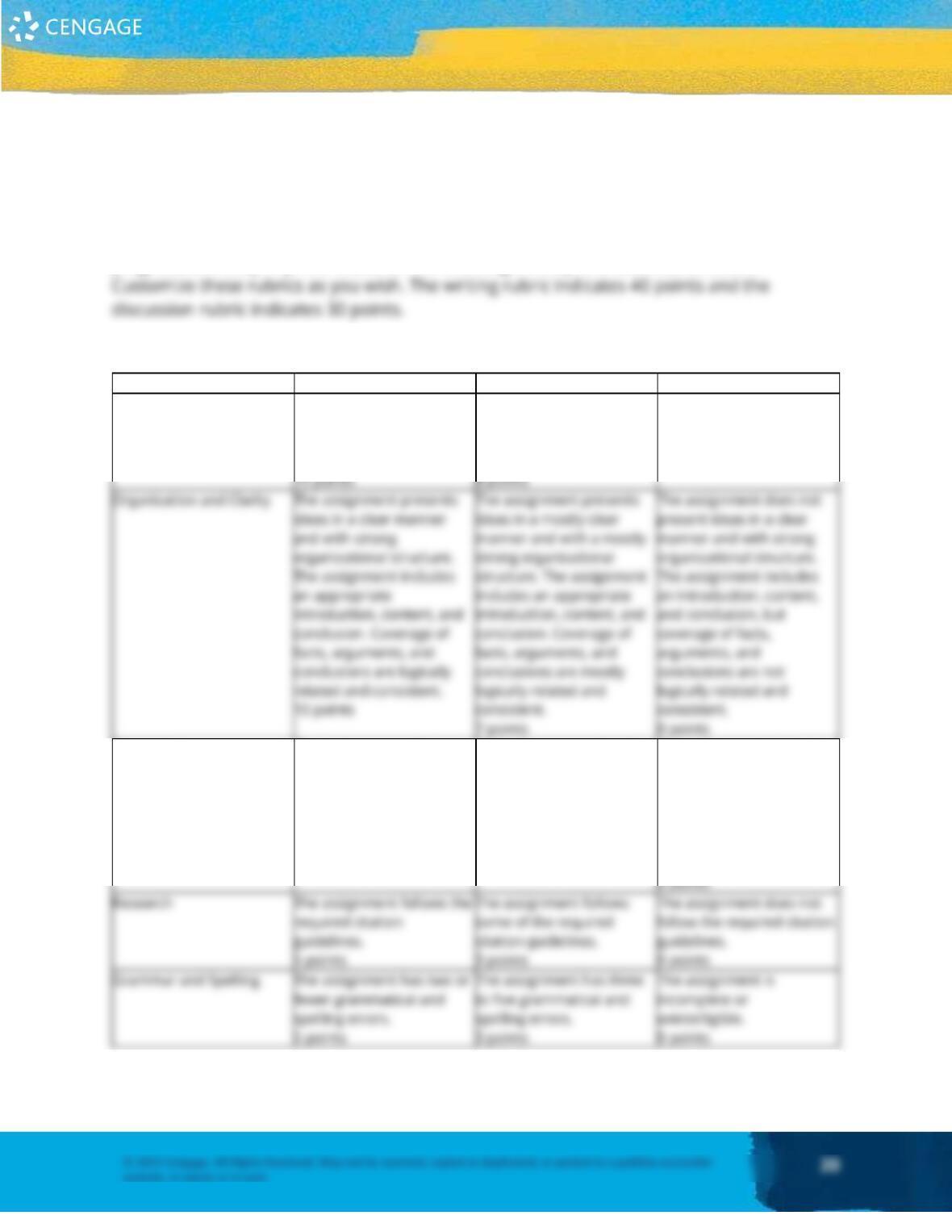
Generic Rubrics
Providing students with rubrics helps them understand expectations and components of
assignments. Rubrics help students become more aware of their learning process and
progress, and they improve students’ work through timely and detailed feedback.
Standard Writing Rubric
Criteria
Meets Requirements
Needs Improvement
Incomplete
Content
The assignment clearly and
comprehensively
addresses all questions in
the assignment.
The assignment partially
addresses some or all
questions in the
assignment.
The assignment does not
address the questions in
the assignment.
0 points
Research
The assignment is based
upon appropriate and
adequate academic
literature, including peer
reviewed journals and
other scholarly work.
5 points
The assignment is based
upon adequate academic
literature but does not
include peer reviewed
journals and other
scholarly work.
3 points
The assignment is not
based upon appropriate
and adequate academic
literature and does not
include peer reviewed
journals and other
scholarly work.
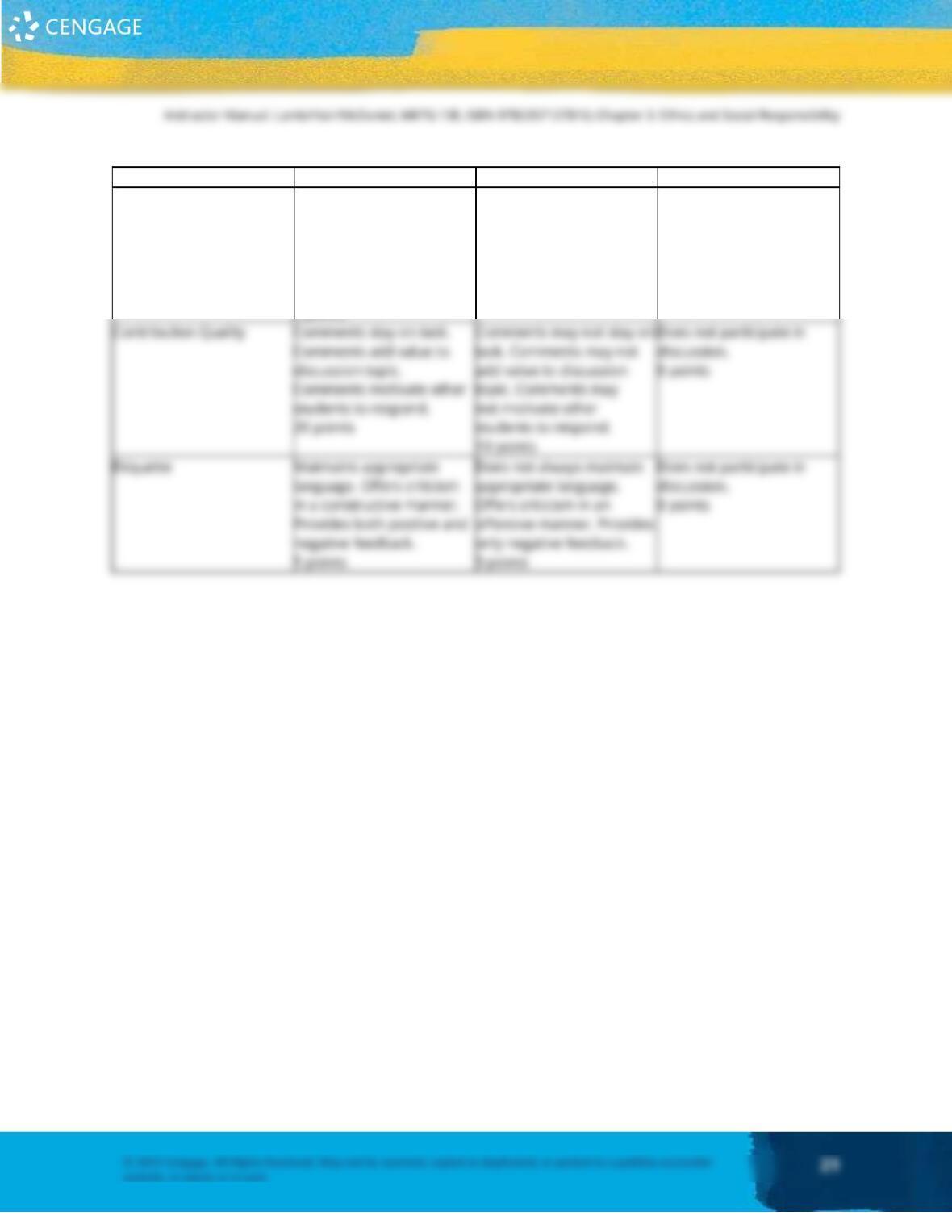
Standard Discussion Rubric
Criteria
Meets Requirements
Needs Improvement
Incomplete
Participation
Submits or participates in
discussion by the posted
deadlines. Follows all
assignment. instructions
for initial post and
responses.
Does not participate or
submit discussion by the
posted deadlines. Does not
follow instructions for
initial post and responses.
3 points
Does not participate in
discussion.
0 points