20-12 Chapter 20 ♦ Setting the Right Price
3.3 Divide into teams of four persons. Each team should choose one of the following topics: skimming,
penetration pricing, status quo pricing, price fixing, geographic pricing, adopting a single-price tactic,
flexible pricing, or professional services pricing. Each team should then pick a retailer that it feels most
closely follows the team’s chosen pricing strategy. Go to the store and write down examples of the strategy.
Interview the store manager, and get his or her views on the advantages and disadvantages of the strategy.
Each team should then make an oral report in class.
3.4 The U.S. Postal Service regularly raises the price of a first-class stamp but continues to operate in the red
year after year. Is uniform delivered pricing the best choice for first-class mail? Explain your reasoning.
destinations. 3.4 is a good question to use as the basis for a debate or small group discussions in the class.
3.5 How is the “information age” changing the nature of pricing?
The media constantly informs consumers of low price alternatives, therefore making pricing more competitive.
3.6 Have you ever paid a price penalty? How did it affect your attitude toward that company?
Student answers will vary. Price penalties are commonly used in certain industries, such as the hospitality
3.7 Imagine that you are a marketing manager for a mid-sized amusement park. You have attended an
industry-wide meeting where a colleague gave a talk about new pricing strategies for amusement parks.
You were very motivated by the seminar. Upon your return to work, write a memo to your boss
outlining the pros and cons of the new pricing strategy. End your memo with a recommendation either
for or against à la carte pricing of attractions (pricing each attraction separately rather than charging a
single high entrance fee).
4.1 Develop a price line strategy for each of these firms: a) a college bookstore, b) a restaurant, c) a video–
rental firm.
Product line pricing is setting prices for an entire line of products, which is a broader concern than setting the right
Chapter 20 ♦ Setting the Right Price 20–13
5.1 During a recession, what pricing strategies would you consider using to gain or maintain product-market
share? Explain your answer.
Periods of reduced economic activity call for special marketing tactics. One strategy, value pricing, stresses to
5.2 After a decade of astounding growth and prosperity, Americans were challenged by the economic downturn
of the early 2000s. As a result, pricing became an issue for many consumers looking to pinch pennies. This
was also true in areas where penny–pinching isn’t a common occurrence, like high-end retailers. Search the
Wall Street Journal online archives (www.wsj.com) to find an article about pricing during a recession.
Students will vary in how they respond. The main pricing tactics that are described can be considered cash
Supplemental Exercise: Group Work
Review and Applications
Review and Application Question 3.3 is suited for group work. For this activity, divide the class into small groups of
4-5 people. Students from each group should read the question and then use their textbooks, or any work that was
completed previously, to perform the exercise. Then each group should discuss or present its work to the class.
APPLICATION EXERCISE
Purpose: To show students the effects of various markups and discounts on overall sales revenue.
Setting It Up: You will want to review the markup concepts from chapter 19 and the concept of discounts from this
chapter. Know in advance that creator of the problem has found that for his students, the problem has been virtually
unsolvable. For this reason, you may wish to use it as a small group activity/lecture launcher for the topic of discounts.
This application exercise was inspired by the following Great Idea in Teaching Marketing:
William H. Brannen
Creighton University
CAN YOUR MARKETING STUDENTS SOLVE THE BANANA PROBLEM? CAN YOU?
20-14 Chapter 20 ♦ Setting the Right Price
THE BANANA PROBLEM
The average markup for a produce department is 28% on selling price. When sold at a 28% markup on selling price,
Solution:
My quantitative friend and colleague, Dr. I-Shien Chien, works the problem in a mathematical formula as follows:
My own solution is mathematically not so pure, but does illustrate to many students exactly what is going on when
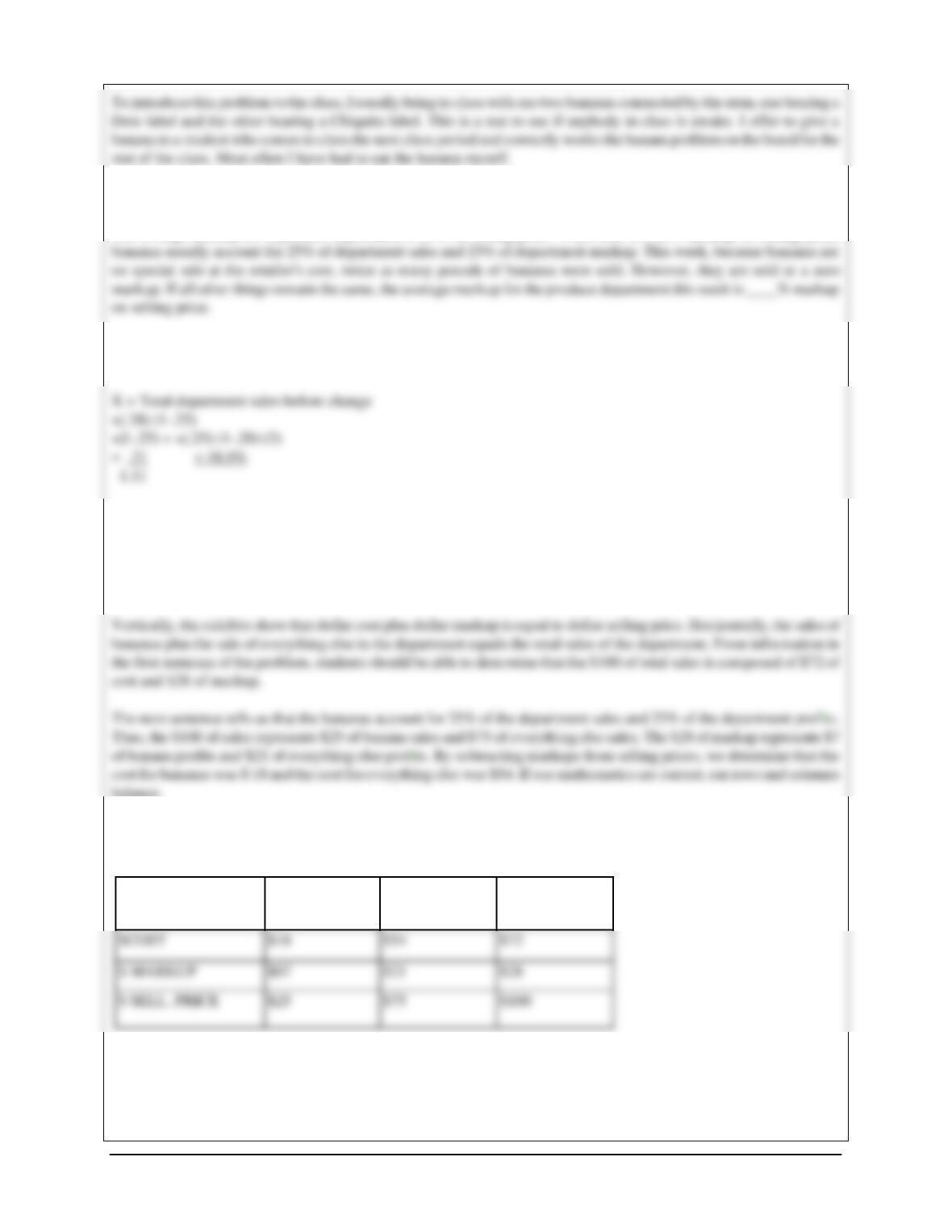
bananas are on sale. This solution focuses on an example which is illustrated in Exhibits 1 and 2.
Exhibit 1 is for a normal week when bananas are not on a special sale price. For purpose of illustration, it is assumed that
total sales for the produce department for that week are $100. Students are then asked to begin reading the problem,
sentence by sentence, to fill in the empty boxes with whatever other information they can determine.
balance.
EXHIBIT 1 PRODUCE DEPARTMENT IN ‘TYPICAL” WEEK
PRODUCTS
BANANAS
EVERYTHING
ELSE
TOTAL
At this point, students should be able to see what happened during a normal week when bananas were not on sale at a
special price.
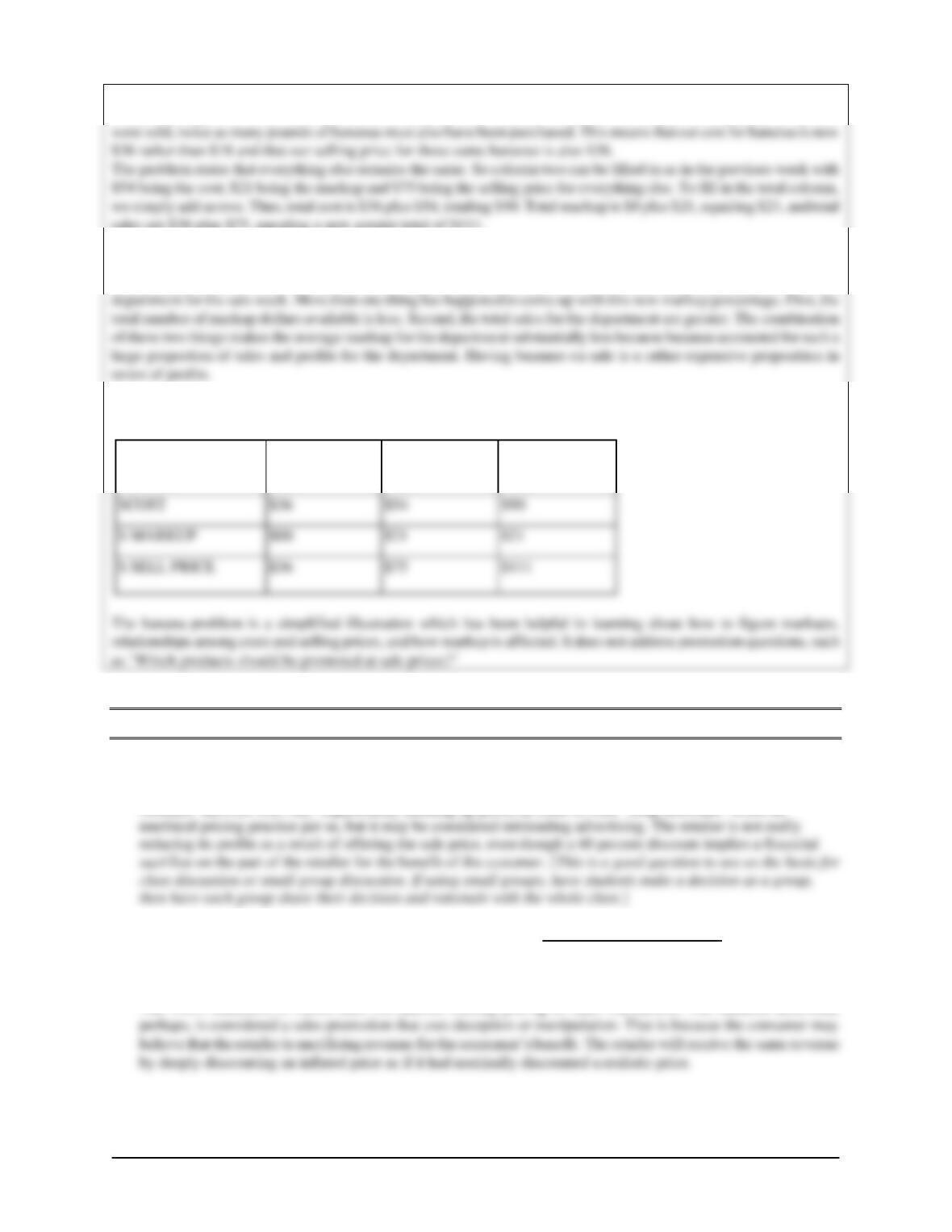
Now we move to Exhibit 2, beginning with all the boxes empty. The next sentence of the problem tells us that bananas
are on sale and that they are being sold at cost. This should tell the student that the dollar markup from bananas is zero
Chapter 20 ♦ Setting the Right Price 20–15
and that the figure in the cost and markup boxes for bananas will be an identical amount.
The problem goes on to tell us that twice as many pounds of bananas were sold. If twice as many pounds of bananas
sales are $36 plus $75, equaling a new greater total of $111.
To find the average markup for the produce department for the sale week, we now divide the total number of markup
dollars by the total sales. $21 divided by $111 is equal to approximately 19%. This is the average markup for the produce
EXHIBIT 2 PRODUCE DEPARTMENT WITH BANANAS ON SALE
PRODUCTS
$
BANANAS
EVERYTHING
ELSE
TOTAL
ETHICS EXERCISE
1. What do you think?
Students’ answers will vary. Significantly marking up prices in order to offer “deep discounts” is not an
2. Does the AMA Statement of Ethics address this issue? Go to www.marketingpower.com and review the
statement. Then, write a brief paragraph summarizing what the AMA Statement of Ethics contains that
relates to retail pricing.
The AMA Statement of Ethics does not address markup pricing or retail markdowns. The situation described,
20-16 Chapter 20 ♦ Setting the Right Price
MARKETING PLAN EXERCISE
For continued general assistance on business plans and marketing plans, visit www.bplans.com or
CASE STUDY
Black Friday Sales—Deal…or No Deal?
1. Are the Black Friday deals discussed here examples of seasonal discounts? Why or why not?
Black Friday deals would not be examples of seasonal discounts. Seasonal discounts are price reductions for
2. During the 2008 holiday season as it was becoming evident that the U.S. was entering a severe recession,
many retailers found themselves with way too much inventory as consumers were sharply cutting back
on spending. When holiday sales came in well below expected levels, retailers were forced to drastically
slash prices to get rid of excess inventory. How would you handle a situation like that and what pricing
strategies would you use to encourage customers to come out, while trying to avoid cutting too much into
profits?
LESSON PLAN FOR VIDEO
Company Clips
Segment Summary: Pricing Perspectives – Method, ReadyMadeMag, Sephora, Vans, and Acid+All
Setting the right price is one of the most challenging aspects of a marketer’s job. How high a price will the market bear?
What kind of message does the price communicate? How flexible can our price be? The answer to those and a
Chapter 20 ♦ Setting the Right Price 20–17
1. Compare the pricing strategies of Method, ReadyMade, and Acid+All. Do all of these relatively new brands
use the same strategy? Explain.
The pricing strategy for Method and Acid+All are similar in that their product fills the “best spot” in their market
2. In what ways is the pricing strategy of Sephora similar to that of Acid+All?
3. Does it make sense for Method to use product line pricing? Why or why not?
4. What is Vans’ primary strategy for setting prices on tickets to the Warped Tour it sponsors?
Supplemental Exercise: Video
Company Clips
Pre-Class Prep for You:
• Preview the Company Clips video segment for Chapter 20. This exercise reviews concepts for LO1, LO3, and LO4.
• Review your lesson plan.
• Make sure you have all of the equipment needed to show the video to the class, including the DVD and a way to
project the video.
• Ask students to choose one of the terms or concepts from the list above to explain to a student who has not studied
• Have students summarize the pricing strategy of at least two stores or companies they use or otherwise know
Pre-Class Prep for Students:
• Have students review and familiarize themselves with the following terms and concepts: setting price; tactics for fine
Video Review Exercise Activity
• Warm-up
o Have an open discussion about the pricing strategies used by the students’ favorite companies.
o Do they have distinct product lines? How do prices differ from their competition? Are the messages the
company sends with its prices consistent with how students perceive their brand(s)?
• In-Class Preview
o Review Exhibit 20.1, Steps in Setting the Right Price, with the class. Follow review of the diagram with a
discussion of price strategies listed on following pages. Point out that price strategy is strongly influenced
by the other three Ps in the marketing mix.
20-18 Chapter 20 ♦ Setting the Right Price
o Divide the class into small groups for the following activity: Determine what products each company does
Supplemental Exercise: Class Activity
Pricing Strategies
The goal of this exercise is to make students aware of pricing strategies used by the airline industry.
• Have your students collect price quotes for airline tickets to a city pair with departure dates that are less than 7, 7,
What kind of pricing strategy is being used?
GREAT IDEAS FOR TEACHING CHAPTER 20
Keith Absher, University of North Alabama
RETAIL PRICE PATROL: A COMPARISON OF RETAIL PRICES
The price section in many marketing textbooks is often not as inherently interesting to students as promotion,
product, or place. I have found this simple price assignment stimulates a lot of interest on the part of the students,
Possible suggestions for store comparison could include:
1. Grocery items—large chain store, local chain, and convenience store;
The day the assignment is due, ask students to select three or four of their price comparisons and place them on
the board. You may elect to do this by types of goods, types of stores, or price ranges. This assignment can lead to an
excellent discussion of such topics as price competition, non-price competition, odd-even pricing, promotional pricing,
prestige or image pricing, customary pricing, price lining, and unit pricing.
Some possible questions for stimulating discussion are:
1. What factors do you think account for the price variations?
Chapter 20 ♦ Setting the Right Price 20–19
5. Could you identify any specific marketing strategies or policies in the stores visited?
6. Did the location of the store play a role in the prices?
______________________________________________________________________________________________
Irvine Clarke, III, Oklahoma City University
THE PRICE IS RIGHT
This exercise helps students think about consumer behavior relative to the pricing issues an international
marketer must face when introducing products into new foreign markets. It works well as an opening application for
a discussion on international pricing.
In many countries of the world, the television show, “The Price is Right,” remains a popular entertainment source.
Most students are familiar with the format of the show, whereby contestants guess the price of leading consumer goods.
________________________________________________________________________________________________
Gregory J. Baleja, Alma College
MARGINAL ANALYSIS
When lecturing on the pricing component of the Marketing Mix, I find the presentation of the various concepts
and theories to be very straightforward. Pricing theories such as cost plus pricing, market skimming, market
penetration, break-even analysis, pricing by channel members, and marginal analysis are all discussed in great depth.
However, it is this last pricing method of marginal analysis that I would like to focus this article on.
At Alma College, microeconomics is a prerequisite for the Basic Marketing course. However, having spent twenty-
three years as a professor, my experience is that for the typical student, the amount of recall from most prerequisite
20-20 Chapter 20 ♦ Setting the Right Price
The second example that I like to utilize, deals with the commercial airline industry. Again I ask the students
to focus on the “last” passenger that boards the plane prior to departure. The question that the students must answer
deals with the idea of what additional costs will be incurred by the airline if they carry one additional passenger (the
assumption here is that the plane in question is operating at less than full capacity prior to departure). The students
will quickly realize that the crew will not be paid more for carrying one additional passenger. In addition, the airline
Part 6 ♦ Pricing Decisions – Solutions 20–21
PART 6 – SOLUTIONS
MARKETING MISCUES
6pm.com’s $1.6 Million Pricing Error
1. What is the relationship between demand and price for products on the 6pm.com e-commerce site?
Evidently, there is a strong relationship between demand and price on the 6pm.com website. The relationship is
2. Should there be any legislation that requires companies to adhere to online prices even when posted in
error?
This is a difficult question to answer since it has to be viewed from both the online retailer’s and the consumer’s
CRITICAL THINKING CASE
Will a New Reservation System Translate to Higher Prices for Travelers?
1. Identify each channel member’s pricing objective.
American Airlines: sales-oriented
Retailer (e.g., Expedia, Orbitz, Priceline): profit-oriented
The pricing objective for channel members appears to vary based on position in the channel. American Airlines
juggles pricing on a daily basis so as to maximize sales. Ultimately, the goal is to have every aircraft take off with
2. What is American Airlines’ pricing strategy?
American Airlines appears to follow a penetration pricing strategy. The constant juggling of prices to accommodate
seats since customers can buy directly from the company.