21
LO: 2-1, 2-4, 2-5
6. Review the customer value framework. At the first glance, what aspects of the customer
value framework do you believe are most relevant in helping you understand that consumer
behavior is useful to study in order to make you a better consumer?
Chapter Video Summary
To view the video case on E-Business at Evo, access the Chapter 2 Media Quiz in CB8
Online (create a course at login.cengage.com).
E-Business at Evo
When ski enthusiast Bryce Phillips launched Evo from his garage in 2001, the sports equipment
company consisted of an Internet connection, used ski gear, and a single employee. Today the
Seattle-based ski-and-snowboard retailer is the premier online destination for closeout-model
equipment and apparel. Consumers of ski and water sport products choose Evo for its online
shopping experience, discounted brand name merchandise, and no-haggle customer service. The
retailer’s website also delivers value through detailed product reviews and Evo-hosted travel
opportunities.
Ask Your Students
1. According to Bryce, what is the heart and soul of Evo?
22
©2018 Cengage Learning. All Rights Reserved. May not be scanned, copied or duplicated, or posted to a publicly accessible website, in whole or in part.
Answer: Bryce Phillips says, “In many ways the retail environment, the brick-and-mortar,
the physical presence of the store are the heart and soul of the company. You know,
whether it be a customer, or a sales manager or a rep, or whoever it may be; they can come
in and really kind of experience what our brand is all about.”
BUSPROG: Reflective Thinking
DISC: Customer
LO: 2-3
Topic: A-head: Marketing Strategy and Consumer Value
Bloom’s: Knowledge
Difficulty: Easy
2. How does Evo offer value to its customers?
3. Name a significant competitive advantage of Evo.
23
©2018 Cengage Learning. All Rights Reserved. May not be scanned, copied or duplicated, or posted to a publicly accessible website, in whole or in part.
customers who prefer shopping online. Evo also sells street wear apart from skis,
snowboards, wakeboards, skateboards, and so on. This product differentiation strategy
gives it an upper hand over its competitors.
BUSPROG: Analytic
DISC: Customer
LO: 2-3 | 2-4
Topic: A-head: Marketing Strategy and Consumer Value | Market Characteristics: Market
Segments and Product Differentiation
Bloom’s: Analysis
Difficulty: Challenging
Part 1 In-Text Case Answers
Case 1-1 IDEO: Consumer-Focused Innovation
1. Where does IDEO get inspiration for its product designs?
2. What kind of value do you think successful products deliver to consumers?
©2018 Cengage Learning. All Rights Reserved. May not be scanned, copied or duplicated, or posted to a publicly accessible website, in whole or in part.
3. Why do you think having a product that simply works doesn’t always translate to
consumer acceptance?
4. What is the relative importance of the utilitarian versus the hedonic value of products, as
suggested by the work of IDEO?
©2018 Cengage Learning. All Rights Reserved. May not be scanned, copied or duplicated, or posted to a publicly accessible website, in whole or in part.
5. Do you agree with Edison’s observation that “genius is 1% inspiration and 99%
perspiration”? Explain your answer.
Case 1-2 Born or Reinvented in the “Foreign” Land? Examining Brands and Their
Country of Origin
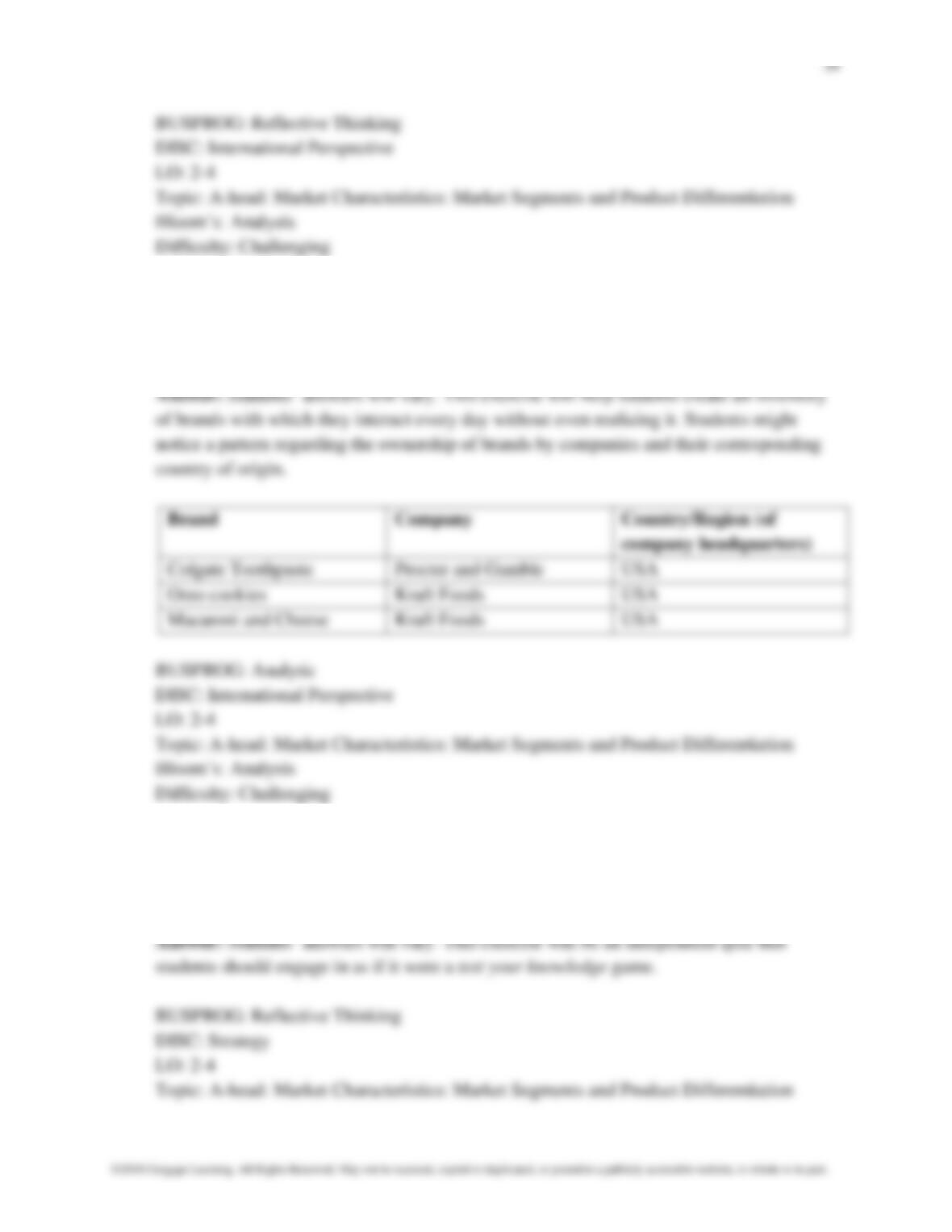
1. Examine further the “2011 Ranking of Top 100 Brands.” Classify these brands while
considering the product category or sector and the country of origin. Can you detect a
pattern? For example, do you see that strong players in the automotive sector emerge
largely in Western Europe?
©2018 Cengage Learning. All Rights Reserved. May not be scanned, copied or duplicated, or posted to a publicly accessible website, in whole or in part.
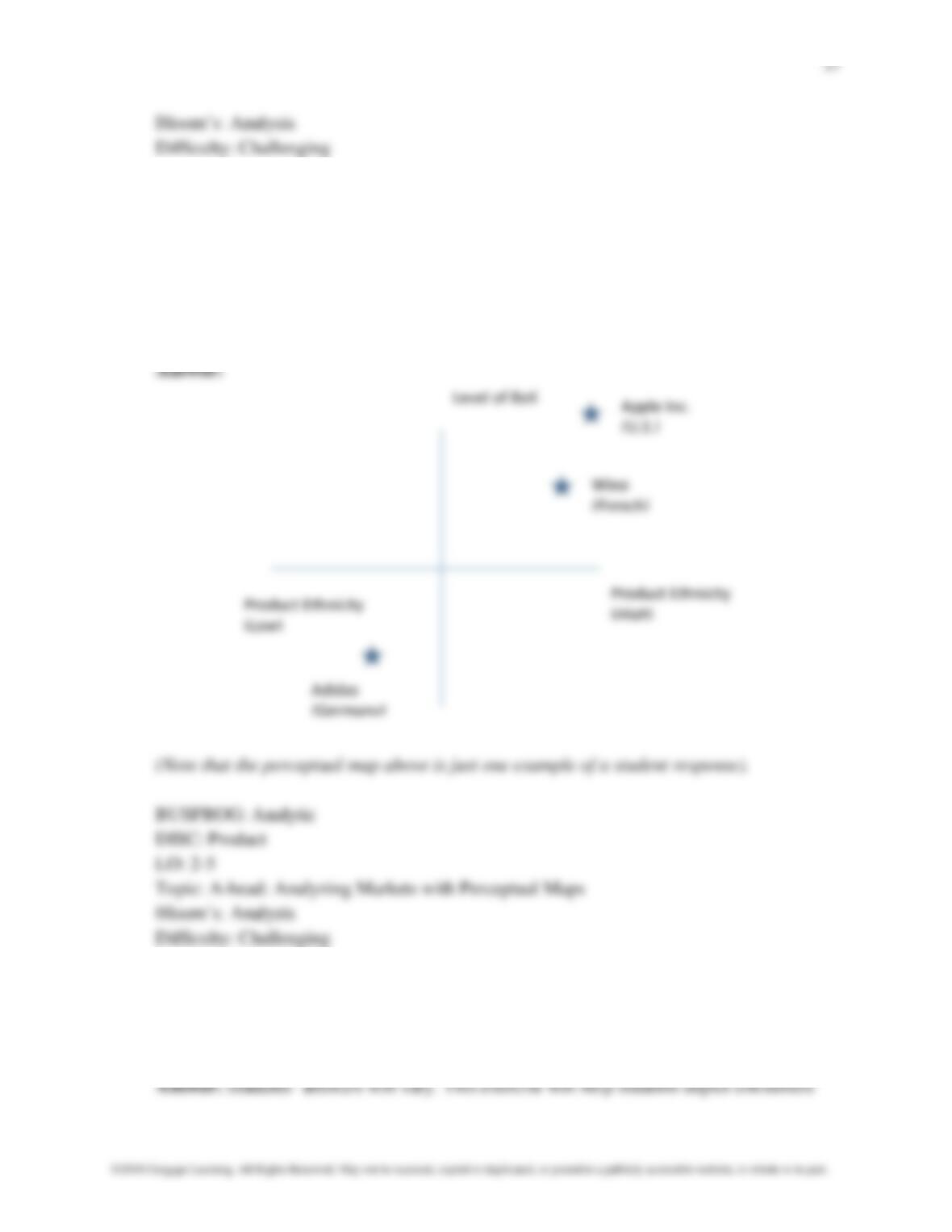
2. List all the brands that you have in your home. Then research to find the country of origin
of all the brands on your list. What do you find? How can marketing professionals make
use of the information that you have analyzed?
3. Use the “2011 Ranking of Top 100 Brands” table to test the level of BoK of at least five
people (excluding yourself). Examine and write a short reflection on how the extent of
their knowledge varies with their lifestyles.
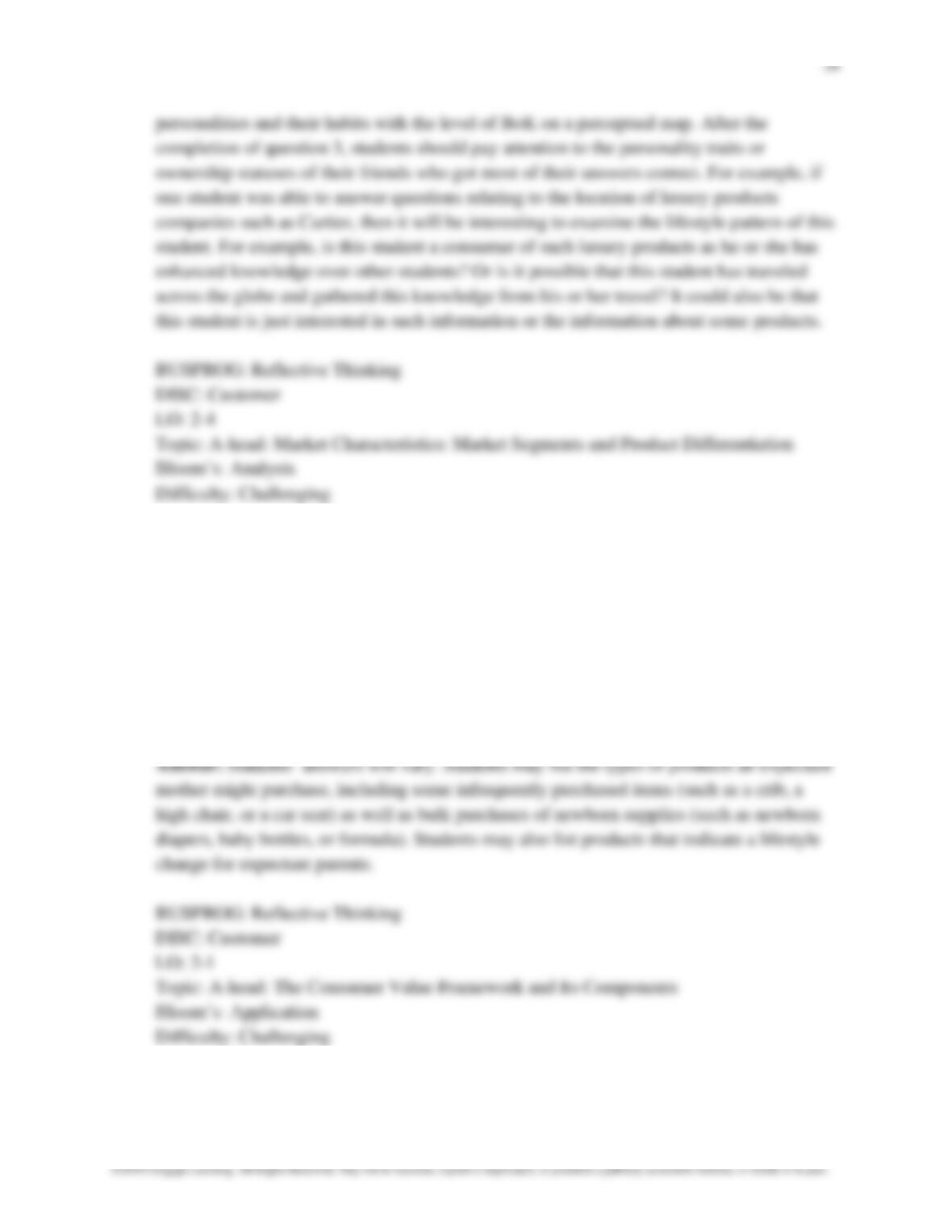
4. Your textbook refers to the concept of perceptual maps. Construct a perceptual map using
the following two dimensions: (i) product ethnicity (low versus high) and (ii) level of BoK
(low versus high). Choose at least 10 brands or product categories to represent on the map.
You may use the list of brands/categories available at the Interbrand website to populate a
list for the map. Use the information from question 3 to identify the average level of
knowledge of product ethnicity and extent of BoK.
5. Using the information in question 3, how do you think a company can enhance its
understanding of market segmentation so as to efficiently target a marketing message to its
potential and existing consumers?
©2018 Cengage Learning. All Rights Reserved. May not be scanned, copied or duplicated, or posted to a publicly accessible website, in whole or in part.
Case 1-3 DemandTec®: Using Collaborative Analytics in a Fragmented Latin American
Market
1. Predictive models used by Target identified changes in the purchase behavior of female
shoppers that indicated they might be pregnant, including increased spending on
supplements important to neonatal development as well as unscented soaps and lotions.
What other changes in purchase behavior might indicate that a female shopper is
expecting?
2. How does the use of collaborative analytics provide value to the consumer and help to
29
facilitate exchanges between buyers and sellers?
3. Based on collaborative analytics, Target created targeted sales promotions for newly
expectant mothers, such as mailing coupons to them for purchasing diapers or baby bottles.
GPA, in Brazil, uses collaborative analytics to optimize prices for their various customer
segments. These are only two of the four marketing mix variables. Can you think of other
ways that companies might use collaborative analytics to fine-tune the other marketing mix
variables?
4. GPA uses collaborative analytics to look at the shopping behavior of their customers. The
next time you purchase food items (groceries), make a list of every item you purchased.
Try to organize the items in a meaningful way. Imagine that a researcher was using
ethnographic methods to analyze your grocery list. What insights might they have about
you based on your purchases?
30
©2018 Cengage Learning. All Rights Reserved. May not be scanned, copied or duplicated, or posted to a publicly accessible website, in whole or in part.
Answer: Students’ answers will vary. At first, students might list “surface” responses
about the types of products they purchased. However, as they start to think critically about
the list, they may make inferences about their lifestyle choices based on the nature of their
purchased products (i.e., natural, healthy, unhealthy, vegan) or the way these products
might be used (i.e., for entertaining). This question could be adapted to provide students
with a list from an anonymous shopper, which would remove their knowledge of their own
lifestyles and purchase behavior.
BUSPROG: Reflective Thinking
DISC: Customer
LO: 2-4
Topic: A-head: Market Characteristics: Market Segments and Product Differentiation
Bloom’s: Analysis
Difficulty: Challenging
5. Choose a local retailer that is not part of a national or regional chain. Assume they have
decided to expand their efforts internationally and have therefore enlisted the help of
DemandTec. How will the use of collaborative analytics help them to better understand
consumers in this new market?
Case 1-4 Sears: A Dying Company?
1. Describe how some of the trends mentioned in the textbook are affecting Sears.
©2018 Cengage Learning. All Rights Reserved. May not be scanned, copied or duplicated, or posted to a publicly accessible website, in whole or in part.
2. Describe the external and situational influences that steer shoppers like Ashley away from
Sears.
3. Compare the total value concept for Sears and your favorite retailer.