Chapter 2: Social consumers
Chapter overview
In Chapter 2, students learn about segmentation and targeting. The chapter begins with a review
of the segmentation process and the bases of segmentation. Explanations relate directly to social
media marketing but reinforce the bases of segmentation covered in principles of marketing and
consumer behaviour courses. The chapter introduces social media data left behind as we interact
online, how marketers can use the data and related concerns about privacy. The second part of
the chapter explains the motives for social media participation and the importance of
understanding motives when designing social media marketing campaigns. The chapter
concludes with segmentation schemes that relate directly to social media behaviour.
Running Case Study: 221BC’s Segmentation and Targeting
Critical Reflection: Do We Have The Right To Be Forgotten? How Courts Evaluate
Social Media Infringements of Freedom of Speech versus Freedom of Privacy
Teaching tips and resources
To review the relevance of social media participation to one’s personal brand:
For discussion of the Critical Reflection and privacy concerns:
Learning objectives
When students finish reading this chapter, they should be able to answer these questions:
1. Why do social media marketers need to understand the behaviour of consumer
segments? What are the bases of segmentation used to group consumers?
2. What are the elements of social identity? How do individuals build their social
identities? How are these identities relevant to marketers?
Chapter outline
I. Segmentation and Targeting for Social Media Marketing
A. Profiling the Targeted Segments
1. Market segmentation is the process of dividing a market into distinct groups that
have common needs and characteristics.
2. Marketers use several variables as the basis to segment markets including
geographic, demographic, psychographic, benefits sought and behaviour.
B. Geographic Segmentation
1. Geographic segmentation refers to segmenting markets by region, country,
market size, market density, or climate.
2. GPS technology is a satellite system that provides real-time location and time
information.
3. For social media marketers, there are three geolocation techniques:
C. Demographic Segmentation
1. When marketers employ demographic segmentation they utilise common
characteristics such as age, gender, income, ethnic background, educational
attainment, family life cycle and occupation to understand how to group similar
consumers together.
2. General Mills creates specialised campaigns for different demographic segments,
such as when it launched QueRicaVida.com as an online platform for Latina
moms.
D. Psychological Segmentation
1. Psychographic segmentation approaches slice up the market based on
personality, motives, lifestyles and attitudes and opinions.
2. Understanding how people’s lifestyles influence marketing is relevant here.
E. Benefit Segmentation
2. A buyer persona is a snapshot of your ideal customer that tells a story using the
information you used for segmentation.
II. Social Identity
• Social identity is the way we represent ourselves via text, images, sounds
and video to others who access the Web.
• Big Social Data (BSD) is data generated from technology-mediated social
interactions and actions online, which can be collected and analysed.
A. Social Touchpoints: The DNA of Social Identity
B. Social Footprints
1. A social footprint is the mark a person is present in a social media space.
2. Records of your activities may make up a lifestream (assuming you share
enough detail with regularity), which is essentially a diary you keep through
your social media activities.
C. Your Social Brand
D. Your Social Brand in the Age of Selfies
1. A hashtag is a word or phrase comprised of letters, numbers and/or emoji
preceded by what was once referred to as the pound symbol (#).
2. A selfie is one of the most active aspects because you are in control.
3. A personal social media audit should categorise social media activity
according to the values expressed in the social engagement.
• Vision: A vision post answers the questions, ‘Did I learn
something? Was I inspired?’
4. Once you’ve completed the audit, you will be ready to cultivate a personal
brand identity using social media by answering five questions.
• What goal are you seeking to accomplish?
• What do you want to be known for?
• What groups and people are active in your desired field and
which social media channels do they use?
III. Motives and Attitudes Influencing Social Media Activities
A. Motives and Attitudes Influences Social Media Activities: Why We Login
1. Affinity impulse: Social networks enable participants to express an affinity, to
acknowledge a liking and/or relationship with individuals and reference groups.
2. Personal utility impulse: While we tend to think of social media participation
truly as community participation, some do consider, ‘What’s in it for me?’ This is
4. Altruistic impulse: Some participate in social media as a way to do something
good. They use social media to ‘make the world a better place’ and ‘pay it
forward’. The altruistic impulse is also aided by the immediacy of social media,
and this value has been played out in the immediate altruistic responses (IAR)
of social media users to aid calls during crises such as the earthquake relief for
Haiti or Japan. Altruism can also explain negatively-valenced social media
activities including ‘altruistic punishment’, in which social media users seek to
draw attention to a company or person whose behaviour is unacceptable to the
B. Privacy Salience: How Much Do They Know and How Much Do They Care?
1. The extent to which one worries about privacy and the risks related to the
collection, unauthorised secondary use, errors in and improper access of personal
data is known as privacy salience.
2. The privacy paradox describes people’s willingness to disclose personal
information in social media channels despite expressing high levels of concern for
privacy protection.
3. Social privacy refers to concerns about disclosing personal information to others.
IV. Social Media Segments
A. Social Technographics
1. Social technographics is based on research conducted on the social and digital
lives of consumers.
2. There are six types of social behaviour. People can belong to multiple categories.
Categories included joiners, spectators, creators, critics, collectors and
conversationalists.
3. The behaviours are still useful, but as the population of social media users became
increasingly savvy and engaged, a revised model incorporates an overall score of
social media usage. The Social Technographics Score reflects how actively a
segment uses social tools, how important those tools are within customer life
cycle, how willingly they engage with brands in social media.
• Social stars (scores of 60+) demand social interactions with your
company.
4. Figure 2.7 illustrates Forrester’s Social Technographics model.
5. Social Technographics also provides scores by customer life cycle stage, to enable
brands to better choose objectives for social media marketing.
• Discover score – measures the extent to which the target audience uses
social media to learn about new brands as well as how likely they are
to spread the word about their favourite products and services.
• Explore score – gauges whether social media can be used to create
purchase intent.
B. The Social Consumption/Creation Matrix
1. Another segmentation framework, the Social Consumption/Creation Matrix,
categorises social media user types according to their degree of social media
consumption and creation.
• Attention seekers have large networks, high social capital and the
ability to create and promote social content.
2. Figure 2.8 illustrates the Social Consumption/Creation Matrix.
C. Typology of Social Utility
1. Researchers took a different approach to categorising social media segments using
user propensity to socialise and seek information in social media communities. By
categorising social media users into passive or active information seekers and
passive or active participants, four segments were identified and form the
typology of social utility.
• Minimalists
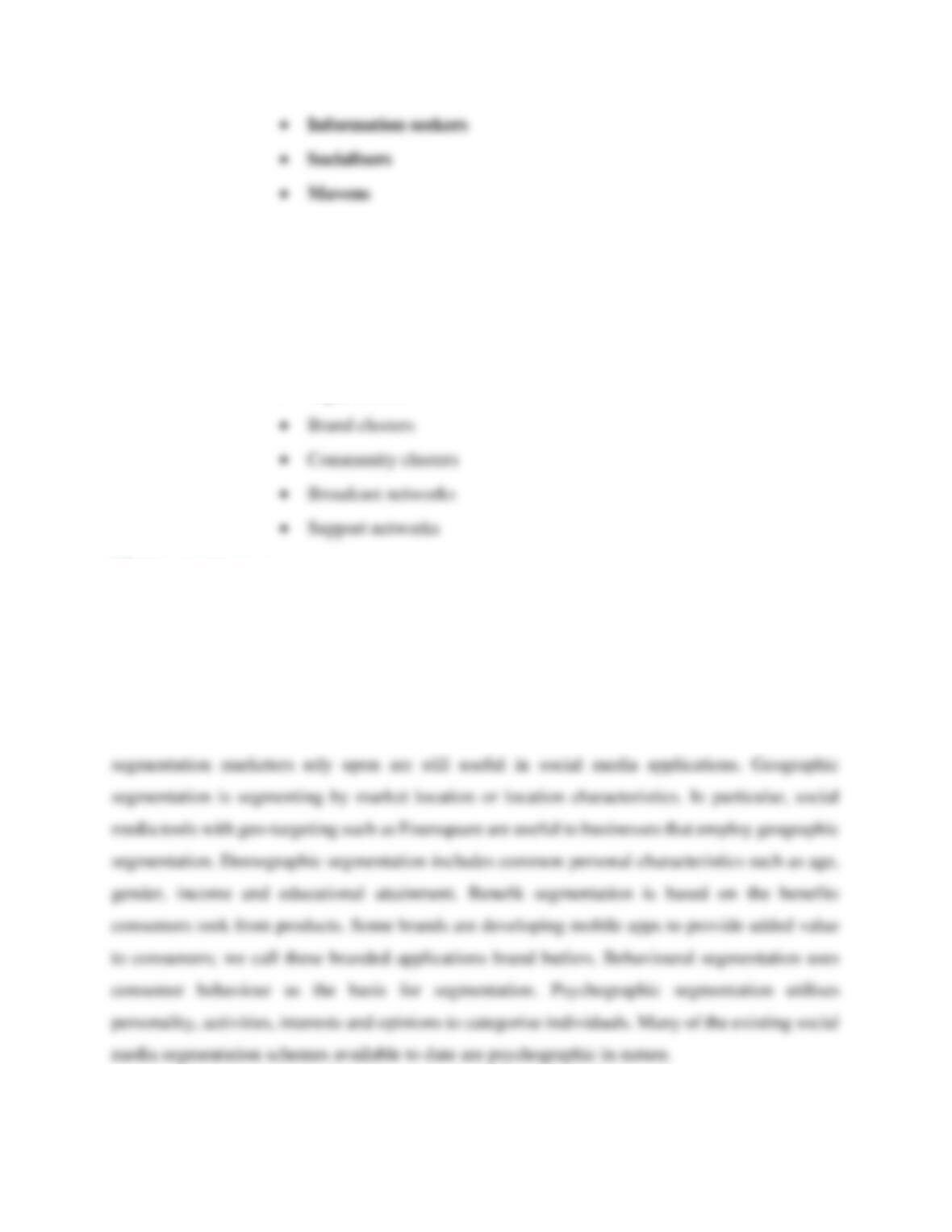
2. Figure 2.9 illustrates the typology of social utility.
D. Microblog User Types
1. There are six specific archetypes of social media participation in its analysis of
Twitter conversations.
• Polarised crowds
• Tight crowds
Chapter summary
1. Why do social media marketers need to understand the behaviour of consumer segments?
What are the bases of segmentation used to group consumers?
Segmentation is the process by which the total available market is clustered into groups, based on
similarities. Once a target segment is selected, the segmentation characteristics of the group
provide insights marketers use to design effective marketing offers. The traditional bases of
2. What are the aspects of social identity? How do individuals build their social identities?
How are these identities relevant to marketers?
Social identity is the information marketers collect using our social footprints (the residue from
3. What behaviours are exhibited by people using social media? To what extent are people
participating in the four zones of social media?
Increasingly our lives are spent online checking email, shopping, banking, watching videos,
playing games and socialising in social networks. In zone 1, consumers interact and communicate
4. How can we explain the motives for participation in social media activities? What attitudes
are most relevant for our understanding of social consumer behaviour?
There are several motivations for consumer participation in social media activities. The affinity
impulse is our need to acknowledge a liking or relationship with individuals or reference groups.
5. What are the most important segments of social media consumers? What do they tell us
about targeting users of the social Web?
Several typologies of digital consumers exist, including the Social Technographics profiles from
Forrester Research, the Social Consumption/Creation Matrix, the Typology of Social Utility and
Chapter 2 Appendix
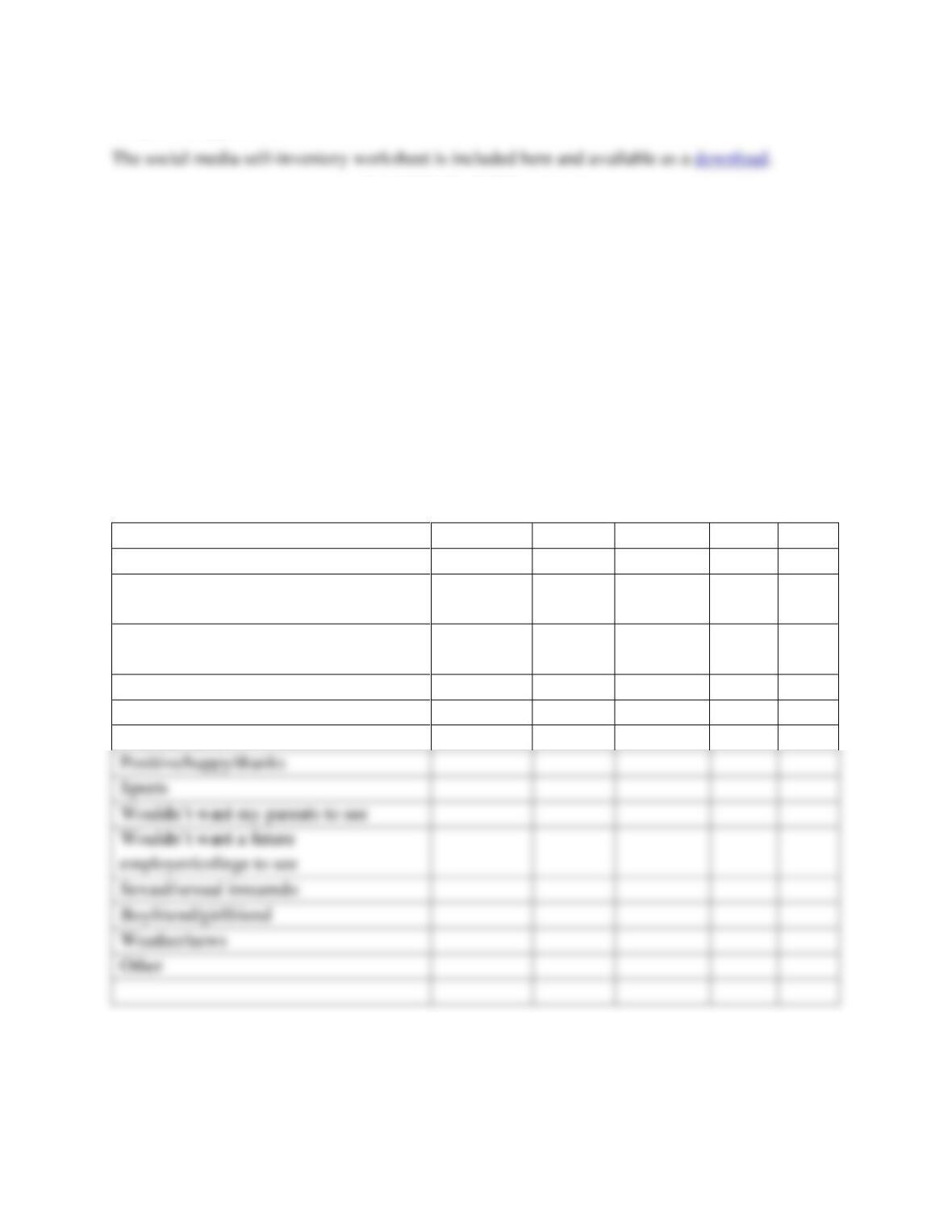
Social Media Self-Inventory
Name _____________________________________________________________________
Part 1: You Are What You Post
• Analyse at least 100 of your OWN posts on the SNS of your choice. You are
welcome to go back further than 100 posts.
• Be honest with your results, but keep it to tally marks only. (I don’t want to know
your business!) Some posts may be tallied into multiple categories. For instance, a
post can be negative AND something you don’t want your parents to see.
• Calculate the % of each type of post. You may then use the information to create a
graphic of YOU in social media. Remember: in social media, you are your posts!
Type of post
Instagram
Twitter
Facebook
Other
Total
Selfie
Questionable language/racial
slurs/bullying
Highlight positive activities, hobbies,
volunteer work
Quotes/song lyrics/ TV
Teen angst/anti-authority
Weather/news
Positive/happy/thanks
Sports
employer/college to see
Sexual/sexual innuendo
Boyfriend/girlfriend
Weather/news
Other
Part 2: Brand You
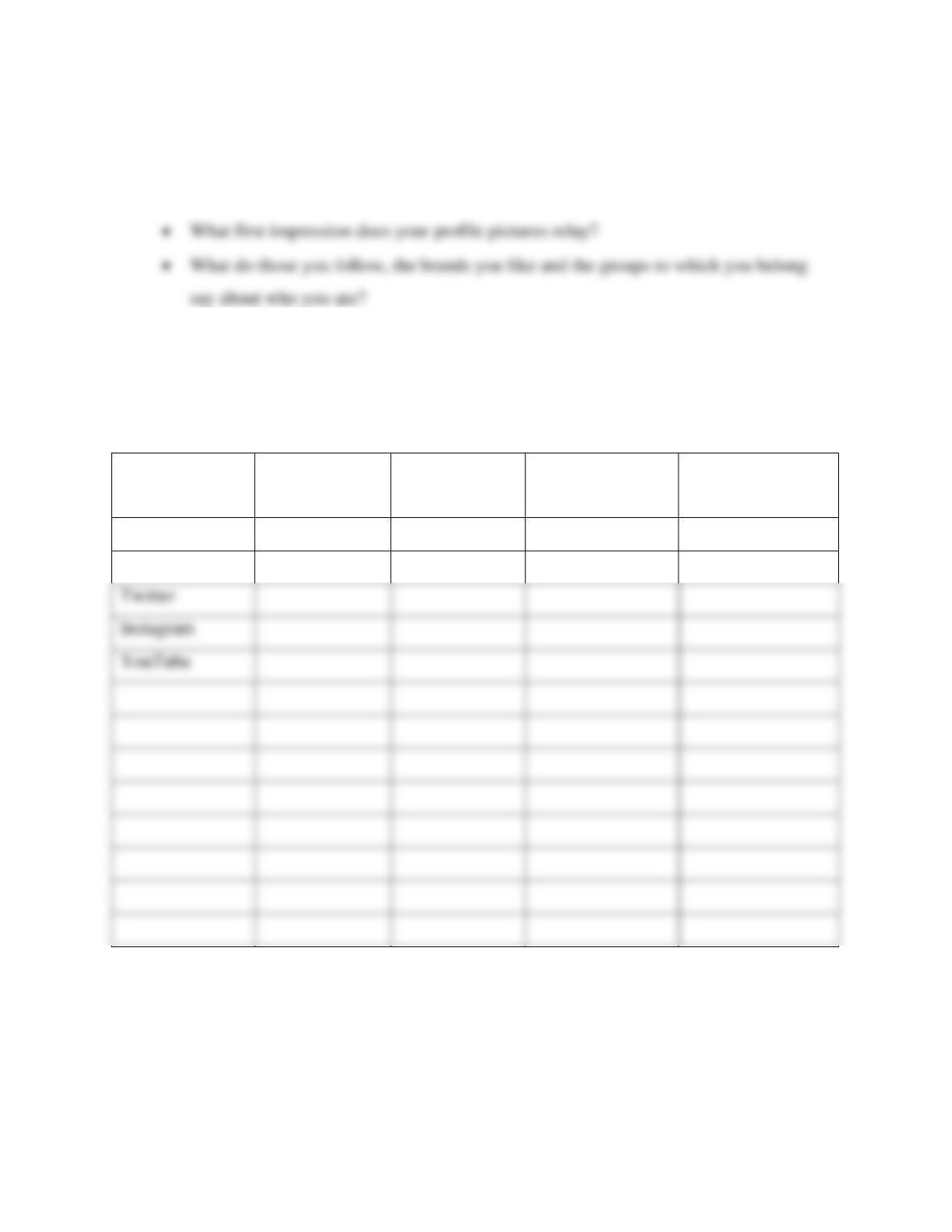
• What do your social media handles say about who you are? Should you change
them?
• What is the primary communication objective you have for each social media
channel in which you participate?
• Given the primary objective, how do you need to change your posting behaviour in
the future?
Handle
Profile pic ok?
Relationships
ok?
Communication
objective
LinkedIn
Facebook
Twitter
Instagram
YouTube
Part 3: Class Discussion
1. Share percent of post types. Are the results surprising? How/why? Having reviewed
your posts and seen those of your classmates, what changes do you wish to make in
your future posts?
2. Your profile handle and picture are relevant whether your account is strictly for
personal (and private) use or for business use. This is because even if your account is
totally private, others can see your handle and profile picture. Move around the room
so you are sitting with someone you don’t know well. Then ask the person closest to
you what characteristics they would expect from the person pictured in your social
media profile pictures.
5. Now that we’ve done this activity, what are your plans?