
The Top 10 Franchises for 2017 include many familiar names. Students will likely report having
8. Best Buy is a category specialist with more than 1,400 store locations. It sells appliances
(refrigerators, washers and dryers, small household appliances) and electronics (televisions,
computers, cell phones, car electronics, wearable technology). What are the SIC and NAICS
codes used by this retailer? What other retailers compete against Best Buy, and which store
format is implemented by each competitor?
PRIMARY SIC AND NAICS CODES
Primary Industry
Consumer Electronics &
Appliances Stores
Primary SIC Code
57310000: Radio, television,
and electronic stores
Primary NAICS Code
443142: Electronics Stores
Top Best Buy Competitors
Company
Format
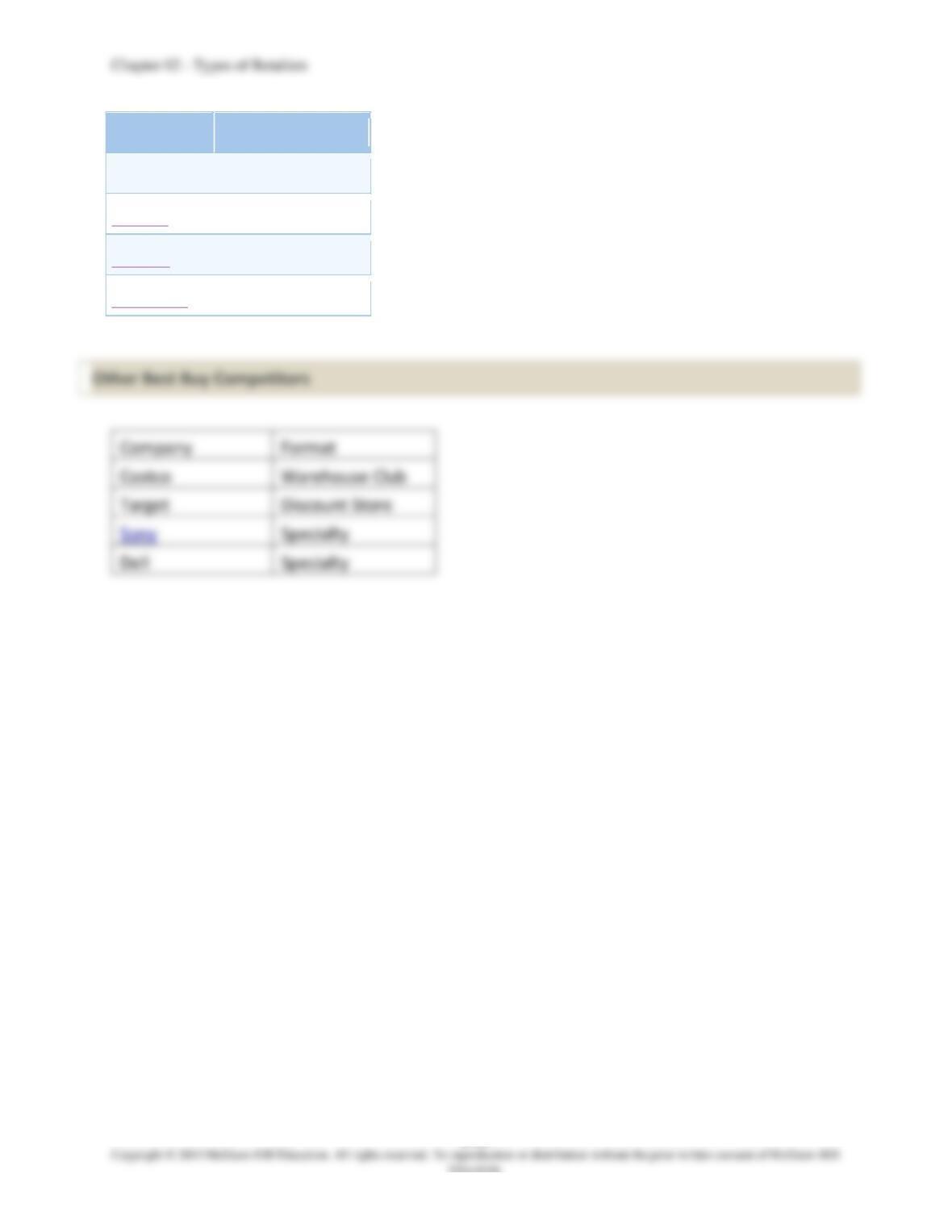
Company
Format
Best Buy
Category Killer
Wal-Mart
Discount Store
Apple Inc.
Specialty
Amazon.com
Electronic Retailer
ANSWERS TO DISCUSSION QUESTIONS AND PROBLEMS
1. Distinguish between variety and assortment. Why are these important elements of retail
market structure?
The main difference between variety and assortment is that variety refers to the number of
different merchandise categories a retailer sells, whereas assortment is the number of
2. What sorts of competitive pressures are confronting traditional grocery stores? What
options do these stores have to ease these pressures?
Supermarkets are under competitive pressures from supercenters, warehouse clubs,
extreme-value retailers, convenience stores, and even drug stores. These retailers have
increased the amount of space that they provide for consumables. In addition, these
3. What do off-price retailers need to do to compete against other formats in the future?
The main competitive weapon for the off-price retailers is their low price. While they may
not directly compete with higher service formats, such as department and specialty stores,
they do face increasing competition from discount stores. Here, the off-price stores may be
at a relative disadvantage since their merchandise is based upon opportunistic buying, while
discount stores offer a relatively stable mix of merchandise at stable prices (everyday low
pricing).
but near major highways). They can also implement more efficient inventory and
merchandise management systems (note that for a discount store, such as Walmart,
operational efficiency and costs reductions are crucial to offering lower prices to
customers). Also, they can expand their sourcing to include imports from low cost
international markets.
4. Compare and contrast the retail mixes of convenience stores, traditional supermarkets,
superstores, and warehouse stores. Can all of these food retail institutions be successful
over the long run? How? Why?

Chapter 02 – Types of Retailers
Element of
Retail Mix
Convenience Store
Traditional
Supermarket
Superstore
Warehouse Store
Location
Typically
freestanding, easily
Typically in strip
shopping centers
Typically in strip
shopping centers
Typically in strip
shopping centers
opportunistic buying.
Pricing
Higher pricing than
supermarkets
Average pricing.
Some chains have
constant (every day)
pricing and others
have special sale
Store design and
Designed for quick
and easy
selection and
checkout
Typically use a grid–
iron with cross-hatch
signs.
Same as
supermarket.
Same as supermarket. A
bit more disorganized
the feel of searching for
a bargain.
Lower pricing than
supermarkets.
Typical every day
pricing.
Lower pricing than
supermarkets. Pricing
depends on cost of
merchandise bought on
special buys.
Service
Minimal
Some services for
produce, bakery,
meat and fish
categories.
Some services for
produce, bakery,
meat and fish areas.
Minimal
All four types will persist because they appeal to different customer needs. The warehouse
stores typically have larger pack sizes that are very attractive to customers with large
families and to small business owners like local restaurants. In addition, due to the varying
assortments, customers who are brand loyal might not want to shop in these stores.
The superstores are low in price but more inconvenient to shop in because of the large size.
Thus they appeal to customers who are very price conscious and are willing to drive a longer
distance and spend more time shopping in a larger store.
Note that the same consumer may shop at all four types of food retailers depending on the
nature of the shopping trip. For example, a consumer might stock up on basic such as toilet
paper, soft drinks, and can goods at a warehouse or superstore and then go to a
supermarket to buy meat, produce, and gourmet food.
5. Why is Walmart, the largest retailer in the world, facing slower growth than in the past?
What can it do to accelerate its growth?
Full-line discount stores, like Walmart, face challenges from category specialists that
6. Why are retailers in the limited-assortment supermarket and extreme-value discount
store sectors growing so rapidly? From which retailers are they getting these additional
sales?
Both limited-assortment supermarkets and extreme-value discount stores focus on
relatively limited merchandise offerings at highly appealing (low!) prices. The retail formats
are able to offer their extremely low prices through maximizing efficiency. By reducing
7. The same brand and model of tablet is sold by specialty computer stores, discount stores,
category specialists, online retailers, and warehouse stores. Why would a customer
choose one retail format over the others?
Each type of retail store provides a unique combination of price and services tailored to the
needs of different types of customers. The specialty store typically will have higher prices,
On the other hand, discount stores, category specialists, and warehouse stores have lower
prices and do not offer much personalized service. These stores are more attractive to
customers who have more expertise and do not need personalized service.
8. Choose a product category that both you and your parents purchase (e.g., business
clothing, casual clothing, music, electronic equipment, shampoo). In which type of store
do you typically purchase this merchandise? What about your parents? Explain why
there is, or is not, a difference in your store choices.
Students may emphasize specialty stores such as H&M, Old Navy, Forever 21, , and Best
Buy, etc. for their purchases for clothing, or electronic equipment, while mentioning that
their parents favor traditional department stores such as Macy’s or Sears for the purchase
9. At many optical stores you can get your eyes checked and purchase glasses or contact
lenses. How is the shopping experience different for the service as compared to the
product? Design a strategy designed to get customers to purchase both the service and
the product. In so doing, delineate specific actions that should be taken to acquire and
retain optical customers.
Optical stores present an interesting mix of service and related merchandise. On one hand,
the eye examination is usually done by a trained and licensed eye doctor and here the
Chapter 02 – Types of Retailers
options. The contrasts between the service and retail environments may be unnerving for
some customers.
It must also be recognized that most customers who are prescribed glasses for the first time
are likely to continue wearing glasses or contact lenses for the rest of their lives. Thus, it is
important to start building consumer trust and confidence through professional service and
10. There are services and products involved when buying or renting a car, and in both cases,
the customer drives away in a car. But buying a car focuses more on the product,
whereas renting involves the service. Explain four ways in which marketing for a rental
car company differs from marketing for an automobile dealership.
The differences in offerings provided by service retailers include (1) intangibility, (2)
simultaneous production and consumption, (3) perishability, and (4) inconsistency of the
offering to customers. Although the automobile at the rental car company is tangible, the
experience of renting is an intangible offering. The services surrounding the accessibility of the
Chapter 02 – Types of Retailers
ANCILLARY LECTURE
LECTURE # 2-1: FRANCHISING
————–——–——–——————-–
Instructor’s Note: Franchising is one of the most popular and successful ways for individuals to start
their own business. The growth in franchising as a retail format will probably continue in the near
future. Many students who take a retailing course have intentions of someday starting their own
business and this lecture may provide them with an interesting possibility to consider. Instructors might
want to use this lecture as a stimulus to a class discussion on the topic. PowerPoint slides 2–59 to 2–67
can be used with this lecture.
————–——–——–——————-–
Introduction
Franchising is the licensing of an ENTIRE business format by a parent company
(FRANCHISOR) to a number of outlets (FRANCHISEES) to market a product or service and
engage in a business developed by the FRANCHISOR using the FRANCHISOR’S trade names,
The growth of franchising
Franchising has had a steady stream of growth. Some of the reasons include
1. Technological advances,
2. Profitable utilization of capital resources,
Technological advances
Equipment and systems—reduce product variability and more efficient marketing and
distribution systems.
For example: Electronic Data Interchange
Profitable utilization of capital resources
Demographic expansion
Urban “sprawl” creates need for more small retail establishments.
No longer just downtown locations.
Types of franchise systems
There are various types of franchise systems including
1. Territorial,
2. Operating,
3. Mobile,
4. Distributorship,
Territorial franchise
The franchise granted encompasses several counties or states.
The holder of the franchise assumes the responsibility for setting up and training individual
franchisees within his territory and obtains an ”override” on all sales in his territory.
For example: McDonald’s and Burger King Regional franchises.
Mobile franchise
A franchise that dispenses its product from a moving vehicle, which is either owned by the
franchisee or leased from the franchisor.
For example: Snap-On Tools and Chem-Dry Carpet Cleaning.
Distributorship
Chapter 02 – Types of Retailers
The franchisee takes title to various goods and further distributes them to sub-franchisees.
The distributor has exclusive coverage of a wide geographical area and acts as a supply
house for the franchisee that carries the product.
For example: Texaco gasoline supply centers.
Co-management
The franchisor controls the major part of the investment.
The partner-manager shares profits proportionately.
For example: Travelodge and Holiday Inn.
Manufacturing
The franchisor grants a franchise to manufacture its product through the use of specified
materials and techniques.
The franchisee distributes the product, utilizing the franchisor’s techniques.
This method enables a national manufacturer to distribute regionally when distribution
costs from central manufacturing facilities are prohibitive.
For example: Sealy.
Why franchises fail
Individuals who are interested in franchising need to recognize that there is risk despite the
high potential for success.
Franchises can fail for several reasons including
1. Inept management,
Chapter 02 – Types of Retailers
2. Fraudulent activities, and
3. Market saturation.
Inept management
Poor finances, product/service mix rejected, grew too quickly.
Franchisors and the marketing channel
A franchisor may occupy any position in the marketing channel.
Manufacturer-retailer franchise
Automobile dealers and service stations.
Service Sponsor—Retailer franchise
Avis, Hertz, and National, McDonald’s, Chicken Delight, KFC, Howard Johnson’s and Holiday
Inn, Midas and AMCO, Kelly Girl and Manpower
Franchisor benefits
Franchisees (the store) provide benefits for the franchisor (the parent company).
Money
Principal sources of franchise company revenue.
Royalty fees
Chapter 02 – Types of Retailers
Royalties provide continuous income although often the rate may decrease as sales volume
increase.
Sometimes a flat rate is established regardless of level of sales.
License fees
There may be special fees that allow the franchisee to use and display the franchisor’s
trademark.
Initial services
There are a number of initial services that franchisors provide for franchisees including
1. Market survey and site selection,
2. Facility design and layout,
3. Lease negotiation advice,
Continuous Services
There are also a number of continuous services that franchisors offer to franchisees
including
1. Field supervision,
2. Merchandising and promotional materials,
6. Centralized purchasing,
7. Market data and guidance,
Franchisor advantages/disadvantages
Depending upon which viewpoint one takes (the franchisor or franchisee) there are many
advantages and disadvantages of franchising.
From the perspective of the franchisor, the advantages include
1. Rapid expansion,
The disadvantages include
1. Company-owned units may be more profitable,
Franchisee advantages/disadvantages
From the viewpoint of the franchisee the advantages include
1. Established/proven product/service,
The disadvantages include
1. Loss of control — are really only semi-independent business people,
3. High royalties, fees, costs of equipment, supplies, merchandise, rental or lease rates and
mandatory participation in promo and support services.
Franchising trends
Most of the growth of franchising has occurred in the retailing of goods and services.
However, there are two basic types of franchising that merit consideration.
The second, business format franchising, sells the right to operate the same business in
different geographic locations.
The emphasis here is on how the business is run.
Examples include KFC, McDonald’s and Burger King.
The major franchising trends are
1. Sustained growth,
2. Enduring plus unimagined applications,
Sustained Growth
It is perceived that franchising will continue to grow steadily.
One of the possible explanations for this growth is that franchising offers franchisors rapid
expansion as well as highly motivated owner-managers.
Enduring plus unimagined applications
Today, such things like travel planning, pet-sitting services, and house calls by doctors may
be owned by franchises.
International expansion
Franchisors are currently exploring foreign markets.
In addition, this trend has also been reciprocated by foreign franchisors as well.
However, non-U.S. franchisors have had a more difficult time in the U. S. due to stiff
competition.
Increasing tensions
Chapter 02 – Types of Retailers
First, perceived inequity among this group regarding mandated or proposed changes may
be a major source of conflict.
Also unsatisfactory financial performance may be another cause of discord.
Greater emphasis on financial returns
The main sources of financial returns include: dual operations in which a franchisee may be
permitted to run two or more franchises from a common or adjacent area; reduced costs
due to downsizing; and incentives for ownership.
Chapter 02 – Types of Retailers
CONNECT ACTIVITIES FOR CHAPTER 2
Activity Title
Activity Type(s)
Topic
Learning Objective(s)
Types of Retailers
Drag and Drop;
Matching (accessible
version)
Categories of food
and general
merchandise retailers
2-1 List the different
characteristics that
define retailers.
2-3 Identify the
various types of
general merchandise