Chapter 2: Strategic Planning in Contemporary Marketing
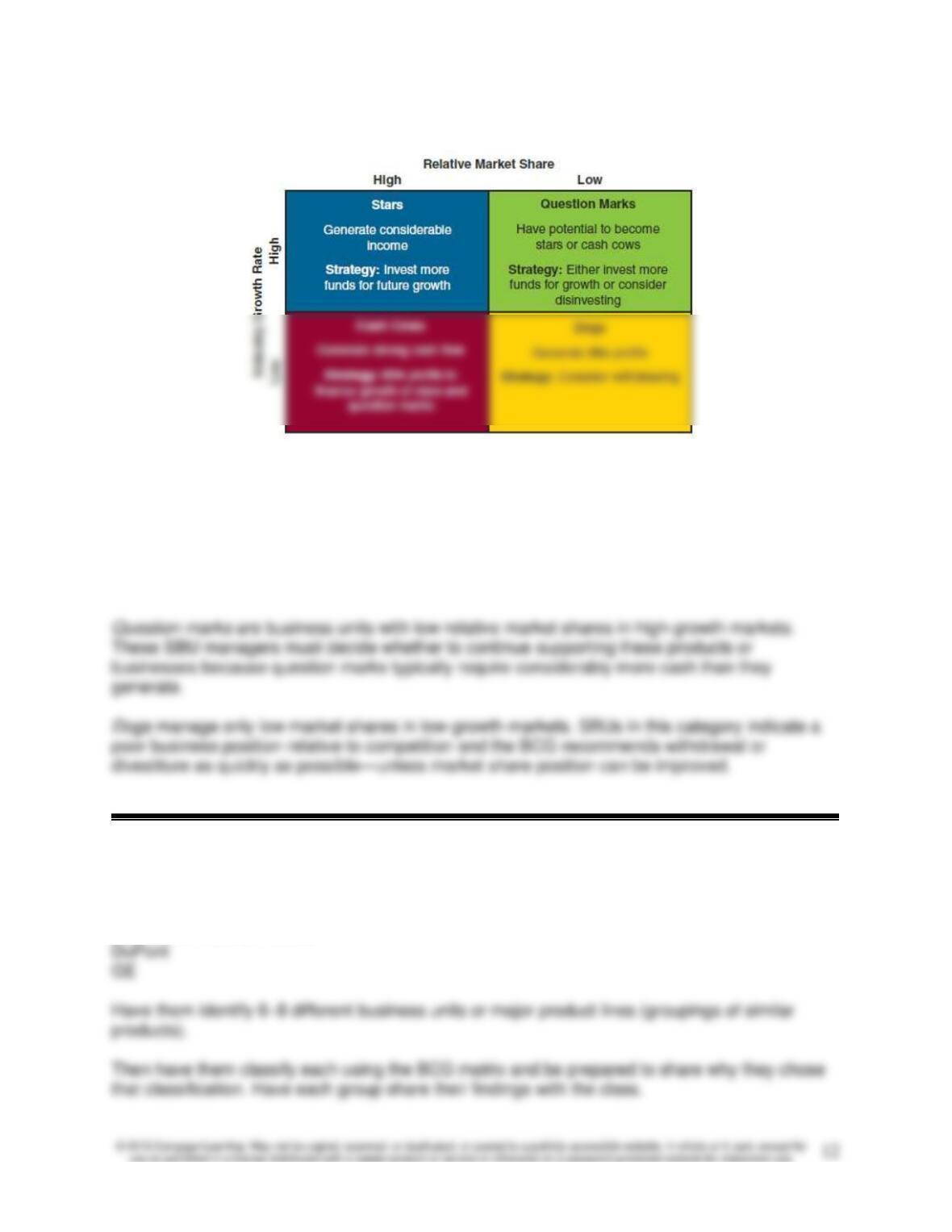
PRESENTATION VISUAL: MindTap Exhibit 2.7 showing BCG matrix for a company
Stars represent units with high market shares in high-growth markets. These products or
businesses are high-growth market leaders. Although they generate considerable income, they
need considerable inflows of cash to finance further growth.
Cash cows command high market shares but are in low-growth markets. Marketers for such an
SBU want to maintain this status for as long as possible since the generation of cash fuels other
business units that have higher growth potential.
Classroom activity: In small groups, have students research one of the following companies
on their phone or laptop:
Disney
Johnson & Johnson
Starwood Hotels & Resorts
Chapter 2: Strategic Planning in Contemporary Marketing
Note: Students will only be able to make their best guess based on what they know about the
Key Takeaway: Categorizing SBUs using the BCG matrix allows managers to identify
business units with potential, versus those that aren’t living up to expectations.
Estimated time: 20–25 minutes
2-6 Using SWOT Analysis and BCG Matrix
Note: This section of the chapter is intended to provide practical application of the analysis tools
presented in this chapter, in particular SWOT and BCG matrix. If you have already facilitated the
This section of the chapter revolves around the company Under Armour (UA) and their strategic
planning process.
If the executive team at UA put their company and the marketing environment under a
microscope, they might observe the following factors that could impact their company:
• Charismatic and empowering CEO, Kevin Plank, who is known for inspiring and
motivating employees to achieve success.
• Nike is still eight times bigger, has greater brand awareness, and bigger marketing
How might UA’s strategic planning team categorize these factors? There are two steps:
1. Determine whether the factors are internal to the company or part of the external
environment.
As a reminder:
• Positive, internal factors are strengths.
Chapter 2: Strategic Planning in Contemporary Marketing
• Negative, internal factors are weaknesses.
Classroom activity: In small groups, have students categorize without looking at MindTap or
the print companion (since the answers are in there).
After student discussion, show the answers and discuss as a class.
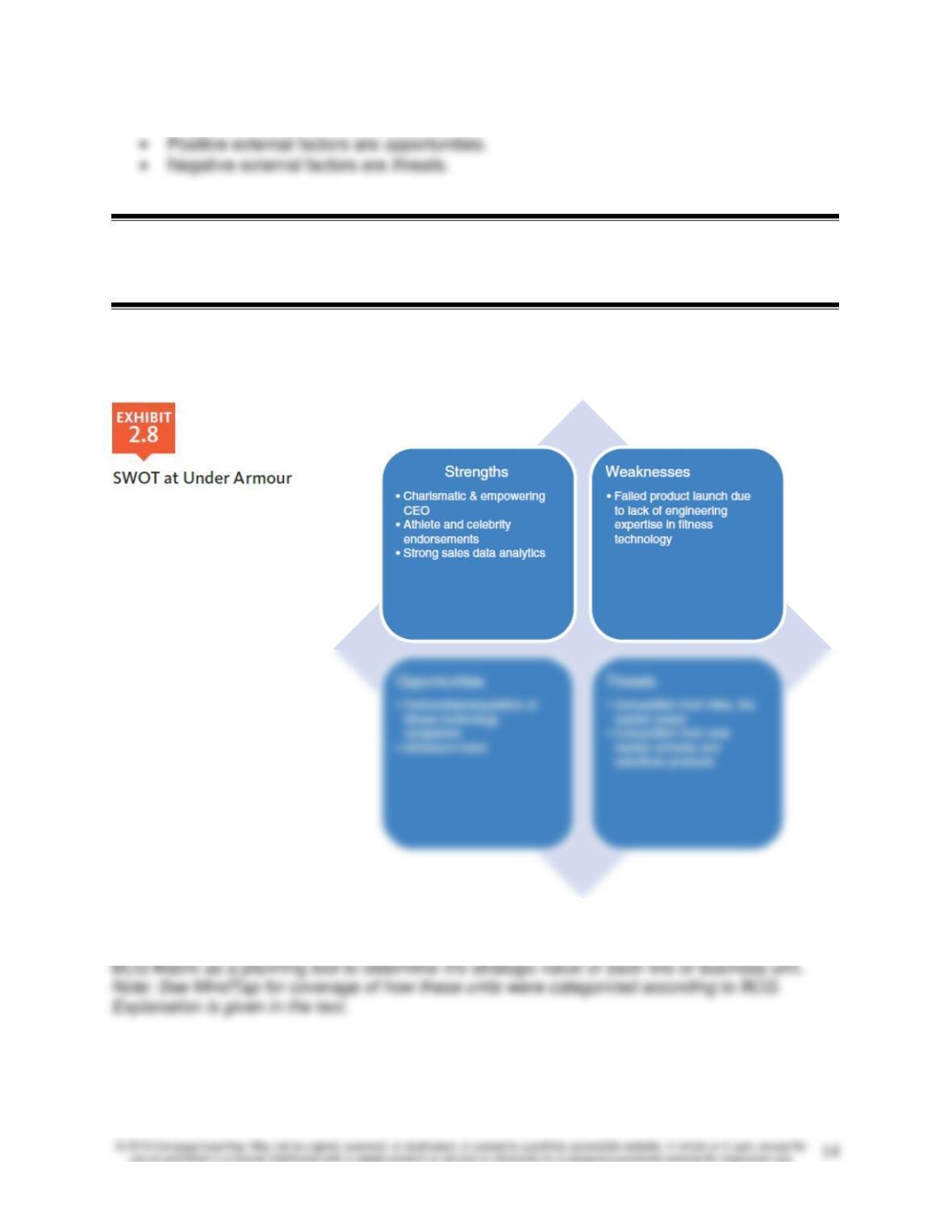
PRESENTATION VISUAL: MindTap Exhibit 2.8 showing how these factors were
categorized
Under Armour has a wide range of product lines for men, women, girls, and boys. This includes
athletic apparel, shoes, casual wear, and technology services. Under Armour can utilize the
Key Takeaway: Practicing use of these analyses demonstrate how relevant and useful
they can be for strategic planning.
Estimated time: 15–25 minutes
Chapter 2: Strategic Planning in Contemporary Marketing
LEARN IT TODAY…USE IT TOMORROW
VIGNETTE AND ACTIVITY
The opening vignette for Chapter 2 introduces Under Armour, maker of athletic apparel. It
introduces Under Armour’s attempt to take on their #1 competitor – Nike – as a jumping off point
for the chapter’s discussion about strategic planning.
Note: Answers to the chapter-ending activity can be discussed in class after the activity
due date.
Applying SWOT Analysis
Under Armour seems well positioned to attack Nike and grab market share as the company
continues to expand its product lines, make acquisitions, and capitalize on customer
relationships. However, strategic planning never stops.
Consider the following set of factors and perform a SWOT analysis by categorizing each as a
strength, weakness, opportunity, or threat.
• Macy’s, a large department store chain and one of Under Armour‘s (UA) key retail
partners, is closing a number of stores across the United States and will now operate
roughly 730 locations, versus 850 in 2009.ii Answer: Threat. This is an external
environmental factor that potentially reduces the number of stores where Under Armour
product is available.]
• Under Armour (UA) is partnering with Kohl’s to have product available in its 1,100
department stores, and also has strong relationships with Foot Locker and Champs.iv
[Answer: Strength. Existing, strong partnerships with retail outlets are an internal factor
that extends UA distribution to reach more customers].
Chapter 2: Strategic Planning in Contemporary Marketing
• China recently announced interest in developing its domestic sports industry, which is
estimated to be a $1 billion opportunity for sports apparel, shoes, and fitness devices.vi
[Answer: Opportunity. This is external to the company and could have positive impact on
the company if they pursue this market.]

Chapter 2: Strategic Planning in Contemporary Marketing
ADDITIONAL HOMEWORK/CLASSROOM ACTIVITIES
Planning throughout the Organization
Purpose: To highlight a key challenge in gathering information for strategic planning.
Relationship to Text: Planning at Different Organizational Levels
Estimated Class Time: 10–15 minutes
Exercise: Ask your class why they think it is so difficult to achieve a free flow of information and
ideas in most companies. As they share their thoughts, you may want to point out that money
isn’t always the answer; in fact, offering money in exchange for ideas can spawn a
Questions for Reflection:
• How does planning affect—and how is it affected by—a company’s corporate
culture?
• Is employee participation likely to become more or less important as our economy
evolves? Why?
Defining the Organization’s Mission and Objectives
Purpose: To give students a personal perspective on mission statements.
Relationship to Text: Defining the Organization’s Mission and Objectives
Estimated Class Time: 10 minutes

Chapter 2: Strategic Planning in Contemporary Marketing
Exercise: Ask each student to spend a few moments writing a personal mission statement for
his or her life. For the discussion to be effective, avoid providing many cues. You can let the
discussion progress on its own and intervene to provide a direction when students get stuck.
Questions for Reflection:
• What are the characteristics of a strong mission statement? (You might want to
precede this question with some examples of corporate mission statements. Some
Formulating a Marketing Strategy
Purpose: To help students explore strategic solutions for a contemporary marketing issue.
Background: Not surprisingly, fast-food restaurants are feeling under siege. Recent studies are
highlighting health hazards across the United States and citing rampant obesity, child obesity,
Relationship to Text: Formulating, Implementing, and Monitoring a Marketing Strategy
Estimated Class Time: About 20–25 minutes
Preparation/Materials: You may want to copy the background and the case situation for each
student.
Exercise: Divide your class into small groups and share with them the following case.
Situation: You and your teammates are partners in the ownership of a medium-sized fast-food
chain in the Midwest. You own 41 outlets, most of them in small towns. The mainstay of your

Chapter 2: Strategic Planning in Contemporary Marketing
You have to meet with your partners to discuss potential solutions. Give your class about 10
minutes to brainstorm options. Encourage them to consider all the possibilities including doing
nothing (“This will all blow over ….”). Then, direct each group to choose their best option, and to
identify the potential risks and benefits (e.g., if they made changes to attract new customers, will
they alienate their current customers?). Reconvene as a class, and ask each group to report
briefly to their peers. Which solution does the class like best? Why?
Questions for Reflection:
• What additional information do you need to formulate the best solution?
BCG Matrix
Purpose: To help students gain a fuller understanding of the BCG matrix as a planning tool.
Background: While the concept of the BCG matrix is straightforward, many students have
Relationship to Text: BCG Matrix
Estimated Class Time: 25 minutes
Exercise: Announce to your class that they will do a case study on the talent agency business,
(which most of them find more glamorous and exciting than it really is). Begin by brainstorming
Questions for Reflection:
• What are the strengths and weaknesses of the BCG Matrix as a strategic planning
tool?
• What kind of information do you need in order to use this tool most effectively?

Chapter 2: Strategic Planning in Contemporary Marketing
Internet Research Activity—Business Portfolio Analysis
Occasionally, companies sell parts of themselves to other firms. One stated motive for such
divestitures is that the sold assets are a poor strategic fit for the rest of their business portfolios.
One recent example is the sale of a controlling interest in NBC Universal by General Electric to
cable giant Comcast. Using a major search engine, research the sale of NBC Universal. In the
context of business portfolio analysis, why did GE decide to sell, and why did Comcast decide to
buy NBC Universal?
Chapter 2: Strategic Planning in Contemporary Marketing
KEY TERMS
Planning: The overall process of anticipating conditions and determining the best way to
achieve organizational objectives.
Marketing planning: The process of planning devoted specifically to achieving marketing
objectives.
Marketing plan: A written plan that outlines the strategic marketing goals of an organization.
Porter’s Five Forces: Five competitive forces that influence planning strategies.
SWOT analysis: An important strategic planning tool that helps managers analyze the internal
and external environment to assess strengths, weaknesses, opportunities, and threats.

Chapter 2: Strategic Planning in Contemporary Marketing