Chapter 2: Strategic Planning in Contemporary Marketing
CHAPTER SUMMARY AND LEARNING OBJECTIVES
LO 2.1 Contrast how marketing plans differ at various levels in an organization.
Planning is often classified based on its scope or breadth where top-level managers
spend more time engaged in long-range strategic planning while middle management
devotes time to tactical planning. Supervisory managers such as regional sales
managers engage in operational planning.
LO 2.2 Summarize the six components of a marketing plan.
Managers involved in marketing typically create a marketing plan as part of their
LO 2.3 Summarize the competitive forces of Porter’s five forces model.
Michael E. Porter identified five competitive forces that influence planning strategies in a
LO 2.4 Differentiate the elements of a SWOT analysis.
SWOT (strengths, weaknesses, opportunities, and threats) analysis helps planners
LO 2.5 Explain how the BCG matrix is used for marketing planning.
A widely-used portfolio analysis framework was developed by the Boston Consulting
LO 2.6 Given an example of a strategic analysis, categorize the findings utilizing
the SWOT analysis and BCG matrix.
The ability to apply the strategic planning tools of SWOT analysis and BCG Matrix are
important to organizations who seek to achieve their business goals within an ever–
changing marketplace and competitive environment.
Chapter 2: Strategic Planning in Contemporary Marketing
ACTIVATOR EXERCISE: Planning without a framework
Purpose: For students to understand the difficulty of strategic planning without frameworks to
facilitate the process.
Format: Small group discussion, then short student presentations to the class.
Time: 20–40 minutes, depending on format.
Activity: Divide students into groups and have them follow these steps:
• Choose a large company, such as Facebook, Apple, Ford, or another well-known brand.
You may want to assign a company to each group to ensure there is no overlap.
Possible discussion questions for class: What other recommendations would you have for
this company? What other things are they doing well and not so well? What trends should this
company worry about in the future? How could they anticipate these trends and respond to
them early? How competition is their industry and how can you make that determination?
Result: Students will use common sense to do this analysis, but will soon find out they may
Key takeaway: Strategic planning is an important process that requires sound and thorough
analysis.
Chapter 2: Strategic Planning in Contemporary Marketing
LECTURE OUTLINE
2-1 Marketing Planning—The Basis for Strategy and Tactics
Planning is the overall process of anticipating conditions and determining the best way to
achieve organizational objectives.
Marketing planning is devoted specifically to achieving marketing objectives.
Planning is often classified on the basis of its scope or breadth and is generally regarded as
Strategic planning is the process of determining an organization’s long-term primary objectives
and adopting courses of action that will achieve these objectives.
Tactical planning typically addresses shorter-term actions that a firm must complete to
implement its larger strategies. Sometimes tactical planning requires swift decision-making and
actions.
Example (Uber): Based on the strategic decision to enter Indonesia, the middle-
Operational planning is where managers develop specific programs to meet goals in their area
of responsibility.
Example (Uber): Based on the tactical plan, the supervisors of the new office in
Classroom activity: In groups, have students choose a company and provide examples of
After a group sharing time, have some or all of the groups share their examples with the class.
Chapter 2: Strategic Planning in Contemporary Marketing
Discussion questions: What is an example of a company that may have had a good strategic
plan, but failed in execution of that plan?
What is an example of a company that might have executed well, but had a poor strategy to
begin with?
Example: Amazon released a phone and got generally good reviews, but consumers were
Key Takeaway: There are different times of planning that take place at different levels of
the organization, all of which are important for company success.
Estimated time: 20–30 minutes
2-2 Marketing Plan Components
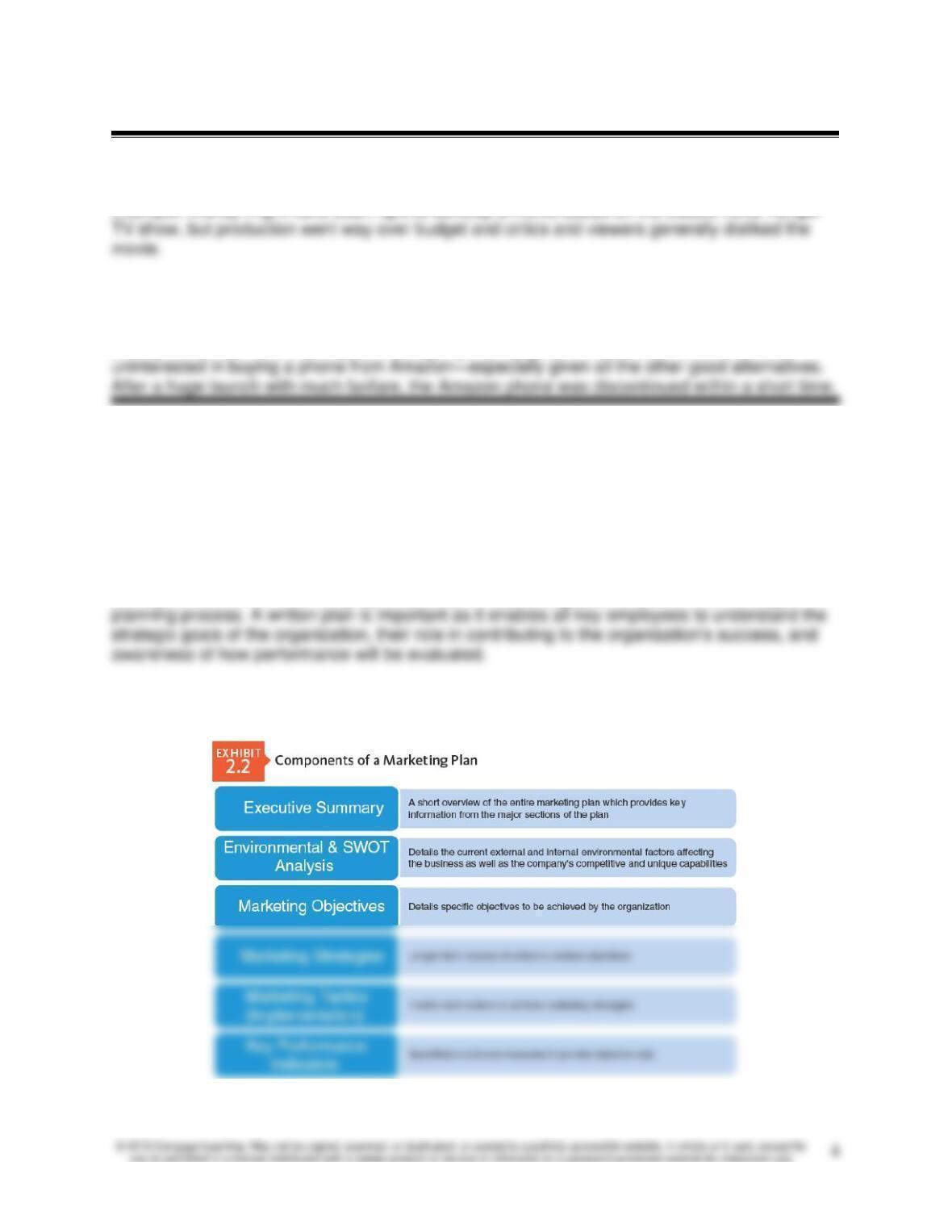
Managers involved in marketing typically create a marketing plan as part of their strategic
PRESENTATION VISUAL: MindTap Exhibit 2.2 showing the components of a marketing
plan
Chapter 2: Strategic Planning in Contemporary Marketing
The core components are:
Executive Summary
Environmental & SWOT Analysis
Note: This does not necessarily reflect the table of contents of a plan, but is the basis for what
goes in each section of the plan. The important point is for students to understand the link
between the objectives that are created during the planning process and how those are
converted into strategies and specific, measurable tactics.
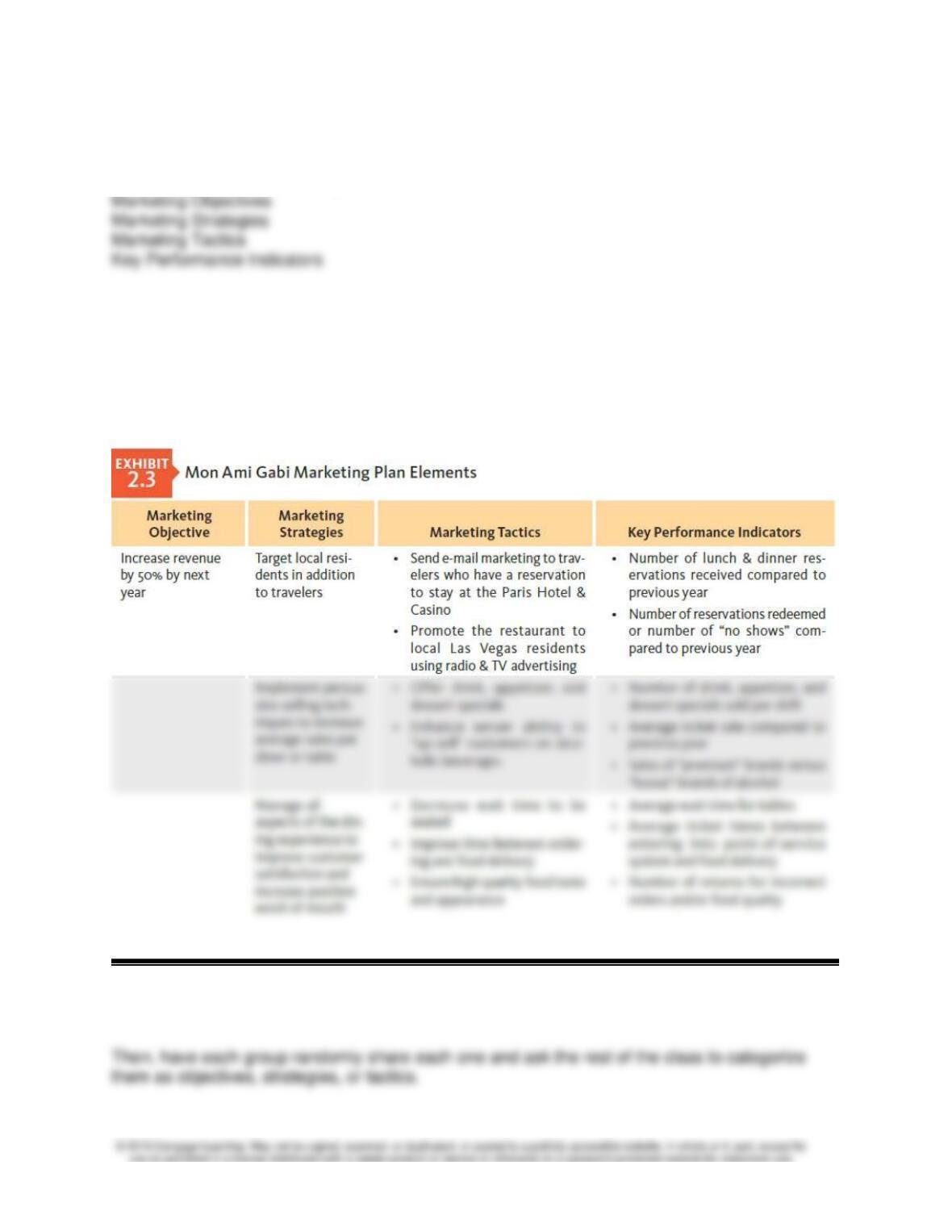
PRESENTATION VISUAL: MindTap Exhibit 2.3 showing an example of how these
elements of a marketing plan are linked
Classroom activity: In groups, have students pretend that they are writing a marketing plan for
Chipotle. Have them create three marketing objectives, then a marketing strategy related to
each of those objectives, then a marketing tactic related to each of those strategies.
Chapter 2: Strategic Planning in Contemporary Marketing
The purpose of this activity is to ensure students understand the difference. By having all
groups working on the same company, students will begin to recognize the differences among
objectives, strategies, and tactics.
Example: An objective might be to increase revenue by 30%, a supporting strategy might be to
By tracking the key performance indicators and comparing those outcomes to the stated
objectives, managers can identify areas where they should direct their attention or shift
resources in order to improve performance.
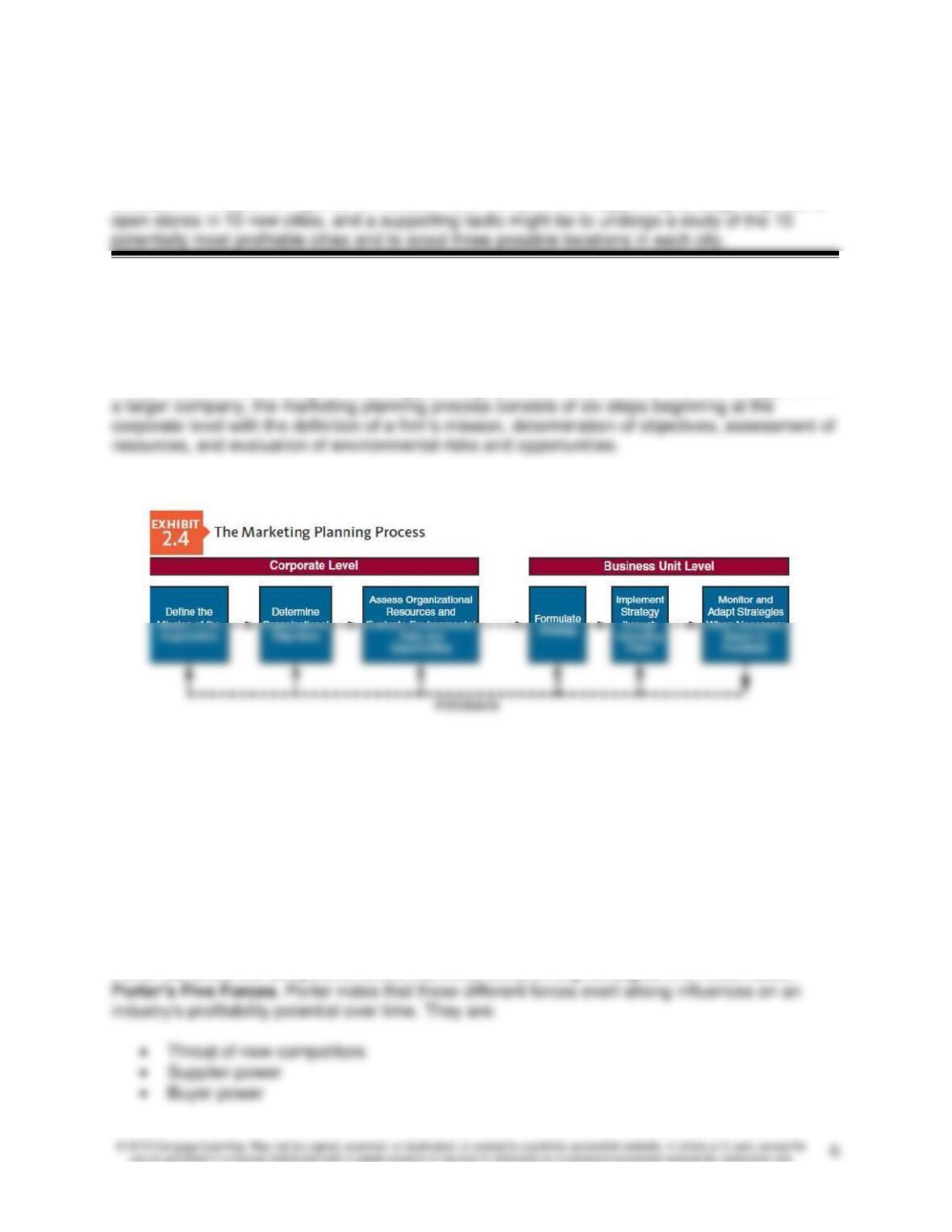
The marketing planning process
The process for developing a marketing plan largely mirrors the sections of a marketing plan. In
PRESENTATION VISUAL: MindTap Exhibit 2.4 showing the marketing planning process
Key Takeaway: A marketing plan enables all key employees to understand the strategic
goals of the organization and their role in contributing to those goals.
Estimated time: 20–25 minutes
2-3 Industry Structure and Competition
As part of the strategic planning process, firms should seek to understand the competitive
structure of the industry. A number of years ago, renowned business strategist Michael E.
Chapter 2: Strategic Planning in Contemporary Marketing
• Threat of substitutes
• Competitive rivalry
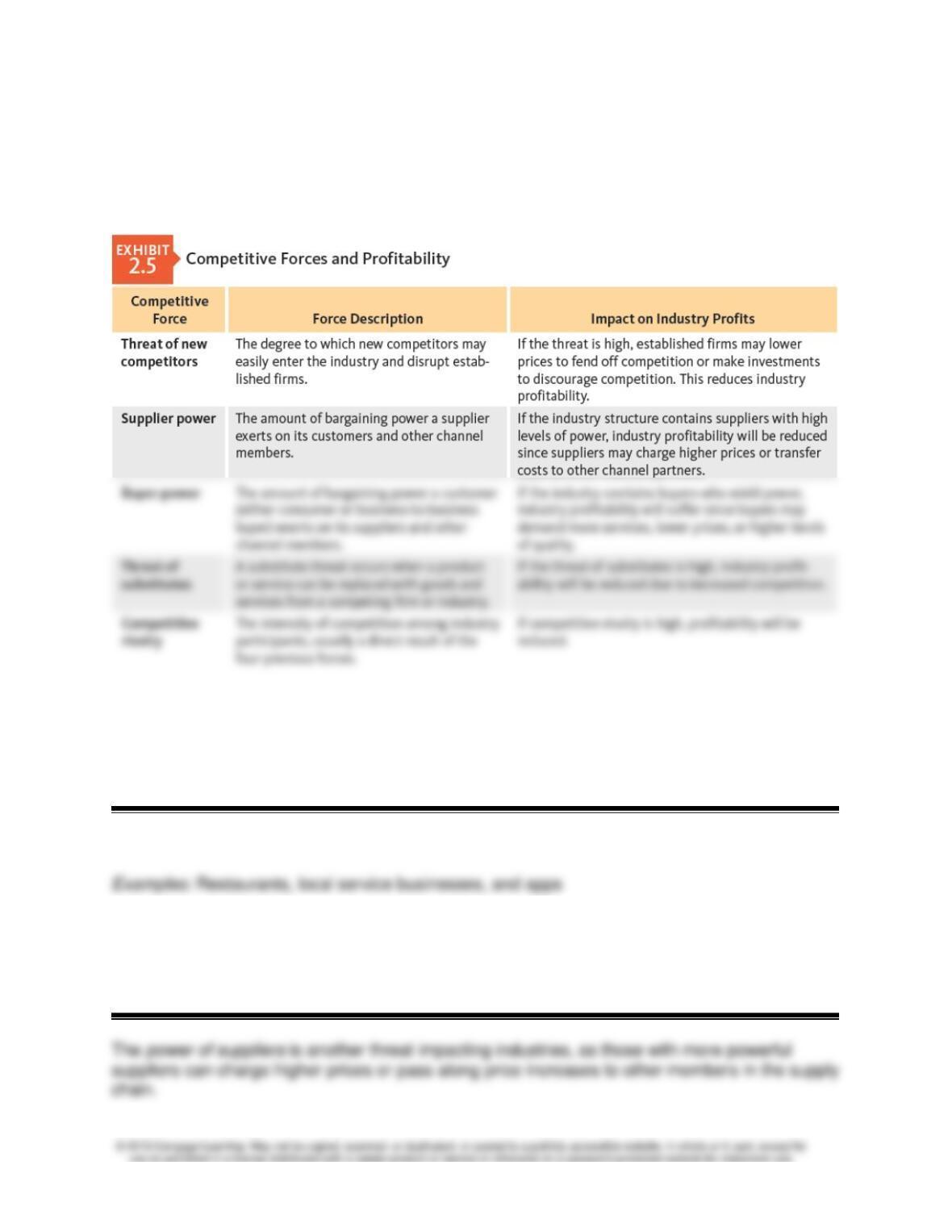
PRESENTATION VISUAL: MindTap Exhibit 2.5 showing the competitive forces and
impact on profitability
The threat of new competitors is based on the level of difficulty for entering a market or industry.
Example: It’s considerably more expensive to begin building automobiles such as Tesla
than to start a house cleaning service.
Discussion questions: What are examples of industries where it’s easy to enter? This is
usually due to lower cost or few technological barriers to entry.
What are examples of industries where it’s more difficult to enter? This is usually due to higher
costs or more technological barriers to entry.
Examples: Airlines, movie studio, virtual or augmented reality company, and biotech
Chapter 2: Strategic Planning in Contemporary Marketing
Example: A chemical manufacturer selling specialized herbicides to agricultural firms
Powerful customers are another threat because they may possess greater negotiating leverage
to extract price concessions or other favorable terms.
Example: As the largest retailer in the world, Walmart has quite a reputation of
The threat of substitutes also is a competitive force impacting industries. If customers have the
opportunity to replace a company’s products with goods or services from a competing firm, the
company’s marketers may have to find a new market, change prices, or compete in other ways
to maintain an advantage.
Discussion question: For each of the following products, ask the class what substitutes might
threaten the industry or particular companies in that industry:
TV’s
The four previous forces can highly influence rivalry among competitors, especially if forces
within that industry favor new entrants and substitutes, or provide bargaining power to suppliers
and/or buyers.
Key Takeaway: The higher the rivalry in an industry, usually the harder it is to maintain
profits over time.
Estimated time: 15–20 minutes
2-4 SWOT Analysis
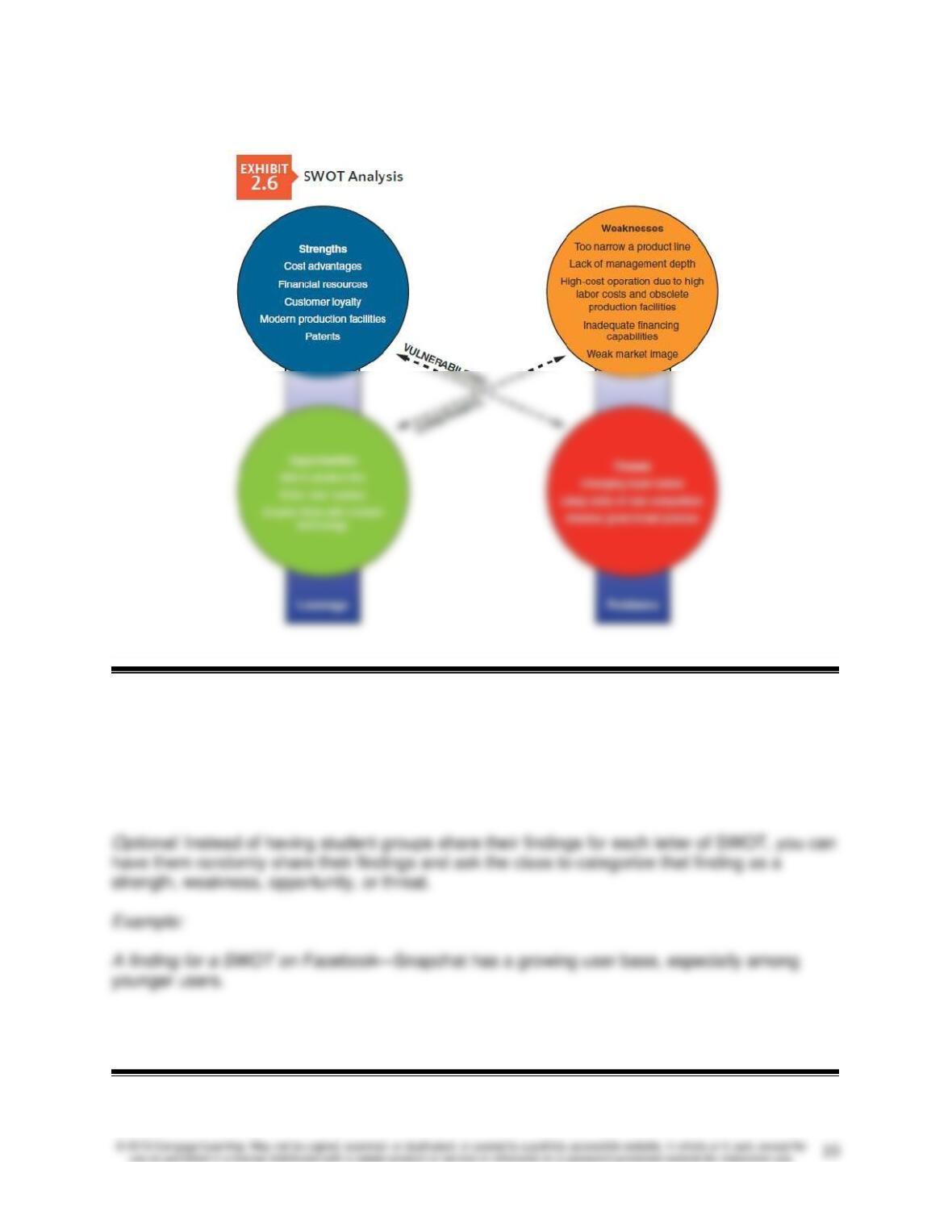
SWOT analysis is an important strategic planning tool that helps managers analyze the internal
and external environment to assess strengths, weaknesses, opportunities, and threats.
Chapter 2: Strategic Planning in Contemporary Marketing
Important distinction: Strengths and weaknesses are factors internal to the firm while
opportunities and threats are factors external to the firm.
Strengths represent a firm’s core competencies or points of differentiation from the competition.
Example: Patagonia encourages their customers to fix their worn garments rather than
Weaknesses are limitations that place the company at a disadvantage. Since weaknesses are
factors internal to a company, the company largely controls whether those weaknesses can be
overcome.
Example: Patagonia realizes that, while its brand is well-recognized among outdoor
Opportunities are factors in the external environment that could potentially be exploited by the
company.
Threats are factors in the external environment that could limit the company’s success. Since
threats are external to the company, they can’t always be controlled.
Chapter 2: Strategic Planning in Contemporary Marketing
PRESENTATION VISUAL: MindTap Exhibit 2.6 showing SWOT for a company
Classroom activity: In small groups, have students choose a well-known company and
perform a SWOT analysis. Once students have created their SWOT analysis, have them share
with the class.
Note: If you facilitated the Activator exercise at the beginning of this chapter, consider having
students use the same company they used for that exercise. They’ll see how much more
thorough their analysis is when using the SWOT framework.
Category—Threat, because this is a factor in the external environment that could limit
Facebook’s success in the future.
Chapter 2: Strategic Planning in Contemporary Marketing
Discussion question: Choose a strength from one of the companies you analyzed. How could
that strength be used to address a company weakness, exploit an opportunity, or respond to a
threat?
2-5 Portfolio Analysis—A Planning Tool
While small companies may offer only a few items to their customers, larger organizations
frequently offer and market many products to widely diverse audiences.
Strategic business units (SBUs) are key business units within diversified firms. Each SBU has
its own managers, resources, objectives, and competitors. A division, product line, or single
product may define the boundaries of an SBU, and each SBU typically pursues its own distinct
mission and develops its own marketing plans independently of other units in the organization.
The BCG matrix enables managers to plot the relative position of each business unit, brand, or
product on the basis of two dimensions:
• Industry Growth Rate