Chapter 2
Marketing Foundations: Global, Ethical, Sustainable
2-1
LEARNING OBJECTIVES
LO 2-2 Learn the essential information components for assessing a global market
opportunity.
LO 2-4 Describe the strategies for entering new global markets.
LO 2-6 Learn the importance of ethics in marketing strategy, the value proposition, and the
elements of the marketing mix.
LO 2-7 Recognize the significance of sustainability as part of the marketing strategy and the
use of the triple bottom line as a metric for evaluating corporate performance.
CHAPTER OUTLINE
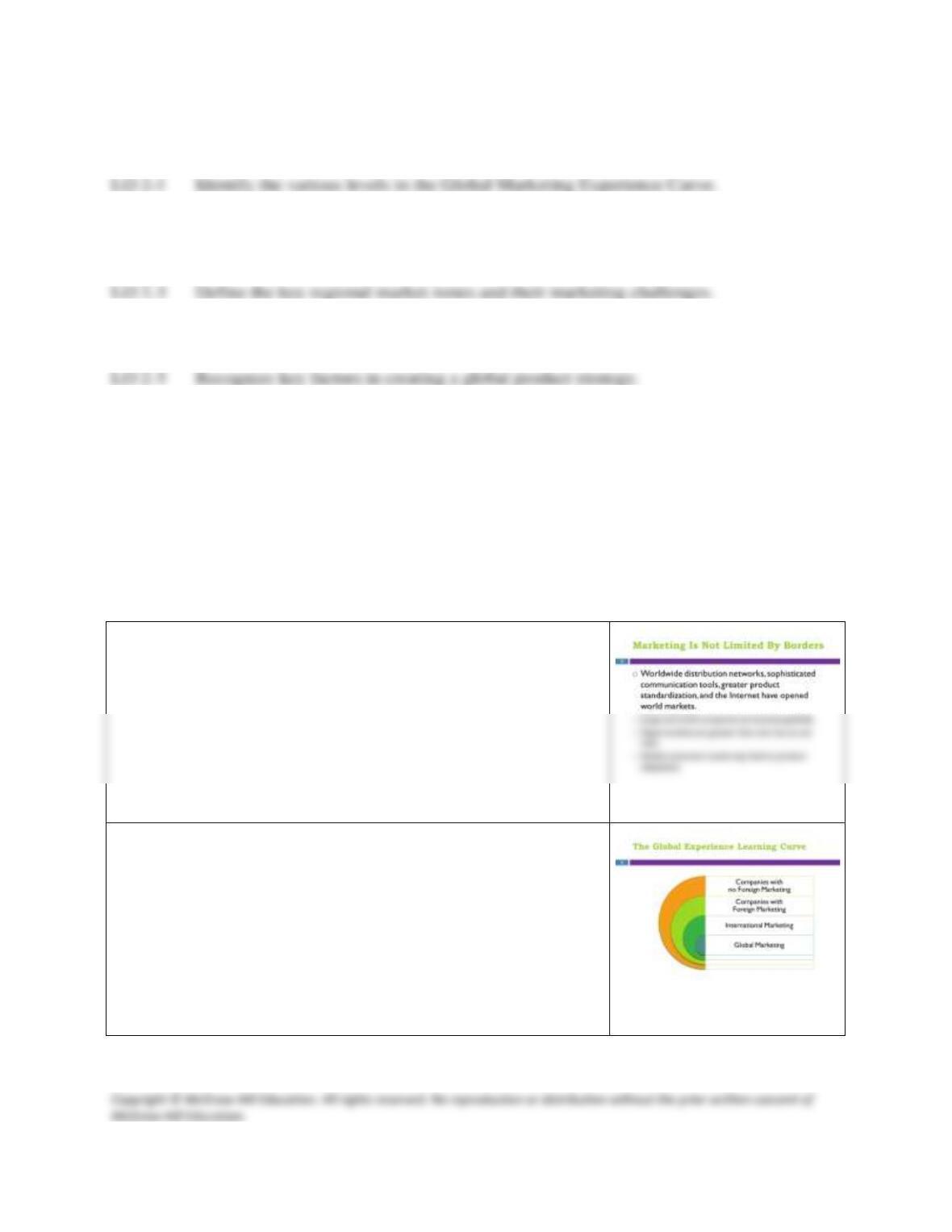
I. MARKETING IS NOT LIMITED BY BORDERS
II. THE GLOBAL EXPERIENCE LEARNING CURVE
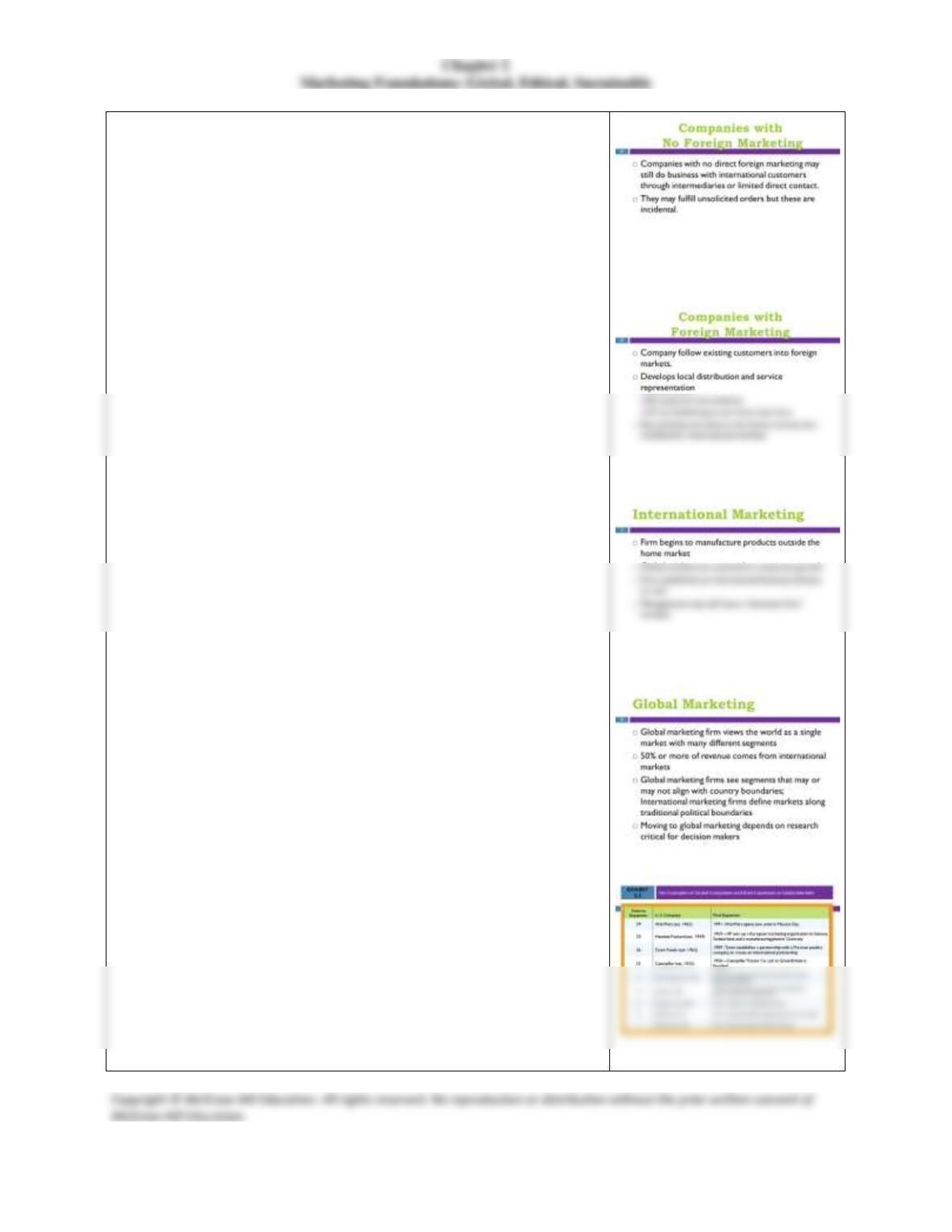
A. Companies with No Foreign Marketing
B. Companies with Foreign Marketing
C. International Marketing
D. Global Marketing
2-2
Chapter 2
Marketing Foundations: Global, Ethical, Sustainable
2-3
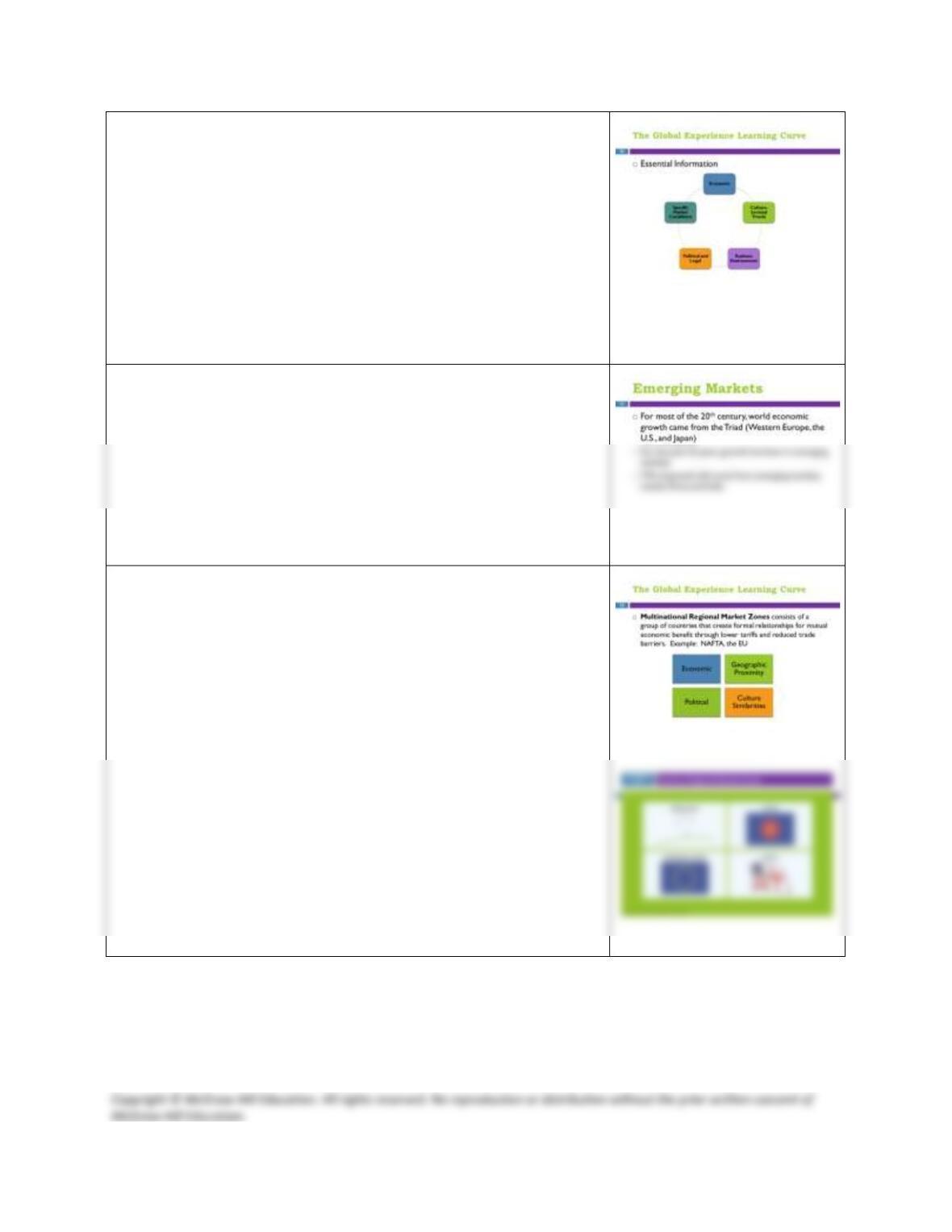
E. Essential Information
i. Economic
ii. Culture, Societal Trends
iii. Business Environment
iv. Political and Legal
v. Specific Market Conditions
F. Emerging Markets
G. Multinational Regional Market Zones
i. Europe
ii. Americas
iii. Asia
Chapter 2
Marketing Foundations: Global, Ethical, Sustainable
2-4
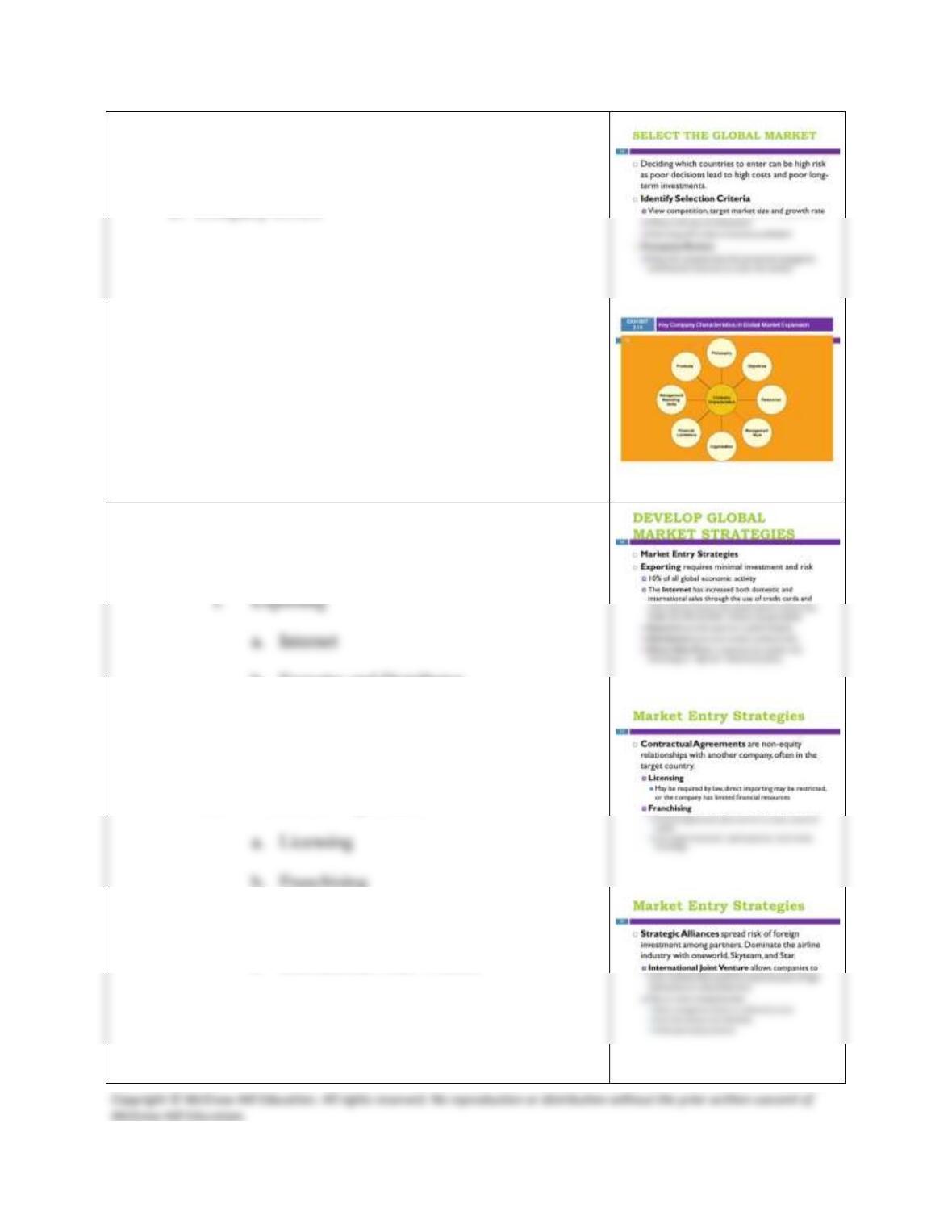
III. SELECT THE GLOBAL MARKET
A. Identify Selection criteria
B. Company review
IV. DEVELOP GLOBAL MARKET STRATEGIES
A. Market Entry Strategies
b. Exporter and Distributor
ii. Distributors
a. Direct Sales Force
iii. Contractual Agreements
b. Franchising
iv. Strategic Alliances
a. International Joint Venture
Chapter 2
Marketing Foundations: Global, Ethical, Sustainable
2-5
v. Direct Foreign Investment
B. Organizational Structure
C. Product
Chapter 2
Marketing Foundations: Global, Ethical, Sustainable
2-6
D. Consumers
i. Quality
iv. Country of Origin
E. Market Channels
i. Channel Structures
ii. Channel Factors
a. Cost
b. Capital
c. Coverage
d. Character
F. Marketing Communications
i. Advertising
ii. Personal Selling
iv. Public Relations
Chapter 2
Marketing Foundations: Global, Ethical, Sustainable
2-7
G. Pricing
i. One World Price
ii. Local Market Conditions Price
iii. Cost-Based Price
iv. Price Escalation
a. Product export costs
b. Tariffs, import fees, taxes
v. Global Pricing Issues
Chapter 2
Marketing Foundations: Global, Ethical, Sustainable
2-8
V. ETHICS: AT THE CORE OF SUCCESSFUL
MARKETING MANAGEMENT
A. Ethics and the Value Proposition
B. Ethics and the Elements of the Marketing Mix
i. Product
ii. Price
iv. Promotion
Chapter 2
Marketing Foundations: Global, Ethical, Sustainable
2-9
C. Code of Marketing Ethics
VI. SUSTAINABILITY: NOT JUST THE RIGHT THING
TO DO BUT A GOOD MARKETING STRATEGY
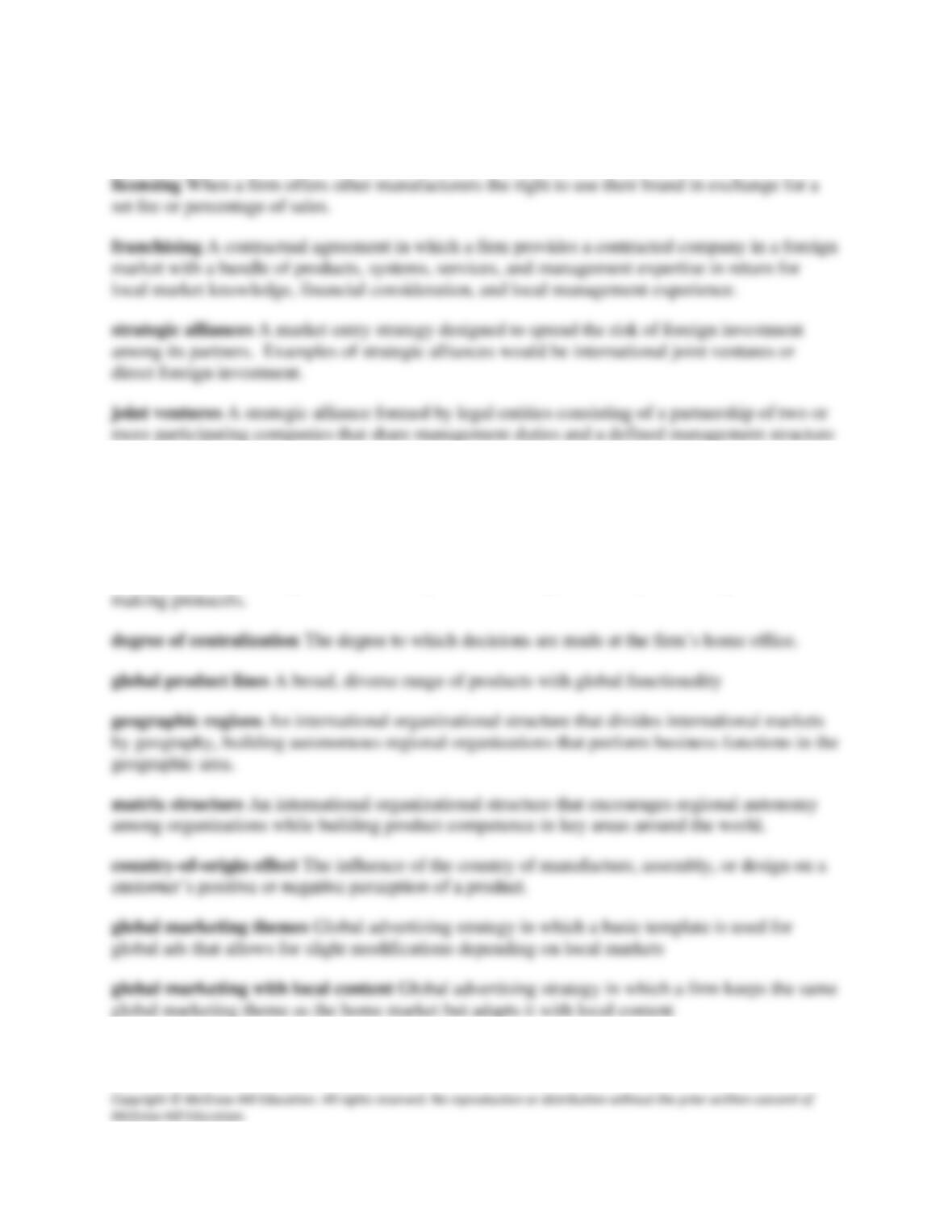
A. Triple Bottom Line: The Link between Doing Well
and Doing Good
Chapter 2
Marketing Foundations: Global, Ethical, Sustainable
2-10
VII. SUMMARY
KEY TERMS
developed economies Specific economies that have fueled world economic growth for much of
the 20th century, including Western Europe, the United States, and Japan.
emerging markets Growing economies that have developed over the last 25 years that are
projected to contribute toward 75 percent of world economic growth over the next 20 years.
regional market zones A group of countries that create formal relationships for mutual
economic benefit through lower tariffs and reduced trade barriers.
European Union A successful regional marketing zone founded more than 50 years ago by six
European countries (Belgium, France, Italy, Luxembourg, The Netherlands, and West Germany)
with the Treaty of Rome that now includes 25 countries.
Chapter 2
Marketing Foundations: Global, Ethical, Sustainable
2-11
contractual agreements Enduring, nonequity relationships with another company that allow a
company to expand its participation in a foreign market.
in which every partner holds an equity position.
direct foreign investment A strategic alliance with long-term implications in which a company
moves
decision-making authority An issue that arises when companies grow internationally and lines
of authority become longer and more complicated resulting in difficulty in defining decision-
Chapter 2
Marketing Foundations: Global, Ethical, Sustainable
2-12
basket of global marketing themes Global advertising strategy in which distinct ads built
around several marketing messages are created that local marketers can select from to best fit
their specific market situation
local market ad generation Global marketing strategy in which a firm allows local marketers to
create local ads that do not necessarily coordinate with its global marketing messages.
transfer pricing The cost companies charge internally to move products between subsidiaries or
divisions.
APPLICATION QUESTIONS
1. You are the marketing manager for a small company located in the United States that
manufactures specialized parts for high-end ink-jet printers. The company’s largest customer
(Hewlett Packard) has asked your company to supply parts to 10 of its distribution and repair
sites around the world. The company has never sold products outside the United States, so
this represents a significant step for the company. What stage in the global experience
learning curve is the company likely entering and why? Identify the activities the company
should undertake at this stage.
Companies with No Foreign Marketing – the company has no formal international channel
relationship or global marketing strategy targeted at international customers. The company
should begin to develop local distribution and service representation in the foreign market.
2. You are the market research director for a consumer product company. You have been asked
to evaluate China as a potential market for your company’s products and begin a search of
Chapter 2
Marketing Foundations: Global, Ethical, Sustainable
2-13
secondary data. What types of information would you consider in assessing China? How
would you find information on these issues?
Economic
An accurate understanding of the current economic environment is essential. At the same
time additional economic data on consumer spending per capita are also needed to facilitate
decision making. A wide array of data is available online on the subject of “doing business
in China”; some is available at no cost and other data is available for a fee.
Culture, Societal Trends
Understanding a global market’s culture and social trends is fundamental for consumer
products. Cultural values, symbols and rituals, and cultural differences affect people’s
3. You are the marketing manager for Oxymoron Detergent and have been tasked with
introducing this product into Argentina. What six factors would you need to consider in
determining the proper channel of distribution for the introduction of Oxymoron detergent?
4. The marketing manager for McDonald’s has been asked to develop a code of marketing
ethics for the company. Develop a marketing code of ethics for McDonald’s, keeping in
mind that the company has stores all over the world.
The marketing mix (“4 Ps”) is a good framework for considering different categories of
behavior specific to marketing that should be addressed in a code of marketing ethics.
Particular attention should be given to standards regarding marketing communications
(truthful, clear) and product (safety, quality, green packaging).
Chapter 2
Marketing Foundations: Global, Ethical, Sustainable
2-14
After creating their own version, students will benefit from reviewing the several codes of
conduct (for Directors, Suppliers, and Employees) that is shown on the McDonald’s website.
While much broader than just marketing, these documents will give students a sense of how
seriously large corporations like McDonald’s take the subject of ethics.
http://corporate.mcdonalds.com/mcd/investors/corporate-governance/codes-of-conduct.html
5. The CEO of Timberland has called and asked you to develop a triple bottom line report for
the company. What might be included in a TBL report for Timberland?
Here, students should focus not on developing a code of behavior, but rather a progress
report on how well Timberland is doing in the key areas of the Triple Bottom Line. Exhibit
2.14 can be used as an outline for the report.
• Profit
o Shareholder returns (e.g., earnings per share)
o Growth rates (revenues, earnings, market share)
o Risk management (key areas of risk such as regulation or lawsuits)
MANAGEMENT DECISION CASE
Selling to the Bottom of the Pyramid
Marketing Unilever Products in Rural Villages Around the World
Instructors leading a discussion about this case will find a review of the two HBR articles by
Simanis & Duke and Mahajan to be very helpful*. One way to introduce the case is to ask
students why a company would even bother marketing to a target market made up of consumers
Chapter 2
Marketing Foundations: Global, Ethical, Sustainable
2-15
This case provides another opportunity to reinforce the definition of value and to emphasize that
value should be considered from the perspective of the consumer. A concluding point that
should become clear is that marketing to BOPMs is a more complex proposition than marketing
in traditional markets. Consequently, it is probably only the largest consumer products
companies and ones with sophisticated marketing organizations that should take on this
interesting challenge.
Questions for Consideration:
1. Is Unilever providing value to their Indian customers? In what ways? Consider the four
types of utility when forming your answer.
Value is defined in this chapter as a ratio of the bundle of benefits a customer receives from
an offering compared to the costs incurred by the customer in acquiring that bundle of
benefits. In light of that definition, the very small unit size of the Wheel detergent product
2. Considering the competition Unilever is receiving from Procter & Gamble and other
companies, in what creative ways could Unilever change their Wheel detergent product
offering to differentiate it from competitors’ offerings?
Differentiation comes with increasing the relative perceived value. Assuming that Unilever
has lowered their prices as much as possible, they would need to focus on expanding the
3. What principles should be used to determine if a product is a good fit for a BOPM market?
Are there products that should not be offered to BOPM consumers? Should this issue be
decided by marketers, governments or consumers?
Chapter 2
Marketing Foundations: Global, Ethical, Sustainable
2-16
• Product is able to be produced and packaged in units small enough that the costs to
product and distribute can lead to a price that is affordable by BOPM consumers.
• The resulting package size needs to be meaningful/practical.
The question of what products are appropriate for BOPM markets should lead to interesting
discussions about whether consumers in BOPM markets require different kinds of
consideration in this regard. If it is acceptable to sell candy to middle class American
families, are BOPM families not also entitled to the benefits of enjoying candy? There are
4. Is it ethical for marketers to try to make money off people who are living at a subsistence
level? Should companies only market their products to people in certain income classes?
What factors should a marketer take into consideration when trying to answer these
questions?
The ethics of selling certain kinds of products is a fair question for marketers to consider
regardless of the income level of their target markets. Students will be able to list products
that could fit into this category: those that hurt customers’ health (e.g., cigarettes, sugary
* E. Simanis & D. Duke, “Profits at the Bottom of The Pyramid,” Harvard Business Review, 92(10), (2014), pp. 86-
93.
Chapter 2
Marketing Foundations: Global, Ethical, Sustainable
2-17
V. Mahajan, “How Unilever Reaches Rural Consumers in Emerging Markets,” Harvard Business Review Digital
Articles, (2016), pp. 2-6.
SUGGESTED VIDEO
YUM! BrandsS (11:30 Minutes)
Description: YUM! Brands customizes its marketing approach to expand to global markets.
Peter Bassi (President of YUM! Restaurants International) describes 7 key marketing
perspectives that company focuses on to be competitive and successful on a global scale.
1. What central changes are contributing to the growth of Yum! Brands in global markets?
Ongoing changes leading to the growth in the global fast food market
• Rise of the middle class in emerging economies such as China and India
2. Give some examples of ways that you believe Yum! Brands will have to adapt its offerings to
appeal to global customers in different countries.
Taco Bell (India) – Crunchy potato tacos and extra-spicy burritos filled with paneer, the
rubbery, fresh Indian cheese.
Global Marketing: Domino’s Abroad (4:18 minutes)
Description: Domino’s Pizza is the world’s largest pizza delivery chain, with stores in over 80
countries worldwide and over half its sales outside the United States. In order to satisfy
consumer preferences in that many markets, Domino’s must understand its global customers
and adjust its marketing mix to meet local needs. The video describes Domino’s marketing
efforts in several countries.
1. When going global, one of the most fundamental decisions marketers must make is the
standardization/localization decision regarding the different elements of the marketing mix.
For the Product component of the mix, Domino’s chose a localization strategy, modifying
Chapter 2
Marketing Foundations: Global, Ethical, Sustainable
the product to regional tastes. Some companies choose a standardization approach, keeping
the product essentially the same as the one offered in domestic markets.
a. What are the pros and cons of standardization?
b. Considering the markets in India, do you believe Domino’s could have been as
successful with this one-size-fits-all approach?
The major benefit to standardization is cost. For manufactured products, localization
can be an expensive process, involving retooling and specialized training of workers.
While Domino’s has a finely-tuned process of making pizzas in the flavors offered in
c. What steps could you take as a marketing manager to determine which approach—
localization or standardization—would be most effective for moving into India or any
other new region/country?
The clear answer is to do some research. Marketers can start by looking at the
experience of competitors or businesses with similar products (what did KFC do, for
example?). Hiring local employees who were raised in the region can be a great