• Product design: Cutting-edge design technology can help offset high labor costs.
Reverse engineering—the process of disassembling a product piece by piece to
learn its components and obtain clues as to the manufacturing process—can
also mean savings. Reverse engineering a low-cost competitor’s product can
save research and design costs.
c. Product/Service Differentiation Competitive Advantage: A product/service
differentiation competitive advantage occurs when a firm provides something
that is unique and valuable to buyers beyond simply offering a lower price than that
of the competition. Because cost competitive advantages are subject to continual
erosion, product/service differentiation tends to provide a longer-lasting
competitive advantage.
d. Niche Competitive Advantage: A niche competitive advantage seeks to target
and effectively serve a small segment of the market. For small companies with
e. Building Sustainable Competitive Advantage: The key to having a competitive
advantage is the ability to sustain that advantage. A sustainable competitive
advantage is one that cannot be copied by the competition. Competitive
advantages can include the skills and assets of the organization.
• Assets include patents, copyrights, locations, and equipment that are superior to
competitor to:
• Identify the leader’s competitive advantage.
7. Setting Marketing Plan Objectives (LO 2-7, PPT Slide 2-7, DISC: Marketing Plan)
a. A marketing objective is a statement of what is to be accomplished through
marketing activities. Carefully specified objectives serve several functions.
• They communicate marketing management philosophies and provide direction
for lower-level marketing managers so that marketing efforts are integrated
and pointed in a consistent direction.
b. Marketing objectives should be:
• Realistic: Managers should develop objectives that have a chance of being met.
• Measurable: Managers need to be able to quantitatively measure whether or
Example: A marketing objective for Purina brand cat food that meets the four
8. Describing the Target Market (LO 2-8, PPT Slide 44, DISC: Customer)
a. A marketing strategy involves the activities of selecting and describing one or
more target markets and developing and maintaining a marketing mix that will
produce mutually satisfying exchanges with target markets.
• By appealing to the entire market with one marketing mix
9. The Marketing Mix (LO 2-9, PPT Slide 48, DISC: Product, DISC: Pricing)
a. The marketing mix (four Ps) is a unique blend of product, place (distribution),
promotion, and pricing strategies designed to produce mutually satisfying
exchanges with a target market. The marketing manager can control each
likely fail.
b. Product Strategies: The heart of the marketing mix, the starting point, is the
product offering and product strategy. The product includes not only the physical
unit but also its:
• Package and warranty
• Value
c. Of the four Ps, the marketing mix typically starts with the product. It is hard to
design a place strategy, decide on a promotion campaign, or set a price without
knowing the product to be marketed. Products can be:
• Tangible goods
• Ideas
• Services
e. Promotion Strategies: Promotion’s role in the marketing mix is to bring about
mutually satisfying exchanges with target markets by informing, educating,
persuading, and reminding them of the benefits of an organization or a product.
Promotion includes one of the following:
• Advertising
• Public relations
10. Following Up on the Marketing Plan (LO 2-10, PPT Slide 57, DISC: Promotion)
a. One of the keys to success overlooked by many businesses is to actively follow up
on the marketing plan. One of the best ways to get the most out of a marketing
plan is to correctly implement it. Once the first steps to implementation are taken,
evaluation and control will help guide the organization to success as laid out by
c. Sometimes a strategic plan also requires task force management. A task force is a
tightly organized unit under the direction of a manager who, usually, has broad
authority. It is established to accomplish a single goal or mission that has a
reasons for failing to achieve a marketing objective are:
• Unrealistic marketing objectives
• Inappropriate marketing strategies in the plan
f. After a marketing plan is implemented, its effectiveness must also be monitored.
Control provides the mechanisms for evaluating marketing results in light of the
plan’s objectives and for correcting actions that do not help the organization reach
those objectives within budget guidelines. One of the broadest control devices
and the new opportunities available to it.
• Ensure that the role of the audit has been clearly communicated.
• Make someone accountable for implementing recommendations.
11. Effective Strategic Planning (LO 2-11, PPT Slide 67, DISC: Creativity)
a. Effective strategic planning requires:
• Continual attention
[return to top]
Discussion Questions
You can assign these questions several ways: in a discussion forum in your LMS; as whole-
1. Discussion: (LO 2-3) Duration 5-15 minutes.
a. Revisit Exhibit 2.3 and Exhibit 2.4 to get a visual comparison of the Boston
Consulting Group model and the General Electric model. Then ask students
the following questions:
• What similarities do you see between the two?
• What differences do you see between the two?
• What advantages and disadvantages might the two approaches offer?
i. The Boston Consulting Group’s portfolio matrix classifies each
SBU by its present or forecast growth and market share. The
2. Discussion: (LO 2-10) Duration 10-15 minutes.
a. Guide students on a discussion of the need for follow up:
• What could happen if an organization never evaluated its marketing
efforts?
[return to top]
Additional Activities and Assignments
A generic discussion and writing rubric is provided in the Appendix.
1. Activator Exercise: Planning Without a Framework (LO 2-1)
Purpose: For students to understand the difficulty of strategic planning without
frameworks to facilitate the process.
Format: This activity can be facilitated in both a classroom and an online
Classroom Format: Small group discussion, then class presentations (Estimated
Time: 20-40 minutes).
1. After dividing into groups of three or four students, choose a large
company, such as Facebook, Apple, Ford, or another well-known brand.
You may want to assign a company to each group to ensure there is no
their findings to the class.
Note: Provide only these instructions and no further hints. The variability in each
group’s results and likely gaps in their analysis is the point of this exercise.
Online Format: Discussion board with posted response from each student
(Estimated Time: 20-30 minutes).
1. Use the following prompt to facilitate this activity in a discussion board.
Choose a large company, such as Facebook, Apple, Ford, or another well-
known brand. Imagine that you are a company executive who is putting
together a 3- to 5-year strategic plan for the organization you’ve chosen.
2. Identify what the company is doing well and what it’s not doing so well.
Be specific about each of these.
Additional questions for a classroom or discussion board: What other
recommendations would you have for this company? What other things are they
doing well and not so well? What trends should this company worry about in the
future? How could they anticipate these trends and respond to them early? What
kind of competition do they face in their industry, and how can you make that
determination?
Result: Students will use common sense to do this analysis but will soon find out
they may have missed important and obvious factors that would have contributed
2. Class activity: (LO 2-2)
Format: This activity can be facilitated in both a classroom and an online
environment. Instructions for how to facilitate the activity in the classroom and
online are provided below. (Estimated time: 10-20 minutes)
Classroom Format: Have students break into groups of three or four to discuss the
3. Class activity: (LO 2-4)
Format: This activity can be facilitated in both a classroom and an online
environment. Instructions for how to facilitate the activity in the classroom and
online are provided below. (Estimated time: 15-25 minutes)
Classroom Format: Have students break into groups of three or four to discuss
mission statements. Using the Internet, groups should locate websites for three
different organizations that include their mission statements. These can be
Online format: If you’re delivering your course online, you can have students do
this on their own and have them post their answers in a discussion board. Use the
following prompt to facilitate this activity:
Using the Internet, locate websites for two different organizations that include their
mission statements. These can be manufacturers, service providers, or sellers. Based on
4. Class activity: (LO 2-5)
Format: This activity can be facilitated in both a classroom and an online
Classroom Format: Instruct students to divide up into pairs or groups of three.
Online Format: If you’re delivering your course online, you can have students do
this on their own and have them post their answers in a discussion board. Use the
following prompt to facilitate this activity:
Choose a well-known company and perform a simple SWOT analysis. Share your analysis
in your post to the class. In commenting on your classmates’ posts, evaluate and offer
constructive feedback on their SWOT analyses. Can you add more detail to some of your
fellow classmates’ analyses?
5. Class activity: (LO 2-6)
Format: This activity can be facilitated in both a classroom and an online
environment. Instructions for how to facilitate the activity in the classroom and
online are provided below. (Estimated time: 10-20 minutes)
Classroom Format: Have students divide up into groups of three or four. Each
group should choose a product that a group member has recently purchased. What
groups share their findings with the class.
Online Format: If you’re delivering your course online, you can have students do
this on their own and have them post their answers in a discussion board. Use the
following prompt to facilitate this activity:
Choose a product that you have recently purchased or intend to purchase. What specific
6. Class activity: (LO 2-7)
Format: This activity can be facilitated in both a classroom and an online
environment. Instructions for how to facilitate the activity in the classroom and
online are provided below. (Estimated time: 15-25 minutes)
Classroom Format: Have students divide up into pairs or groups of three. Instruct
each group to choose a fast-food restaurant chain that interests them and write
students fully understand the concept of objectives.
Online Format: If you’re delivering your course online, you can have students do
this on their own and have them post their answers in a discussion board. Use the
following prompt to facilitate this activity:
7. Class activity: (LO 2-8)
Format: This activity can be facilitated in both a classroom and an online
environment. Instructions for how to facilitate the activity in the classroom and
online are provided below. (Estimated time: 10-20 minutes)
Classroom Format: Have students work in pairs or groups of three for this
exercise. Groups should begin by selecting a well-known organization that produces
Online Format: If you’re delivering your course online, you can have students do
this on their own and have them post their answers in a discussion board. Use the
following prompt to facilitate this activity:
8. Class activity: (LO 2-9)
Format: This activity can be facilitated in both a classroom and an online
environment. Instructions for how to facilitate the activity in the classroom and
online are provided below. (Estimated time: 20-30 minutes)
Classroom Format: Challenge students to try developing a marketing mix of their
Online Format: If you’re delivering your course online, you can have students do
this on their own and have them post their answers in a discussion board. Use the
following prompt to facilitate this activity:
It’s your turn to try developing a marketing mix of your own. Choose some type of
9. Additional activity: The BCG Matrix Goes to Hollywood (LO 2-3)
Purpose: To help students gain a fuller understanding of the Boston Consulting
Group matrix as a planning tool.
Background: While the concept of the BCG matrix is straightforward, many
Estimated Class Time: 30-40 minutes
Format: This activity can be facilitated in both a classroom and an online
environment. Instructions for how to facilitate the activity in the classroom and
online are provided below.
Classroom Format: Divide your class into groups of three to five students, then
direct them to follow these steps:
1. Brainstorm a list of 8 to 12 movie stars, celebrities, and other
Ask each group to share their casting choices and their rationale behind their
investments, using the BCG matrix to present their decisions.
Online Format: Discussion board with posted response from each student.
(Estimated time: 15-25 minutes)
Use the following prompt to facilitate this activity in a discussion board:
Imagine that you are the casting director for a movie studio. To create your
post for this assignment, follow these steps:
1. Brainstorm a list of 8 to 12 movie stars, celebrities, and other
entertainers, including those of all ages and levels of fame and
Additional Questions for Reflection:
10. Online Research activity: (LO 2-11, 20–30 minutes)
Occasionally, companies sell parts of themselves to other firms. One stated motive
for such divestitures is that the sold assets are a poor strategic fit for the rest of
their business portfolios. One example is the sale of a controlling interest in NBC
Universal by General Electric to cable giant Comcast. Using an Internet search
engine, research the sale of NBC Universal. In the context of business portfolio
analysis, why did GE decide to sell, and why did Comcast decide to buy NBC
Universal?
[return to top]
Additional Resources
External Videos or Playlist
[return to top]
Appendix
Generic Rubrics
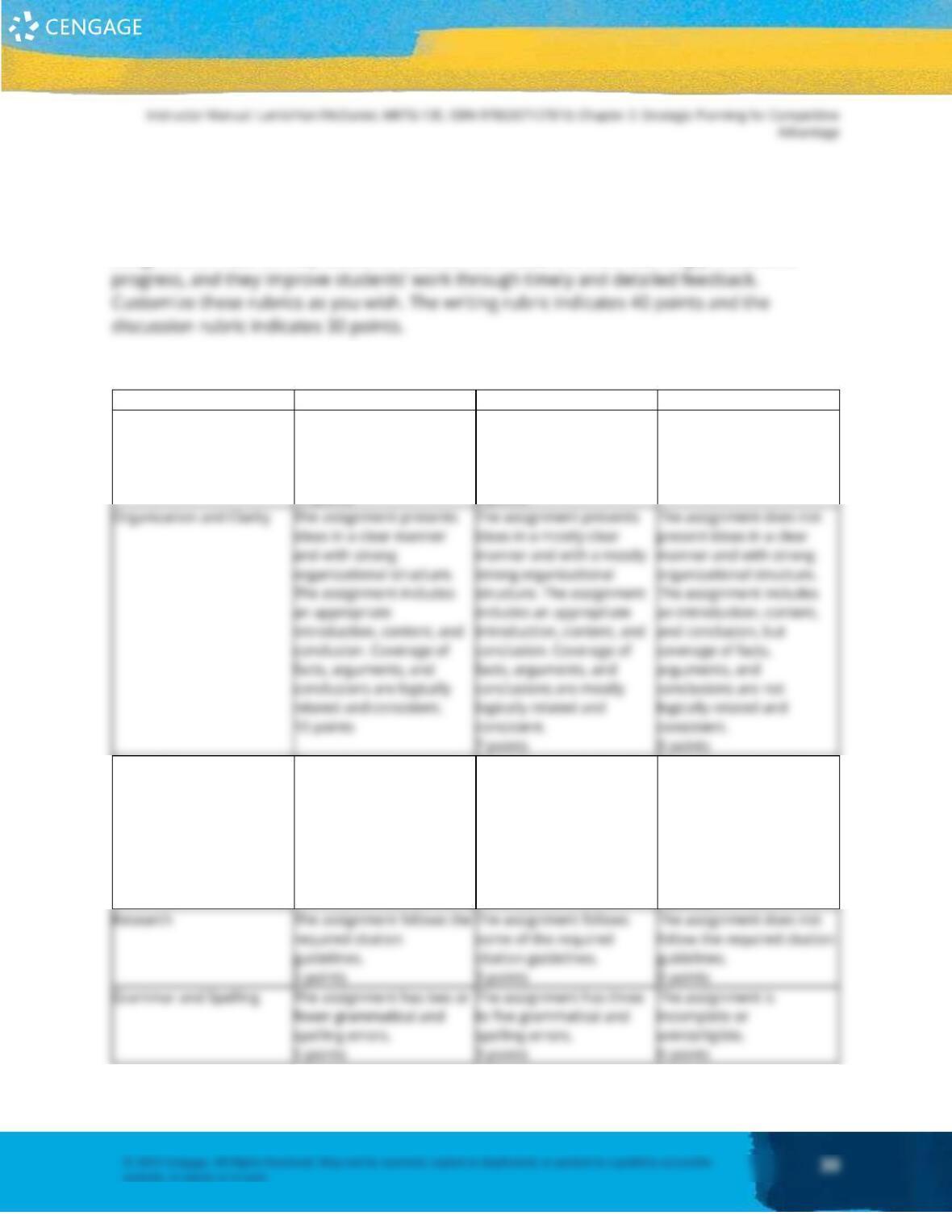
Providing students with rubrics helps them understand expectations and components of
assignments. Rubrics help students become more aware of their learning process and
Standard Writing Rubric
Criteria
Meets Requirements
Needs Improvement
Incomplete
Content
The assignment clearly and
comprehensively
addresses all questions in
the assignment.
The assignment partially
addresses some or all
questions in the
assignment.
The assignment does not
address the questions in
the assignment.
0 points
Research
The assignment is based
upon appropriate and
adequate academic
literature, including peer
reviewed journals and
other scholarly work.
5 points
The assignment is based
upon adequate academic
literature but does not
include peer reviewed
journals and other
scholarly work.
3 points
The assignment is not
based upon appropriate
and adequate academic
literature and does not
include peer reviewed
journals and other
scholarly work.
0 points
5 points
3 points
0 points
5 points
3 points
0 points

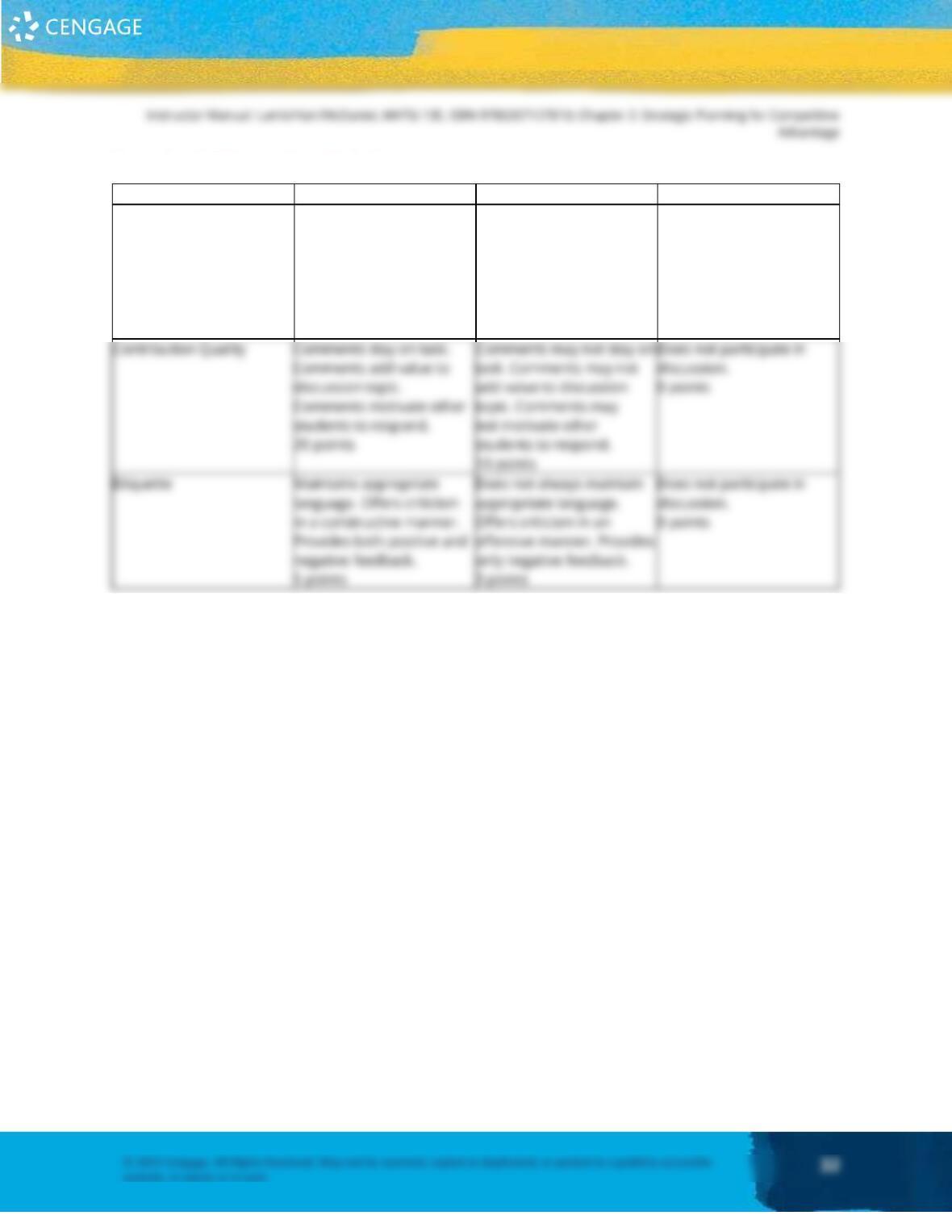
Standard Discussion Rubric
Criteria
Meets Requirements
Needs Improvement
Incomplete
Participation
Submits or participates in
discussion by the posted
deadlines. Follows all
assignment. instructions
for initial post and
responses.
5 points
Does not participate or
submit discussion by the
posted deadlines. Does not
follow instructions for
initial post and responses.
3 points
Does not participate in
discussion.
0 points