
Instructor Manual
Lamb/Hair/McDaniel, MKTG 13E, ISBN 9780357127810; Chapter 2: Strategic Planning for
Competitive Advantage
Table of Contents
Purpose and Perspective of the Chapter …………………………………………………………………………. 2
Cengage Supplements …………………………………………………………………………………………………… 2
Learning Outcomes ……………………………………………………………………………………………………….. 2
Complete List of Chapter Activities and Assessments ……………………………………………………… 3
Key Terms ……………………………………………………………………………………………………………………… 4
What’s New in This Chapter ……………………………………………………………………………………………. 7
Chapter Outline …………………………………………………………………………………………………………….. 7
Discussion Questions …………………………………………………………………………………………………… 21
Additional Activities and Assignments …………………………………………………………………………… 22
Additional Resources ……………………………………………………………………………………………………. 29
External Videos or Playlist ……………………………………………………………………………………………………….. 29
Appendix …………………………………………………………………………………………………………………….. 30
Generic Rubrics ……………………………………………………………………………………………………………………… 30
Standard Writing Rubric …………………………..……………………………………………………………………………… 30
Standard Discussion Rubric ……………………………………………………………………………………………………… 32
Purpose and Perspective of the Chapter
The purpose of this chapter is to begin to understand strategic planning, fitting the
company’s objectives with opportunities in the market, and why it is important to a
Cengage Supplements
The following product-level supplements provide additional information that may help you
in preparing your course. They are available in the Instructor Resource Center.
• Transition Guide (provides information about what’s new from edition to edition)
• Educator’s Guide (describes assets in the platform with a detailed breakdown of
activities by chapter with seat time)
Learning Outcomes
The following learning outcomes are addressed in this chapter:
2-1 The Nature of Strategic Planning
2-2 Strategic Business Units
2-3 Strategic Alternatives
2-10 Following Up on the Marketing Plan
2-11 Effective Strategic Planning
Complete List of Chapter Activities and Assessments
For additional guidance refer to the Teaching Online Guide.
Chapter
Learning
Outcome
PPT slide
Activity/Assessment
Duration
Certification
Standard
N/A
MindTap: Why Does the
Marketing Plan Matter to
Me?
5 minutes
BUSPROG:
Reflective
Thinking
DISC: Customer
2-1 – 2-2
MindTap: Learn It 2-1
and 2-2: The Nature of
Strategic Planning and
Strategic Business Units?
BUSPROG:
Analytic
DISC: Marketing
Plan
2-4 – 2-5
MindTap: Learn It 2-4
and 2-5: Defining the
Business Mission and
Conducting a Situation
Analysis
10 minutes
BUSPROG:
Analytic
DISC: Marketing
Plan
2-6
MindTap: Learn It 2-6:
Competitive Advantage
10 minutes
BUSPROG:
Analytic
DISC: Marketing
Plan
MindTap: Learn It 2-8
and 2-9: Describing the
Target Market and The
Marketing Mix
10 minutes
BUSPROG:
Analytic
DISC: Marketing
Plan
on the Marketing Plan
and Effective Strategic
Planning
DISC: Marketing
Plan
MindTap: Assignment
25 minutes
BUSPROG:
Analytic
DISC: Marketing
Plan
MindTap: Case Activity
15 minutes
BUSPROG:
DISC: Strategy
2-2
8
Knowledge Check 1 in
PPT
5 minutes
BUSPROG:
Communication
DISC: Product
2-4
26
Group Activity 1 in PPT
30 minutes
BUSPROG:
Analytic
DISC: Marketing
Plan
2-5
31
Group Activity 2 in PPT
30 minutes
BUSPROG:
Analytic
DISC: Research
Technology
DISC:
Online/Computer
65
Group Activity 4 in PPT
45 minutes
BUSPROG:
Communication
DISC: Marketing
Plan
[return to top]
Key Terms
Cash cow: in the portfolio matrix, a business unit that generates more cash than it needs
to maintain its market share.
Competitive advantage: a set of unique features of a company and its products that are
perceived by the target market as significant and superior to those of the competition.
Control: provides the mechanisms for evaluating marketing results in light of the plan’s
objectives and for correcting actions that do not help the organization reach those
objectives within budget guidelines.
Dog: in the portfolio matrix, a business unit that has low growth potential and a small
market share.
Environmental scanning: collection and interpretation of information about forces,
events, and relationships in the external environment that may affect the future of the
organization or the implementation of the marketing plan.
Market opportunity analysis (MOA): the description and estimation of the size and sales
potential of market segments that are of interest to the firm and the assessment of key
competitors in these market segments.
Market penetration: a marketing strategy that entails attracting new customers to
existing products.
Marketing audit: a thorough, systematic, periodic evaluation of the objectives, strategies,
structure, and performance of the marketing organization.
Advantage
Marketing plan: a written document that acts as a guidebook of marketing activities for
the marketing manager.
Mission statement: a statement of the firm’s business based on a careful analysis of
benefits sought by present and potential customers and an analysis of existing and
anticipated environmental conditions.
Problem child (question mark): in the portfolio matrix, a business unit that shows rapid
growth but poor profit margins.
Product development: a marketing strategy that entails the creation of new products for
present markets.
Product/service differentiation competitive advantage: the provision of something that
is unique and valuable to buyers beyond simply offering a lower price than that of the
competition.
Star: in the portfolio matrix, a business unit that is a fast-growing market leader.
SWOT analysis: identifying internal strengths (S) and weaknesses (W) and also examining
external opportunities (O) and threats (T).
[return to top]
What’s New in This Chapter
The following elements are improvements in this chapter from the previous edition:
• New example of strategic planning by Ford
• New example of market penetration using JCPenney and InStyle
• New examples of diversification using Lego and Tencent
[return to top]
Chapter Outline
In the outline below, each element includes references (in parentheses) to related content. “LO
CH–##” refers to the chapter learning outcome; “PPT Slide #” refers to the slide number in the
PowerPoint deck for this chapter (provided in the PowerPoints section of the Instructor Resource
Center); and, as applicable for each discipline, accreditation or certification standards (“DISC”).
Introduce Chapter 2 and review the learning outcomes. (PPT Slide 2).
1. The Nature of Strategic Planning (LO 2-1, PPT Slide 3, DISC: Marketing Plan)
a. Strategic planning is the managerial process of creating and maintaining a fit
between the organization’s objectives and resources and the evolving market
opportunities.
• The goal of strategic planning is long-run profitability and growth.
2. Strategic Business Units (LO 2-2, PPT Slide 6, DISC: Strategy)
a. Large companies may manage a number of very different businesses, called
strategic business units. A strategic business unit (SBU) is a subgroup of a single
3. Strategic Alternatives (LO 2-3, PPT Slide 9, DISC: Strategy)
a. Three commonly used tools that a company, or SBU, uses to manage the strategic
direction of its portfolio of businesses are:
• Ansoff’s strategic opportunity matrix
• The Boston Consulting Group model
• The General Electric model
b. The choice of which tool to use depends on whether a company expects profits right
PRESENTATION VISUAL: Exhibit 2.1 Ansoff’s Opportunity Matrix
Present Product
New Product
Present
Market
Market Penetration
Starbucks sells more coffee to customers
who register their reloadable Starbucks
cards.
Product Development
Starbucks develops
powdered instant coffee
called Via.
Chile.
Music and buys Ethos Water.
d. Firms can explore four options:
• Market penetration: A firm using the market penetration alternative would try
to increase market share among existing customers.
Example: Retailer JCPenney recently partnered with fashion magazine InStyle to
• Market development: Market development involves attracting new customers
to existing products. Ideally, new uses for old products stimulate additional sales
• Product development: A product development strategy entails the creation of
new products for present markets.
Example: Yogurt maker Danone (formerly Dannon) is adding milk-free products
to its yogurt line, as well as boosting vegan brands such as Silk.
• Diversification: Diversification is a strategy of increasing sales by introducing
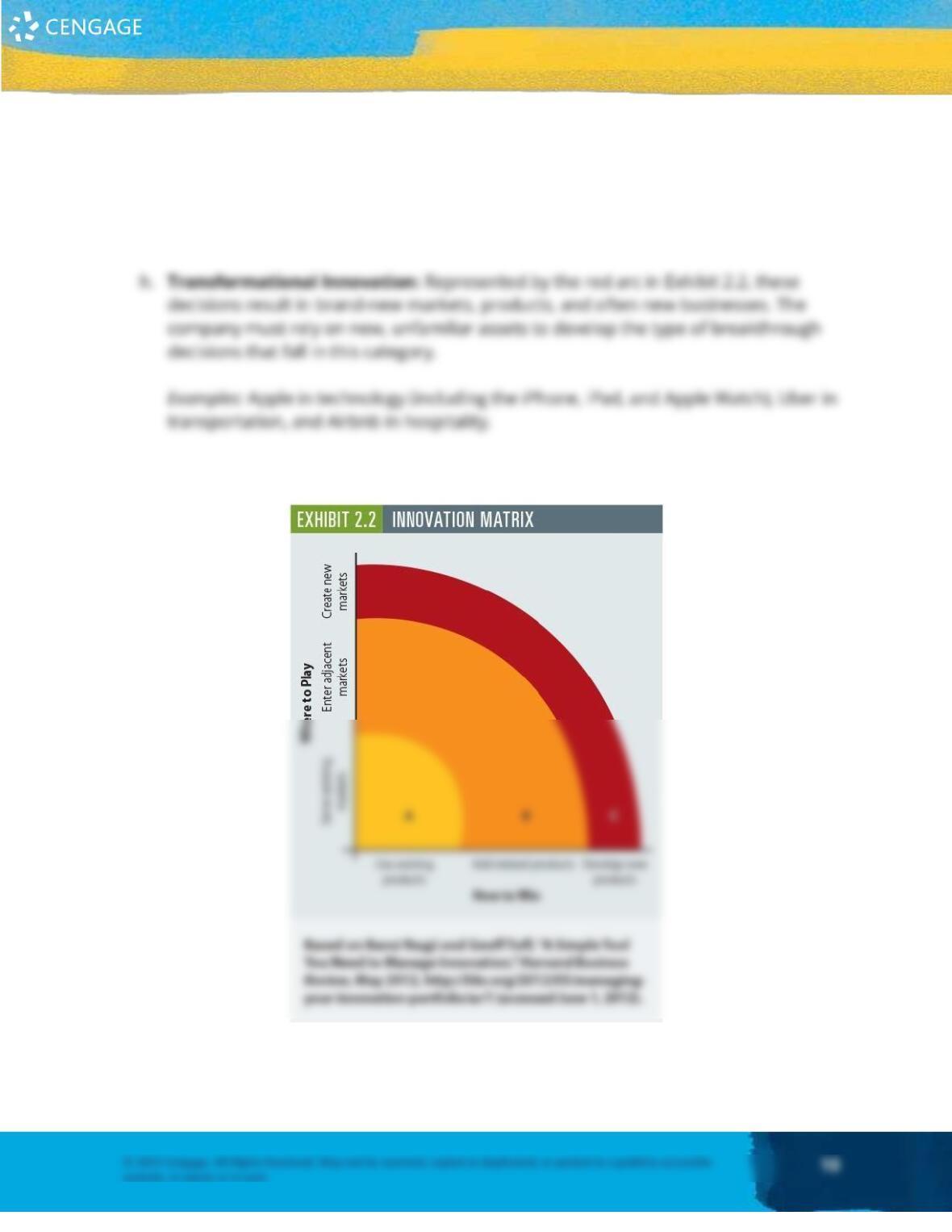
e. The Innovation Matrix : Critics of Ansoff’s matrix believe that modern businesses
plan growth in a more fluid manner based on current capabilities rather than the
clear-cut sectors outlined by the opportunity matrix. To reflect this, the innovation
f. Core Innovation: Represented by the yellow circle in Exhibit 2.2, these decisions
implement changes that use existing assets to provide added convenience to
existing customers and potentially entice customers from other brands.
Example: Blue Apron, the meal kit company, is starting to sell its kits in physical
Instructor Manual: Lamb/Hair/McDaniel, MKTG 13E, ISBN 9780357127810; Chapter 2: Strategic Planning for Competitive
Advantage
Example: Botox, the popular cosmetic drug, was originally developed to treat
intestinal problems and to treat crossed eyes. Leveraging the drug into cosmetic
medicine has dramatically increased the market for Botox.
PRESENTATION VISUAL: Exhibit 2.2 Innovation Matrix
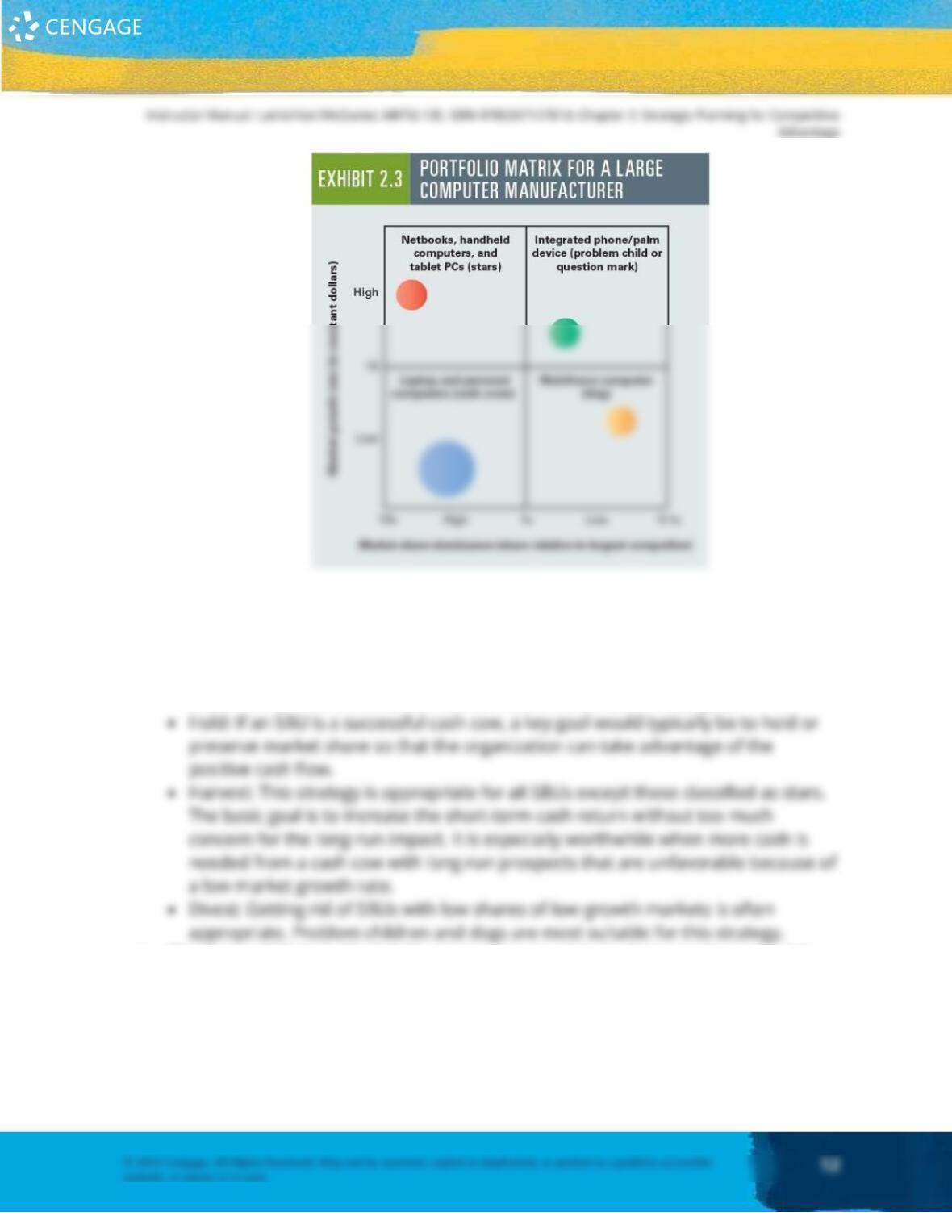
i. The Boston Consulting Group Model: To determine the future cash contributions
and cash requirements expected for each SBU, managers can use the Boston
Consulting Group’s portfolio matrix. The portfolio matrix is a tool for allocating
resources among products or SBUs on the basis of market share and market growth
rate. The underlying assumption is that market share and profitability are strongly
linked. The measure of market share used in the portfolio approach is relative
market share, the ratio between the company’s share and the share of the largest
• Cash cows. A cash cow is an SBU that generates more cash than it needs to
maintain its market share (Examples: Apple’s iPhone and Google’s search engine).
It is in a low-growth market, but the product has a dominant market share. The
basic strategy for a cash cow is to maintain market dominance by being the price
leader and making technological improvements in the product. Managers should
resist pressure to extend the basic line unless they can dramatically increase
demand. Instead, they should allocate excess cash to the product categories for
which growth prospects are the greatest.
PRESENTATION VISUAL: Exhibit 2.3 Portfolio Matrix for a Large Computer
Manufacturer
k. After classifying the company’s SBUs in the matrix, the next step is to allocate future
resources for each. The four basic strategies are to:
• Build: If an organization has an SBU that it believes has the potential to be a star,
building would be an appropriate goal. The organization may decide to give
short-term profits and use its financial resources to achieve this goal.
l. The General Electric Model: The dimensions used in the General Electric Model—
market attractiveness and company strength—are richer and more complex than
those used in the Boston Consulting Group model but are harder to quantify.
Exhibit 2.4 illustrates the GE model.
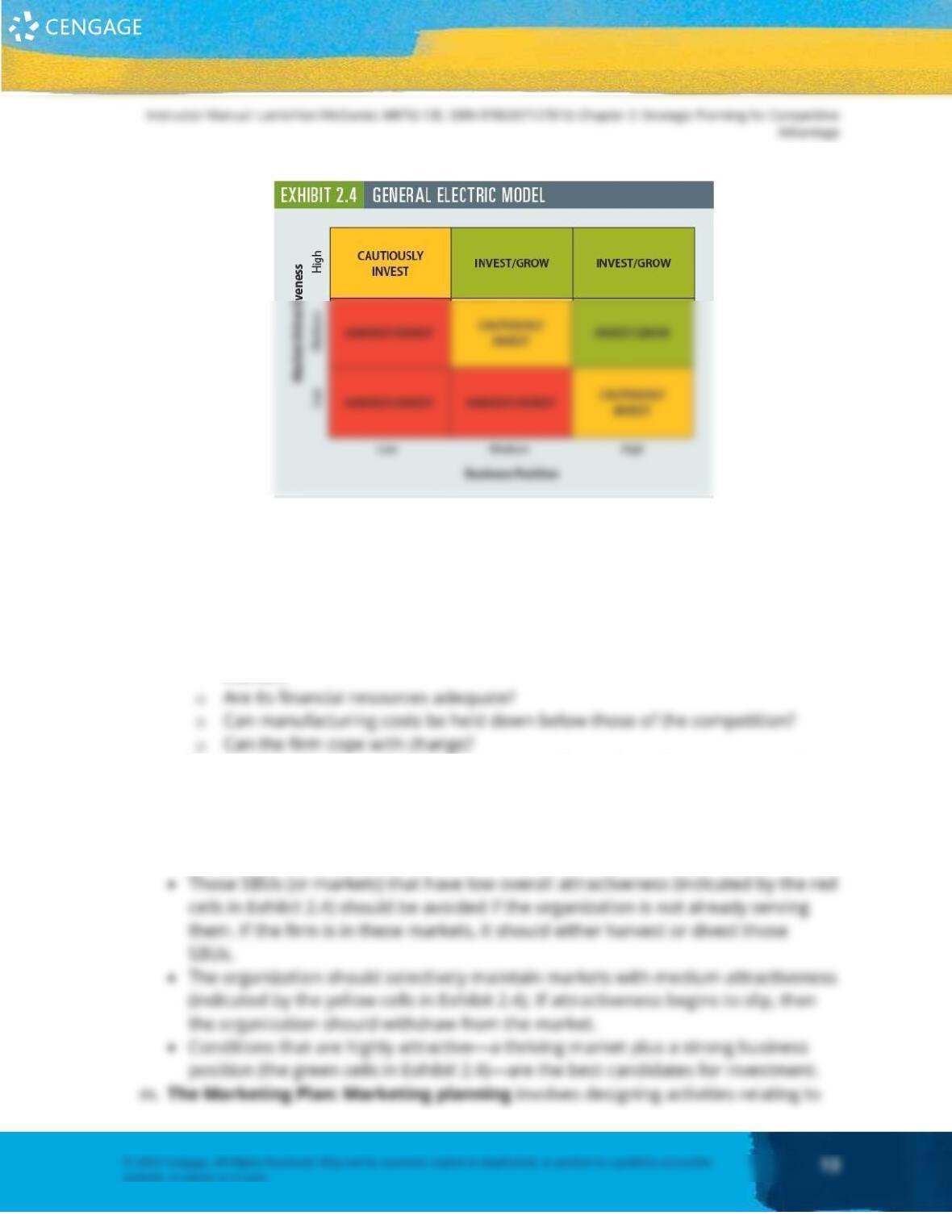
PRESENTATION VISUAL: Exhibit 2.4 General Electric Model
• The grid is divided into three overall attractiveness zones for each dimension:
High, Medium, and Low.
• The horizontal axis, Business Position, refers to how well positioned the
organization is to take advantage of market opportunities. Business position
answers questions such as:
o Does the firm have the technology it needs to effectively penetrate the
• The vertical axis measures the attractiveness of a market, which is expressed
both quantitatively and qualitatively. Some attributes of an attractive market are
high profitability, rapid growth, a lack of government regulation, consumer
insensitivity to a price increase, a lack of competition, and availability of
technology.
marketing objectives and the changing marketing environment. Marketing planning
is the basis for all marketing strategies and decisions. A marketing plan is a written
document that acts as a guidebook of marketing activities for the marketing
n. Why Write a Marketing Plan? Writing a marketing plan allows you to examine the
marketing environment in conjunction with the inner workings of the business. A
written marketing plan:
• Provides clearly stated activities that help employees and managers understand
and work toward common goals
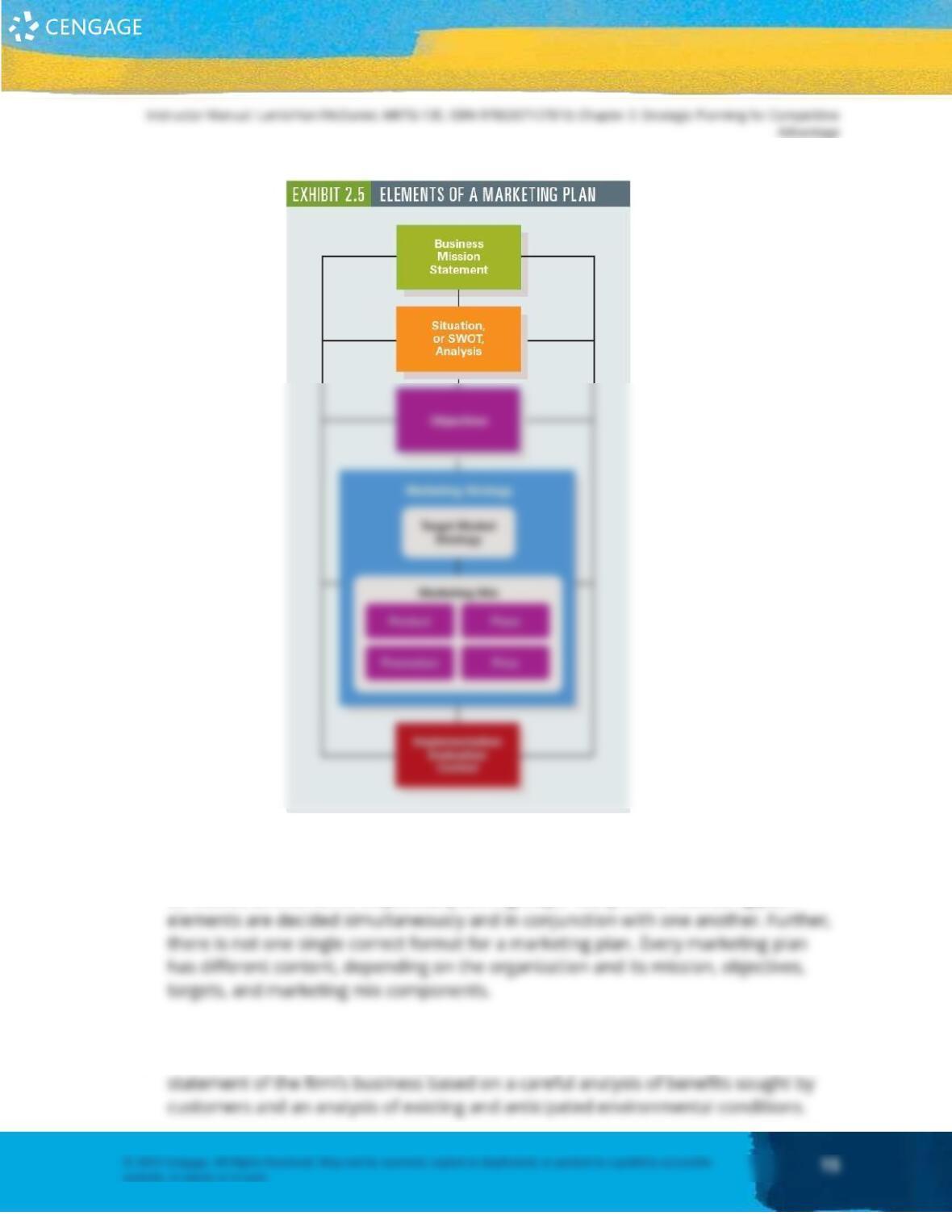
PRESENTATION VISUAL: Exhibit 2.5 Elements of a Marketing Plan
p. Writing the Marketing Plan: The overall structure of the marketing plan should not
be viewed as a series of sequential planning steps. Many of the marketing plan
4. Defining the Business Mission (LO 2-4, PPT Slide 24, DISC: Marketing Plan)
a. The foundation of any marketing plan is the firm’s mission statement, which is a
5. Conducting A Situation Analysis (LO 2-5, PPT Slide 28, DISC: Strategy)
a. Marketers must understand the current and potential environment in which the
product or service will be marketed.
• A situation analysis is sometimes referred to as a SWOT analysis—that is, the
6. Competitive Advantage (LO 2-6, PPT Slide 33, DISC: Customer)
a. Performing a SWOT analysis allows firms to identify their competitive advantage. A
competitive advantage is a set of unique features of a company and its products
that are perceived by the target market as significant and superior to those of the
competition. There are three types of competitive advantage:
• Cost
b. Cost Competitive Advantage: Having a cost competitive advantage means
being the low-cost competitor in an industry while maintaining satisfactory profit
margins. Costs can be reduced in a variety of ways:
• Experience curves: Experience curves tell us that costs decline at a predictable
rate as experience with a product increases. Experience curves allow