
1
Instructor’s Manual – Chapter 2
Hunt/Mello/Deitz:
Marketing 2e
Chapter 2: Strategic Planning
© John Lund/Digital Vision/Getty Images RF
Use this Instructor’s Manual to facilitate class discussion and incorporate the unique features of the text.
C H A P T E R F O R E C A S T
This chapter explores the importance of strategic planning in marketing. Executing a thoughtful strategic
marketing plan is the most likely path to sustainable business success. The chapter examines the role of a
mission statement, situation analysis, marketing strategy, global marketing strategy, and other elements of
an effective marketing plan. The appendix that follows the chapter presents a complete sample marketing
plan.
L E A R N I N G O B J E C T I V E S
LO 2-1 Discuss the importance of strategic planning for marketing.
LO 2-2 Analyze the characteristics of an effective mission statement.
LO 2-3 Outline the five main components of the marketing plan.
LO 2-4 Explain three tools and techniques for the situation analysis: market summary, SWOT analysis, and
competition analysis.
K E Y T E R M S
competitive advantage
direct ownership
diversification
exporting
financial projections
franchising
joint venture
market share analysis
market summary
marketing analytics
marketing plan
mission statement
opportunities (in SWOT
analysis)
revenue analysis
situation analysis
strategic plan
strategic planning
strategy
strengths (in SWOT analysis)
SWOT analysis
Instructor’s Manual – Chapter 2
Hunt/Mello/Deitz:
Marketing 2e
T H O U G H T – P R O V O K I N G A C T I V I T Y
With each chapter, begin class with a thought-provoking activity (TPA) for 10 minutes. TPAs allow students to
pull in real-world, current findings into class, and better enable students to partake in class discussion with
relation to the chapter’s material in an icebreaker format. (This activity is included in the PowerPoint for this
chapter.)
How It Works: When class begins, two to three students are called on via random assignment to provide
Set 1: What is a mission statement? Provide an example of a mission statement in a franchise.
Set 2: What is the BCG matrix? With each of the four sections, provide an example.
C O N T E N T O U T L I N E
The following section provides the flow of information using the LEARNING OBJECTIVES as a guide, FIGURES
and TABLES as visuals to elaborate on key areas, and KEY TERMS learners will need to take away from the
course, and a notation of when to use POWERPOINT SLIDES with LECTURE NOTES to drive home teaching
Executive Perspective
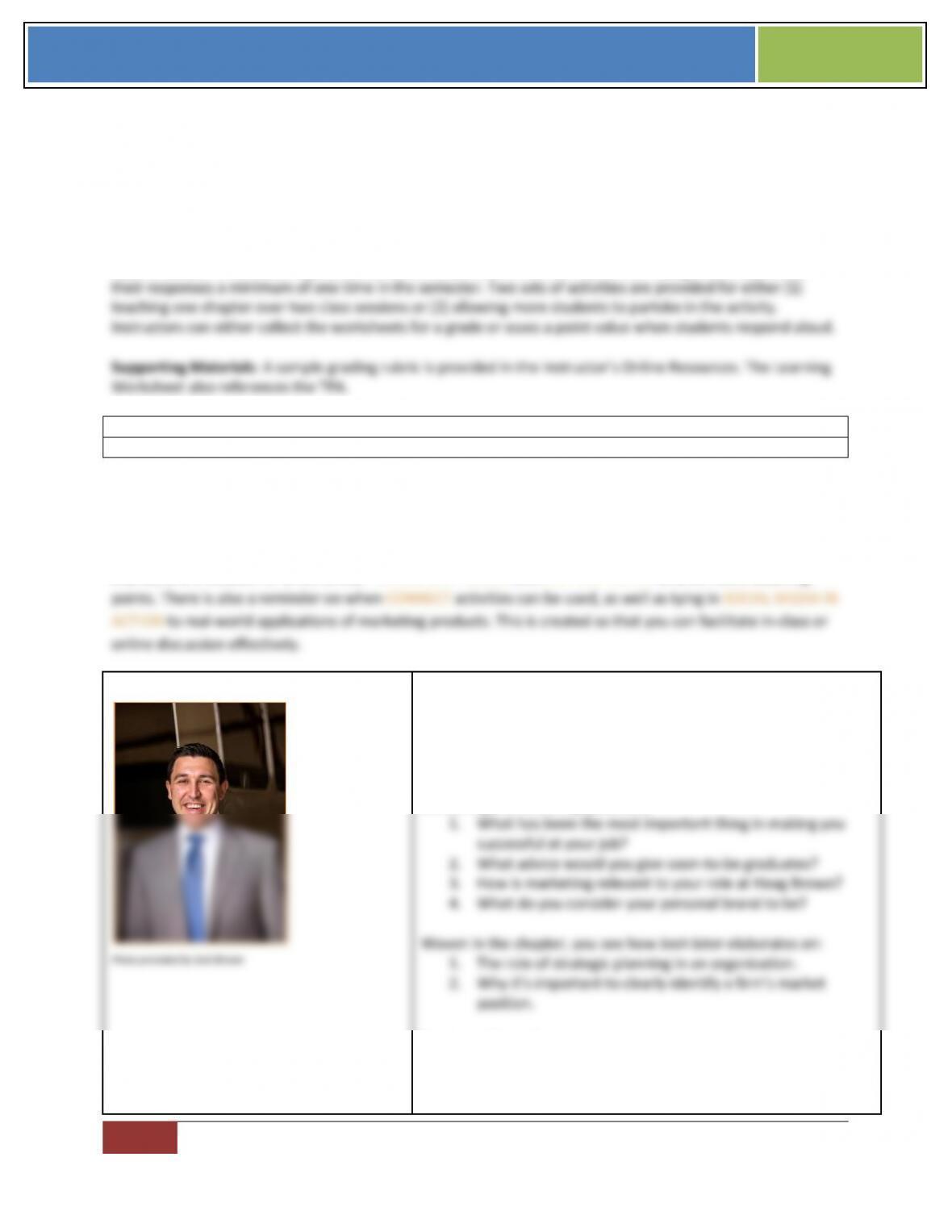
Josh Brown
Partner and Co-Owner, Haag Brown Commercial Real Estate
Josh Brown, political science major turned broker, attributes his
success to winning at small things since a young age. He explains
how taking responsibility for marketing yourself elicits success in
answering the following questions:
1. What has been the most important thing in making you
successful at your job?
2. What advice would you give soon-to-be graduates?
3. How is marketing relevant to your role at Haag Brown?
4. What do you consider your personal brand to be?
Instructor’s Manual – Chapter 2
Hunt/Mello/Deitz:
Marketing 2e
LO 2-1
Discuss the importance of
strategic planning for marketing.
• The Importance of Strategic
Planning
Key Terms:
• Strategic planning
• Strategic plan
PowerPoint Slides
PPt 2.6
PPt 2.7
Lecture Notes:
• Essential to meeting both professional and personal objectives because it greatly
increases the likelihood of success
• What does strategic planning mean? To plan with strategy.
• Strategic planning – process of thoughtfully defining a firm’s objectives and
developing a method for achieving those objectives
o A continuous process – shifting conditions, customer needs, and
competitive threats are always present
o Helps us to ensure that marketers select and execute the right
marketing mix to maximize success
• Strategic plan – organization’s plans for key functional areas, such as marketing,
human resources, finance, and risk management
• Strategic planning is essential to meeting both professional and personal
objectives. In the same way that a strategic plan will help you accomplish your
goal of earning a college degree, a firm’s strategic plan helps guide it to success.
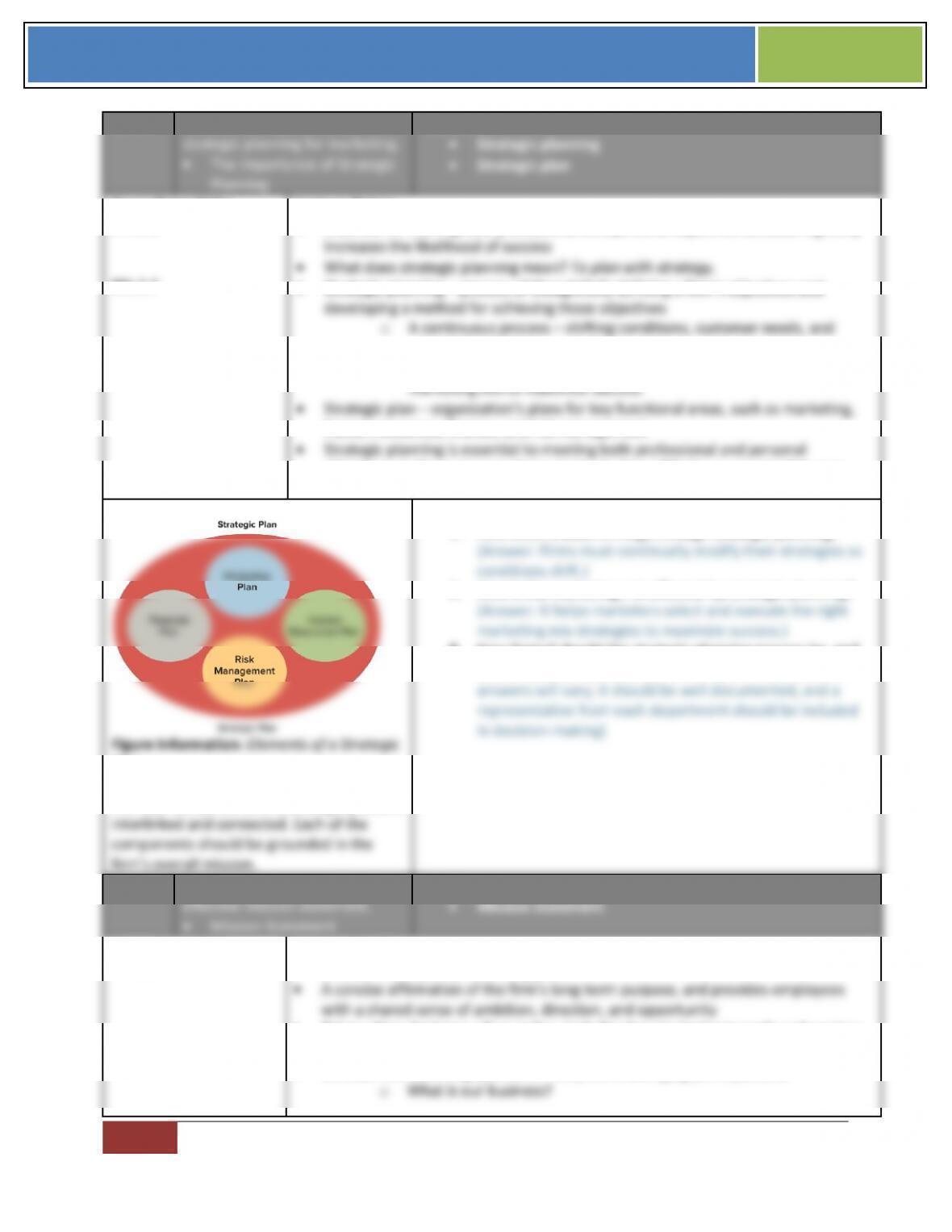
Figure 2.1
Figure Information: Elements of a Strategic
Plan
The four components of a strategic plan are
interlinked and connected. Each of the
components should be grounded in the
firm’s overall mission.
Insight Questions:
1. How often should firms go through strategic planning?
(Answer: Firms must continually modify their strategies as
conditions shift.)
2. How is the marketing mix affected by strategic planning?
(Answer: It helps marketers select and execute the right
marketing mix strategies to maximize success.)
3. How formal should the strategic planning process be, and
who should be included? (Answer: open ended, student
answers will vary; it should be well documented, and a
representative from each department should be included
in decision-making)
LO 2-2
Analyze the characteristics of an
Key Terms:
PowerPoint Slides
Lecture Notes:
with a shared sense of ambition, direction, and opportunity
• Drives other decisions a firm makes, including how to best get goods and services
Instructor’s Manual – Chapter 2
Hunt/Mello/Deitz:
Marketing 2e
PPt 2.10
o Who is our customer?
o What is our value to the customer?
o What will our business be?
o What should our business be?
• Three primary characteristics of a good mission statement:
o Focus on a limited number of goals
o Customer oriented, satisfying the basic customer needs and wants
o Capture a shared purpose and provide motivation for employees
THINK LIKE A MARKETER
Find an example of a “bad” mission statement. What makes it “bad”? How could it be
better?
THINK LIKE A MARKETER
What do you think of a company not having a mission statement?
• In pursuit of its mission statement to build the best products and implement
environmentally friendly solutions, Patagonia partners with a Long Beach
company, Upcycle It Now, to deconstruct old rain coats and fleece jackets and use
them to create dog attire.
LO 2-3
Outline the five main components
of the marketing plan.
• The Marketing Plan
o Executive Summary
o Situation Analysis
o Marketing Strategy
o Financials
o Controls
Key Terms:
• Marketing plan
• Situation analysis
• Market summary
• Strategy
• Financial projections
PowerPoint Slides
PPt 2.11
Lecture Notes:
• Marketing plan – action-oriented document/playbook that guides the analysis,
implementation, and control of the firm’s marketing strategy
o Primary strategic planning tool
o Contains input, guidance, and review from various departments,
employees
o Essential that all departments know the plan
o Format will vary
o Contains (all grounded by the mission statement):
▪ Executive summary
▪ Situation analysis
▪ Marketing strategy
▪ Controls
Figure 2.2
Insight Questions:
Most departments in a firm, not just the marketing
department.)
realistic objectives)
Instructor’s Manual – Chapter 2
Hunt/Mello/Deitz:
Marketing 2e
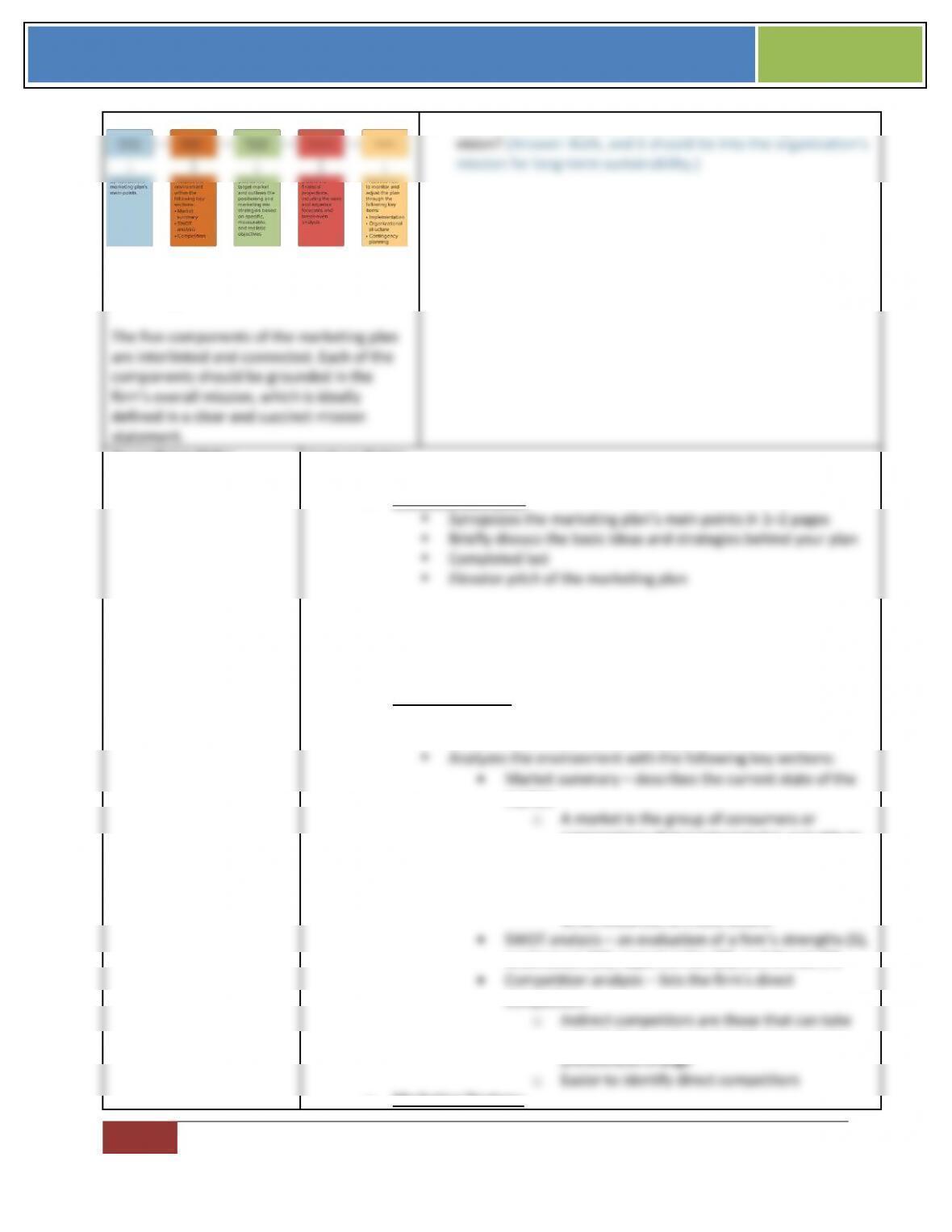
Figure Information: Key Components of the
Marketing Plan
The five components of the marketing plan
are interlinked and connected. Each of the
components should be grounded in the
firm’s overall mission, which is ideally
defined in a clear and succinct mission
statement.
3. Should a marketing plan have a short-term or long-term
vision? (Answer: Both, and it should tie into the organization’s
mission for long-term sustainability.)
PowerPoint Slides
PPt 2.11
Lecture Notes:
• Key Components of the Marketing Plan
o Executive summary:
▪ Synopsizes the marketing plan’s main points in 1–2 pages
▪ Briefly discuss the basic ideas and strategies behind your plan
▪ Completed last
▪ Elevator pitch of the marketing plan
THINK LIKE A MARKETER
▪ Foundation of the marketing plan (current situation understood
so the firm can best move forward)
▪ Analyzes the environment with the following key sections:
• Market summary – describes the current state of the
market
o A market is the group of consumers or
organizations that is interested in and able to
buy a particular product.
what resources to invest where.
weaknesses (W), opportunities (O), and threats (T)
• Competition analysis – lists the firm‘s direct
competitors
o Indirect competitors are those that can take
market share as macro trends or consumer
o Easier to identify direct competitors
6
Instructor’s Manual – Chapter 2
Hunt/Mello/Deitz:
Marketing 2e
PPt 2.12
▪ Strategy – set of actions taken to accomplish organizational
objectives based on the mission
▪ Defines the target market and outlines the positioning and
marketing mix strategies based on specific, measurable, and
realistic objectives
▪ Lists the actions the firm must take to accomplish the
marketing objectives it established in its mission statement and
strategic planning
▪ Can lead to higher profits, strong brands, larger market share
o Financials:
• Sales Forecast – projects how many units of a product
expected to sell during a specific time period
• Expense Forecast – estimate of the costs the company
will incur to create, communicate, and deliver the
product
o Needed so resources can be allocated, and to
know when the product will become profitable
• Break-Even Analysis – combines the data provided in
the previous two so the company can estimate how
much it needs to sell to cover all expenses
strategy and objectives in the mission
statement
o Adjustments may be necessary
• Organizational Structure:
o What specific departments should be
necessary
Instructor’s Manual – Chapter 2
Hunt/Mello/Deitz:
Marketing 2e
LO 2-4
Explain three tools and
techniques for the situation
analysis: market summary, SWOT
analysis, and competition
analysis.
• Tools and Techniques for the
Situation Analysis
o Market Summary
▪ BCG Matrix
o SWOT Analysis
▪ Internal
Considerations
▪ External
Considerations
o Competition Analysis
Key Terms:
• SWOT analysis
• Strengths (in SWOT analysis)
• Weaknesses (in SWOT analysis)
• Opportunities (in SWOT analysis)
• Threats (in SWOT analysis)
PowerPoint Slides
PPt 2.14
Lecture Notes:
• Market Summary
o Sets the stage for the situation analysis section of the marketing plan
▪ Ex: McDonald’s – look at size of fast food market in the U.S.
and how rapidly #s are growing or declining
o Should provide perspective on important marketplace trends
▪ Ex: McDonald’s – look at eating habits of baby boomers and
millennials
o Growth opportunities internationally and potential sales through
international expansion would also be considered
o BCG Matrix
▪ Popular analysis tool to describe a current market
▪ Graphically depicts the strength and attractiveness of a
market
▪ Combines two elements: market growth and relative market
share
▪ Result: four unique product categories (stars, cash cows,
question marks, and dogs/problem child)
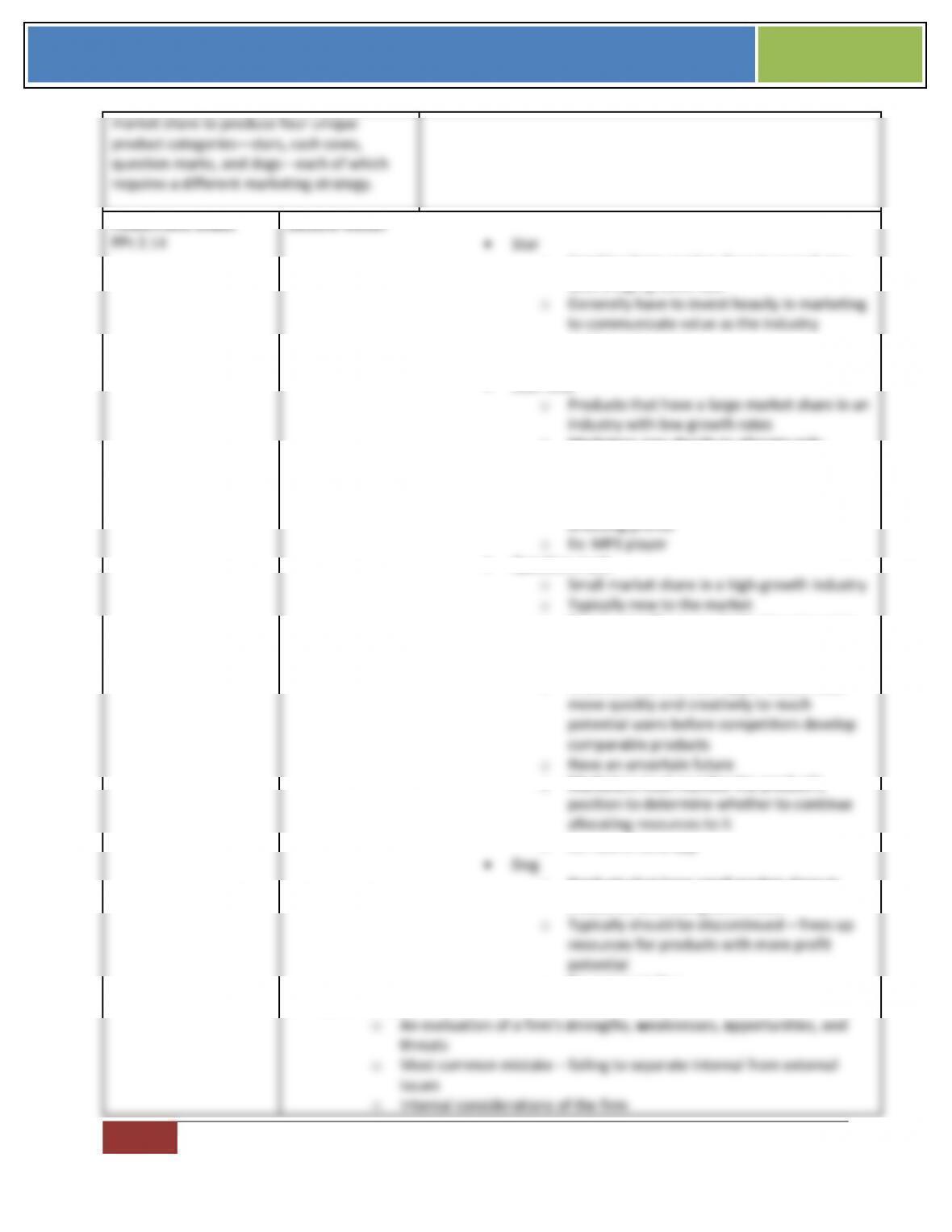
Figure 2.3
Insight Questions:
1. What does the BCG Matrix determine? (Answer: where its
product will fall in the marketplace and serve as a starting
point for developing marketing strategies to address that
market position)
2. What quadrant would represent the Apple iPad? (Answer:
(Answer: question mark)
Instructor’s Manual – Chapter 2
Hunt/Mello/Deitz:
Marketing 2e
market share to produce four unique
product categories—stars, cash cows,
question marks, and dogs—each of which
requires a different marketing strategy.
PowerPoint Slides
PPt 2.14
PPt 2.16
Lecture Notes:
• Star
o Combine large market share in an industry
with a high growth rate
o Generally have to invest heavily in marketing
to communicate value as the industry
continues to grow
• Cash cow
o Products that have a large market share in an
enough marketing resources to keep sales
strong without increasing product-
development and costs or negatively
• Question mark
o Small market share in a high-growth industry
o Typically new to the market
o Require significant marketing investment in
promotion, product management, and
o Marketers for the new Apple Watch must
comparable products
o Have an uncertain future
o Marketers must monitor the product’s
position to determine whether to continue
industries with low growth rates
potential
• SWOT Analysis
o An evaluation of a firm’s strengths, weaknesses, opportunities, and
o Internal considerations of the firm
Instructor’s Manual – Chapter 2
Hunt/Mello/Deitz:
Marketing 2e
▪ Strengths – internal capabilities that help the company
achieve its objectives
• Brand recognition
• Brand reputation
• Effective supply chain strategy
• Long-term profitability
▪ Weaknesses – internal limitations that prevent/disrupt the
firm’s ability to meet objectives
• Inflexible to market changes
• Difficult to find and retain employees
• Drive to achieve shareholder value conflicts with CSR
o External considerations of the environment
▪ Opportunities – external factors that firm can capitalize to
meet or exceed objectives
• Internal expansion
• Positive environmental commitments
• CSR committee
• Public interest in ethical and sustainable business
practices
▪ Threats – current and potential external factors that may
• Weak economy – fewer people dining out
• Consumer trend to choose healthier options
• Contributes to global warming
• Health concerns
opportunities?
▪ How can the firm overcome weaknesses that keep it from
taking advantage of opportunities?
threats?
▪ How can the firm overcome weaknesses that will make threats
a reality?
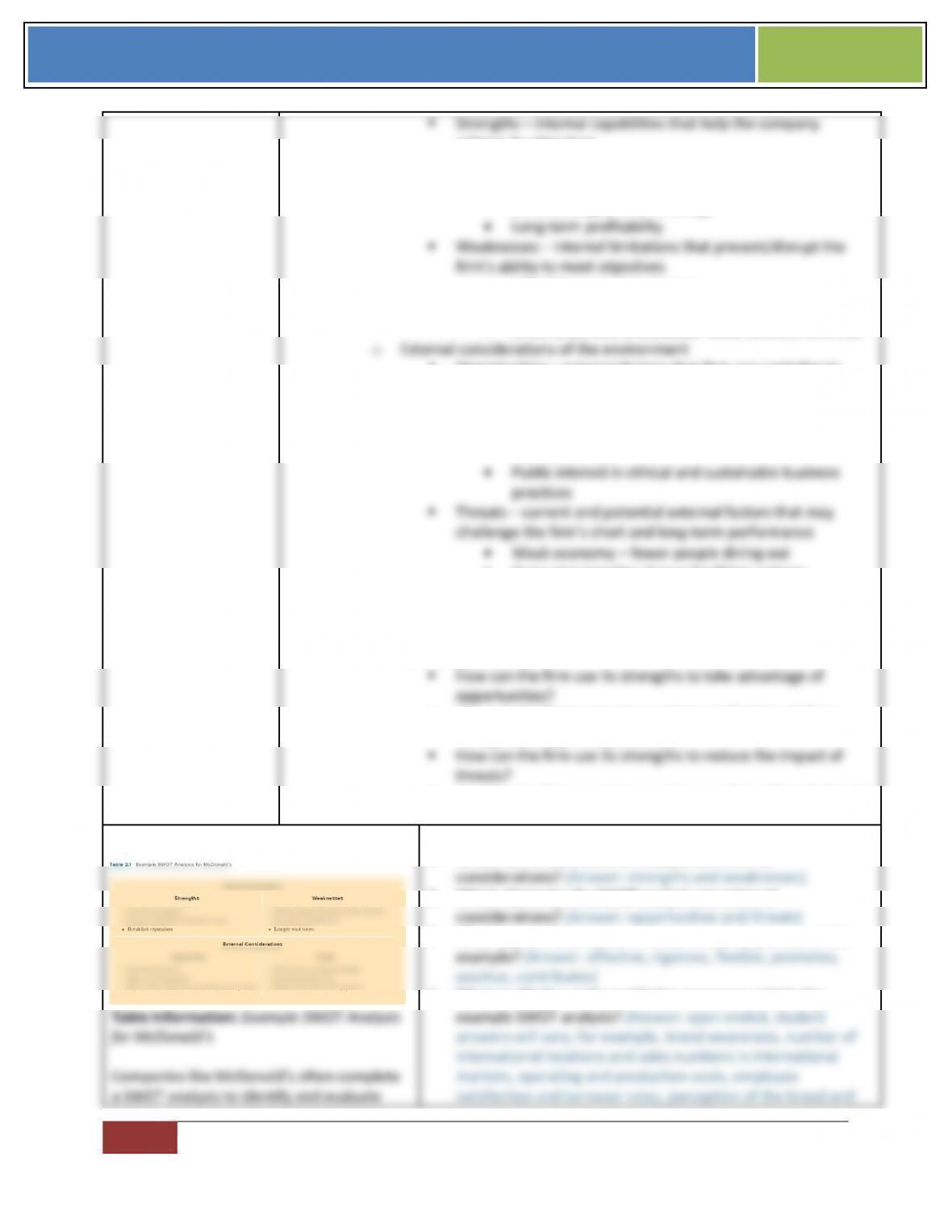
Table 2.1
Table Information: Example SWOT Analysis
for McDonald’s
Companies like McDonald’s often complete
Insight Questions:
1. Which elements of a SWOT analysis are internal
positive, contributes)
4. What qualitative and quantitative measures exist in the
example SWOT analysis? (Answer: open ended, student
answers will vary; for example, brand awareness, number of
international locations and sales numbers in international
markets, operating and production costs, employee
Instructor’s Manual – Chapter 2
Hunt/Mello/Deitz:
Marketing 2e
their strengths, weaknesses, opportunities,
and threats. Evaluating internal and external
considerations are extremely important in
determining a firm’s position and
competitive advantage.
its products)
Connect Application Exercise 2-1
Topic: SWOT Analysis
By identifying which elements of a fictional company’s situation
analysis fall into each category, you will understand the key
differences among each of the four SWOT components.
CONNECT BACK Insight Questions:
1. In a real SWOT analysis, what resources will you use to
compose your SWOT analysis? (Answer: open ended, student
answers will vary; for example, friends and family members,
professors and current/past employers)
2. For measurement and analysis, figure out which elements are
quantitative, and which ones are qualitative. (Answer: open
ended, student answers will vary; Figuring out how each
element of the SWOT analysis is measured is just as important
as the content itself.)
3. When should a SWOT analysis be conducted? Think in terms
of frequency, product development, and strategic planning.
(Answer: open ended, student answers will vary; no less than
once a year)
PowerPoint Slides
PPt 2.20
PPt 2.21
Lecture Notes:
• Competition Analysis
o Clearly state the firm’s direct and indirect competition; including
vulnerability, addressing market share
o Thoughtful and thorough analysis
o Direct competitors – describe the relative products to the brand
▪ Market research can provide key data for this section
o Indirect competitors – comparative products of the brand
▪ Tend to be overlooked or ignored completely
▪ When completing a situation analysis, it’s just as
important for a firm like McDonald’s to analyze indirect
Instructor’s Manual – Chapter 2
Hunt/Mello/Deitz:
Marketing 2e
LO 2-5
Explain the basic tools and
techniques of marketing strategy:
segmentation, strategic direction,
and the marketing mix.
• Basic Tools and Techniques of
Marketing Strategy
o Segmentation, Target
Markets, and Positioning
▪ Segmentation
▪ Target Markets
▪ Positioning
o Strategic Direction
▪ Market Penetration
▪ Product
Development
▪ Market Development
▪ Diversification
o Marketing Mix
▪ Product
▪ Promotion
▪ Ditribution
▪ Pricing
Key Terms:
• Market segmentation
• Market segments
• Target market
• Positioning
• Market penetration
• Product development
• Market development
• Diversification
• Competitive advantage
PowerPoint Slides
PPT 2.22
PPT 2.23
Lecture Notes:
• Marketing strategy lists the specific actions the firm must take to accomplish the
marketing objectives it has established
o The effectiveness depends on the clarity of the short- and medium-term
objectives the firm has defined
o Three basic characteristics:
▪ Specific – increase ad revenues. By how much? By when? How
▪ Measurable – Is the strategy working?
• Segmentation, Target Markets, and Positioning
characteristics and similar product needs
▪ Success can be dependent on this
Instructor’s Manual – Chapter 2
Hunt/Mello/Deitz:
Marketing 2e
PPT 2.24
• Strategic Direction
o Based on the product and industry related to the market
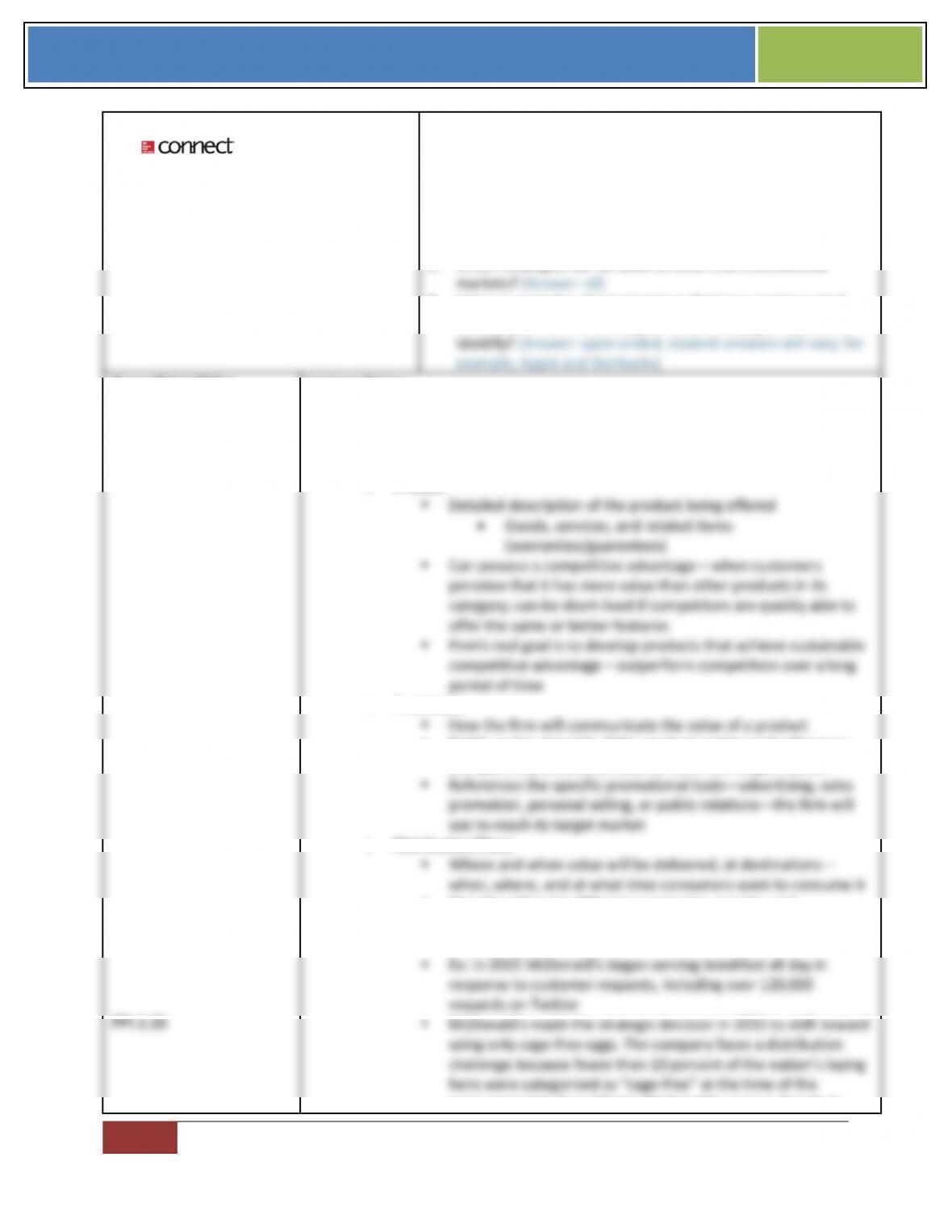
Figure 2.4
Figure Information: The Four Basic
Categories of Market Growth Strategies
A company’s marketing strategy can follow
various paths based on the product and
industry, but most seek to move the product
in one of the four directions: market
penetration, product development, market
development, and diversification. Each of
these categories represents the intersection
of a strategy related to products and
another related to markets.
Insight Questions:
1. Which strategy involves encouraging current customers to buy
more each time they patronize a store or to buy from the
store on a more frequent basis? (Answer: market penetration)
2. Which strategy did Dr Pepper Ten use in their campaign
launch of, “It’s not for women?” (Answer: product
development)
3. Which strategy focuses on selling existing goods and services
to new customers? (Answer: market development)
4. List three examples of companies that have used the
diversification strategy. (Answer: open ended, student
answers will vary; for example, Disney)
PowerPoint Slides
PPt 2.24
PPt 2.26
Lecture Notes:
o Market penetration
▪ Selling more of existing goods and services to existing
customers
▪ Involves encouraging current customers to buy more each
time they patronize a store or to buy from the store on a
more frequent basis
▪ Ex: Pizza Hut Big Dinner Box
o Product development
o Market development
o Diversification
unrelated to the existing products produced by the
▪ International expansion is an increasingly necessary part of
a successful market development strategy for small firms
as well as retailers like Wal-Mart.
Instructor’s Manual – Chapter 2
Hunt/Mello/Deitz:
Marketing 2e
Connect Application Exercise 2-2
Topic: Strategic Directions
By matching particular strategies with companies that used those
strategies, you will better understand how different marketing
strategies may impact your future employer.
CONNECT BACK Insight Questions:
1. Which strategies can be used to enter into international
markets? (Answer: all)
2. List two examples of organizations that have implemented
each one of the four strategies. Which strategy is easiest to
identify? (Answer: open ended, student answers will vary; for
example, Apple and Starbucks)
PowerPoint Slides
PPt 2.27
PPt 2.28
Lecture Notes:
• Marketing Mix
o How does the marketing mix support the strategy?
o Combination of activities that a firm can do to influence demand for its
good or service
o Product
▪ Detailed description of the product being offered
• Goods, services, and related items
(warranties/guarantees)
▪ Can possess a competitive advantage – when customers
perceive that it has more value than other products in its
category; can be short-lived if competitors are quickly able to
use to reach its target market
▪ Where and when value will be delivered, at destinations –
when, where, and at what time consumers want to consume it
▪ Ex: in 2015 McDonald’s began serving breakfast all day in
▪ McDonald’s made the strategic decision in 2015 to shift toward
using only cage-free eggs. The company faces a distribution
challenge because fewer than 10 percent of the nation’s laying
Instructor’s Manual – Chapter 2
Hunt/Mello/Deitz:
Marketing 2e
PPt 2.27
reach its goal of having 100 percent cage-free eggs in its
products.
o Pricing
▪ How much each consumer will pay and why that price was
selected
Connect Application Exercise 2-3
Social Media in Action
Topic: Social Media
By understanding the role social media can play in achieving your
objectives, you will be able to apply these strategies to successfully
implement a marketing plan for your organization in the years
ahead.
CONNECT BACK Insight Questions:
1. Should social media strategies always be included in a
company’s marketing plan since it is a popular medium?
(Answer: not necessarily, and only if the demographics of the
platform align)
2. How would you determine the social media platform a
company should use (i.e., Facebook, Twitter, LinkedIn,
YouTube, Snapchat, Pinterest, etc.)? Should they use all of
them? (Answer: open ended, student answers will vary; check
out the competitors and what platforms they are on; start
with one platform and slowly add on others that are aligned
socioculturally)
LO 2-6
Discuss the strategic decisions
involved in reaching international
consumers.
• Marketing Strategy in a Global
Context
o Exporting
o Licensing
o Franchising
o Joint Venture
o Direct Ownership
Key Terms:
• Exporting
• Licensing
• Franchising
• Joint venture
• Direct ownership
PowerPoint Slides
PPt 2.29
Lecture Notes:
• Globalization is the new reality
o As a result, a firm’s strategic planning process must consider what, if any,
international presence the firm wants to pursue.
How do firms enter foreign markets?
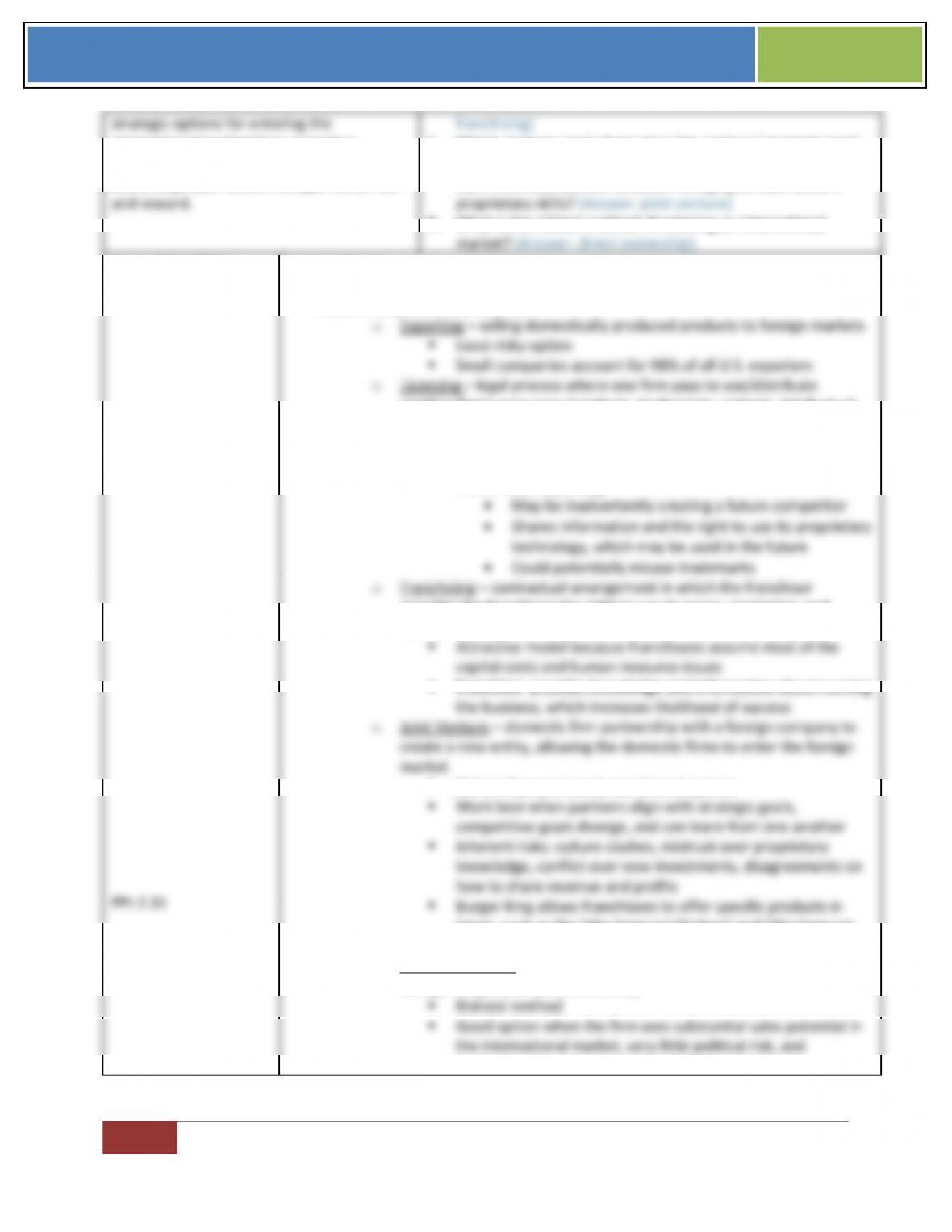
Figure Information: International Market
Entry Strategies
involves global marketing, firms must choose
from among the following five major
markets? (Answer: exporting)
2. Which strategy offers marketers the advantages of expanding
the reach of their products quickly in a low cost way? (Answer:
licensing)
markets because its licensees assume the majority of the
capital costs and human resource issues? (Answer:
15
Instructor’s Manual – Chapter 2
Hunt/Mello/Deitz:
Marketing 2e
strategic options for entering the
international marketplace: exporting,
licensing, franchising, joint venture, or direct
ownership. Each offers a unique mix of risk
and reward.
franchising)
4. Which strategy works best when the partners’ strategic goals
align, their competitive goals diverge, and they are able to
learn from one another without infringing on each other’s
proprietary skills? (Answer: joint venture)
5. What is the riskiest method of entering an international
market? (Answer: direct ownership)
PowerPoint Slides
PPt 2.29
Lecture Notes:
• Five major strategic options for entering the international marketplace – each
offers a unique risk and reward:
o Exporting – selling domestically produced products to foreign markets
▪ Least risky option
▪ Small companies account for 98% of all U.S. exporters
o Licensing – legal process where one firm pays to use/distribute
another firm’s resources (products, trademarks, patents, intellectual
property, proprietary knowledge)
▪ Advantage of expanding the reach of products quickly at a low
cost
technology, which may be used in the future
• Could potentially misuse trademarks
o Franchising – contractual arrangement in which the franchisor
provides the franchisee the right to use its name, marketing, and
operational support in exchange for a fee and share of the profits
▪ Attractive model because franchisees assume most of the
market
▪ Riskier than previously mentioned options
▪ Inherent risks: culture clashes, mistrust over proprietary
Beef,” to better satisfy local customer tastes.
Instructor’s Manual – Chapter 2
Hunt/Mello/Deitz:
Marketing 2e
Connect Application Exercise 2-4
Topic: International Market Approaches
By identifying an example of each strategy and its risk level, you
will understand the potential risks and rewards of marketing your
products globally.
CONNECT BACK Insight Questions:
1. What key factors determine the market strategy? (Answer:
open ended, student answers will vary; risk level desired,
opportunity and resource availability; consumer research can
also dictate the strategy chosen)
2. Do the same risks exist for small companies and large
companies? (Answer: open ended, student answers will vary;
no, smaller companies may incur larger risk because resources
are limited)
3. How do rewards differ for small and large companies?
(Answer: open ended, student answers will vary; larger
companies may have more resources and expertise available)
LO 2-7
Describe the use of four key
marketing analytics: return on
marketing investment (ROMI),
revenue analysis, market share
analysis, and profitability analysis.
• Marketing Analytics
o Return on Marketing
Investment
o Revenue Analysis
o Market Share Analysis
o Profitability Analysis
Key Terms:
• Marketing analytics
• Return on marketing investment (ROMI)
• Revenue analysis
• Market share analysis
• Profitability analysis
PowerPoint Slides
PPt 2.32
Lecture Notes:
• Marketing analytics – Practice of measuring, managing, and analyzing marketing
performance
o Goal: maximize marketing effectiveness and optimize return on
investment
o Enables organizations to measure and evaluate marketing outcomes,
and therefore the marketing strategy is more accountable
THINK LIKE A MARKETER
• Return on Marketing Investment
o Used to ensure the firm’s expenditures produce results
o Return on marketing investment (ROMI) – measure of the firm’s
effectiveness in using the resources allocated to its marketing effort
▪ Indicates the rate at which spending on marketing
Instructor’s Manual – Chapter 2
Hunt/Mello/Deitz:
Marketing 2e
paid by the customer) and cost (the amount required to produce
the good or service), which is expressed as a percentage
▪ Subtract the cost of goods sold per unit from the selling
price of the item, divided by the selling price
o Marketing expenditures – amount of money spent on all marketing
activities during a specified period of time
• Revenue Analysis
o Measures and evaluates revenue from specific products or regions
o Goal: pinpoint what is working and what is not, relative to the
objectives of the organization
• Market Share Analysis
o Indicates market share – percentage of the total market sales
captured by a brand, product, or firm
o Provides marketers with a quick look at how they are performing
relative to their competitors
o Typically depicted using a pie graph
Figure 2.6
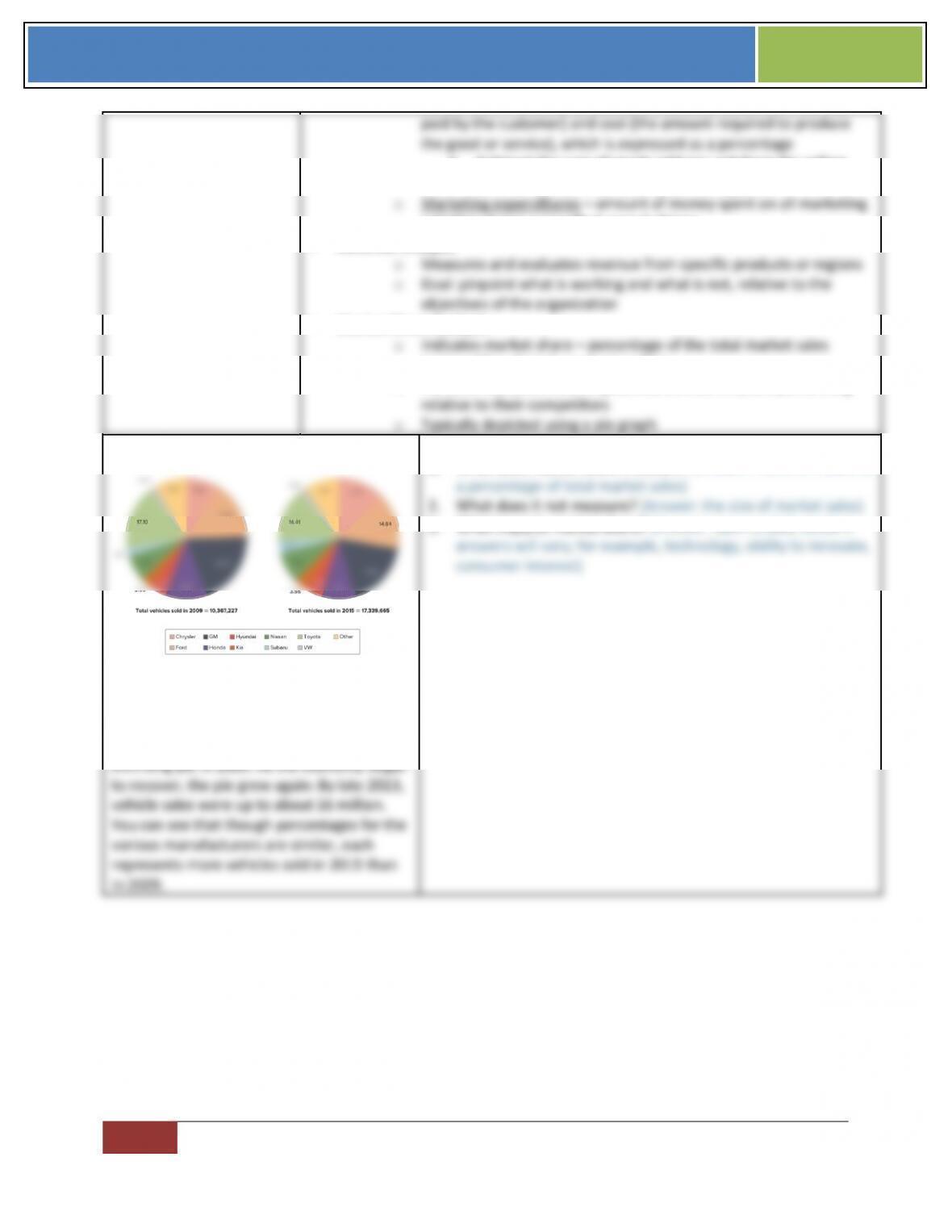
Figure Information: Auto Manufacturer
Market Share in the U.S., 2009 and 2015
Market share is typically depicted using a pie
graph, and auto manufacturers were facing a
shrinking pie in 2009. As the economy began
to recover, the pie grew again: By late 2013,
vehicle sales were up to about 16 million.
represents more vehicles sold in 2015 than
Insight Questions:
1. What does market share measure? (Answer: the firm’s sales as
a percentage of total market sales)
2. What does it not measure? (Answer: the size of market sales)
3. What impacts market share? (Answer: open ended, student
answers will vary; for example, technology, ability to innovate,
consumer interest)
Instructor’s Manual – Chapter 2
Hunt/Mello/Deitz:
Marketing 2e
PowerPoint Slides
PPt 2.34
Lecture Notes:
• Profitability Analysis
o Profits are the positive gain from a business operation after subtracting all
expenses
o Profitability analysis – measures how much profit the firm generates
▪ Can be broken down to measure the profit contribution of regions,
channels, or customer segments
o Marketers often use two important metrics to evaluate profitability
▪ Customer acquisition – measures how much the firm spent to gain
new customers
• Typically includes spending on marketing advertising,
public relations, and sales
▪ Individual customer profitability – profit a firm makes from a
customer over a specified period of time
Today’s Professional
Photo provided by Tyler Cornwell
Tyler Cornwell
Development Coordinator, The Red Wolves Foundation
Tyler Cromwell draws on his collegiate interests and explains how being honest,
transparent, and consistent can further your career. He makes the suggestion of
“analyzing your current state,” and provides insight in answering the following
questions:
1. Describe your job.
2. How did you get your job?
3. What has been the most important thing in making you successful at your
job?
4. What advice would you give soon-to-be graduates?
5. What do you consider your person brand to be?
Review with students:
• What does he mean by “always think – think about everything”?
M A R K E T I N G P L A N E X E R C I S E
Your Marketing Plan. In this chapter we discussed the elements and importance of the situation analysis. The
next step in developing a full marketing plan for yourself is to conduct a SWOT analysis on yourself. It should
tie back to the objectives you developed at the end of Chapter 1. Be sure to think through each element and
honestly assess where you are today. This will help you focus on what you need to accomplish over the rest
of your college career. This activity is located at the end of the Learning Worksheet.
• Strengths. Most people have some notion of their strengths—maybe you’re an effective public speaker,
pay a great deal of attention to detail, or work well with others, for example. It’s likely that you’ve had
those strengths reinforced by those around you over the course of your life.
aware of, or to acknowledge, their weaknesses. Corporate recruiters often tell humorous stories about
the responses they receive when asking new college graduates about their biggest weaknesses. Answers
19
Instructor’s Manual – Chapter 2
Hunt/Mello/Deitz:
Marketing 2e
range from “I care too much,” or “I am too smart for my group members,” to “I am too attractive to have
many friends.” (Any of these responses might produce a negative impression in a job interview, by the
way.)
o Give serious consideration to your personal weaknesses, and then list three to five weaknesses
• Opportunities. As the global economy changes, you will enter a job market very different from the one
faced by previous generations. It is important to honestly assess your opportunities. Ask yourself
questions like, What jobs in my major are most in demand? What internship openings are there, and how
• Threats. Assessing threats is an essential part of developing a strategic plan for your professional future.
If the economy goes into a recession at the same time you graduate, for example, your earnings growth
could be reduced for years to come. By examining what potential threats could affect your professional
development and creating contingency plans, you will be in a better position to succeed in your pursuit
of a job.
Student Task: You’ve now listed three to five strengths, weaknesses, opportunities, and threats that could
affect your professional development. For each weakness and threat you identify, include a brief one- to two-
sentence description of how you might overcome the challenge associated with it.
How It Works: Host a series of Personal Marketing Plan classes succeeding course exams. Each student
should build a Personal Marketing Plan and realize that everyone is a marketer.
Supporting Materials: At the end of each chapter’s Learning Worksheet is a place for students to
immediately relate the course content to their Personal Marketing Plan. Additionally, a Personal Marketing
Plan Worksheet is provided in the Instructor’s Online Resources. The worksheet recaps the chapter’s content
and outlines the supporting topics for reference. It is recommended that the Personal Marketing Plan be a
semester-long, graded project and outcome for the course.
D I S C U S S I O N Q U E S T I O N S
1. Find mission statements from five Fortune 500 companies, then rank them from best (1) to worst (5)
and discuss why you ranked them in that order. Which mission statements did you like best, and
2. Conduct a SWOT analysis for your college or university. List three to five strengths, weaknesses,
3. Select a marketing strategy implemented by a large firm or nonprofit organization that you think was
effective. Describe why you liked the strategy. Identify which of the strategic directions discussed in
20
Instructor’s Manual – Chapter 2
Hunt/Mello/Deitz:
Marketing 2e
4. Select two businesses you frequent (e.g., restaurants, clothing stores, grocery stores, etc.). Who is
their target market? Then identify at least two competitors (either direct or indirect) for each
business. Describe how the two businesses you selected position themselves in the market relative
to their competitors. Which one of the two businesses does a better job positioning its products to
5. Is marketing a firm’s products globally always a good decision? Discuss your answer and provide
examples of firms that have both succeeded and failed in international markets. (Answer: open
6. Select a company from which you have made a purchase in the past month. Search online to conduct
a market share analysis and a profitability analysis about that company. Based on that analysis, give
S O C I A L M E D I A A P P L I C A T I O N
Review your entire social media profile and consider how each of the social media platforms you use
personally can affect your career positively or negatively as you move forward. Analyze your efforts to build
your brand via social media using the following questions and activities as a guide:
1. List the social media platforms on which you have any type of presence. How many of those
platforms do you check or use at least once per week?
This activity is located in an additional worksheet that can be used with group interaction, and can be found
in the Instructor’s Online Resources. A sample grading rubric for this activity is also provided.
How It Works: Host a series of Social Media Application classes preceding course exams. This serves as a
Supporting Materials: Social Media Application Worksheets and a sample grading rubric are provided in the
Instructor’s Online Resources. The worksheets recap the chapter’s content and outline the supporting topics
21
Instructor’s Manual – Chapter 2
Hunt/Mello/Deitz:
Marketing 2e
for reference. It is important for students to be able to connect social media to real world examples as it is
conveyed in the chapter; therefore, the grading rubric focuses on this.
M A R K E T I N G A N A L Y T I C S E X E R C I S E
Have students complete the Connect exercise in Chapter 2 that focuses on a key marketing analytics
measure: return on marketing investment (ROMI).
E T H I C A L C H A L L E N G E
Fantasy sports are played by millions of Americans each year, generating billions of dollars in revenue. In the
last decade, daily fantasy sites like FanDuel and DraftKings grew in popularity. To play, competitors assemble
Whether this constitutes sports betting, which is illegal in all but four states, has been a hotly contested
issue. The 2006 federal legislation that prohibited online gambling made an exception for fantasy sports,
which legislators said requires more skill than luck. That was before the advent, and massive growth, of daily
fantasy sports.
In 2015, a New York Times story reported that a DraftKings employee may have used proprietary information
to win money—most recently, $350,000 on a $25 entry fee—at FanDuel. The revelation unsettled fantasy
Student Task:
1. Analyze the reasons for the success of daily fantasy sports from a marketing perspective. Who are
2. Use the ethical decision-making framework to analyze Major League Baseball’s investment in
DraftKings. (Answer: A decision-maker would have to consider the cultural effects of offering
3. If you were a marketer for the NCAA, would you look to develop a strategic partnership with daily
Source: Christie Smythe, Keri Geiger, and Scott Soshnick. “FanDuel Turns to Ex-Attorney General in Fantasy
Sports Probe,” Bloomberg.com, October 7, 2015.

22
Instructor’s Manual – Chapter 2
Hunt/Mello/Deitz:
Marketing 2e
V I D E O C A S E
Have students go to Connect to access the video case featuring Ford Motor and Potbelly Sandwich Shop
Company that accompanies this chapter.
C A R E E R T I P S
To help students think about how to market themselves and develop their social skills, follow this insight.
Photo provided by Michael Friloux.
Michael Friloux, Senior Vice President of Business Development at Citynet,
encourages you to spend time considering two things that many college
graduates don’t fully appreciate: the power of questions and the importance of
people skills.
1. The Power of Questions: When in doubt, always ask the question.
2. The Importance of People Skills: It’s important to cultivate positive
and productive interactions with everyone you work with.
Review with students:
• What resources can be used to find the types of questions asked?
• What activities can you do now to give you the people skills needed?