
Instructor Manual
Lamb/Hair/McDaniel, MKTG 13E, 9780357127810; Chapter 19: Pricing Concepts
Table of Contents
Purpose and Perspective of the Chapter …………………………………………………………………………. 2
Cengage Supplements …………………………………………………………………………………………………… 2
Learning Outcomes ……………………………………………………………………………………………………….. 2
Complete List of Chapter Activities and Assessments ……………………………………………………… 3
Key Terms ……………………………………………………………………………………………………………………… 5
What’s New in This Chapter ……………………………………………………………………………………………. 7
Chapter Outline …………………………………………………………………………………………………………….. 8
Discussion Questions …………………………………………………………………………………………………… 21
Additional Activities and Assignments …………………………………………………………………………… 22
Additional Resources ……………………………………………………………………………………………………. 28
External Videos or Playlist ……………………………………………………………………………………………………….. 28
Appendix …………………………………………………………………………………………………………………….. 29
Generic Rubrics ……………………………………………………………………………………………………………………… 29
Standard Writing Rubric …………………………..……………………………………………………………………………… 29
Standard Discussion Rubric ……………………………………………………………………………………………………… 30
Purpose and Perspective of the Chapter
The purpose of this chapter is to learn the importance of pricing decisions to the economy
and to the individual firm. Pricing plays an integral role in the U.S. economy by allocating
Cengage Supplements
The following product-level supplements provide additional information that may help you
in preparing your course. They are available in the Instructor Resource Center.
• Transition Guide (provides information about what’s new from edition to edition)
• Educator’s Guide (describes assets in the platform with a detailed breakdown of
activities by chapter with seat time)
Learning Outcomes
The following learning outcomes are addressed in this chapter:
LO 19-1 Discuss the importance of pricing decisions to the economy and to the individual
firm
LO 19-2 List and explain a variety of pricing objectives
LO 19-3 Explain the role of demand in price determination
LO 19-4 Understand the concepts of dynamic pricing and yield management systems
LO 19-5 Describe cost-oriented pricing strategies
Complete List of Chapter Activities and Assessments
For additional guidance refer to the Teaching Online Guide.
Chapter
Learning
Objective
PPT slide
Activity/Assessment
Duration
Certification
Standard
N/A
MindTap: Why Does
Breakeven Point Matter
to Me?
5 minutes
BUSPROG:
Reflective
Thinking
DISC:
Marketing
Plan
19–1 – 19-2
MindTap: Learn It 19-1
and 19-2: The Importance
of Price and Pricing
Price
DISC: Pricing
10 minutes
BUSPROG:
Analytic
DISC: Pricing

Instructor Manual: Lamb/Hair/McDaniel, MKTG 13E, 9780357127810; Chapter 19: Pricing Concepts
19-6
MindTap: Learn It 19-6:
Other Determinants of
Price
5 minutes
BUSPROG:
Analytic
DISC: Pricing
MindTap: Learn It 19-7:
How to Set a Price on a
Product
5 minutes
BUSPROG:
Analytic
DISC: Pricing
MindTap: Learn It 19-8
Tactics for Fine-Tuning
the Base Price
5 minutes
BUSPROG:
Analytic
DISC: Pricing
19–1 – 19-9
MindTap: Assignment
25 minutes
BUSPROG:
Analytic
DISC:
Marketing
Plan
19–1 – 19-9
MindTap: Case Activity
15 minutes
BUSPROG:
Analytic
DISC:
Strategy
Knowledge Check 1 in PPT
BUSPROG:
Analytic
DISC: Pricing
19-3
22
Knowledge Check 2 in PPT
BUSPROG:
Customer
19-6
39
Knowledge Check 3 in PPT
10 minutes
BUSPROG:
Analytic
DISC: Pricing
19-7
48
Group Activity 1 in PPT
15-20 minutes
BUSPROG:
Analytic
[return to top]
Key Terms
bait pricing: a price tactic that tries to get consumers into a store through false or
misleading price advertising and then uses high-pressure selling to persuade consumers to
buy more expensive merchandise.
cash discount: a price reduction offered to a consumer, an industrial user, or a marketing
intermediary in return for prompt payment of a bill.
consumer penalty: an extra fee paid by the consumer for violating the terms of the
purchase agreement.
elastic demand: a situation in which consumer demand is sensitive to changes in price.
elasticity of demand: consumers’ responsiveness or sensitivity to changes in price.
extranet: a private electronic network that links a company with its suppliers and
customers.
fixed cost: a cost that does not change as output is increased or decreased.
market share: a company’s product sales as a percentage of total sales for that industry.
markup pricing: the cost of buying the product from the producer, plus amounts for profit
and for expenses not otherwise accounted for.
noncumulative quantity discount: a deduction from list price that applies to a single
order rather than to the total volume of orders placed during a certain period.
intent of driving competitors out of business or out of a market.
price lining: the practice of offering a product line with several items at specific price
points.
price skimming: a pricing policy whereby a firm charges a high introductory price, often
coupled with heavy promotion.
price strategy: a basic, long-term pricing framework that establishes the initial price for a
product and the intended direction for price movements over the product’s life cycle.
status quo pricing: a pricing objective that maintains existing prices or meets the
competition’s prices.
supply: the quantity of a product that will be offered to the market by a supplier at various
prices for a specified period.
variable cost: a cost that varies with changes in the level of output.
zone pricing: a modification of uniform delivered pricing that divides the United States (or
the total market) into segments or zones and charges a flat freight rate to all customers in
a given zone.
[return to top]
What’s New in This Chapter
The following elements are improvements in this chapter from the previous edition:
• New discussion of consumers with a local or “global mindset” can affect their
elasticity of demand.
[return to top]
Chapter Outline
In the outline below, each element includes references (in parentheses) to related content. “LO
CH–##” refers to the chapter learning outcome; “PPT Slide #” refers to the slide number in the
PowerPoint deck for this chapter (provided in the PowerPoints section of the Instructor Resource
Center); and, as applicable for each discipline, accreditation or certification standards (“DISC”).
Introduce Chapter 19 and review the learning outcomes. (PPT Slide 2).
1. The Importance of Price (LO 19-1, PPT Slide 3, DISC: Pricing)
a. Organizations that successfully manage prices do so by creating a pricing
infrastructure within the company, which involves:
• Defining pricing goals
b. Marketing managers are frequently challenged by the task of price setting, but
they know that meeting the challenge of setting the right price can have a
significant impact on the firm’s bottom line.
c. What Is Price? Price is that which is given up in an exchange to acquire a good
or service.
• The Sacrifice Effect of Price: “That which is given up” usually means money.
Consumers may also sacrifice time or forego buying other products and
services.
d. The Importance of Price to Marketing Managers: Revenue is the price
charged to customers multiplied by the number of units sold. It is what pays for
every activity of the company: production, finance, sales, distribution, and so on.
Profit is revenue minus expenses. To earn a profit, managers must choose a
2. Pricing Objectives (LO 19-2, PPT Slide 1-, DISC: Pricing)
a. To survive in today’s highly competitive marketplace, companies must choose
pricing objectives that are specific, attainable, and measurable.
b. Profit-Oriented Pricing Objectives
• Profit Maximization: Profit maximization means setting prices so that total
Example: Lowe’s lost market share when it cut costs by reducing the number of
associates on the floor. Customer service declined—and so did revenue.
• Satisfactory Profits: Rather than maximizing profits, many organizations strive
for profits that are satisfactory to the stockholders and management.
ROI measures management’s overall effectiveness in generating profits with the
available assets as compared to the industry average. Generally speaking, firms
seek ROIs in the 10 to 30 percent range, but the competitive environment, risks
in the industry, and economic conditions must be considered.
c. Sales-Oriented Pricing Objectives: Sales-oriented pricing objectives are based
on market share as reported in dollar or unit sales.
• Market Share: Market share is a company’s product sales as a percentage of
total sales for that industry. Usually, market share is expressed in terms of
Instructor Manual: Lamb/Hair/McDaniel, MKTG 13E, 9780357127810; Chapter 19: Pricing Concepts
• Sales Maximization: Rather than strive for market share, which is not always
an indicator of profitability, some companies try to maximize sales. A firm
d. Status Quo Pricing Objectives: Status quo pricing is a pricing objective that
seeks to maintain existing prices or meet the competition’s prices. Status quo
pricing often leads to suboptimal pricing because the strategy ignores
customers’ perceived value of both the firm’s goods or services and those
offered by its competitors.
3. The Demand Determinant of Price (LO 19-3, PPT Slide 17, DISC: Pricing)
a. The price marketers set for products depends mostly on two factors: the
b. The Nature of Demand: Demand is the quantity of a product that will be sold
in the market at various prices for a specified period. The higher the price, the
c. Elasticity of Demand: To appreciate the concept of demand, you should
understand elasticity:
• Elasticity of demand – consumers’ responsiveness or sensitivity to changes
d. Factors That Affect Elasticity:
• Availability of substitutes: When many substitute products are available, the
consumer can easily switch from one product to another, making demand
more elastic. When there is no substitute, demand is more inelastic.
• Price relative to purchasing power: If a price is so low that it is an
inconsequential part of an individual’s budget, demand will be inelastic.
• Product durability: With durable products, consumers often have the option
of repairing rather than replacing them, thus prolonging their useful life. This
makes people more sensitive to price increases, meaning demand is more
4. Dynamic Pricing and the Growing Use of Artificial Intelligence in Setting Prices (LO
19-4, PPT Slide 23, DISC: Pricing)
a. When competitive pressures are high, a company must know when it should
raise or lower prices to maximize its revenues. Although dynamic pricing
originated with airlines, it can be used in any industry in which demand or
$7.25 the next. At the same time, another brand rose from $11 to $12 per shot.
b. The Addition of Artificial Intelligence (AI) to Dynamic Pricing: New AI pricing
systems incorporate huge amounts of historical and real-time data, both
5. The Cost Determinant of Price (LO 19-1, PPT Slide 26, DISC: Pricing)
a. Sometimes companies minimize or ignore the importance of demand and
decide to price their products largely or solely on the basis of the company’s
costs. Prices determined strictly on the basis of costs may be too high for the
target market or too low, resulting in unnecessarily low returns. Types of costs
include:
b. Markup Pricing: Some wholesalers and retailers use markup pricing to establish
a selling price. Markup pricing uses the cost of buying the product from the
To use markup based on cost or selling price effectively, the marketing manager
must calculate an adequate gross margin—the amount added to cost to
determine price. Many small retailers use a tactic called keystoning, which
c. Break-Even Pricing: Break-even analysis is a method of determining what
sales volume must be reached before total revenue equals total costs. The
typical break-even model assumes a given fixed cost and a constant average
6. Other Determinants of Price (LO 19-6, PPT Slide 6, DISC: Pricing)
a. Stages in the Product Life Cycle: As a product moves through its life cycle, the
demand for the product and the competitive conditions tend to change.
• Introductory stage: Management often sets prices high during the
introductory stage to recover its development costs quickly. However, if the
o Competitors have entered the market, increasing the available supply.
• Maturity stage: Maturity usually brings further price decreases as competition
increases and inefficient, high-cost firms are eliminated. Logistics become a
significant cost factor. Because demand is limited and producers have similar
b. Competition, Price Matching, and Customer Loyalty: Competition varies
during the product life cycle. Although a firm may not have any competition at
first, the high prices it charges may eventually induce another firm to enter the
market. Fierce competition may drive down prices, but price matching may
actually result in higher prices. Price-matching guarantees may persuade
customers not to shop around. As a result, cutting prices no longer wins the
competitor new business and means lower profits on existing sales, so the
competitor will likely conclude that it is better to keep prices high.
d. Distribution Strategy: An effective distribution network can sometimes
overcome other minor flaws in the marketing mix. Although consumers may
e. The Impact of the Internet and Extranets: Technology is linking sellers and
buyers like never before, enabling buyers to quickly and easily compare
products and prices and putting them in a better bargaining position. An
extranet is a private electronic network that links a company with its suppliers
and customers.
• Using Shopping Bots: A shopping bot is a program that searches the Web for
Shopping, Nextag, and Price Grabber), while the niche-oriented type searches
for prices for only one type of product [e.g., CNET (consumer electronics),
SeatGeek (event tickets), and Kayak (travel-related services)].
f. Promotion Strategy: Price is often used as a promotional tool to increase
consumer interest. Consumer perceptions of a store’s prices are more impactful
g. Price Transparency: The Internet has enabled consumers to compare prices in
h. The Appearance of Being Well-Informed or Not: Customers who are
misinformed are often quoted significantly higher prices, especially for services
i. Demands of Large Customers: Manufacturers find that their large customers,
such as department stores, often make specific pricing demands that the
suppliers must agree to. For some product categories, the demands are nearly
wiping out profits for all but the very biggest suppliers.
Example: When Walmart decided that its grocery department needed to have
j. The Relationship of Price to Quality: When a purchase decision involves
uncertainty, consumers tend to rely on a high price as a predictor of good
quality. In the absence of other information, people typically assume that prices
7. How to Set a Price on a Product (LO 19-7, PPT Slide 40, DISC: Pricing)
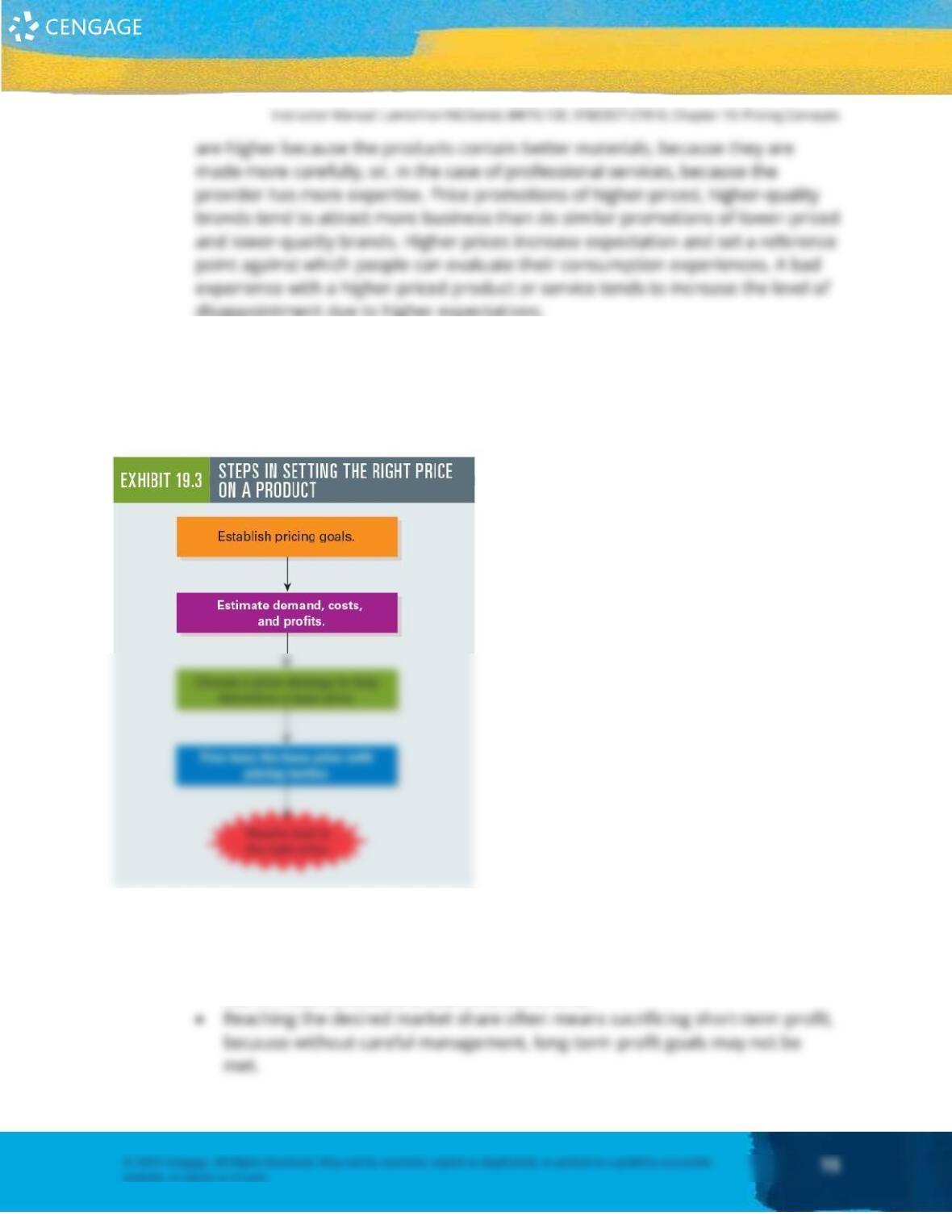
a. Setting the right price on a product is a four-step process, as illustrated in
Exhibit 19.3.
PRESENTATION VISUAL: Exhibit 19-3 Steps in Setting the Right Price on a Product
b. Establish Pricing Goals: Pricing objectives fall into three categories—profit
oriented, sales oriented, and status quo—and each come with trade-offs.
• A profit-maximization objective may require a bigger initial investment than
the firm can commit to or wants to commit to.