c. Estimate Demand, Costs, and Profits: Total revenue is a function of price and
quantity demanded, and quantity demanded depends on elasticity. Elasticity is a
function of the perceived value to the buyer relative to the price. After
d. Choose a Price Strategy: A price strategy is a basic, long-term pricing
framework that establishes the initial price for a product and the intended
direction for price movements over the product’s life cycle. The price strategy
sets a competitive price in a specific market segment based on a well-defined
positioning strategy. A company’s freedom in pricing a new product and devising
a price strategy depends on the market conditions and the other elements of the
marketing mix. If a firm launches a new item resembling several others on the
market, it will probably have to charge a price close to the average market price.
• Penetration Pricing: Penetration pricing is a pricing policy whereby a firm
charges a relatively low price for a product when it is first rolled out as a way
to reach the mass market. If obtaining a large market share is the firm’s
Example: Jay-Z recently used a combination skimming and penetration
strategy on his concert tour for his album 4:44. He used a skimming strategy
for the very best seats, such as front row or with VIP experiences at ultra-
high prices. For all other seats, a penetration strategy was used, with some
seats going for as low as $6.
8. Tactics for Fine-Tuning the Base Price (LO 19-8, PPT Slide 50, DISC: Pricing)
a. After managers understand both the legal and the marketing consequences of
b. Discounts, Allowances, Rebates, and Value-Based Pricing: A base price can
be lowered through the use of discounts and the related tactics of allowances,
rebates, low or zero percent financing, and value-based pricing. The following
are the most common tactics:
• Quantity discounts: A quantity discount is a price reduction offered to buyers
buying in multiple units or above a specified dollar amount. Two types of
quantity discounts include:
• Cash discounts: A cash discount is a price reduction offered to a consumer,
an industrial user, or a marketing intermediary in return for prompt payment
of a bill.
• Functional discounts: A functional discount (trade discount) is offered to
wholesalers and retailers for performing channel functions; typically a
percentage discount from the base price.
term revenue stream.
• Reframing discount and markdown math: Some retailers may layer discounts.
To make the price reductions easier to understand, they show the sales price
with a final dollar amount rather than percentage discounts, or the final cost
• Zero percent financing: Manufacturers sometimes offer zero percent
financing, which is a type of loan that enables purchasers to borrow money
to pay for products with no interest charge.
• Free shipping: Another method of lowering the price for purchasers is free
shipping, but the expense must be built into the cost of the product.
c. Value-Based Pricing: A pricing strategy known as value-based pricing involves
d. Geographic Pricing: Because many sellers ship their wares to a nationwide or
even a worldwide market, the cost of freight can greatly affect the total cost of a
product. Common methods of geographic pricing include:
• FOB origin pricing – a price tactic that requires the buyer to absorb the
freight costs from the shipping point (“free on board”)
e. Other Pricing Tactics
• Single-Price Tactic: A single-price tactic offers all goods and services at the
same price (or perhaps two or three prices). For example, Dollar Tree and
Dollar Bill chains sell everything for $1 or less.
• Flexible Pricing: Flexible pricing (variable pricing) is a price tactic in which
different customers pay different prices for essentially the same
merchandise bought in equal quantities. Flexible pricing allows the seller to
• Price Lining: Price lining is the practice of offering a product line with several
items at specific price points. It reduces confusion for both the salesperson
and the consumer and may result in fewer markdowns, simplified
purchasing, and lower inventory carrying charges. Price lines may also enable
a seller to reach several market segments.
• Odd-Even Pricing: Odd-even pricing (psychological pricing) is a price tactic
that uses odd-numbered prices to connote bargains and even-numbered
prices to imply quality. For example, $99.95 makes consumers feel they are
paying a lower price for the product, whereas $100 connotes a prestige
Examples: Microsoft uses bundling by offering “suites” of software that
bundle spreadsheets, word processing, graphics, email, and Internet access.
A simpler example of bundling can be seen at fast food restaurants.
McDonald’s Happy Meals are bundles.
Example: A health club might be able to sell only 100 memberships at $700
annually with unlimited use of facilities, for a total revenue of $70,000.
However, it could sell 900 memberships at $200 with a guarantee of using
the racquetball courts 10 times a month. Thus, membership revenue would
be $180,000.
• Pay What You Want: Asking people to pay what they want or think something
is worth is a very risky tactic. Social pressures can come into play if an
f. Consumer Penalties: Some businesses are adopting consumer penalties,
which are extra fees paid by the consumer for violating the terms of the
purchase agreement. With profit margins in many companies increasingly
coming under pressure, organizations are looking to stem losses resulting from
customers not meeting their obligations. However, the perceived unfairness of a
penalty may affect some consumers’ willingness to patronize a business in the
future.
9. The Legality of Price Strategy (LO 19-9, PPT Slide 68, DISC: Pricing)
a. Unfair Trade Practices: Unfair trade practice acts prohibit wholesalers and
retailers from selling below cost. Wholesalers and retailers must usually take a
b. Price Fixing: Price fixing is an agreement between two or more firms on the
price they will charge for a product. Such practices are illegal under the Sherman
Act and the Federal Trade Commission Act. The U.S. Justice Department’s
enforcement of these laws is vigorous.
c. Price Discrimination: The Robinson–Patman Act of 1936 prohibits any firm
Instructor Manual: Lamb/Hair/McDaniel, MKTG 13E, 9780357127810; Chapter 19: Pricing Concepts
• Cost: A firm can charge different prices to different customers if the prices
represent manufacturing or quantity discount savings.
the buyer for the product in question.
d. Predatory Pricing: Predatory pricing is the practice of charging a very low price
for a product with the intent of driving competitors out of business or out of a
market. Once competitors have been driven out, the firm raises its prices. This
[return to top]
Discussion Questions
You can assign these questions several ways: in a discussion forum in your LMS; as whole-
class discussions in person; or as a partner or group activity in class. A generic discussion
rubric is provided in the Appendix.
1. Discussion: (LO 19-1, PPT Slides 8-9) Duration 5-10 minutes.
a. Lead students in a discussion of the importance of price with the following. Have
students provide examples.
• Have you ever purchased something for which you did not perceive value at
the time of purchase, meaning you felt the item was too expensive but you
had to buy it?
• Have you purchased something and felt greater satisfaction with the item
later on?
• Have you felt satisfied with the value of an item at the time of purchase but
then later felt dissatisfied?
i. Use these questions to get students to understand that the perception
2. Discussion: (LO 19-5, PPT Slides27) Duration 5-10 minutes.
Instructor Manual: Lamb/Hair/McDaniel, MKTG 13E, 9780357127810; Chapter 19: Pricing Concepts
a. For the following items, ask students to vote on whether each is a variable cost or
fixed cost. Everyone must vote on one or the other.
• Nike running a TV ad (Answer: Fixed Cost)
• The rubber used in a Nike shoe (Answer: Variable Cost)
[return to top]
Additional Activities and Assignments
A generic discussion and writing rubric is provided in the Appendix.
1. Activator Exercise: Pricing a Disneyland Ticket (LO 19–1)
Purpose: To prompt discussion about price as an exchange of value.
Format: This activity can be facilitated in both a classroom and an online environment.
Instructions for how to facilitate the activity in the classroom and online are provided
below.
Classroom Format: Small group discussion, then class discussion
(Estimated Time: 10-20 minutes)
1. Divide the class into groups of three or four, then present them with this
information:
Disneyland charges a flat fee for admissions to the park. That fee gets you unlimited
Online Format: Discussion board with posted response from each student
(Estimated Time: 10-20 minutes)
1. Use the following prompt to facilitate this activity in a discussion board:
Disneyland charges a flat fee for admissions to the park. That fee gets you unlimited
access to rides, parades, and other attractions. There are a number of factors driving the
• If you believe the price is too high, you probably also believe you have better
alternatives for a day of fun. What are some of those alternatives?
• If you don’t think the price is too high, how much could it increase before you would
believe it is too high?
2. Have students respond to their classmates’ posts, discuss prices, and pricing
strategy.
Additional questions for a classroom or discussion board: Do you think Disney’s flat-fee
pricing is the best strategy to use? Why or why not? Instead of charging a flat fee, what
other pricing strategies might Disney use?
Result: Students will have a wide range of opinions about what the “fair price” is, what
2. Class Activity (LO 19-2)
Classroom Format: Small group discussion, then class discussion
(Estimated Time: 15-20 minutes)
Divide the class into pairs or groups of three. Have each group select a product that
interests them, or perhaps one that a group member has recently purchased, and
determine an appropriate price for that product.
1. Which type of pricing objective would they choose—profit-oriented, sales-
Online activity: Discussion board with posted response from each student.
(Estimated time: 15-20 minutes)
1. Use the following prompt to facilitate this activity:
• Select a product that interests you, or perhaps one that you’ve recently
purchased, and determine an appropriate price for that product.
2. Have students respond to their classmates’ posts, discuss prices, and pricing
strategy.
3. Class activity (LO 19-6)
Classroom Format: Small group discussion, then class discussion
(Estimated Time: 15-20 minutes)
Divide the class into groups of three or four, and present groups with the following
scenario:
1. You’ve stopped by your local drugstore to pick up a bottle of shampoo. Most
of the brands cost somewhere between $3.99 and $6.49 for roughly the
Online activity: Discussion board with posted response from each student
(Estimated time: 10-20 minutes)
1. Use the following prompt to facilitate this activity:
You’ve stopped by your local drugstore to pick up a bottle of shampoo. Most of
the brands cost somewhere between $3.99 and $6.49 for roughly the same sized
2. Have students respond to their classmates’ posts, and discuss pricing
strategy.
4. Class activity (LO 19-7)
Classroom Format: Small group discussion, then class discussion
(Estimated Time: 15-20 minutes)
1. Divide the class into groups of three or four.
2. Have them use the Internet to find one example of a product using a price
Online activity: Discussion board with posted response from each student.
(Estimated time: 15-25 minutes)
1. Use the following prompt to facilitate this activity:
Using the Internet, find an example of a product using a price skimming strategy
2. Have students respond to their classmates’ posts, and discuss these two
pricing strategies and the specific examples.
5. Class Activity (LO 19-8)
Classroom Format: Small group discussion, then class discussion
(Estimated Time: 15-20 minutes)
1. Divide the class into groups of three or four.
3. Ask them to use the Internet to find an example of a company using their
selected pricing tactic. Then ask them to discuss why the company is using
this tactic.
Online activity: Discussion board with posted response from each student.
(Estimated time: 15-25 minutes)
1. Use the following prompt to facilitate this activity:
Choose one of the following types of pricing tactics: flexible pricing, leader pricing,
price bundling, or two-part pricing.
• Use the Internet to find an example of a company using your selected
pricing tactic.
2. Have students respond to their classmates’ posts, discuss the various pricing
tactics and how well they work.
6. Additional Activity: Pricing Objectives (LO 19-7)
Purpose: To understand the categories that help achieve pricing objectives.
Background: Pricing objectives can be classified into three major groups.
Relationship to Text: Pricing Objectives
Classroom Format: Small group discussion, then class discussion
(Estimated Time: 10-15 minutes)
1. Divide the class into groups of three or four.
• Breakfast cereal
• Household cleaner
• Surplus books in a bookshop
4. Ask each group to share their results with the class.
1. Use the following prompt to facilitate this activity in a discussion board:
Choose three products from the following list. For each product category you
choose, write a post describing a pricing strategy that would use one or more of
the three pricing objectives: profit-oriented, sales-oriented, and status quo.
• Breakfast cereal
2. Have students respond to their classmates’ posts, ask questions and offer
constructive feedback on their strategies.
Additional Questions for a classroom or discussion board: What knowledge
about consumer behavior does a marketer need to know when developing pricing
Online Research Activity (LO 19-4)
1. Using a popular travel site, look up airfares for each of the pairs of cities
listed below.
2. Then check the airfares on the website of a major airline, such as American
Airlines or Delta, and a discount airline, such as Spirit Airlines.
• Baltimore to Los Angeles
3. Are the airfares for each pair of cities priced similarly on all the travel or
airline sites? If not, where did you find the better deal? What are some of the
4. Once you’ve completed your research, summarize it in one to two
paragraphs. Then, conclude your summary with an explanation on how this
activity provides insight into the pricing concepts of dynamic pricing,
competitive pricing, discount pricing, customer loyalty, and the impact of the
Internet on pricing.
Note: Before attempting this exercise, students should visit the websites mentioned in the
question and get an idea about the travel fares and connectivity (whether nonstop or
with transit) between the given pairs of cities. The differences in fares will depend on
diverse factors like the time and day of travel, distance between the cities, average
passenger load on a particular route and even the choice of airlines. Discount or low-cost
airlines will generally charge a lower fare in exchange for eliminating many traditional
passenger services.
[return to top]
Additional Resources
Appendix
Generic Rubrics
Providing students with rubrics helps them understand expectations and components of
assignments. Rubrics help students become more aware of their learning process and
progress, and they improve students’ work through timely and detailed feedback.
Customize these rubrics as you wish. The writing rubric indicates 40 points and the
discussion rubric indicates 30 points.
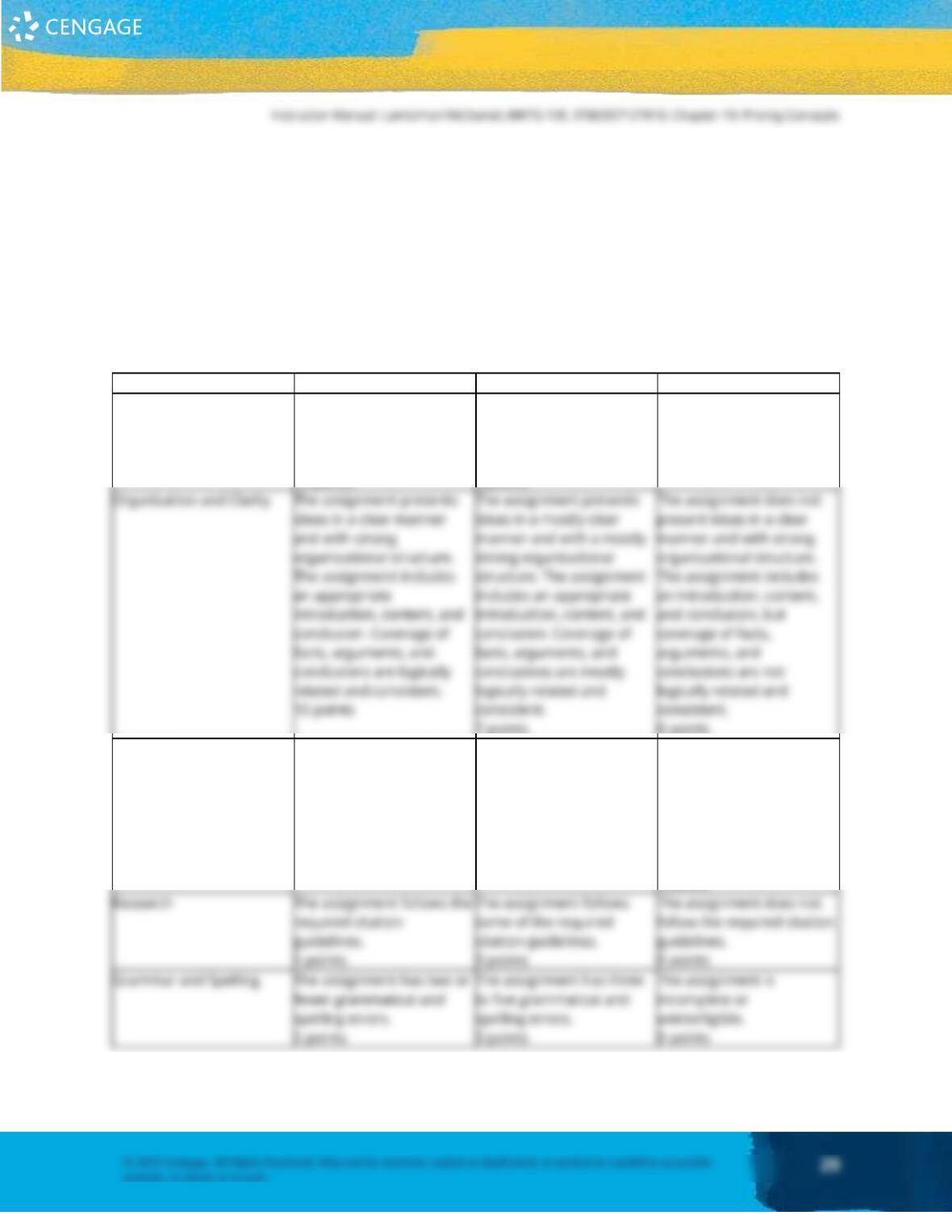
Standard Writing Rubric
Criteria
Meets Requirements
Needs Improvement
Incomplete
Content
The assignment clearly and
comprehensively
addresses all questions in
the assignment.
The assignment partially
addresses some or all
questions in the
assignment.
The assignment does not
address the questions in
the assignment.
0 points
7 points
0 points
Research
The assignment is based
upon appropriate and
adequate academic
literature, including peer
reviewed journals and
other scholarly work.
5 points
The assignment is based
upon adequate academic
literature but does not
include peer reviewed
journals and other
scholarly work.
3 points
The assignment is not
based upon appropriate
and adequate academic
literature and does not
include peer reviewed
journals and other
scholarly work.
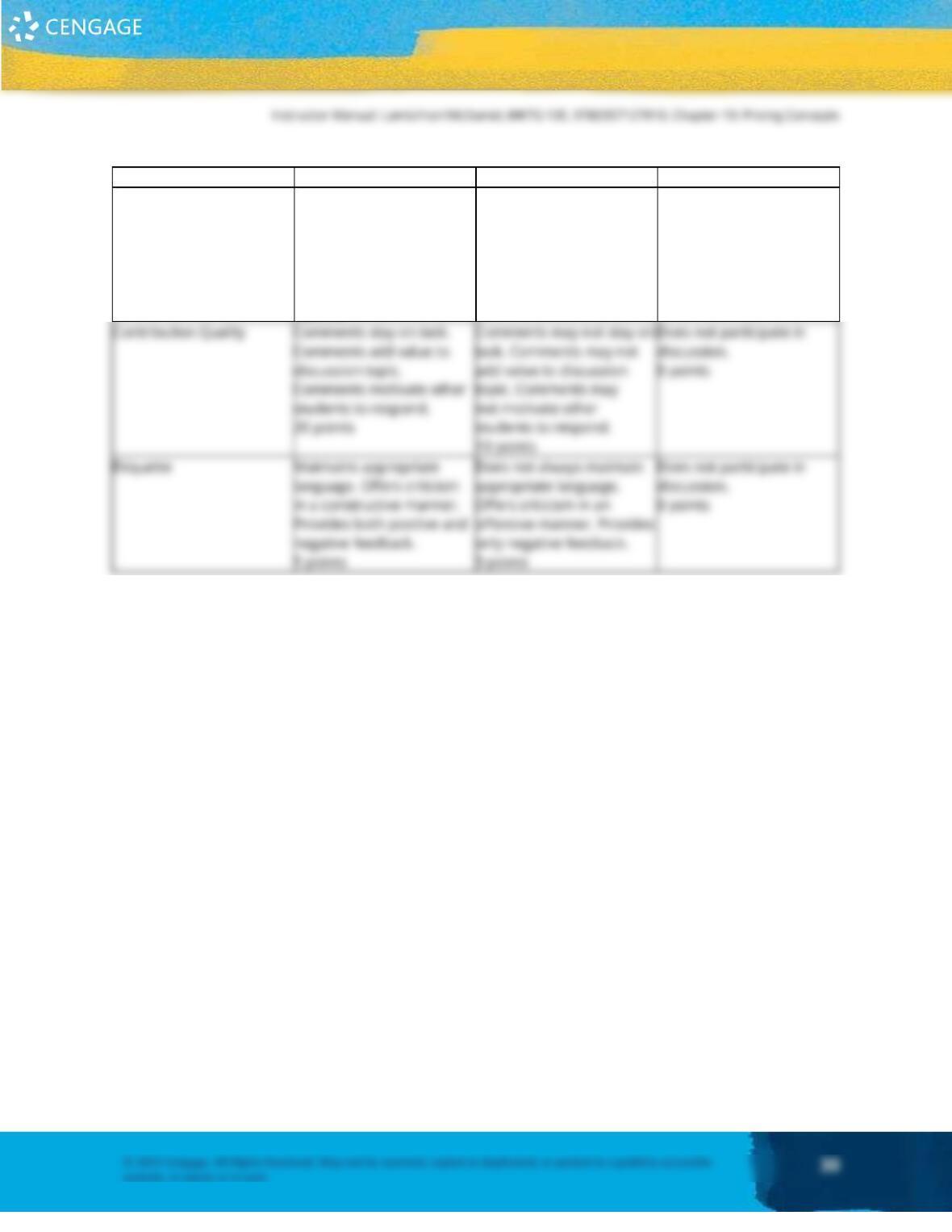
Standard Discussion Rubric
Criteria
Meets Requirements
Needs Improvement
Incomplete
Participation
Submits or participates in
discussion by the posted
deadlines. Follows all
assignment. instructions
for initial post and
responses.
5 points
Does not participate or
submit discussion by the
posted deadlines. Does not
follow instructions for
initial post and responses.
3 points
Does not participate in
discussion.
0 points