CHAPTER 19
Personal Selling and Sales Promotion
TEACHING RESOURCES QUICK REFERENCE GUIDE
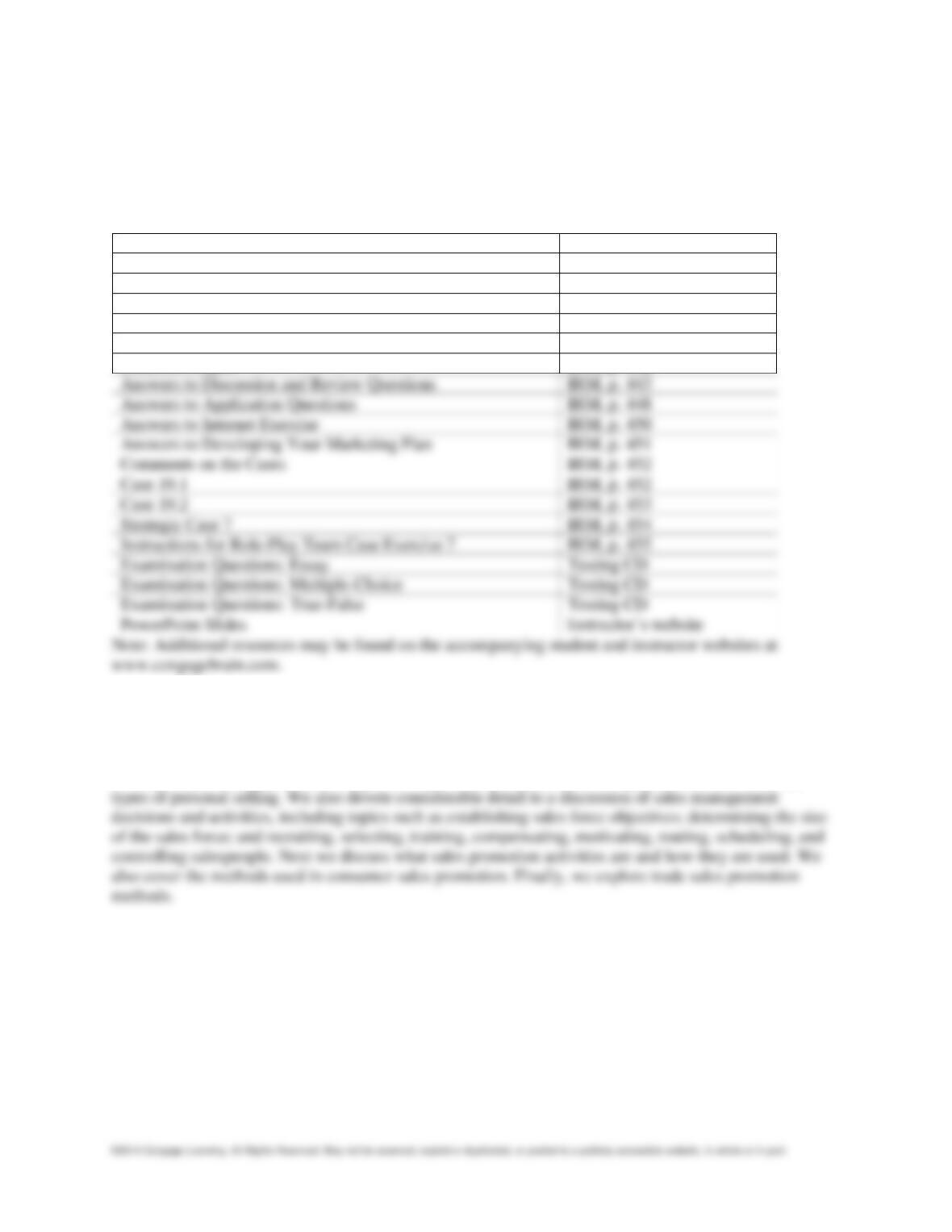
Resource
Location
Purpose and Perspective
IRM, p. 422
Lecture Outline
IRM, p. 423
Discussion Starters
IRM, p. 437
Class Exercise
IRM, p. 439
Chapter Quiz
IRM, p. 441
Semester Project
IRM, p. 442
Answers to Discussion and Review Questions
IRM, p. 443
Answers to Application Questions
IRM, p. 448
Answers to Internet Exercise
IRM, p. 450
Answers to Developing Your Marketing Plan
IRM, p. 451
Case 19.1
IRM, p. 452
Strategic Case 7
IRM, p. 454
Examination Questions: Essay
Testing CD
Examination Questions: True-False
Testing CD
PURPOSE AND PERSPECTIVE
This chapter covers two promotion mix elements: personal selling and sales promotion. To help students
build a better understanding of the purposes and roles of salespeople, we initially discuss the basic steps
in the personal selling process, the types of sales force personnel used in organizations, and some new
Chapter 19: Personal Selling and Sales Promotion 423
LECTURE OUTLINE
I. The Nature of Personal Selling
A. Personal selling is paid personal communication that attempts to inform customers and persuade
them to purchase products in an exchange situation.
B. There are several advantages of personal selling.
1. Personal selling provides marketers the greatest freedom to adjust a message to satisfy
customers’ information needs.
C. A major disadvantage of personal selling is its cost: generally, it is the most expensive element in
the promotion mix.
D. Many people earn their living through personal selling activities.
1. Sales careers can offer high incomes, freedom, and a high degree of job satisfaction.
E. Personal selling goals vary from one firm to another.
1. Typical goals usually involve identifying prospects, determining their needs, persuading
prospects to buy, following up on the sale, and keeping customers satisfied. Identifying
potential buyers is critical.
a. Because most potential buyers seek certain types of information before they make a
F. Salespeople must be aware of their competitors.
1. They must monitor the development of new products and competitors’ sales efforts in their
sales territories, how often and when the competition calls on their accounts, and what the
424 Chapter 19: Personal Selling and Sales Promotion
G. Personal selling is changing today based on new technology, how customers gain information
about products, and the way customers make purchase decisions.
1. Customer information sharing through social media, mobile and web applications,
and electronic sales presentations are impacting the nature of personal selling.
H. For long-run survival, most marketers depend on repeat sales and thus need to keep their
customers satisfied.
1. Much of this burden falls on salespeople because they are usually closer to customers than
II. Elements of the Personal Selling Process
A. No two salespeople use exactly the same selling methods, but many move through a general
selling process consisting of seven steps.
B. Prospecting
1. The first element in the selling process is developing a database of potential customers, or
prospecting.
2. A salesperson seeks the names of prospects from several sources, including company sales
C. Preapproach
1. Before contacting acceptable prospects, a salesperson finds and analyzes information about
each prospect’s specific product needs, current use of brands, feelings about available brands,
Chapter 19: Personal Selling and Sales Promotion 425
D. Approach
1. The approach—the manner in which a salesperson contacts a potential customer—is a
critical step in the sales process because the prospect’s first impression of the salesperson
3. Types of Approaches
a. In the referral approach, the salesperson explains to a prospect that an acquaintance, an
associate, or a relative suggested the call.
E. Making the Presentation
1. During the sales presentation, the salesperson must attract and hold the prospect’s attention,
stimulate interest, and spark a desire for the product.
F. Overcoming Objections
1. An effective salesperson usually anticipates a prospect’s objections in order to address and
counter them before the prospect has an opportunity to raise them; however, this approach
G. Closing the Sale
1. Closing is the stage in the selling process when the salesperson asks the prospect to buy the
426 Chapter 19: Personal Selling and Sales Promotion
H. Following Up
1. If attempts to close the sale are successful, the salesperson must follow up the sale.
III. Types of Salespeople
A. Most business organizations use several kinds of salespeople.
B. Order Getters
1. An order getter increases sales by selling to new customers and increasing sales to present
customers, which is sometimes called “creative selling.”
2. Current-Customer Sales
a. These sales personnel concentrate on current customers, calling on people and
C. Order Takers
1. An order taker primarily seeks repeat sales.
a. Order takers generate the bulk of many firms’ total sales.
2. Inside Order Takers
a. These salespeople work in sales offices and receive orders by mail, telephone, and the
3. Field Order Takers
Chapter 19: Personal Selling and Sales Promotion 427
D. Support Personnel
1. Support personnel facilitate selling but usually are not involved solely with making sales.
3. Missionary Salespeople
4. Trade Salespeople
a. Trade salespeople are not strictly support personnel because they take orders as well.
5. Technical Salespeople
a. Technical salespeople direct their efforts toward the organization’s current customers by
IV. Selected Types of Selling
A. Personal selling has become an increasingly complex process due in large part to rapid
technological innovation; this is changing the roles of personal selling to create new types of
personal selling.
B. Team Selling
1. Team selling involves the salesperson joining with people from the firm’s financial,
C. Relationship Selling
1. Relationship selling, also known as consultative selling, involves building mutually
428 Chapter 19: Personal Selling and Sales Promotion
4. Relationship selling is well poised to help sellers understand their customers’ individual
needs.
5. Relationship selling has significant implications for the seller.
a. Firms spend six times more on finding new customers than in keeping current customers.
6. Relationship selling efforts can be improved through sales automation technology tools that
enhance interactive communication.
V. Managing the Sales Force
B. Establishing Sales Force Objectives
1. Sales objectives tell salespeople what they are expected to accomplish during a specified
period. They give the sales force direction and purpose.
C. Determining Sales Force Size
1. The size of the sales force affects the firm’s ability to generate sales and profits, the
compensation methods used, salespeople’s morale, and overall sales force management.
2. Several analytical methods are used to determine the size of the sales force.
a. One method involves determining how many sales calls per year are necessary for the
D. Recruiting and Selecting Salespeople
1. Recruiting is a process by which the sales manager develops a list of qualified applicants for
sales positions.
Chapter 19: Personal Selling and Sales Promotion 429
4. A sales manager usually recruits applicants from several sources: departments within the
firm, other firms, employment agencies, educational institutions, respondents to
advertisements, and individuals recommended by current employees.
5. The process for recruiting and selecting a sales force varies from one company to another, but
E. Training Sales Personnel
1. Many organizations have formal training programs; others depend on informal, on-the-job
training.
4. Sales training may be performed in the field, at educational institutions, in company facilities,
and/or by using web-based technology.
a. In some firms, recently hired salespeople receive the bulk of their training before being
5. Sales managers often engage in sales training, whether daily on the job or periodically during
sales meetings; training may also be provided by outside companies specializing in training.
F. Compensating Salespeople
1. A compensation plan should attract, motivate, and retain the most effective individuals.
a. It should be designed to give sales management the desired level of control and to
430 Chapter 19: Personal Selling and Sales Promotion
2. To create compensation programs, the developers must determine the general level of
compensation required and the most desirable method of calculating it.
a. In analyzing the required compensation level, a firm’s sales management tries to
3. To deliver the required compensation, a firm may have one or more of three basic
compensation methods.
(1) In a straight salary compensation plan, salespeople are paid a specified amount per
time period, regardless of selling effort, and this sum remains the same until they
G. Motivating Salespeople
1. A sales manager should develop a systematic approach for motivating salespeople to obtain
high productivity.
2. Effective sales force motivation is achieved through an organized set of activities
H. Managing Sales Territories
1. The effectiveness of a sales force which must travel to its customers depends on sales
Chapter 19: Personal Selling and Sales Promotion 431
(1) Territories with equal sales potential usually will be unequal in geographic size; this
causes salespeople with larger territories to have to work harder and longer to
customer coverage and should minimize selling costs.
3. Routing and Scheduling Salespeople
a. The geographic size and share of a sales territory are the most important factors affecting
the routing and scheduling of sales calls, followed by the number and distribution of
customers.
I. Controlling and Evaluating Sales Force Performance
1. To control and evaluate sales force performance properly, sales management needs
information, which can be obtained from salespersons’ call reports, customer feedback, and
invoices.
2. The dimensions used to measure a salesperson’s performance are determined largely by the
VI. The Nature of Sales Promotion
A. Sales promotion is an activity and/or material that acts as a direct inducement, offering added
value or incentive for the product to resellers, salespeople, or consumers.
1. It encompasses all promotional activities other than personal selling, advertising, and public
relations.
432 Chapter 19: Personal Selling and Sales Promotion
5. The use of sales promotion has increased dramatically, primarily at the expense of
advertising. This shift has occurred for several reasons:
a. Heightened concerns about value have made customers more responsive to promotional
offers, especially price discounts and point-of-purchase displays.
B. Consumer Sales Promotion Methods
1. Consumer sales promotion methods encourage or stimulate consumers to patronize a
specific retail store or try a particular product.
2. Coupons
a. Coupons reduce a product’s price and aim to prompt consumers to try new or established
(1) Print advertisements with coupons are often more effective at generating brand
awareness than print ads without coupons.
(2) Coupons reward present product users, win back former users, and encourage
f. Coupons also have drawbacks.
(1) The primary drawback is fraud and mis-redemption, which can be expensive for
manufacturers.
Chapter 19: Personal Selling and Sales Promotion 433
3. Cents-Off Offers
a. With a cents-off offer, buyers pay a certain amount less than the regular price shown on
4. Money Refunds
a. With money refunds, consumers submit proof of purchase and are mailed a specific
5. Rebates
a. With rebates, the consumer is sent a specified amount of money for making a single
product purchase.
b. Marketers use rebates to reinforce brand loyalty, provide promotion buzz for sales
people, and as advertisement for the product.
quicker and easier.
6. Frequent-User Incentives
a. Many firms develop incentive programs to reward customers who engage in repeat
purchases.
7. Point-of-Purchase Materials and Demonstrations.
a. Point-of-purchase (P-O-P) materials include outside signs, window displays, counter
434 Chapter 19: Personal Selling and Sales Promotion
b. Demonstrations are a sales promotion method that manufacturers offer temporarily to
8. Free Samples
a. Free samples are given out to stimulate trial of a product, increase sales volume in the
early stages of the product’s life cycle, or obtain desirable distribution.
9. Premiums
a. Premiums are items offered free or at a minimum cost as a bonus for purchasing a
product.
10. Consumer Contests,
a. In consumer contests, individuals compete for prizes based on their analytical or
creative skills.
11. Consumer Games
a. In consumer games, individuals compete for prizes based primarily on chance.
b. Because the collecting of multiple pieces may be necessary to win or increase chances of
12. Sweepstakes
Chapter 19: Personal Selling and Sales Promotion 435
a. The entrants in a consumer sweepstakes submit their names for inclusion in a drawing
C. Trade Sales Promotion Methods
1. Trade sales promotion methods attempt to persuade wholesalers and retailers to carry
3. Trade Allowances
a. A buying allowance is a temporary price reduction offered to resellers for purchasing
specified quantities of a product.
(1) Such offers are used to provide an incentive to handle a new product, achieve a
4. Cooperative Advertising and Dealer Listings
a. Cooperative advertising is an arrangement in which a manufacturer agrees to pay a
certain amount of a retailer’s media costs for advertising the manufacturer’s products.
5. Free Merchandise and Gifts
a. Free merchandise sometimes is offered to resellers that purchase a stated quantity of
436 Chapter 19: Personal Selling and Sales Promotion
6. Premium (Push) Money
a. Premium, or push, money is additional compensation to salespeople offered by the
manufacturer as an incentive to push a line of goods.
Chapter 19: Personal Selling and Sales Promotion 437
DISCUSSION STARTERS
Discussion Starter 1: Sales Force Automation
ASK: How do you think technology has revolutionized personal selling?
Technology has radically altered how sales people do their jobs. The amount of data a salesperson has
Discussion Starter 2: Personal Selling Skills and Successful Job Interviewing
ASK: How can an understanding of personal selling skills and tools assist you during job interviews?
If you know personal selling skills, you are better able to understand how to read the interviewer and how
to respond to the interviewer’s questions.
Doing your homework for an interview, similar to the way a sales person plans for a sales meeting, will
Discussion Starter 3: Modern Day Marketing for Vitamin Water
In this exercise you will be showing a 1:30 video clip of Canadian NBA star Steve Nash and hip-hop
mogul 50 Cent headlining as promoters for the Vitamin Water product line.
438 Chapter 19: Personal Selling and Sales Promotion
Chapter 19: Personal Selling and Sales Promotion 439
CLASS EXERCISES
Class Exercise 1: Understanding the Steps Involved in Personal Selling
The objective for this class exercise is for students to understand and apply the steps used in personal
selling. Students may want to make a table with the steps and the scenarios.
Prompt for students:
Explain how you can use the seven steps of personal selling in everyday activities such as dating, asking
parents for money, negotiating a higher grade on a term project, getting a job, or asking for a pay raise.
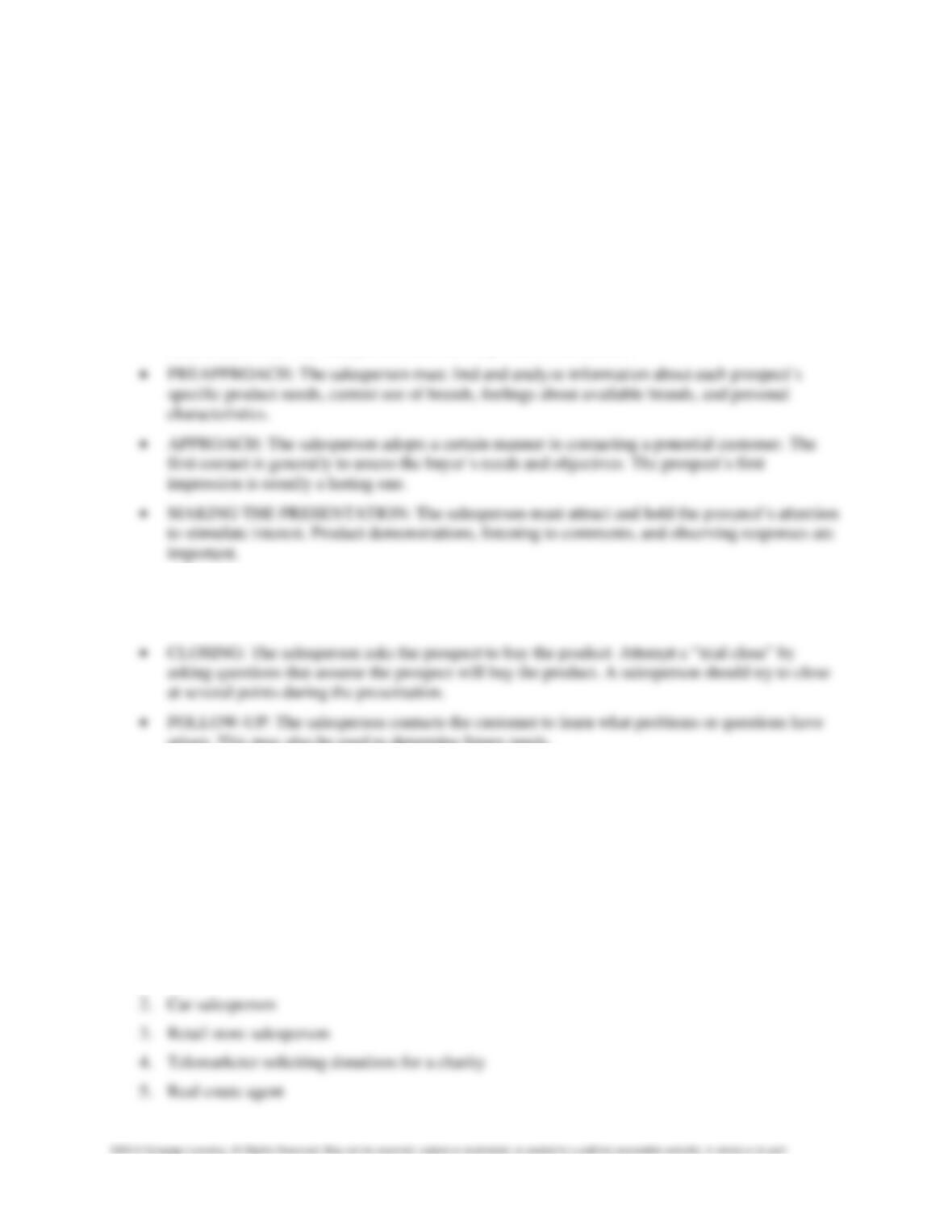
The seven steps are:
• PROSPECTING: The salesperson must develop a list of customers.
• OVERCOMING OBJECTIONS: One of the best ways to do this is to anticipate and counter
objections before the prospect has an opportunity to raise them. Otherwise, deal with objections
when they occur.
arisen. This may also be used to determine future needs.
Class Exercise 2: Classifying Salespeople
This exercise is relatively straightforward. Almost every student will have had some contact with one or
several of these types of salespeople. However, students usually do not think about the types of selling
these people do. Have your students classify each salesperson and then justify their answers.
Prompt for students:
Salespeople are typically classified as order getters, order takers, and support personnel. How would you
classify the following salespeople?
1. Pharmaceutical salesperson selling to doctors