Chapter 18: Personal Selling and Sales Promotion
CHAPTER SUMMARY AND LEARNING OBJECTIVES
LO 18.1 Contrast the factors that favor use of personal selling versus advertising.
LO 18.2 Describe the four sales channels.
Personal selling occurs through several types of communication channels: over-the-counter
selling, field selling, telemarketing, and inside selling.
LO 18.3 Explain how each step in the sales process relates to the AIDA concept.
LO 18.4 Summarize the seven steps of the sales process.
(5) handling objections, (6) closing, and (7) follow-up.
LO 18.5 Describe the seven key functions of a sales manager.
LO 18.6 Summarize eight types of sales promotion.
LO 18.7 Given an example of market conditions and promotional objectives, identify the
most effective promotional tactic.
Determining the most appropriate promotional technique involves analyzing the situation and
selecting the option that best achieves the firm’s goals in an efficient and cost-effective manner.
Chapter 18: Personal Selling and Sales Promotion
ACTIVATOR EXERCISE: Learning to Sell
Purpose: To help students understand the importance of personal selling.
Format: Interactive exercise
Time: 10 minutes
Give them a couple of minutes for preparation, then divide students into small groups.
Now, ask each student to “sell” their material to the rest of their group. Allow 2–3 minutes, then
rotate until all students in the group have had the chance to “sell” their item.
Questions for Reflection:
• What problems did you encounter when you were making a sales pitch?
• How do you motivate someone to buy the product that you are selling?
Result: Students will learn several lessons, including the importance of connecting your product
Chapter 18: Personal Selling and Sales Promotion
LECTURE OUTLINE
18-1 Personal Selling
Personal selling is person-to-person promotional presentation to a buyer. The sales process is
PRESENTATION VISUAL: MindTap Exhibit 18.1 showing factors favoring advertising
versus personal selling
Variable
Conditions That Favor Personal Selling
Conditions That Favor Advertising
Consumer
Geographically concentrated
Geographically dispersed
Relatively low numbers
Relatively high numbers
Product
Expensive
Inexpensive
Technically complex
Simple to understand
Custom made
Standardized
Special handling requirements
No special handling requirements
Transactions frequently involve trade-ins
Transactions seldom involve trade-ins
Price
Relatively high
Relatively low
Channels
Relatively short
Relatively long
Classroom activity: Divide students into pairs and ask them to create two marketing scenarios:
One that favors personal selling as the primary promotional tactic.
One that favors advertising as the primary promotional tactic.
Salespeople must communicate the advantages of their firms’ goods and services over those of
competitors. They must be able to:
Key Takeaway: Since both advertising and personal selling represent large expense
categories for firms, it’s important to identify factors that may influence how much to
spend on each of these major promotional components.
Chapter 18: Personal Selling and Sales Promotion
18-2 The Four Sales Channels
Personal selling occurs through several types of communication channels: over-the-counter
selling (including online selling), field selling, telemarketing, and inside selling. Each of these
channels can be used for business-to-business and business-to-consumer selling. Many
organizations use a number of different channels.
Over-the-Counter Selling
Over-the-counter selling typically describes selling in retail or wholesale locations in which
Field Selling
Field selling involves making sales calls on prospective and existing customers at their
businesses or homes. Field sales of large software installations or large industrial installations,
such as Airbus’s A380 double-deck airliner, often require considerable effort and technical
expertise. Largely because it involves travel, field selling is typically more expensive than other
selling options.
Telemarketing
Telemarketing is when the selling process is conducted by phone. It functions to provide sales
and service to customers, and is used for both business-to-business and direct-to-customer
markets. Both inbound and outbound telemarketing are forms of direct marketing.
Inside Selling
Inside selling is a more advanced version of inbound telemarketing that requires more
experienced sales reps. While accepting an order for products at Pottery Barn is a somewhat
Classroom activity: Divide students into small groups and ask them to brainstorm a real-world
example for each of the four channels of selling. Note: Remind them not to use any examples
already mentioned in the text.
Chapter 18: Personal Selling and Sales Promotion
Estimated time: 15 minutes
18-3 The Sales Process and the AIDA Concept
As discussed in Chapter 17, the AIDA concept (attention, interest, desire, action) describes the
steps consumers pass through when reaching a purchase decision.
In personal selling, the sales process typically follows a sequence of activities:
1. Prospecting and qualifying
2. Approach
These steps in the selling process can and should be aligned with the AIDA concept to be in
sync with the consumer’s decision process.
PRESENTATION VISUAL: MindTap Exhibit 18.2 showing how the sales process and AIDA
align
Discussion question: How likely is it that you can sell something without the prospect’s
attention?
Let’s assume you do get the prospect’s attention, but they have no interest? What can you do to
move them from interest to desire?
Chapter 18: Personal Selling and Sales Promotion
relevant in personal selling.
Estimated time: 5–10 minutes
18-4 The Sales Process
Professional sales representatives utilize a sequential process designed to create attention,
interest, desire, and action by the prospect.
Prospecting and Qualifying
Prospecting is the process of identifying potential customers. Leads for prospects come from
• Do prospects possess the appropriate Need for the product?
Even though an employee in a firm might like your products, he or she might not be authorized
or eligible to make the purchase, or have the financial means to purchase the product. This is
why qualifying is such an important step in the sales process.
Classroom activity: Divide students into pairs or small groups. Ask them to describe a qualified
AND unqualified prospect for each of the following sales situations:
A car salesperson selling a car to consumers
Approach
Once sales representatives have identified a qualified prospect, the next step involves gathering
relevant information and planning an approach—the initial contact with the prospective
customer. Before contacting the customer, it’s important to gather information to develop an
understanding of his or her business, current suppliers, and other pertinent details.
Presentation
Chapter 18: Personal Selling and Sales Promotion
Classroom activity: Students will have a chance to improve their attempt to sell the items from
the Activator Exercise. As a refresher, here is what it said:
Provide the class with a list of materials. The list could contain items such as sand, ice, water,
glass, steel, iron, silk, cotton, nylon, and so on. Assign one item in the list to each student in the
class. Give them a couple of minutes and ask them to “sell” this material to their small group.
After students have brainstormed 3–5 features and benefits, ask the sellers of each item to
share theirs with the class. Compile a list of the best features and benefits for each item.
Note: The purpose of this exercise is to show how much more effectively a well-considered,
structured presentation can sell than a random, unstructured presentation.
Demonstration
One of the most important advantages of personal selling is the opportunity to demonstrate a
Discussion question: How would you best demonstrate:
A car
A food or beverage product
Handling Objections
Potential customers often have legitimate questions and concerns about a good or service they
are considering. Objections are expressions of resistance by the prospect, and it is reasonable
Chapter 18: Personal Selling and Sales Promotion
Discussion question: Imagine you are salesperson for Facebook who is trying to convince
small businesses to advertise on Facebook. What are some objections you might run into?
Note: These likely will relate to cost or the complexity of using Facebook.
Closing
The moment of truth in selling is the closing—the point at which the salesperson asks the
prospect for an order. If a presentation has been effective and the sales representative has
handled all objections, a closing would be the natural conclusion to the meeting.
Follow-Up
The word close can be misleading because the point at which the prospect accepts the seller’s
Key Takeaway: The sales process typically includes seven steps, including prospecting
and qualifying, approach, presentation, demonstration, handling objections, closing, and
follow-up.
Estimated time: 20–50 minutes (depending on whether you facilitate some or all of the
discussion questions and activities in this section)
18-5 Sales Management Functions
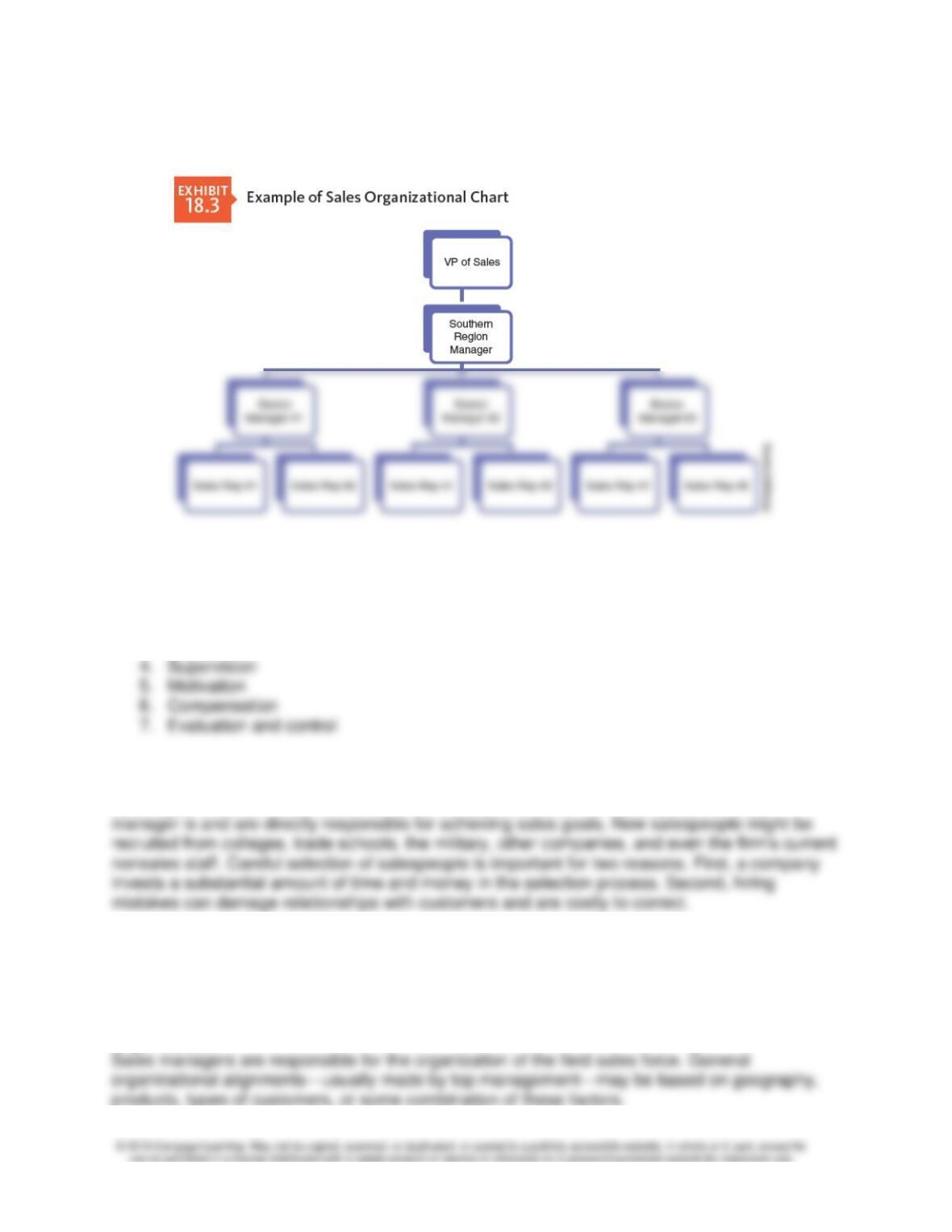
The overall direction and control of personal selling efforts are in the hands of a firm’s sales
managers. In a typical geographic sales structure, a district or divisional sales manager might
Chapter 18: Personal Selling and Sales Promotion
PRESENTATION VISUAL: MindTap Exhibit 18.3 showing an example of a sales
organizational chart
The sales manager performs seven basic managerial functions:
1. Recruitment and selection
2. Training
3. Organization
Recruitment and Selection
Recruiting and selecting successful salespeople are among the sales manager’s greatest
challenges. After all, these workers will collectively determine how successful the sales
Training
To shape new sales recruits into an efficient sales organization, managers must conduct an
effective training program. The principal methods used in sales training are on-the-job training,
individual instruction, in-house classes, and external seminars.
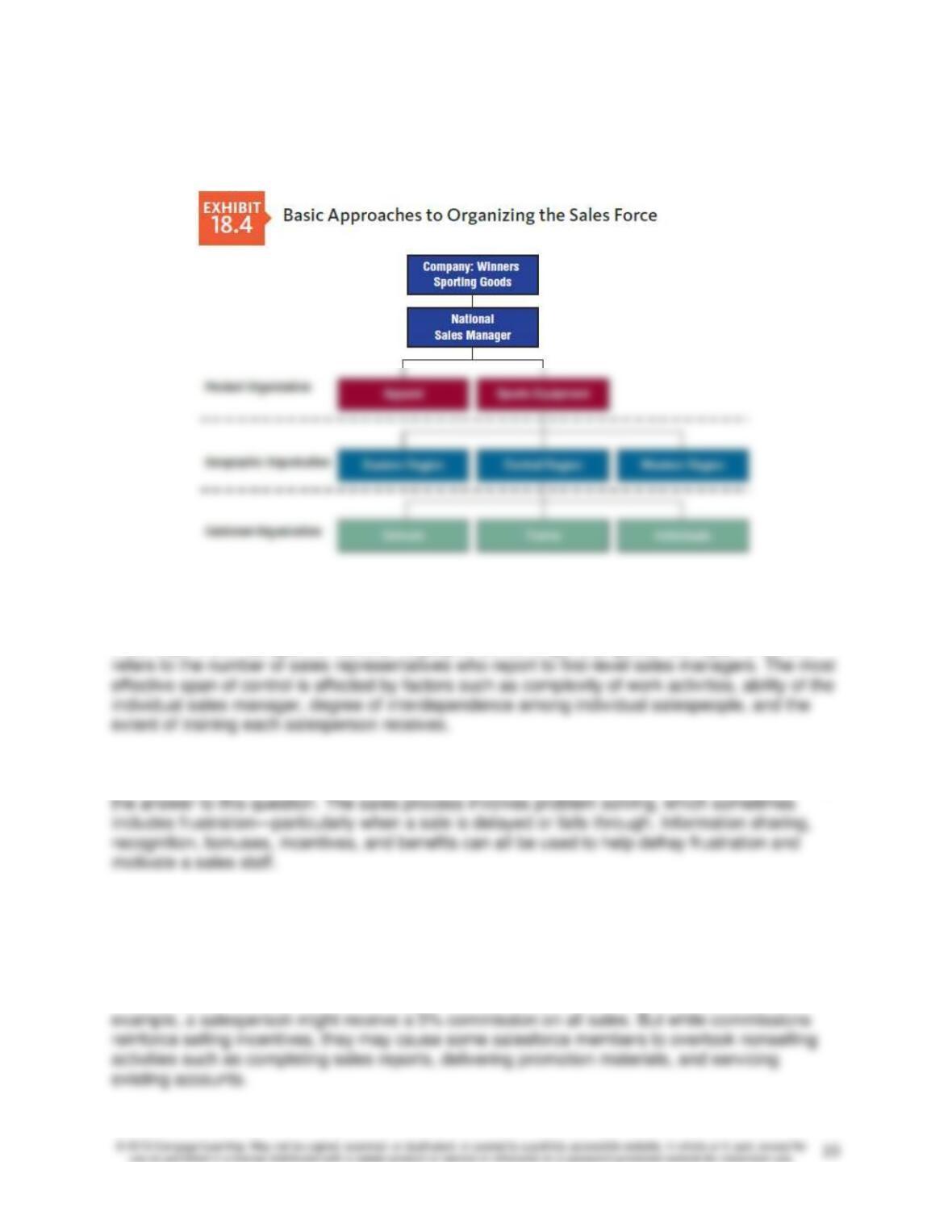
Organization
Chapter 18: Personal Selling and Sales Promotion
PRESENTATION VISUAL: MindTap Exhibit 18.4 showing an example of different types of
salesforce organizations
Supervision
Sales managers have differing opinions about the optimal level of supervision for the salesforce.
A concept known as span of control helps provide some general guidelines. Span of control
Motivation
What motivates salespeople to perform their best? The sales manager is responsible for finding
Compensation
Money is an important part of any person’s job, and the salesperson is no exception. Sales
compensation can be based on a commission, a straight salary, or a combination of both.
Bonuses based on end-of–year results are another popular form of compensation.
A commission is a payment tied directly to the sales or profits a salesperson achieves. For
Chapter 18: Personal Selling and Sales Promotion
A salary is a fixed payment made periodically to an employee. A straight salary plan gives
management more control over how sales personnel allocate their efforts, but it may reduce the
incentive to find new markets and land new accounts.
Ethical and Legal Issues in Sales
A difficult economy or highly competitive environment may tempt some salespeople—
particularly those new to the business—to behave in ways they might later regret. Companies
Key Takeaway: The sales manager performs seven managerial functions that influence
the success of their sales organization.
Estimated time: 15–20 minutes
18-6 Sales Promotion
Sales promotion includes marketing activities other than personal selling, advertising, and
publicity designed to enhance consumer purchasing and dealer effectiveness. Sales promotion
techniques were originally intended as short-term incentives aimed at encouraging a purchase.
Today, however, marketers recognize sales promotion as an integral part of the overall
marketing plan, and the focus has shifted from short-term goals to long-term objectives of
building brand equity, maintaining continuing purchases, and establishing loyalty.
Promotions encourage immediate action because they impose limited time frames. Discount
coupons and rebates usually have expiration dates. In addition, sales promotions produce