CHAPTER 17
OUTLET SELECTION AND PURCHASE
LEARNING OBJECTIVES
LO1: Describe how retailing is evolving
LO2: Discuss the relationship among retail outlets as part of omni-channel shopping
LO3: Explain the retail and consumer attributes that affect outlet selection
SUMMARY
LO1: Describe how retailing is evolving
Retail outlet refers to any source of products or services for consumers. Retailing has moved well beyond
traditional physical stores and catalogs to include the Internet, interactive TV ads, and mobile shopping
apps. Computers learn and recall consumer information and preferences; full-body scanners allow for
LO2: Discuss the relationship among retail outlets as part of omni-channel shopping
While store-based retailing continues to dominate in terms of overall sales, online and mobile retailing
as well as other forms of in-home retailing including catalogs are increasingly important retail outlets to
shoppers. Consequently, most retailers are engaging in multi-, or omni-channel marketing to reach their
customers. The need for omni-channel marketing reflects shifts in consumer shopping. Consumers are
LO3: Explain the retail and consumer attributes that affect outlet selection
The decision process used by consumers to select a retail outlet is the same as the process described for
selecting a brand. The only difference is in the nature of the evaluative criteria used. Retail outlet image is
an important evaluative criterion. Store-based image and online retailer image are both important,
LO4: Summarize the in-store and online influences on brand choice
While in a retail outlet, consumers often purchase a brand or product that differs from their plans before
entering. Such purchases are referred to as unplanned purchases. Most of these decisions are the result of
additional information processing induced by in-store or online stimuli. However, some are impulse
LO5: Understand how purchase plays a role in the shopping process
Once the outlet and brand have been selected, the consumer must acquire the rights to the item. This often
involves credit. Whether purchasing is in-store, online, or via mobile or on social media, the retailer’s job
is to simplify the process since it will enhance the likelihood of purchase and enhance their image.
LECTURE TIPS AND AIDS
1) Have the students write down and rank order the characteristics (evaluative criteria) they look for in a
store when (a) on a major grocery shopping trip, (b) buying a quart of milk when in a hurry, (c)
buying a suit, (d) buying a watch, and (e) buying a newspaper. Use their answers to discuss the
product, individual, and situational influences on desired outlet evaluative criteria.
2) Repeat Question 1 as they think the following people would respond: (a) a middle-aged doctor, (b) an
3) Have each student describe a recent stock-out experience and his/her total response to it.
4) C. Mathwick, et al., Journal of Retailing, Vol. 77(1), 39-56, provides a measure to evaluate websites.
Assign ahead of time and have students create a survey which includes this measure, pick a website,
should reinforce student appreciation of online image and atmospherics.
5) Ask students to describe their shopping habits involving the use of the Internet and mobile apps.
Generate a list of functionalities (evaluative criteria) that students want from the Internet and mobile
apps when it comes to shopping.
7) Student Handout 1 discusses the challenges to converting Internet users to online buyers. Questions
are provided at the end of the handout with answers below:
a) Students should be encouraged to list additional elements not covered in the insight that could be
used to turn browsers to buyers.
for shopping of the different students to help understand differences.
c) “Recapture” strategies for consumers who started but abandoned shopping carts online are likely
successful because creating a shopping cart means they were already interested in the items and
relatively serious about making a purchase. Email campaigns that focus on key issues such as
price or shipping charges are likely to be most effective since these are some of the major reasons
consumers abandon carts online to begin with.
Student Handout 1: Converting Web Site Visitors to Buyers
With about 90 percent of U.S. adults online and roughly two-thirds having made an online
purchase, online sales will only grow by increasing how frequently and how much consumers
buy online. The following provides a set of guidelines for online retailers to help them convert
Web site visitors to buyers.
• Appropriate Landing Page. Bad landing pages can be purchase killers. An example is
clicking on an Esurance-sponsored link after searching for homeowner’s insurance and
having the landing page be about auto insurance. Companies are trying to target their
landing pages specifically to the type of consumer who is clicking through. For example,
Elite Island Resorts set up two landing pages to target different travel buyers.
i
Four approaches to reducing online privacy concerns seem possible. First is direct control
through “opt in” features that let consumers choose directly how their information is used.
iii
Second is the use of direct trust signals such as privacy statements and the incorporation and
communication of security verification systems such as VeriSign.
iv
These signals can increase
trust, reduce privacy concerns, and enhance purchases, but sometimes do not. A third approach is
The approach a firm should use depends on the type of Web visitor, with searchers (search-task
directed) more responsive to the indirect Web site investment signal and browsers (pleasure
directed) more responsive to the direct privacy statement signal.
• Deal with Lack of Touch. The lack of touch or ability to physically handle, test, or try
products prior to purchase is a top concern and affects product categories such as apparel
consumers to create their own model and try on various fashion brands and styles.
viii
• Deal with Lack of Social Element. In-store retailing allows for the social element, which is
a major shopping motive and lacking in many online shopping sites. To deal with this,
• Deal with Shopping Cart Abandonment. Roughly 70 percent of all shopping carts that
consumers start get abandoned prior to a purchase. That’s a lot of revenue left on the table
Critical Thinking Questions
1. What other strategies can online retailers use to increase the purchase likelihood of Web
site visitors?
2. Do you think the social element even matters online? Explain.
3. Why do you think campaigns targeting shopping cart abandonment are so successful?
REVIEW QUESTIONS
1) The consumer faces the problems of what to buy and where to buy it. How do these two types of
decisions differ?
In any purchase decision, a consumer faces two very basic decisions: which brand to buy and where
to buy it. What differentiates these decisions is mainly in what criteria they use and this is motivated
2) How is the retail environment changing?
Retail outlet refers to any source of products or services for consumers. Retailing has moved well
beyond traditional physical stores and catalogs to include the Internet, interactive TV ads, and mobile
3) Describe online retailing.
Online retailing is selling products and services through the Internet directly to consumers. It accounts
for just about 9% of total retail sales.
4) Describe mobile retailing.
Mobile retailing is selling products and services through the Internet or an app which are accessed by
a consumer on his/her phone. Smartphone users can access the retailer’s mobile website or download
5) What are concerns for consumers in using online retailing and mobile apps?
Barriers exist for buying products online and through a mobile app. These include: preference for
seeing product in person, not wanting to pay shipping fees, not wanting to wait on delivery, online
6) What is omni-channel shopping and what implications does it hold for retailer strategy?
Omni-channel shoppers are consumers who browse and/or purchase in more than one channel.
Mobile phones and apps allow consumers to search for information, prices, coupons, and discounts,
while standing in a physical store. Omni-channel consumers spend more at a given retailer than
single-channel consumers and retailers are designing platforms to maximize their cross-channel
shopping.
7) What is meant by showrooming and webrooming? Why are they important issues for retailers?
Omni-channel shoppers who search online and ultimately buy a product at a physical store engage in
webrooming. Showrooming is the opposite. As discussed in Chapter 4, showrooming is common
among Gen Yers who go to the brick-and-mortar store to touch, try out or try on a product and then
8) What is a store image and what are its dimensions and components?
Store image is the overall perception of a retail outlet that is formed on the basis of impressions of
9) Describe online retailer image and compare/contrast it with store image.
Online retailer image is the online counterpart to store image – that is “the target market’s perception
of all the attributes associated with a retail outlet.” While different dimensions may be important
10) What is a store brand? How do retailers use store brands?
A store brand is a brand with the same name as the store or a special name developed by the store. At
the extreme, the store or outlet is the brand. Patagonia, Victoria’s Secret, and Body Shop International
are examples. All the items carried in the store are the store’s own brand. Traditionally stores carried
only manufacturers’ brands and only a few such as Sears and Wards developed their own house or
11) What key decisions do retailers make with respect to retail price advertising?
Retail price advertising attracts people to stores, generates sales of the advertised items, and increases
sales of other, unadvertised items in the store. In addition, both price and nonprice advertising affect
the store’s image.
12) What is meant by the term spillover sales? Why is it important?
13) How does the size and distance to a retail outlet affect store selection and purchase behavior?
The larger a retail store or shopping center, the greater the selection and opportunity to fulfill needs.
This is a shopping benefit unless quickness or convenience is particularly important. However, the
14) How is store choice affected by the perceived risk of a purchase?
Perceived risk in a purchase situation produces a tendency to shop in established, well-known stores.
15) What is meant by social risk? How does it differ from economic risk?
16) What is a shopping orientation?
It is the way a person approaches shopping in general or for a particular type of product. It includes
the person’s activities, motivations, and attitudes.
17) Describe six motivation-based shopping orientations across retail types.
Orientation
Percent
Characteristics
Bargain Hunter
22%
These “precision shoppers” stick to a strict budget and often
put their family’s needs ahead of their own.
Knowledge
Seeker
21
before making a purchase, and may or may not buy it in store.
within their means, and want a fast, easy, and convenient
shopping experience.
Store Reassurer
16
These consumers prefers to shop at a store rather than online.
They can touch and feel the product and be more confident
they are buying the right thing.
Brand Desirer
16
These shoppers choose brands that reflect their status and
values, and like to buy the very latest, often being the first to
discover and try new things. Quality is a priority over price for
this group.
Mobile Warrior
9
For these consumers, the smartphone is the most important
coupons, research alternative products, or make purchases.
18) What is meant by an in-store purchase decision? Why is it important?
An in-store purchase decision occurs when an important part of the decision is made on the basis of
information gained in the store. Purchases can be specifically planned (complete decision made
19) What is meant by an impulse purchase? Why is it important?
This type of purchase occurs when a consumer sees a product in the store and purchases it with little
or no deliberation as the result of a sudden, powerful urge to have it. This is important when
considering POP displays and store layout issues.
20) Once in a particular store, what in-store and/or online characteristics can influence brand and product
choice? Give an example of each.
a. Point-of-purchase displays can attract attention to a brand and produce a greater likelihood of
purchasing that brand. For example, an end–of-aisle display featuring a particular brand of
snack food can be expected to increase purchases of this brand over normal shelf sales.
d. Stock-outs of a particular brand or product can lead to brand switching or store switching. For
example, if a retail outlet were out of a shopper’s brand of cigarettes, most would buy
elsewhere.
e. Sales personnel can often persuade a consumer to purchase or not purchase a particular brand.
Manufacturers often provide some form of direct payment to retail sales personnel for sales of
specified items.
g. Retailing using mobile websites and mobile apps is on the rise. Smartphones and mobile apps
are influencing how consumers shop both inside and outside the store environment. Retailers
do not want to be left behind, as omni-shoppers generate more sales.
21) Describe the impact of point-of-purchase displays on retail sales.
22) Describe the impact of price reductions and deals on retail sales.
Price reductions and promotional deals (coupons, multiple-item discounts, and gifts) are generally
accompanied by the use of some point–of-purchase materials. Therefore, the relative impact of each is
sometimes not clear. Nonetheless, there is ample evidence that in-store price reductions affect brand
decisions.
23) What is meant by store atmosphere? Online atmosphere? How do they affect consumer behavior?
The store’s atmosphere or internal environment affects the shoppers’ mood and willingness to visit
24) What is a servicescape?
Atmosphere is referred to as servicescape when describing a service business such as a hospital, bank,
or restaurant.
25) Why do consumers planning to make a purchase at an online outlet frequently fail to do so?
26) What are frequent problems consumers encounter while shopping online?
A number of factors lead to shopping cart abandonment and are seen as consumer problems
with the online shopping/buying experience. These are listed below.
Shipping and handling costs too high
44%
Not ready to make the purchase
41
Wanted to compare prices on other sites
27
Product price higher than willing to pay
25
Website Factor
Percent
More detailed product information
45%
Better search capabilities
36
Live help options
29
Better navigation
26
Make it easier to contact store
25
Improve the checkout process
22
More offers tailored to my interests or needs
16
27) What can happen in response to a stockout?
Stockouts, the store being temporarily out of a particular brand, can obviously affect a consumer
purchase decision in that the consumer must then decide whether to (a) buy the same brand but at
Discussion Questions
28) Name two mobile apps that affect the choice of brands in the store?
29) Does the image of a retail outlet affect the image of the brands it carries? Do the brands carried affect
the image of the retail outlet?
This depends on the strength of the initial brand image. An unknown brand may take on many of the
image attributes of the store in which it is encountered, while a well-known brand might well be
unaffected. The same is true for the second question.
30) What challenges face omni-channel retailers in managing their image across channel?
Managing one image in one channel is difficult enough. Managing across channels is a whole other
31) Respond to the questions in Consumer Insight 17-1.
Answers will vary based on students’ opinions and personal experiences. However, this question sets
the stage for a discussion about mobile retailing, consumers’ motivations to use mobile retailing, and
the reasons consumers avoid mobile retailing. You could also incorporate diffusion of innovations
from chapter 7 into this as part of a class discussion.
32) How are social and economic risks associated with the following products likely to affect the outlet
choice behavior of consumers? How would the perception of these risks differ by consumer?
Situation?
a) Sports car
b) Athletic shoes (for running)
c) Wine (as a gift)
f) Mouthwash
Product Category
Economic Risk
Social Risk
Reduction Strategy
a. Sports car
b. Athletic Shoes
c. Wine (gift)
d. Hair Dresser
e. Mountain Bike
f. Mouthwash
g. Cell Phone
h. Movie for a date
33) Describe an appropriate strategy for an online store such as Target for each of the motivation-based
shopping orientations described in the text.
Have the students form groups and formulate strategies. It may be more useful to assign each group
of students one motivation orientation. This will facilitate different approaches and illustrate how
differently the same example can be approached.
34) Describe an appropriate strategy for a mobile app of a retailer such as Starbucks for each of the
35) Suggest other methods for developing motivation-based shopping orientations.
One study used projective techniques to ascertain the ways college students approach shopping. It had
consumers “[t]hink about an animal that best describes you as a shopper… [and] explain what it is
36) How should retailer strategies to encourage unplanned purchases differ based on the type of
unplanned purchase generally associated with the product category?
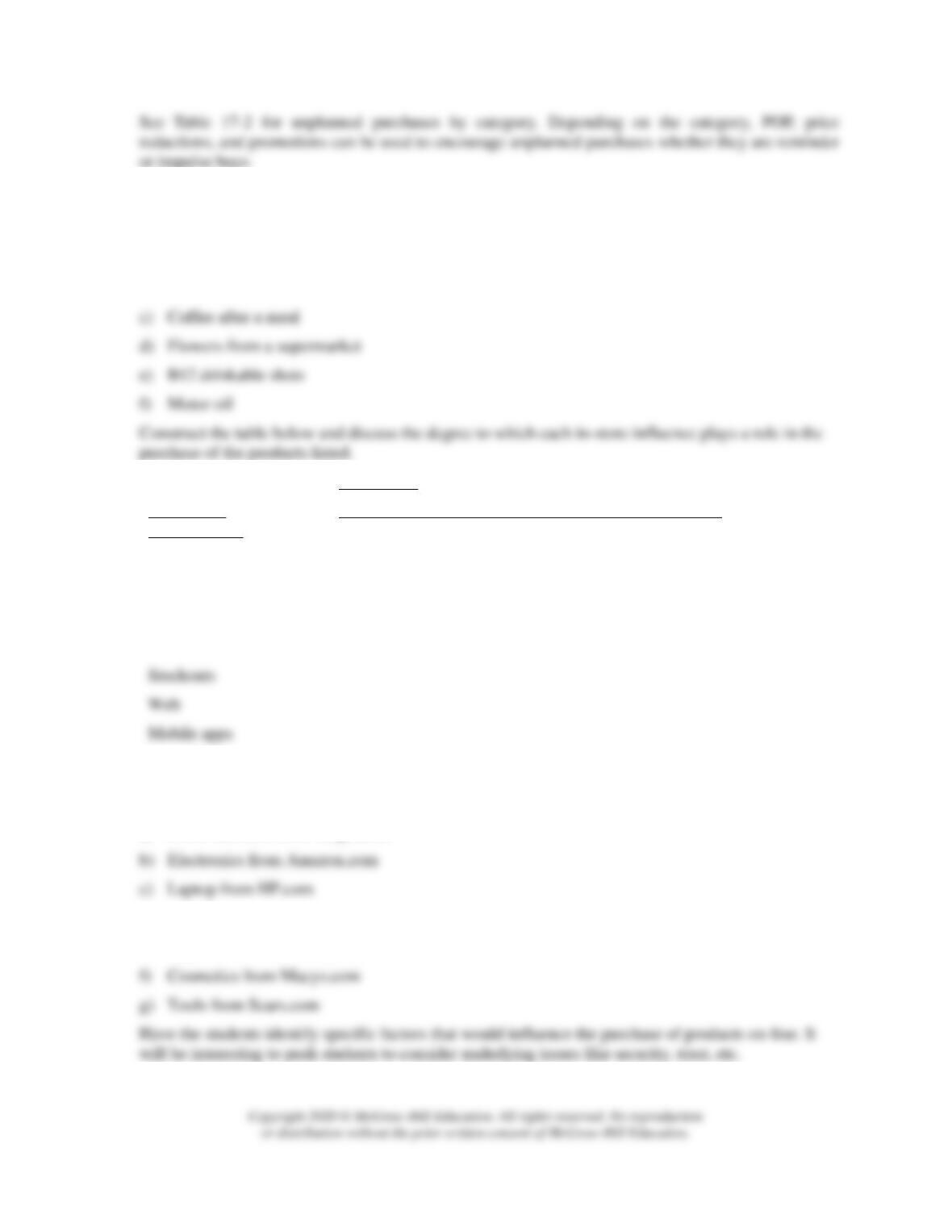
37) What in-store characteristics could retailers use to enhance the probability of purchase among
individuals who visit a store? Describe each factor in terms of how it should be used, and describe its
intended effect on the consumer for the following products:
a) Perfume
b) Ice cream
PRODUCT
IN-STORE
INFLUENCE
Perfume Ice cream Coffee Flowers B12 Shots Motor oil
P-O-P
Price deals
Layout
Personnel
Mobile apps
38) What site characteristics could online retailers use to enhance the probability of purchase among
individuals who visit their sites? Describe each factor in terms of how it should be used, and describe
its intended effect on the consumer for the following products:
a) Dorm furniture from Target.com
d) Backpack from REI.com
e) Apparel from JCPenney.com
39) What type of store atmosphere is most appropriate for each of the following retailer types? Why?
a) Bookstore serving college students
b) Cosmetic section of Sears
e) Mercedes automobiles
f) Inexpensive furniture
g) Thai food restaurant.
40) Repeat Question 39 (except for c and g) for online retailers.
Have the students focus on the interface the firms provide for consumers. They can use the
dimensions detailed in the in-text table relating to online retailer image.
41) How would you respond to a stockout of your preferred brand (or model) of the following? What
factors other than product category would influence your response?
a) SUV
b) Cereal
c) Deodorant
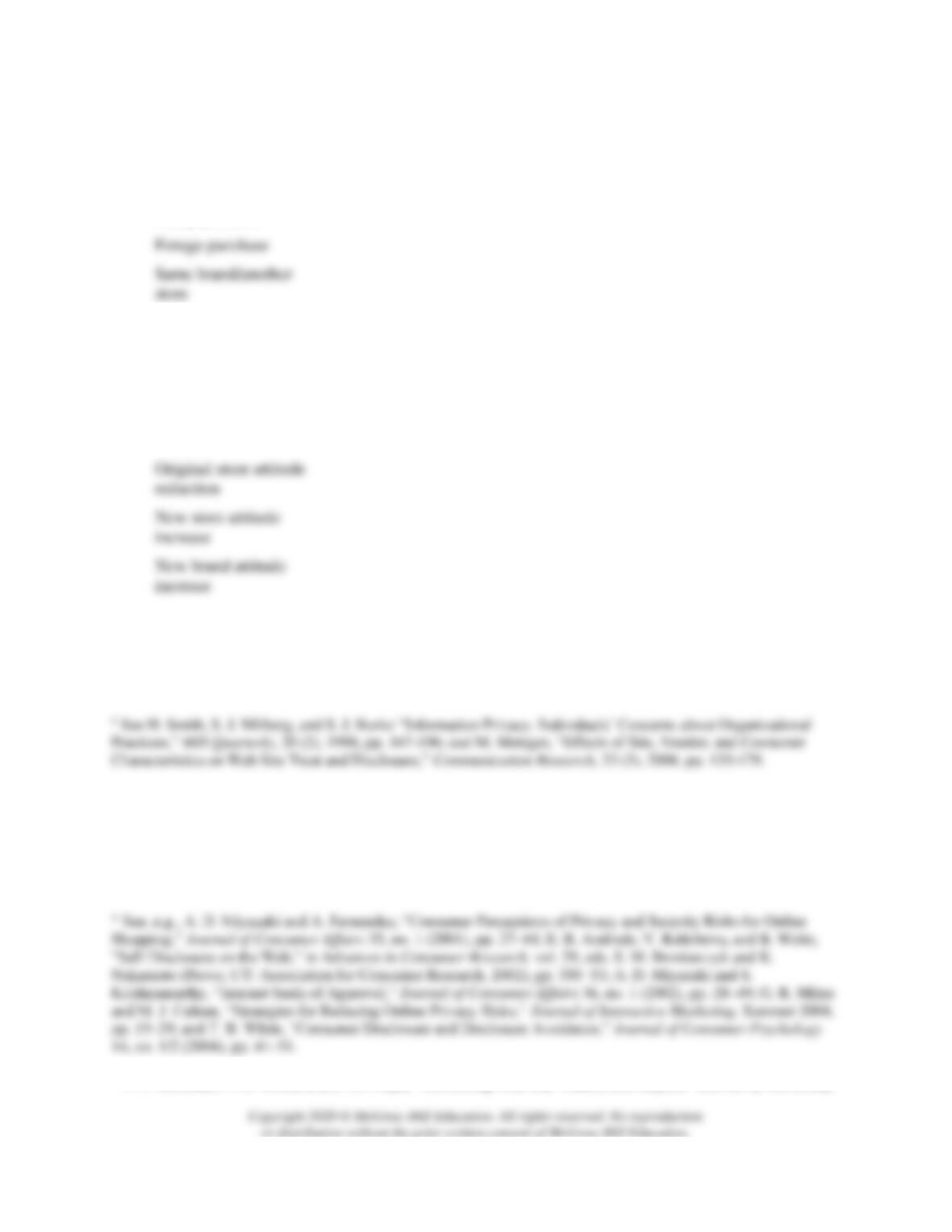
Action
SUV
Cereal
Deodorant
Dress
shirt/blouse
Perfume/
aftershave
Soft drink
Another brand/same
store
Delay purchase
Forego purchase
Same brand/another
store
Negative original
store WOM
Positive new store
WOM
Positive new brand
WOM
Original store attitude
reduction
New store attitude
increase
New brand attitude
increase
i
A. Klaassen, “Ion Interactive Develops System to Turn Online Visitors into Customers,” Advertising Age,
December 11, 2006, p. 32.
iii
For a description of the FTC’s approach in this area and its fit with consumer concerns, see K. B. Sheehan and M.
G. Hoy, “Dimensions of Privacy Concern among Online Consumers,” Journal of Public Policy & Marketing, Spring
2000, pp. 62–73. See also J. Phelps, G. Nowak, and E. Ferrell, “Privacy Concerns and Consumer Willingness to
Provide Personal Information,” Journal of Public Policy & Marketing, Spring 2000, pp. 27–41; and K. B. Sheehan
and T. W. Gleason, “Online Privacy,” Journal of Current Issues and Research in Advertising, Spring 2001, pp. 31–
41.
v
April 2006, pp. 133–48.
vi
Personal Information that US Internet Users Are Willing to Share with Internet Retailers, by Trust Level, 2004
(New York: eMarketer, 2005); and E. Xie, H. Teo, and W. Wan, “Volunteering Personal Information on the
Internet: Effects of Reputation, Privacy Notices, and Rewards on Online Consumer Behavior,” Marketing Letters,
17 (1), 2006, pp. 61-74.
viii
L. R. Klein, “Creating Virtual Product Experiences,” Journal of Interactive Marketing, Winter 2003, pp. 41–55;
J. Nantel, “My Virtual Model,” Journal of Interactive Marketing, Summer 2004, pp. 73–86; and J. Kim and S.
Forsythe, “Adoption of Virtual Try–On Technology for Online Apparel Shopping,” Journal of Interactive
Marketing, Spring 2008, 45-59.
ix
L. Wang, et al., “Can a Retail Web Site Be Social?” Journal of Marketing, July 2007, pp. 143-157.