
15
© 2022 Cengage. All Rights Reserved. May not be scanned, copied or duplicated, or posted to a publicly accessible
website, in whole or in part.
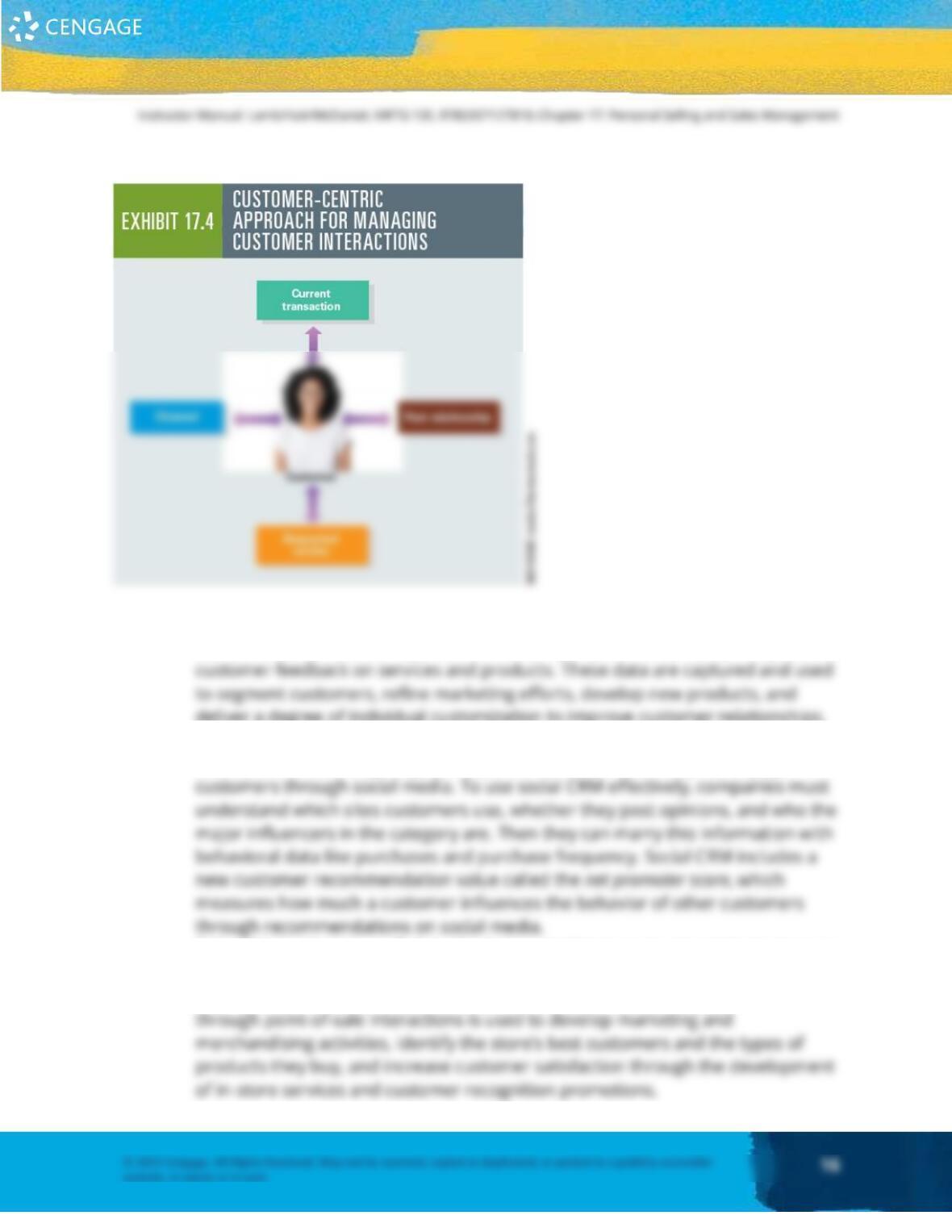
PRESENTATION VISUAL: Exhibit 17.4 Customer-Centric Approach for Managing
Customer Interactions
• Web-Based Interactions: Through web-based interactions, web users can evaluate
and purchase products, make reservations, input preferential data, and provide
deliver a degree of individual customization to improve customer relationships.
• Social CRM: Social CRM takes the most successful aspects of traditional CRM,
such as behavioral targeting, and expands them to include ways to engage
• Point-of-Sale Interactions: Point-of-sale interactions are touch points in stores or
information kiosks that use software to enable customers to easily provide
information about themselves without feeling violated. Information collected
f. Capture Customer Data: In a CRM system, the issue is not how much data can be
obtained, but rather what types of data should be acquired and how the data can be
used effectively for relationship enhancement. The traditional approach for
acquiring data from customers is through channel interactions, including store
g. Leverage Customer Information: Data mining can be used to identify the most
profitable customers and prospects. Managers can then design tailored marketing
strategies to best appeal to the identified segments, commonly referred to as
leveraging customer information.
• Campaign Management: Campaign management involves developing product or
service offerings customized for customer segments and then pricing and
communicating these offerings for the purpose of enhancing customer
relationships. Customizing product and service offerings requires managing
multiple interactions with customers, as well as giving priority to the products
and services that are viewed as most desirable.
• Designing Targeted Marketing Communications: A database allows marketers to
track customers’ relationships to the company’s products and services and
modify the marketing message accordingly. Customers can also be segmented
into infrequent users, moderate users, and heavy users. A segmented
communications strategy can then be developed based on which group the
customer falls into.
[return to top]

Discussion Questions
You can assign these questions several ways: in a discussion forum in your LMS; as whole-
class discussions in person; or as a partner or group activity in class. A generic discussion
rubric is provided in the Appendix.
1. Discussion: (LO 17-1, PPT Slide 4) Duration 5-10 minutes.
a. Kick off this chapter on personal selling by asking students to reflect on all of the
purchases they have made in the last 7 days:
• How many were face-to–face interactions at the salesperson’s place of
• By a show of hands, how many of each type of purchase did you experience?
Share examples.
i. Students’ answers will vary. The sales environment changes
2. Discussion: (LO 17-4, PPT Slides 16-17) Duration 5-10 minutes.
a. Present students with the following scenario and discuss: You are a new sales
associate at a carpet store. One day, a customer walks into the store and tells
sales. Even though you haven’t been thoroughly trained yet, your intuition is
telling you to engage with her.
• What ideas do you have for building a long-term business relationship with
this apartment manager?
• What questions would you like to ask her about her carpeting needs and
expectations?
i. Students’ answers will vary. Relationship selling is a multistage
3. Discussion: (LO 17-7, PPT Slides 59–60) Duration 5-10 minutes.
a. Ask students to consider one of the most ubiquitous products of our times—the
Apple iPhone.
• What might be some of the touch points for this product?
[return to top]
Additional Activities and Assignments
A generic discussion and writing rubric is provided in the Appendix.
1. Activator Exercise: Learning to Sell (LO 17–2)
Purpose: To help students understand the importance of personal selling.
Format: This activity can be facilitated in both a classroom and an online
environment. Instructions for how to facilitate the activity in the classroom and
online are provided below.
Classroom Format: Small group discussion (Estimated Time: 20-30 minutes)
1. Ask each student to think of a very basic, common material that they would like
to work with, such as sand, ice, water, glass, wood, steel, iron, silk, cotton, nylon,
Online Format: Written discussion board posts with responses (Estimated Time: 5-10
minutes)
1. Use the following prompt to facilitate this activity in a discussion board:
2. Have students respond to their classmates’ posts by asking questions and
offering constructive feedback on their sales pitches.
Additional questions for a classroom or discussion board: What problems did
you encounter when you were making a sales pitch? How do you motivate someone
to buy the product that you are selling?
Result: Students will learn several lessons, including the importance of connecting
2. Class activity (LO 17-2)
Format: This activity can be facilitated in both a classroom and an online
environment. Instructions for how to facilitate the activity in the classroom and
online are provided below. (Estimated time: 10-15 minutes)
Classroom Format: Divide students into pairs and ask them to create two
marketing scenarios:
• One that favors personal selling as the primary promotional tactic.
• One that favors advertising as the primary promotional tactic.
When describing each scenario, students should include a description of the
Online Format: If you’re delivering your course online, you can have students do
this on their own and have them post their answers in a discussion board. Use the
following prompt to facilitate this activity:
Create two marketing scenarios:
3. Class Activity (LO 17–3)
Format: This activity can be facilitated in both a classroom and an online
environment. Instructions for how to facilitate the activity in the classroom and
online are provided below. (Estimated time: 15-25 minutes)
Classroom Format: Divide the class into pairs or groups of three. Invite them to
students to share their findings.
Online Format: If you’re delivering your course online, you can have students do
this on their own and have them post their answers in a discussion board. Use the
following prompt to facilitate this activity:
Choose any popular consumer product, such as an electronic device, food item, or
4. Class activity (LO 17–5)
Format: This activity can be facilitated in both a classroom and an online
environment. Instructions for how to facilitate the activity in the classroom and
online are provided below. (Estimated time: 15-25 minutes)
Classroom Format: Have students pair up, designating one partner as the buyer
and the other as the seller. Each pair can choose any familiar product to role play
the seven steps of the buying/selling process. Allow 5 to 10 minutes for teams to
complete the process before leading the entire class in a discussion:
• What types of questions did the seller ask?
Online Format: If you’re delivering your course online, you can have students do
this on their own and have them post their answers in a discussion board. Use the
following prompt to facilitate this activity:
Imagine that you are a salesperson for one of your favorite products. Write out the seven
5. Class activity (LO 17–6)
Format: This activity can be facilitated in both a classroom and an online
environment. Instructions for how to facilitate the activity in the classroom and
online are provided below. (Estimated time: 15-25 minutes)
Classroom Format: Have students pair up, designating one partner as a job
interviewer and the other as the interviewee for a job as either an inside or outside
Online Format: If you’re delivering your course online, you can have students do
this on their own and have them post their answers in a discussion board. Use the
following prompt to facilitate this activity:
You have two job interviews this week—one for an inside sales position and one for an
outside sales position—and you desperately need to land one of these two jobs. You’re
6. Additional activity: The Face-to-Face Sales Process (LO 17–1)
Purpose: To give students a chance to practice face-to-face selling.
Background: Whether or not they realize it, many students are natural salespeople
in their day-to-day lives. This exercise is designed to hone their face-to-face selling
online are provided below.
Classroom Format: Divide your class into pairs, and direct them to follow these
steps:
1. Choose one of the following situations for a “sales” presentation:
• Convincing your sister to lend you her truck for a ski trip with friends
• Convincing someone you really like to go on a date with you
• Convincing a cop not to give you a traffic ticket
2. Take about 10 minutes to prepare your presentation. Consider each step in the
selling process.
3. Make your case to another pair. You can make your presentation as a team or
choose one of the partners to do the talking.
Finish the exercise by choosing several volunteers (perhaps in return for some extra
Online Format: Video presentation submitted by each student (Estimated Time: 20-
30 minutes)
1. Create this assignment in the Bongo app in MindTap or your LMS. Click on the
2. Choose one of the following situations for a “sales” presentation:
• Convincing your sister to lend you her truck for a ski trip with friends
3. Write the script for a one- to two-minute sales pitch, being as creative and
persuasive as you can be.
4. Record your sales pitch. (It is not necessary to include any music or graphics.)
Additional Questions for Reflection:
• What part of the sales process is most important? Why?
• Which works better, a team presentation or an individual presentation? Why?
7. Online Research Activity (LO 17-5)
The Consumer Electronics Show (CES) is one of the largest trade shows in the world.
Visit the CES website and answer the following questions:
Note: The CES is held in Las Vegas, Nevada during the first week of January every
year. Student answers regarding attendance and products will vary according to the
information on the website. The CES could be used to generate leads, interact with
potential customers, probe customer needs, and learn about the competition. The
CES can act as a touch point, allowing the salesperson to gather information.
[return to top]
Additional Resources
Appendix Generic Rubrics
Providing students with rubrics helps them understand expectations and components of
assignments. Rubrics help students become more aware of their learning process and
progress, and they improve students’ work through timely and detailed feedback.
Customize these rubrics as you wish. The writing rubric indicates 40 points and the
discussion rubric indicates 30 points.
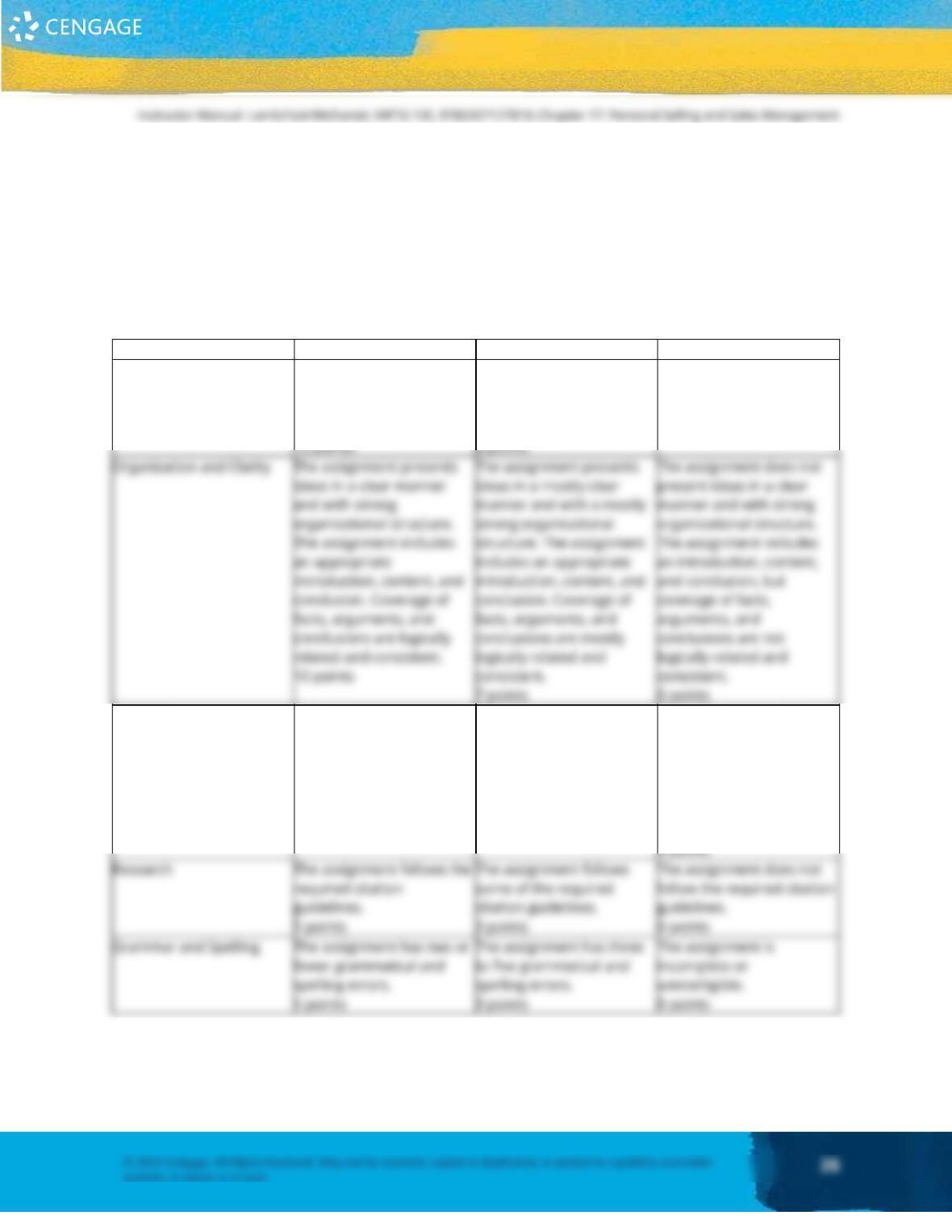
Standard Writing Rubric
Criteria
Meets Requirements
Needs Improvement
Incomplete
Content
The assignment clearly and
comprehensively
addresses all questions in
the assignment.
The assignment partially
addresses some or all
questions in the
assignment.
The assignment does not
address the questions in
the assignment.
0 points
Research
The assignment is based
upon appropriate and
adequate academic
literature, including peer
reviewed journals and
other scholarly work.
5 points
The assignment is based
upon adequate academic
literature but does not
include peer reviewed
journals and other
scholarly work.
3 points
The assignment is not
based upon appropriate
and adequate academic
literature and does not
include peer reviewed
journals and other
scholarly work.
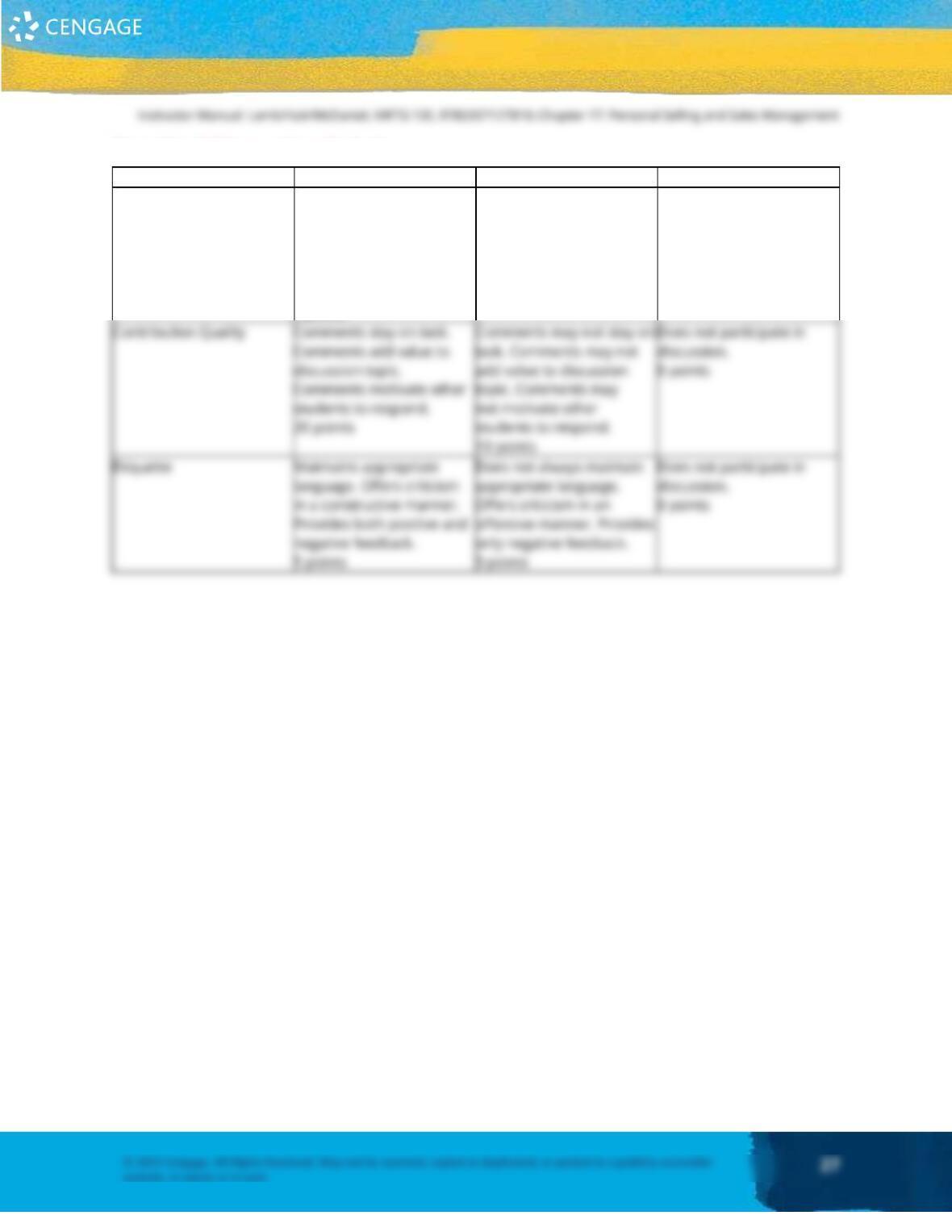
Standard Discussion Rubric
Criteria
Meets Requirements
Needs Improvement
Incomplete
Participation
Submits or participates in
discussion by the posted
deadlines. Follows all
assignment. instructions
for initial post and
responses.
Does not participate or
submit discussion by the
posted deadlines. Does not
follow instructions for
initial post and responses.
3 points
Does not participate in
discussion.
0 points