Chapter 17: Integrated Marketing Communications, Advertising,
and Public Relations
the marketing nature of the messages. To woo younger consumers, especially teens and those
in their 20s, advertisers attempt to make these messages appear as different from
advertisements as possible; they design ads that seem more like entertainment.
In online ads, it is often difficult to separate advertising from editorial content, because many
sites resemble magazine and newspaper ads or television infomercials.
Discussion question: Can you think of an example of information that you once thought was
an authentic news story that turned out to be part of a PR campaign generated by a company?
17-7 Promotional Mix Effectiveness
Marketers strive to develop an effective promotional mix by evaluating various factors.
Nature of the Market
The number of buyers and the type of customer in a marketer’s target audience should affect
the promotional mix. Advertising is most often appropriate to reach large numbers of consumers
scattered across geographic areas. Personal selling works better for business customers,
Chapter 17: Integrated Marketing Communications, Advertising,
and Public Relations
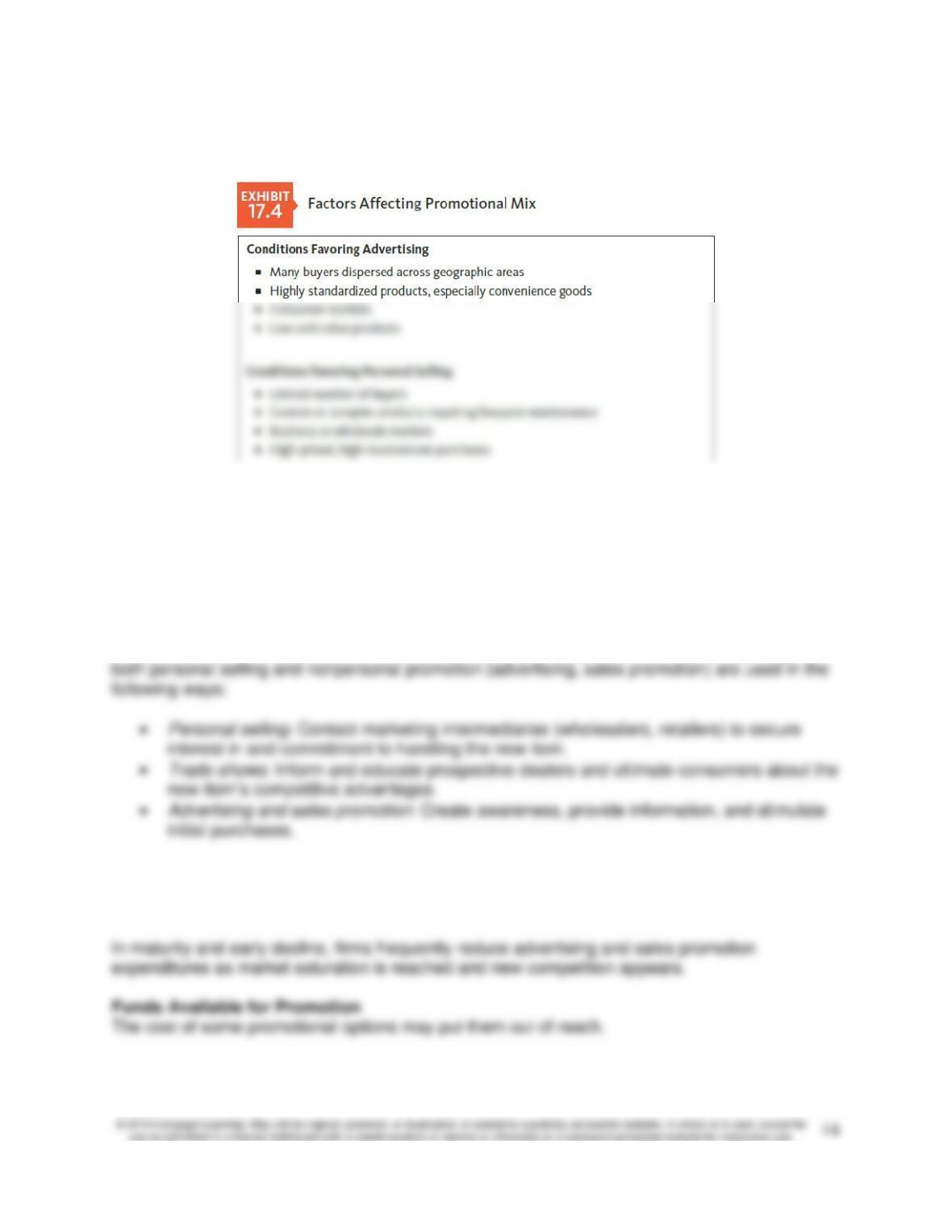
PRESENTATION VISUAL: MindTap Exhibit 17.4 summarizing factors that favor
advertising versus personal selling
Price
Low-unit-price products are usually advertised in mass media, where the marketer’s cost per
contact is low. In contrast, high-priced goods like boats or luxury condos can rarely be sold
without well-presented information from qualified salespeople. Increasingly, such pitches include
high-tech elements such as video presentations on a tablet or augmented reality features
embedded in a display.x
Stage in the Product Lifecycle
The promotional mix also must be tailored to the product lifecycle. In the introductory stage,
As the product moves into the growth and maturity stages, the promotional mix should change.
Advertising gains more relative importance in persuading and reminding consumers to make
purchases. Salespeople attempt to convince marketing intermediaries to expand distribution.

Chapter 17: Integrated Marketing Communications, Advertising,
and Public Relations
Classroom activity: Divide students into groups and ask them to brainstorm a real-world
scenario for a company wanting to build a promotional campaign. Have the groups specify:
The product the company is selling;
Whether they are selling to businesses or consumers;
Ask the groups to write down their scenario. Take each written scenario and give it to another
group. That group should now take the scenario and brainstorm the optimal promotional mix for
that company. Which promotional components are most appropriate for that company? What
portion of their budget should be dedicated to each?
Note: Students can represent their answers in a pie chart if they’d like. An example for a large
energy drink brand with a big budget might be 70% advertising and 30% sales promotion.

Chapter 17: Integrated Marketing Communications, Advertising,
and Public Relations
LEARN IT TODAY . . . USE IT TOMORROW
VIGNETTE AND ACTIVITY
The opening vignette for Chapter 17 introduces students to Pepe’s Pizza, a small chain in the
northeastern United States. Students learn about the various promotional tactics used by
Pepe’s and their approach to branding.
Note: Answers to the chapter-ending activity can be discussed in class after the activity
due date.
Promotion at Pepe’s Pizza
Congratulations! You‘ve been hired as the new director of promotion for Pepe’s Pizza. Your task
is to guide the company’s expansion into two new products.
Knowing that this expansion requires significant changes to Pepe’s traditional promotional mix,
you sit down to figure out the best approach.
Issue #1: One way to market the pizza sauce is to run ads in food magazines; the ads could
explain how Pepe’s pizza sauce coats more evenly than other brands and won’t leave pizza
crusts soggy. For slightly more money, you can hire a salesforce to call on restaurants directly.
Which way should you go:
(a) print advertising or
(b) personal selling?

Chapter 17: Integrated Marketing Communications, Advertising,
and Public Relations
contract will be unique and the product lends itself to effective demonstration, salespeople
would be a better investment than ads.
Issue #2: With your promotional plan for the pizza sauce in place, attention turns to the launch
of Pepe’s first frozen pizza. Two of your key managers in the advertising department are
Correct—(a) Fran is correct to emphasize advertising during a new product introduction, when
it is needed to make people aware of the brand. However, advertising is also needed to
stimulate demand, and will gain in relative importance as Pepe’s Frozen Pizza moves into the
growth and maturity stages. It would be a mistake to yield this promotional ground to
competitors.
Incorrect—(b) You’re on firm ground by agreeing with Sean. Ongoing advertising will be critical
as competition heats up and Pepe’s must make sure consumers know why its product is better
than the numerous mass market alternatives.
Issue #3: Sales Director Paula is very enthusiastic about Pepe’s Frozen Pizza and is now
making a case for using personal selling instead of advertising to reach consumers. In
Incorrect—(a) Personal selling should not replace advertising for Pepe’s Frozen Pizza. Personal
selling is best suited to customized, technically complex products, especially those targeted to a
business market. For a value-priced, standardized product like this, personal selling would be
too expensive. Instead, advertising would be a better fit for reaching the large, dispersed
potential market.
Correct—(b) Fran and Sean are right. Because frozen pizza is a standardized, relatively low
priced product targeted to a mass audience, advertising is not only more cost efficient than
personal selling, but also better able to reach its large, dispersed potential market.
Issue #4: You have now secured several grocery store chains willing to carry your frozen pizza

Chapter 17: Integrated Marketing Communications, Advertising,
and Public Relations
However, you are reviewing the television ad budgets and are growing concerned about the
high costs. You ask the PR director her opinion and she recommends dropping the advertising
Correct—(a) Advertising is the best choice still, although you may want to evaluate media
selection to be sure you are reaching your target market at the most reasonable cost. The
problem with publicity is that you can’t control the timing or the message of any media stories,
which would break a promise made to your grocery store accounts.
Chapter 17: Integrated Marketing Communications, Advertising,
and Public Relations
ADDITIONAL HOMEWORK/CLASSROOM ACTIVITIES
Understanding Integrated Marketing Communications
Purpose: To help students understand the challenge and complexity of integrated marketing
communications.
Exercise: Ask your class how many different promotional messages they have seen or heard
today. (Some classes take a few moments to realize how astronomical the number really is.)
Where and how did they receive those messages? What were the messages specifically?
(Many students won’t remember, which helps them better understand the point about clutter.)
Questions for Reflection:
• What are the ethical issues regarding promotional clutter? Is there likely to be
consumer backlash?
• What role has the Internet played in marketing communication? (You may want to
emphasize that the Web has put more promotional power in the hands of
consumers, which can either work for or against marketers.)
Direct Mail
Purpose: To examine and evaluate direct mail marketing
Relationship to Text: Direct Mail
Estimated Class Time: About 15 minutes

Chapter 17: Integrated Marketing Communications, Advertising,
and Public Relations
Preparation/Materials: A week or two before this exercise, begin collecting direct mail
marketing pieces until you have enough for five pieces for each group of three to five students
(plus a few extra). Try to gather a wide variety of pieces.
Exercise: Help your class understand that the success of any direct mail campaign depends
not only on the quality of the list, but also on the quality and creativity of the piece itself.
Questions for Reflection:
• When does direct mail make the most sense as an integrated marketing
communications tactic? Why?
Advertising Strategies
Purpose: To give students a chance to develop and consider advertising strategy.
Background: Each day, advertising surrounds virtually every student, but few give much
thought to advertising strategy. This exercise is designed to highlight the role of strategy, and to
underscore how it connects to the advertising messages that we see each day.
Exercise: After you cover the topic of advertising strategy, divide your class into groups of five
to seven people, and give each student a copy of the following scenario:
Scenario: You run a highly successful tattoo and piercing parlor in your small west coast city,
but you are fairly certain that you and your key competitor have saturated your target audience
Chapter 17: Integrated Marketing Communications, Advertising,
and Public Relations
Give the groups a few minutes to plan their approach, and then ask each team to share with the
class. The results can be amazing.
Questions for Reflection:
• Is advertising more effective at bringing new customers into a category, or taking
Media Selection
Purpose: To expose students to hands-on media planning.
Background: Without an effective media plan, even the best creative idea won’t do the job.
This exercise is designed to give students hands-on experience with media planning, choosing
both vehicles and timing.
Relationship to Text: Media Selection
Exercise: Once your class understands media planning basics, divide them into groups of five
to seven students, and distribute copies of the following scenario. (While most students seem
clear on the definition of alternative music, you may want to spend a moment asking them to
define the genre, so that everyone can work from the same assumptions.)
Give the groups about 15 minutes, and then ask them to present to the class. Most teams
develop radically different plans, demonstrating firsthand that media planning is more of an art
than a science.
Questions for Reflection:
• Do nontraditional media (e.g., text messages) invade privacy? “Commercial
pollution”? Why or why not?

Chapter 17: Integrated Marketing Communications, Advertising,
and Public Relations
Cross-Promotion
Purpose: To highlight the growing importance of cross-promotional advertising.
Relationship to Text: Cross-Promotion
Estimated Class Time: About 15 minutes
Exercise: Divide your class into small groups. Write each of the following categories on the
board.
• Blue jeans
• Pizza
Direct the groups to choose one specific player in each category (e.g., Rock & Republic Jeans
or Abbots Pizza), and to choose three cross-promotion partners for each. Give them about 10
minutes, and then ask each group to share their ideas for one of the categories until you have
covered all seven. Encourage the other groups to chime in with their additional ideas for that
category at the end of each brief presentation.
Questions for Reflection:
• What are some particularly strong examples of actual cross-promotion? Why were
Internet Exercise—Super Bowl Advertising
Visit the website listed here. How many different organizations ran ads during the most recent
Super Bowl? Which organizations have run the most ads in Super Bowls? During the most
Chapter 17: Integrated Marketing Communications, Advertising,
and Public Relations
KEY TERMS
Integrated marketing communications (IMC): The coordination of all promotional activities to
produce a unified, customer-focused promotional message.
Promotional: Mix advertising, personal selling, sales promotion, direct marketing, and public
relations.
Public relations: A firm’s communications and relationships with its various stakeholders,
including customers, suppliers, stockholders, employees, the government, and the general
public.
Publicity: An aspect of public relations where marketers seek unpaid placement of news about
the company or a product in mass media or on social media.
Guerilla marketing: Using unconventional, innovative, and low-cost techniques to attract
consumers’ attention.
Sender: Source in the communication system as they seek to convey a message to a receiver.

Chapter 17: Integrated Marketing Communications, Advertising,
and Public Relations
Primary demand: Seeks to build demand for a product category, not for a particular brand
within that category.
Advertising campaign: A series of different but related ads that use a single theme and appear
in different media within a specified time period.