Chapter 17: Integrated Marketing Communications, Advertising,
and Public Relations
CHAPTER SUMMARY AND LEARNING OBJECTIVES
LO 17.1 Identify the five components of the promotional mix.
To make their messages stand out from competition, marketers seek to integrate advertising,
personal selling, sales promotion, direct marketing, and public relations in a consistent,
coordinated way.
LO 17.2 Explain how the communications process relates to the AIDA concept.
LO 17.3 Describe the various objectives of promotion.
LO 17.4 Describe the types of appeals used by advertisers.
An effective appeal can help an ad break through the clutter. Among the most common
advertising appeals are fear, humor, sex, celebrity testimonial, and comparison to competitors.
LO 17.5 Compare the seven different advertising media.
LO 17.6 Describe the roles of public relations, publicity, and cross-promotion in an
LO 17.7 Critique a promotional mix based on the five factors that influence the
effectiveness of a promotional mix.
Organizations evaluate various market and product factors to help them select the best
promotional mix. These include nature of the market, nature of the product, price, stage in the
product lifecycle, and funds available for promotion.
Chapter 17: Integrated Marketing Communications, Advertising,
and Public Relations
ACTIVATOR EXERCISE: Effective (and Efficient) Promotion
Purpose: For students to evaluate the various types of promotion.
• How will you tell people about the tickets and convince them to buy?
• Specifically, what tactics will you use?
• Will you use one tactic for everyone or have different tactics for different target groups?
• Why did you choose the tactics you did?
When groups have finished, have them each present their ideas. Note how similar (or different)
their plans are.
Now, ask them to repeat the exercise—this time for launching a new brand of athletic apparel.
After five minutes, ask the groups to share again.
Finally, ask them to repeat the exercise—this time for selling lawn care service in a small, but
affluent town with many large estates. After five minutes, ask the groups to share again.
Chapter 17: Integrated Marketing Communications, Advertising,
and Public Relations
LECTURE OUTLINE
17-1 Integrated Marketing Communications
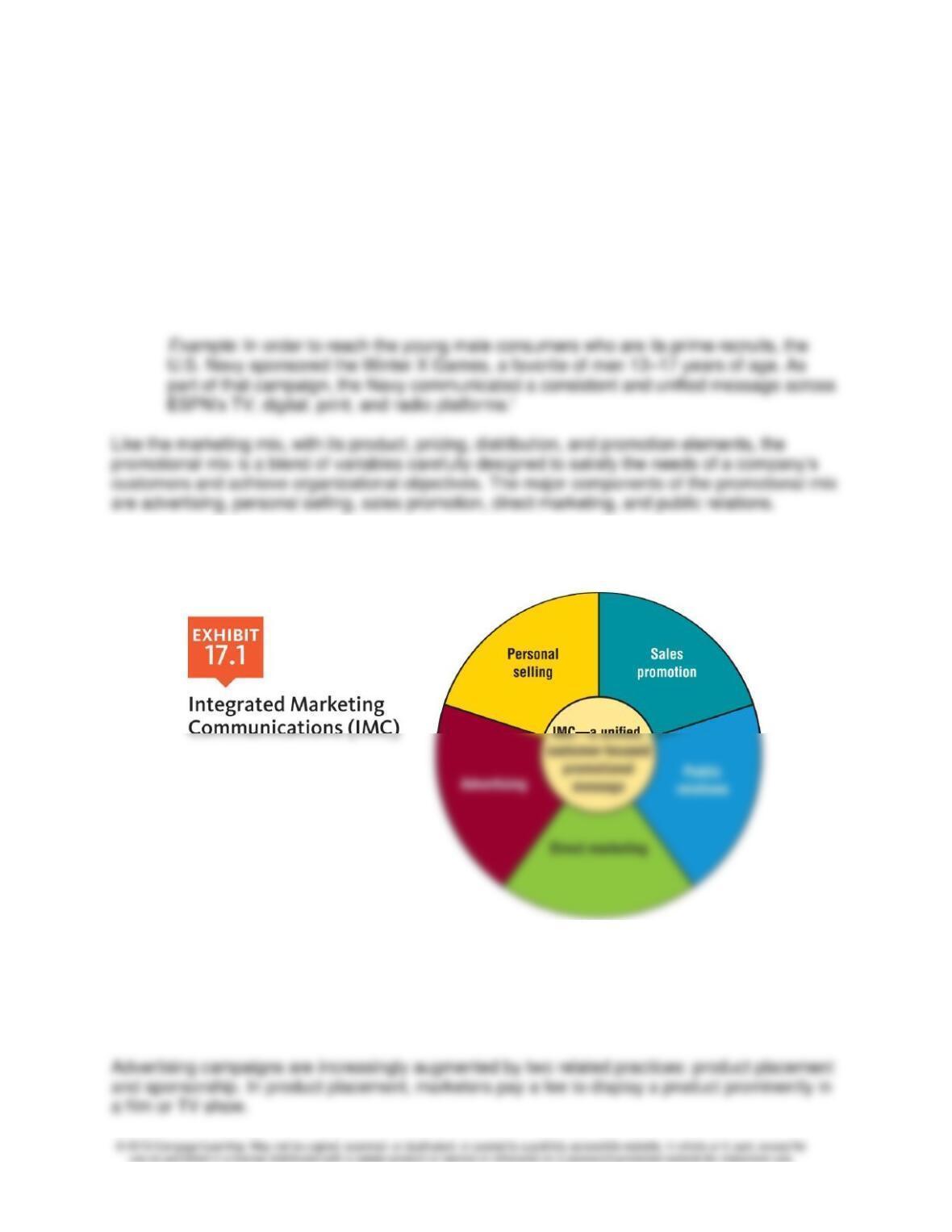
Instead of viewing each part of the promotional mix as isolated components, an integrated
marketing (IMC) strategy looks at these elements together. With an IMC strategy, marketers can
create a unified personality for the product or brand because all of their various marketing
communications align with one another.
PRESENATION VISUAL: MindTap Exhibit 17.1 showing the elements of the promotional
mix
Advertising
Advertising is paid, nonpersonal communication through various mass media, such as
television, radio, magazines, or online. It is a major promotional mix component for thousands of
organizations—total ad spending in the United States is estimated at more than $200 billion;ii
digital ad spending alone is estimated at more than $72 billion.iii
Chapter 17: Integrated Marketing Communications, Advertising,
and Public Relations
Discussion question: Who has seen product placement recently? What was the show and
what were the products?
In sponsorship, an organization supports an event or activity with money or in-kind resources in
exchange for a direct association with that event or activity.
Discussion questions: What are examples where you’ve seen sponsorship in action?
Personal Selling
Personal selling is a seller’s promotional presentation conducted person–to-person with the
buyer. It may take place face-to–face, over the telephone, or by online video. It may involve one
salesperson and one buyer, or a team of salespeople pitching a group of buyers.
Sales Promotion
Discussion questions: What are examples of sales promotion that you’ve seen online? Have
you entered any contests on social media or used online promo codes to get a discount?
Direct Marketing
Another element in a firm’s integrated promotional mix is direct marketing, the use of direct
Chapter 17: Integrated Marketing Communications, Advertising,
and Public Relations
Publicity is the marketing-oriented aspect of public relations where marketers seek unpaid
placement of news about the company or a product in mass media or on social media.
Variants of the Promotion Mix
While not necessarily categories of the promotion mix themselves, some additional promotional
Discussion questions: What is an example of a promotional message that went truly viral?
Follow-up question: How can you tell if it was truly viral or whether it was seeded through paid
online marketing and a public relations strategy? An example might be getting a story about the
“viral video” picked up by a traditional media outlet—which ends up being the true driver of the
video’s popularity?
17-2 The Communication Process
When marketers send a message to an intended audience or market, they want to make sure it
gets through clearly and persuasively. That is why the communication process is so important to
marketing.
The sender acts as the source in the communication system as they seek to convey a
message (a communication of information) to a receiver. An effective message accomplishes
three tasks:
Chapter 17: Integrated Marketing Communications, Advertising,
and Public Relations
The AIDA Concept
The three tasks just listed are related to the AIDA concept (attention, interest, desire, action),
which are the steps consumers take in reaching a purchase decision. First, the promotional
message must gain the potential consumer’s attention. It then seeks to arouse interest in the
good or service. Next, it stimulates desire by convincing the would-be buyer of the product’s
ability to satisfy his or her needs. Finally, the sales presentation, advertisement, or sales
promotion technique attempts to produce action in the form of a purchase now or in the future.
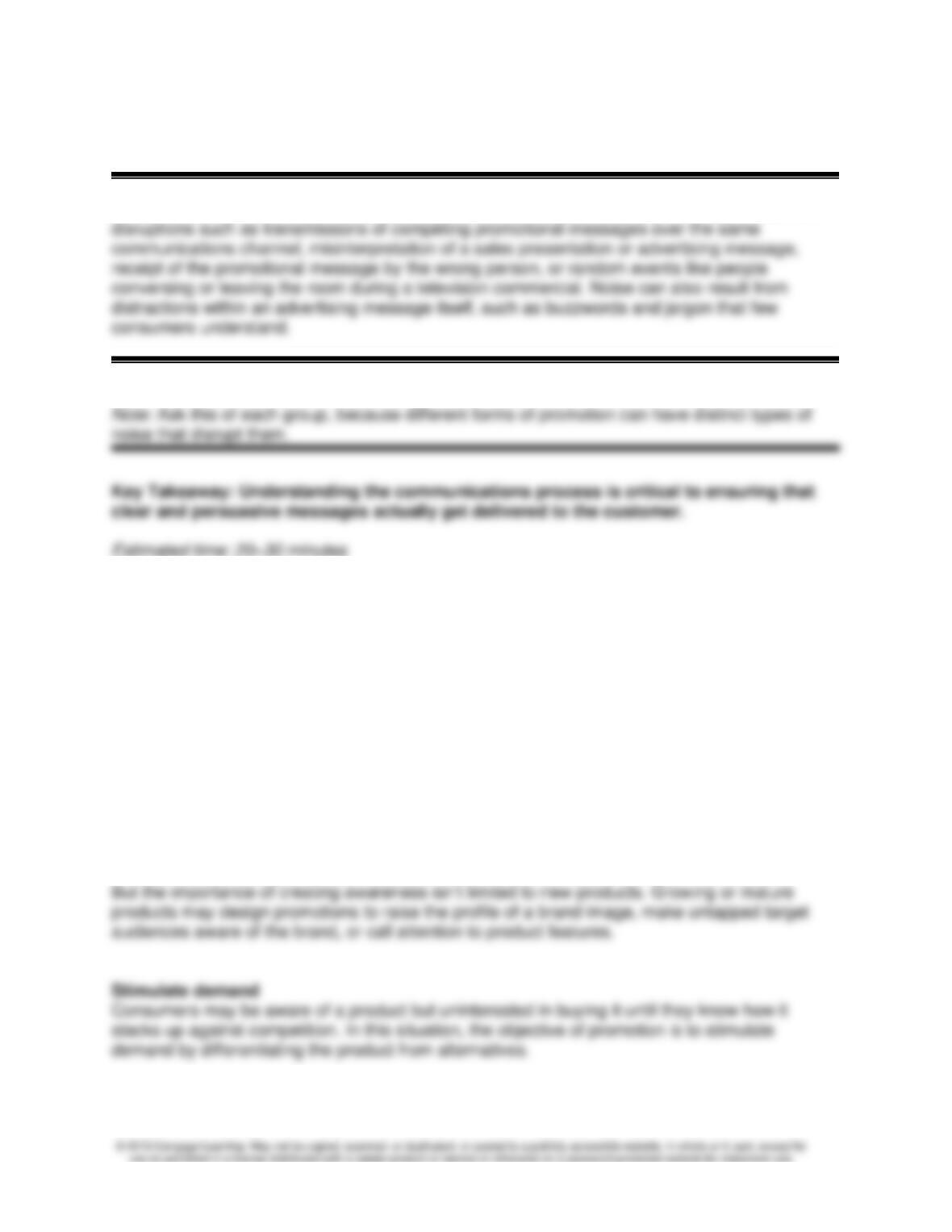
PRESENTATION VISUAL: MindTap Exhibit 17.2 with examples of the AIDA concept in
action
Note: Walking students through the exhibit will help prep them for the upcoming classroom
activity.
Classroom activity: Divide students into groups and assign each group a different component
Chapter 17: Integrated Marketing Communications, Advertising,
and Public Relations
Note: This exercise not only reinforces what each of the different promotional components are
(from LO 17.1) but allows students to consider the whole communications process for that
component from beginning (message sent) to end (feedback received).
Noise represents interference at some stage in the communication process. It may result from
Discussion question: What are two forms of noise that could disrupt the message you sent?
17-3 The Objectives of Promotion
The overall function of promotion is to inform, persuade, and influence the consumer’s purchase
decision. However, the objective of a specific promotion may vary depending on the
organization’s needs and challenges at a given point in time. Among the most common
promotional objectives are to create awareness, stimulate demand, encourage product trial, and
retain loyal customers.
Create awareness
New product marketers must clear a significant hurdle before anyone will buy what they’re
selling: Potential customers need to know the product exists. That’s why the objective of
advertising and other promotion at the introductory stage of the product lifecycle is to create
awareness.
Selective demand has the goal of increasing demand for a specific brand based on attributes
important to potential purchasers.
Chapter 17: Integrated Marketing Communications, Advertising,
and Public Relations
Primary demand has the goal of increasing demand for a product category, but not a particular
brand or product.
Encourage product trial
If prospective customers are aware of a product and favorably impressed by what it offers
Discussion question: What’s an example of a commercial you saw or heard recently that
specifically encouraged product trial? You’ll know it’s encouraging product trial if there was a
specific call-to-action or incentive for buying the product.
Estimated time: 10–15 minutes
17-4 Advertising Appeals
An advertising campaign is a series of different but related ads that use a single theme and
appear in different media within a specified time period. In developing a creative strategy,
advertisers must balance message characteristics—the tone of the appeal, the information
provided, and the conclusion to which it leads the consumer—with the story the ad tells, and its
emphasis on verbal or visual elements. There are some common types of appeals used in
advertising.
• Appeals based on fear
Chapter 17: Integrated Marketing Communications, Advertising,
and Public Relations
Example: Wireless telecommunications carriers Sprint and T-Mobile have invited
comparison to market leader Verizon in a series of ads touting the strength of their
networks and the speed of their services.v
By contrast, advertising by market leaders seldom acknowledges that competing products even
exist, and when they do, they do not point out any benefits of the competing brands.
Classroom activity: In pairs, brainstorm an example of an ad you have seen for EACH of these
appeals.
Key Takeaway: Marketers can use a variety of appeals and tones in advertising, but
should carefully consider what best fits their product and audience.
Estimated time: 10–30 minutes (depending on whether you facilitate the class activity)
17-5 Media Selection and Scheduling
One of the most important decisions in developing an advertising strategy is the selection of
Key notes about each medium
Television—network and cable combined—accounts for just over 40 cents of every advertising
dollar spent in the world.vi Television advertising is attractive because it allows marketers to
reach local and national markets. Whereas most newspaper advertising revenues come from
local advertisers, the greatest share of television advertising revenues comes from
organizations that advertise nationally.
Chapter 17: Integrated Marketing Communications, Advertising,
and Public Relations
Newspaper advertising as a whole is losing ground to alternative media vehicles. However, it
continues to be strong in local markets and is estimated to account for $16.2 billion in annual
advertising expenditures.vii The primary advantage of newspaper advertising is the flexibility it
offers, because the ads can vary from one locality to the next. Unlike television or radio
Direct-mail advertising includes sales letters, postcards, leaflets, folders, booklets, and
catalogs. This medium accounted for nearly $50 billion of spending in a recent year.viii It offers
speed, flexibility, detailed information, and personalization. Disadvantages of direct mail include
high production costs, reliance on the quality of mailing lists, and some consumers’ resistance
to it.
PRESENTATION VISUAL: MindTap Exhibit 17.3 comparing the advantages and
disadvantages of different advertising media
Medium
Advantages
Disadvantages
Television
Largest reach
Audio visual presentation has a high
impact
Ads can be run frequently
Very expensive
Message can be quickly forgotten
Increasingly ignored by users of digital video recorders (DVR)
Outdoor
Geographic selectivity
Allows only very short messages
Chapter 17: Integrated Marketing Communications, Advertising,
and Public Relations
Note: While this is a large exhibit, it can be useful to review in class, as many students skip the
details when seeing this chart in MindTap. Students must be able to distinguish the advantages
and disadvantages of each medium in order to master this learning objective (and be capable of
making effective decisions about media selection).
Classroom activity: Divide students into groups and assign them a particular advertising
medium. Now, ask them to describe an advertising campaign where that medium is being put to
its best use. They should consider the following:
What is it about the company or product that makes this medium the best fit?
What are the budget and messaging priorities of that company that make this medium the best
Key Takeaway: One of the most important decisions in developing an advertising
strategy is the selection of appropriate media to carry a firm’s message to its audience.
Estimated time: 20–30 minutes
17-6 Public Relations
Public relations (PR) is the firm’s communications with various stakeholders, including
customers, employees, stockholders, suppliers, government agencies, and the society in which
it operates. It is concerned with building a positive image for all parts of the organization.
Real-time, measurable feedback
Uncertainty about how to evaluate return on investment
Chapter 17: Integrated Marketing Communications, Advertising,
and Public Relations
Publicity
The aspect of public relations most directly related to promoting a firm’s products is publicity,
which focuses on unpaid placement of news regarding the product in a print, social, or
broadcast medium. Firms generate publicity by creating special events, holding press
conferences, and preparing news releases and media kits. Many businesses, such as
Starbucks and Sam’s Club, built their brands with virtually no advertising.
Classroom activity: Many more news stories than you might think are actually generated
through press releases put out by companies. Look at the trending Facebook stories in your app
and see if you can find any stories that look like they originated from a public relations
campaigns.
Examples: Announcement of a movie sequel or new product, announcement of a factory
expansion or hiring spree, reporting about financial results for a company, and so on.
relations, and sales promotion.
Classroom activity: Divide students into pairs and ask them to search online for examples of
cross promotion. You can provide hints for where they might look, including (but not limited to):
Visiting a brand’s page on Facebook, Twitter, or Instagram
Ethics in PR
Promotion is the element in the marketing mix that raises the most ethical questions. One issue
is the insertion of product messages in media programs without full disclosure to audiences of