
Instructor Manual
Lamb/Hair/McDaniel, MKTG 13E, 9780357127810; Chapter 17: Personal Selling and Sales
Management
Table of Contents
Purpose and Perspective of the Chapter …………………………………………………………………………. 2
Cengage Supplements …………………………………………………………………………………………………… 2
Learning Outcomes ……………………………………………………………………………………………………….. 2
Complete List of Chapter Activities and Assessments ……………………………………………………… 3
Key Terms ……………………………………………………………………………………………………………………… 4
What’s New in This Chapter ……………………………………………………………………………………………. 6
Chapter Outline …………………………………………………………………………………………………………….. 7
Discussion Questions …………………………………………………………………………………………………… 19
Additional Activities and Assignments …………………………………………………………………………… 20
Additional Resources ……………………………………………………………………………………………………. 25
External Videos or Playlist ……………………………………………………………………………………………………….. 25
Appendix …………………………………………………………………………………………………………………….. 26
Generic Rubrics ……………………………………………………………………………………………………………………… 26
Standard Writing Rubric …………………………..……………………………………………………………………………… 26
Standard Discussion Rubric ……………………………………………………………………………………………………… 27
Instructor Manual: Lamb/Hair/McDaniel, MKTG 13E, 9780357127810; Chapter 17: Personal Selling and Sales Management
Purpose and Perspective of the Chapter
The purpose of this chapter is to understand the sales environment. Salespeople can be
consumer-focused (as in the case of retail) or business-focused. The sales environment
changes constantly as new competitors enter the market and old competitors leave. The
ways that customers interact with salespeople and learn about products and suppliers are
changing due to the rapid increase in new sales technologies. Personal selling is direct
Cengage Supplements
The following product-level supplements provide additional information that may help you
in preparing your course. They are available in the Instructor Resource Center.
• Transition Guide (provides information about what’s new from edition to edition)
• Educator’s Guide (describes assets in the platform with a detailed breakdown of
activities by chapter with seat time)
Learning Outcomes
The following learning outcomes are addressed in this chapter:
LO 17-1 Understand the sales environment
LO 17-2 Describe personal selling
LO 17-3 Discuss technology‘s impact, including social media, on the sales environment
Complete List of Chapter Activities and Assessments
For additional guidance refer to the Teaching Online Guide.
Chapter
Learning
Objective
PPT slide
Activity/Assessment
Duration
Certification
Standard
N/A
MindTap: Why Does
Personal Selling Matter
to Me?
5 minutes
BUSPROG:
Analytic
DISC: Promotion
17-4
MindTap: Learn It 17-4:
Relationship Selling
5 minutes
BUSPROG:
Analytic
DISC: Promotion
17-5
MindTap: Learn It 17-5:
Steps in the Selling
Process
5 minutes
BUSPROG:
Analytic
DISC: Promotion
17-6
MindTap: Learn It 17-6:
Sales Management
5 minutes
BUSPROG:
Analytic
DISC: Promotion
Customer Relationship
Management and the
Sales Process
Analytic
DISC: Promotion
Instructor Manual: Lamb/Hair/McDaniel, MKTG 13E, 9780357127810; Chapter 17: Personal Selling and Sales Management
DISC: Marketing
Plan
17–1 – 17–7
MindTap: Case Activity
15 minutes
BUSPROG:
Analytic
17-2
9
Knowledge Check 1 in
PPT
5 minutes
BUSPROG:
Analytic
DISC: Promotion
17-4
18
Knowledge Check 2 in
PPT
10-15 minutes
BUSPROG:
Analytic
DISC: Customer
17-5
33
Group Activity 2 in PPT
15-20 minutes
BUSPROG:
Communication
DISC: Promotion
Knowledge Check 3 in
10 minutes
BUSPROG:
[return to top]
Key Terms
relationship selling (consultative selling): a sales practice that involves building,
maintaining, and enhancing interactions with customers in order to develop long-term
satisfaction through mutually beneficial partnerships.
networking: a process of finding out about potential clients from friends, business
contacts, coworkers, acquaintances, and fellow members in professional and civic
organizations.
lead qualification: determination of a sales prospect’s (1) recognized need, (2) buying
power, and (3) receptivity and accessibility.
negotiation: the process during which both the salesperson and the prospect offer special
concessions in an attempt to arrive at a sales agreement.
follow-up: the final step of the selling process, in which the salesperson ensures delivery
schedules are met, goods or services perform as promised, and the buyers’ employees are
properly trained to use the products.
quota: a statement of the salesperson’s sales goals, usually based on sales volume.
point-of-sale interactions: a touch point in stores or information kiosks that uses
software to enable customers to easily provide information about themselves without
feeling violated.
campaign management: developing product or service offerings customized for the
appropriate customer segment and then pricing and communicating these offerings for the
purpose of enhancing customer relationships.
[return to top]
What’s New in This Chapter
The following elements are improvements in this chapter from the previous edition:
• New content on technology’s impact on selling environment
• New content on diminishing control of companies over social media website
content
[return to top]
Chapter Outline
In the outline below, each element includes references (in parentheses) to related content. “LO
CH–##” refers to the chapter learning outcome; “PPT Slide #” refers to the slide number in the
PowerPoint deck for this chapter (provided in the PowerPoints section of the Instructor Resource
Center); and, as applicable for each discipline, accreditation or certification standards (“DISC”).
Introduce Chapter 17 and review the learning outcomes. (PPT Slide 2).
1. The Sales Environment (17-1, PPT Slide 3, DISC: Promotion)
a. Most direct face-to-face selling of consumer products takes place at the
2. Personal Selling (17-2, PPT Slide 5, DISC: Promotion)
a. Personal selling offers several advantages over other forms of promotion:
• Detailed product explanations or demonstrations can be provided as needed.
b. Limitations of personal selling include:
• Cost per contact is much greater than for mass forms of communication, leading
companies to be highly selective about using salespeople.
c. Generally, personal selling becomes more important when the number of potential
customers decreases, as the complexity of the product increases, and as the value
of the product grows (see Exhibit 17.1). For highly complex goods, a salesperson is
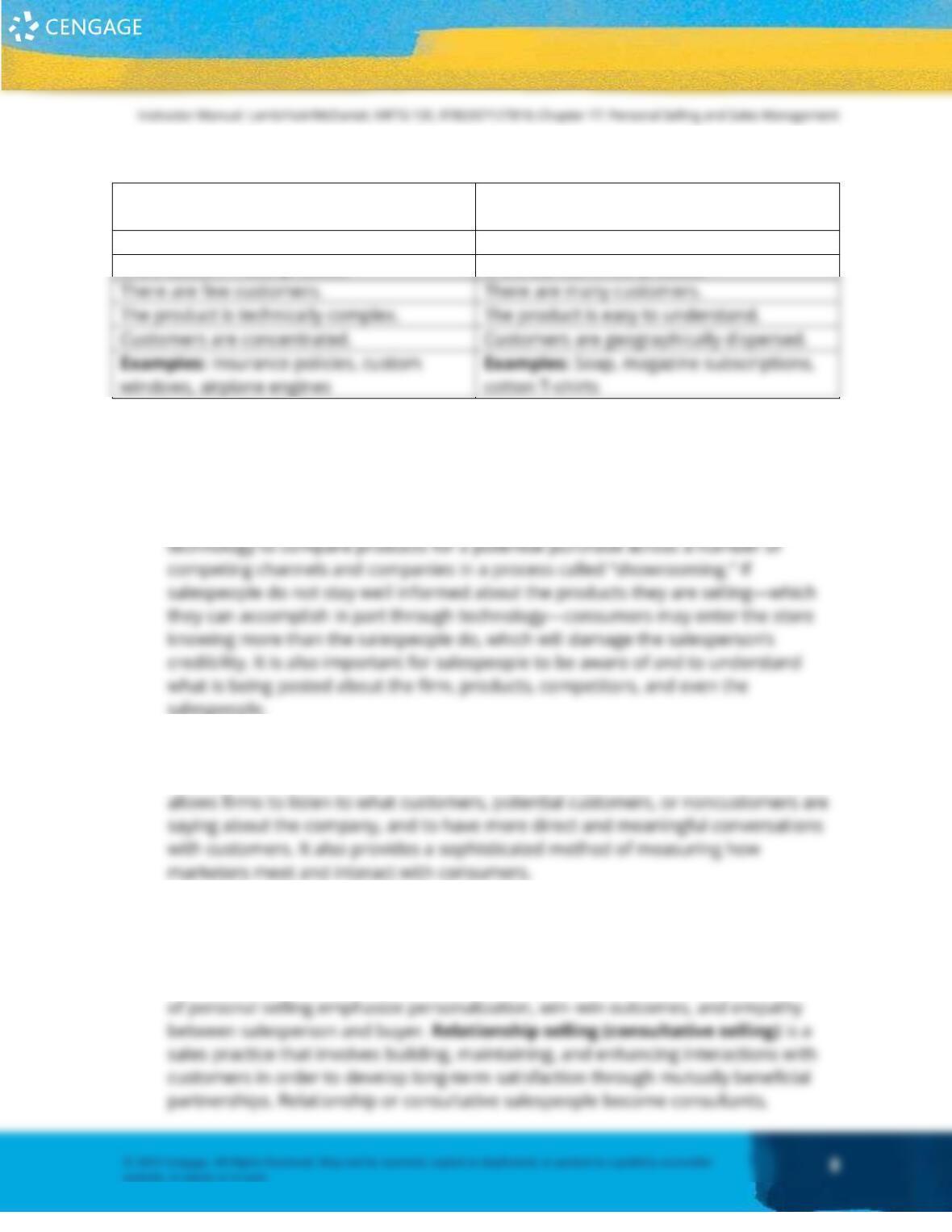
PRESENTATION VISUAL: Exhibit 17.1 Comparison of Personal Selling and
Advertising/Sales Promotion
Personal selling is more important if…
Advertising and sales promotion are
more important if…
The product has a high value.
The product has a low value.
It is a custom-made product.
It is a standardized product.
There are few customers.
There are many customers.
The product is technically complex.
The product is easy to understand.
Customers are concentrated.
Customers are geographically dispersed.
3. Technology’s Impact on Selling (17-3, PPT Slide 10, DISC: Online/Computer)
a. Many consumers compare product features, prices, and quality online—including
on social media—before deciding which store to visit. After entering a store,
consumers often evaluate the products or services firsthand and then use mobile
salespeople.
b. Technology has had a huge impact on marketing in general. Consumers now have
the ability to share experiences quickly with a large number of people, increasing
the impact of word of mouth, both positively and negatively. Social media also
4. Relationship Selling (17-4, PPT Slide 15, DISC: Promotion)
a. Historically, the objectives of a salesperson came at the expense of the buyer,
creating a win–lose outcome. Transactional selling methods attempt to persuade
the buyer to either accept a point of view or take a particular action. Modern views
5. Steps in the Selling Process (17-5, PPT Slide 19, DISC: Promotion)
a. The process for completing a sale can be unique for each product or service offered.
The sales process (sales cycle) is the set of steps a salesperson goes through in a
b. Step 1: Generating Leads: Initial groundwork must precede communication
between the potential buyer and the salesperson. Lead generation (prospecting)
is the identification of the firms and people most likely to buy the seller’s offerings.
Sales leads can be obtained in many different ways, most notably through
advertising, trade shows and conventions, social media, webinars, or direct mail and
telemarketing programs. Additional methods of lead generation include:
Although cold calling is still used, many sales managers have realized the
inefficiencies of this process. The advantages of referrals and networking over other
forms of prospecting include highly qualified leads, higher closing rates, larger initial
transactions, and shorter sales cycles.
c. Step 2: Qualifying Leads: When a prospect shows genuine interest in learning
more about a product and is prepared to answer questions and discuss budgets,
the salesperson has the opportunity to follow up, or qualify, the lead. Lead
qualification involves determining whether the prospect has three things:
on leads.
d. Step 3: Approaching the Customer and Probing Needs: The preapproach is a
process that describes the “homework” that must be done by a salesperson before
he or she contacts a prospect. It applies to most B2B sales and outside consumer
sales. The preapproach may involve visiting a company’s website, consulting
prospect during the sales approach.
The salesperson’s ultimate goal during the approach is to conduct a needs
assessment, which is a determination of the customer’s specific needs and wants
and the range of options they have for satisfying them. The salesperson should
determine how to maximize the fit between what he or she can offer and what the
prospective customer wants by knowing everything there is to know about:
• Products and services
Creating a customer profile during the approach helps salespeople optimize their
time and resources. This profile is then used to help develop an intelligent analysis
of the prospect’s needs in preparation for the next step, developing and proposing
solutions. A salesperson should wrap up the sales approach and need-probing
mission by summarizing the prospect’s need, problem, and interest.
e. Step 4: Developing and Proposing Solutions: Once the salesperson has gathered
the appropriate information, he or she should determine whether the company’s
can make or break the sale. Salespeople must be able to present the proposal and
handle any customer objections confidently and professionally.
f. Step 5: Handling Objections: After a presentation, the prospect often raises
objections about price or suitability or asks questions about the proposal and the
product, so the salesperson should:
• Anticipate specific objections, such as concerns about price
g. Step 6: Closing the Sale: At the end of the presentation, the salesperson should ask
the customer how they would like to proceed. If the customer exhibits behavior or
actions indicating they are ready to purchase, all questions have been answered,
h. Step 7: Following Up: A salesperson’s responsibilities do not end with making the
sale and placing the order. Follow-up is the final step of the selling process, in which
the salesperson ensures delivery schedules are met, goods or services perform as
i. Social Media and the Sales Process: Social selling uses social network sites for
activities such as research, prospecting, networking, and relationship building. Social
media can be used as part of the sales presentation or to provide additional
information or show demonstrations via YouTube. Social selling is also useful for the
6. Sales Management (17-6, PPT Slide 35, DISC: Promotion)
a. Effective sales management stems from a success-oriented sales force that
accomplishes its mission economically and efficiently. Poor sales management can
lead to unmet sales and profit objectives or even to the downfall of the corporation.
b. Defining Sales Goals and the Sales Process: Effective sales management begins
c. Determining the Sales Force Structure: Proper design of the sales department
helps the sales manager organize and delegate sales duties and provide direction
d. Recruiting and Training the Sales Force: Sales managers often look for certain
traits in applicants:
• Ego strength
• Sense of urgency and competitiveness
• Assertiveness
A new salesperson generally receives instruction in company policies and practices,
selling techniques, product knowledge, industry and customer characteristics, and
nonselling duties. Continuous training keeps salespeople up to date on changes in
PRESENTATION VISUAL: Exhibit 17.3 Comparing Inside and Outside Sales
Outside Salespeople
Inside Salespeople
Self-starters
Must be articulate and have effective
communication skills
Manage their own schedules
More control over schedule
More frequent travel expectations
Often surrounded by others in an office
Ongoing workplace schedules
Office politics often an issue
High importance placed on appearance
Cannot physically show the product
Less direct supervision
More direct supervision
e. Compensating and Motivating the Sales Force: Good compensation planning will
ensure that compensation attracts, motivates, and retains good salespeople. Firms
sometimes take profit into account when developing their compensation plans.
Instead of paying salespeople on overall volume, they pay according to the
profitability achieved from selling each product. Other companies tie a part of the
Example: Mary Kay Cosmetics offers a unique type of incentive, whereby salespeople
can earn the use of different types of vehicles—from a Ford Fiesta all the way up to
the coveted pink Mary Kay Cadillac. To qualify for these vehicles, salespeople must
reach certain sales quotas.
f. Evaluating the Sales Force: To evaluate the sales force, the sales manager needs
feedback—that is, regular information from salespeople. Typical performance
measures include sales volume, contribution to profit, calls per order, sales or
7. Customer Relationship Management and the Sales Process (17-7, PPT Slide 44, DISC:
Customer)
a. Customer relationship management (CRM) is the ultimate goal of a new trend in
marketing that focuses on understanding customers as individuals instead of as
part of a group. To do this, marketers are making their communications more
b. Identify Customer Relationships: Companies that have CRM systems follow a
customer-centric focus or model. Customer-centric is a philosophy under which
c. An interaction is the point at which a customer and a company representative
exchange information and develop learning relationships. With CRM, the customer
d. Understand Interactions of the Current Customer Base: Only through effective
interactions can organizations learn about the expectations of their customers,
generate and manage knowledge about them, negotiate mutually satisfying
commitments, and build long-term relationships. Exhibit 17.4 illustrates the
customer-centric approach for managing customer interactions.