
CHAPTER 16
ALTERNATIVE EVALUATION AND SELECTION
LEARNING OBJECTIVES
LO1: Discuss how actual consumer choice often differs from rational choice theory
LO2: Summarize the types of choice processes consumers engage in
LO3: Explain evaluative criteria and their measurement
SUMMARY
LO1: Discuss how actual consumer choice often differs from rational choice theory
Rational choice theory assumes that (1) consumers seek one optimal solution to a problem and choose
on that basis, (2) consumers have the skill and motivation to find the optimal solution, and (3) the
optimal choice does not change as a function of the situation. However, all of these assumptions have
LO2: Summarize the types of choice processes consumers engage in
Affective choice tends to be more holistic in nature. The brand is not decomposed into distinct
components, each of which is evaluated separately from the whole. Decisions based on affect use the
“How do I feel about it” heuristic or decision rule and tend to occur in response to consummatory
motives.
Attitude-based choice involves the use of general attitudes, summary impressions, intuitions, or
heuristics; no attribute-by-attribute comparisons are made at the time of choice. Lower purchase
involvement, scarce information, and certain situational factors such as time pressure increase the
likelihood of attitude-based choice.
LO3: Explain evaluative criteria and their measurement
Evaluative criteria are the various features or benefits a consumer looks for in response to a specific
problem. They are the performance levels or characteristics consumers use to compare different brands
in view of their particular consumption problem.
The measurement of (1) which evaluative criteria are used by the consumer, (2) how the consumer

LO4: Describe the role of evaluative criteria in consumer judgment and marketing strategy
The ability of an individual to distinguish between similar stimuli is called sensory discrimination.
Some evaluative criteria such as price, size, and color can be judged easily and accurately by
consumers. Other criteria, such as quality, durability, and health benefits, are much more difficult to
judge. In general, research indicates that individuals typically do not notice relatively small differences
between brands or changes in brand attributes. In addition, the complexity of many products and
LO5: Summarize the five decision rules for attribute-based choice and their strategic relevance
When consumers judge alternative brands on several evaluative criteria, they must have some method
to select one brand from the various choices. Decision rules serve this function. A decision rule
specifies how a consumer compares two or more brands. Five commonly used decision rules are
LECTURE TIPS AND AIDS
1) Have each student describe the characteristics of the next car he/she will buy. Have them describe
the characteristics they think (1) a 55-year-old bank president, (2) a 23-year-old, single male
2) Student Handout 1 is a quote from a letter from Benjamin Franklin to a friend. Distribute it to the
class and have them characterize the decision rule being recommended.
Discussion can focus on the following:
a) Motives in this case, are evaluative criteria, i.e., aspects of a product’s negative features (e.g.,
its cost) and positive features (e.g., its value).
d) Franklin’s decision rule is analogous to the compensatory decision rule discussed in brand
selection.
3) Student Handout 2 discusses the compromise effect, which challenges rational decision making by
consumers. Questions are provided at the end of the handout with answers below:
a) The compromise effect contradicts rational choice theory because rational choice theory
predicts that choices will be invariant of context (such as the addition of other alternatives). The
compromise effect shows this assumption to not be true.
4) Blind taste tests of any type of food or beverage product are fun and revealing. Students will not
believe how difficult it is to distinguish various brands until they try. For example, use Coca-Cola,
Pepsi, and RC Cola in unmarked cups. Quite often it is smell that differentiates taste perceptions,
so using lids over cups, and straws, makes the taste differentiation much more difficult.

Student Handout 1: BENJAMIN FRANKLIN’S DECISION PROCESS
“I cannot, for want of sufficient premises, advise you what to determine, but if you please, I
will tell you how. My way is to divide half a sheet of paper by a line into two columns;
writing over the one Pro, and over the other Con. Then, doing three- or four-days
consideration, I put down under the different heads short hints of the different motives, that at
different times occur to me for or against the measure. When I have thus got them all together
in one view, I endeavor to estimate the respective weight, and where I find reason pro equal to
some two reasons con, I strike out the three. If I judge some two reasons con, equal to some
Student Handout 2: Situational Influences on Consumer Choice
Rational choice theory suggests that consumer choices and preferences should be independent
of the context. As a simple example, it is assumed that consumers will evaluate a $5 discount
In a similar way, consumers are affected by the competitive context in which they make choices, or
what we referred to in Chapter 13 as the purchase situation. There are numerous context effects on
consumer choice. Here we will discuss the compromise effect.
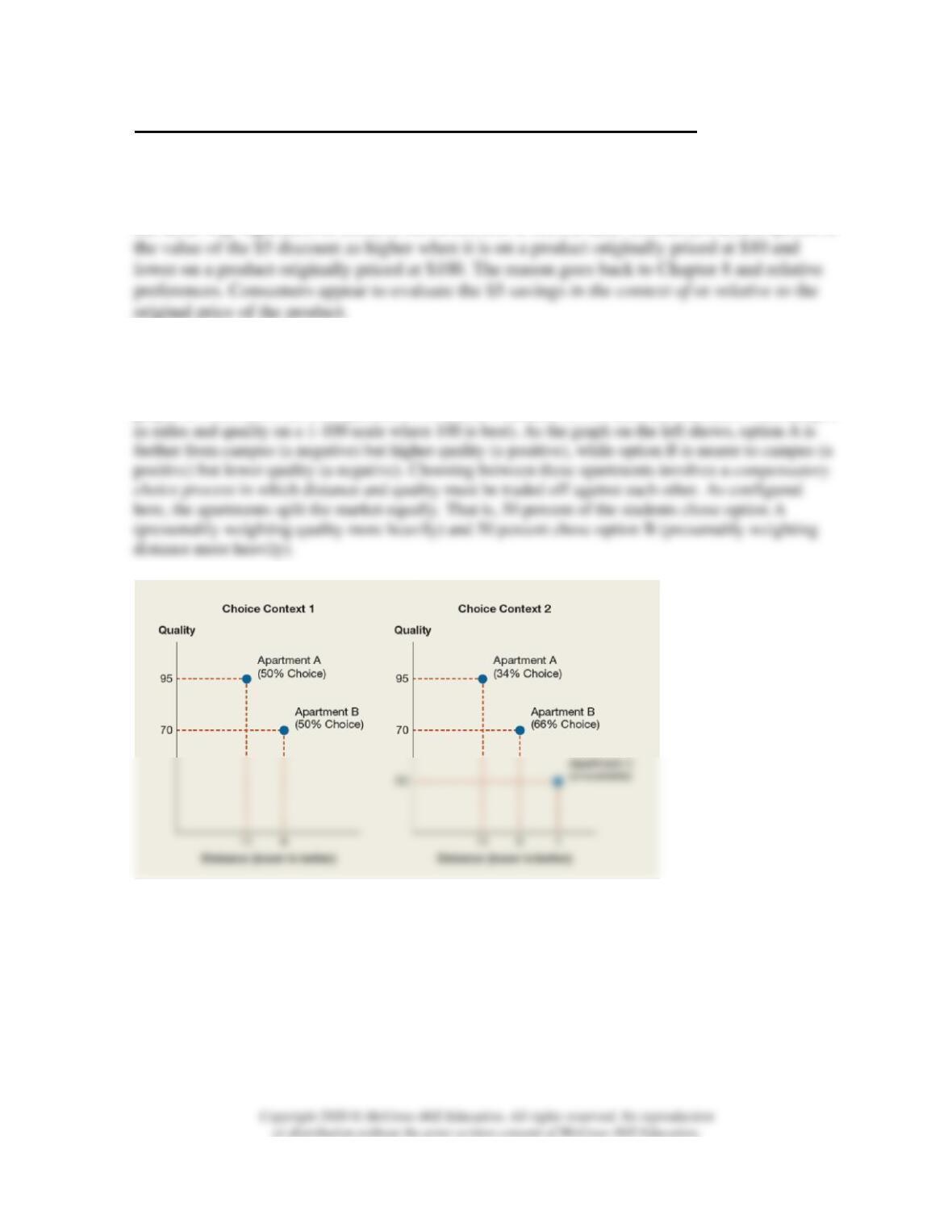
1
We begin with Choice Set 1 (left
graph) in which there are two apartments (A and B) evaluated on two attributes (distance from campus
Now consider Choice Set 2 (right graph). In this context, there is a third apartment that
consumers are aware of but that is not currently available. It is closer than A or B in terms of
distance (a positive) but poorer than A or B in terms of quality (a negative). Rational choice
theory assumes that if an option such as C is included, consumers should still prefer the
brands the same way as they did previously. Particularly since option C is not even available,
rational choice theory would suggest that options A and B would hold steady at 50 percent of
the market each. However, this is not what happens. Instead, adding option C, even though
not available for rent, increases B’s share up to 66 percent!

This is called the compromise effect, because, adding option C made option B the compromise
solution. It is a compromise between the two extremes of A (furthest away, best quality) and C
(nearest, worst quality). Consumers prefer compromise options and find them easy to justify (a
metagoal). The compromise effect seems strongest when the compromise brand is the more familiar
brand in the set.
Discussion Questions
1. Why does the compromise effect contradict rational choice theory?
2. Beyond being easy to justify, can you think of other reasons why consumers prefer
compromise options?
3. Do you see any ethical issues related to strategies designed to position brands as
compromise alternatives? Explain.

REVIEW QUESTIONS
1) What is rational choice theory?
The task in rational choice theory is to identify or discover the one optimal choice for the decision
2) What is meant by bounded rationality?
Bounded rationality is defined as a limited capacity for processing information.
3) What is a metagoal?
4) What are three common metagoals for consumer decisions?
One metagoal is maximizing the accuracy of the decision. This is the only metagoal assumed in
rational choice theory.
5) What is affective choice and when is it most likely to occur?
Affective choices do not lend themselves well to either the attribute-based or the attitude-based
choice approaches. The evaluation of such products is generally focused on the way they will
6) What is the difference between consummatory motives and instrumental motives?
Consummatory motives underlie behaviors that are intrinsically rewarding to the individual
involved. Instrumental motives activate behaviors designed to achieve a second goal.
7) How does attribute-based choice differ from attitude-based choice? When is each most likely?
8) What are evaluative criteria and on what characteristics can they vary?
Evaluative criteria are the various dimensions, features, or benefits a consumer looks for in
9) How can you determine which evaluative criteria consumers use?

You can utilize either direct or indirect methods. Direct would include asking consumers what
10) What methods are available for measuring consumers’ judgments of brand performance on
specific attributes?
They include rank ordering scales, semantic differential scales, and Likert scales.
11) How can the importance assigned to evaluative criteria be assessed?
Either by direct (constant sum scale, for example) or indirect (conjoint analysis) measures.
12) What is sensory discrimination, and what role does it play in the evaluation of products? What is
meant by a just noticeable difference?
Sensory discrimination refers to an individual’s ability to distinguish between similar stimuli. This
plays a major role in the evaluation of products that may differ in characteristics. For example, one
13) What are surrogate indicators? How are they used in the consumer evaluation process?
An attribute used to stand for or indicate another attribute is a surrogate indicator. For many
products it is difficult to assess a product’s quality; consumers may, therefore, use the price of the
product as a basis for inferring the product’s quality.
14) What factors influence the importance of evaluative criteria?
The usage situation, the competitive context, and advertising effects.
15) What is the conjunctive decision rule?
Selects establishes the minimum required performance standard for each evaluative criterion and
selects the first or all brands that meet or exceed these minimum standards.
16) What is the disjunctive decision rule?
17) What is the elimination-by-aspects decision rule?

Rank the evaluative criteria in terms of importance and establish satisfactory levels for each. Start
with the most important attribute and eliminate all brands that do not meet the satisfactory level.
Continue through the attributes in order of importance until only one brand is left.
18) What is the lexicographic decision rule?
19) What is the compensatory decision rule?
Select the brand that provides the highest total score when the performance ratings for all the
relevant attributes are added together (with or without importance weights) for each brand.
20) How can knowledge of consumers’ evaluative criteria and criteria importance be used in
developing marketing strategy?
21) How can knowledge of the decision rules consumers might use in a certain purchase assist a firm
in developing marketing strategy?
Knowing the predominant decision rule used in brand selection for a particular product class can
guide development of marketing strategy. The following strategies would be appropriate for
different decision rules:
a. Disjunctive: Product positioning should establish a level of performance on one or more of
the important evaluative criterion above the desired performance level.
d. Elimination-by-aspects: Insure that the brand meets the target market’s desired level of
performance on all the important attributes that competition can meet, plus one more.
Discussion Questions
22) Respond to the questions in Consumer Insight 16-1.
The center-stage and decoy effects contradict rational choice theory because rational choice theory
predicts that choices will be invariant of context (such as the addition of other alternatives). Both
of these effects show this assumption to not be true.

23) Would you use an attribute-based or an attitude-based decision approach to purchasing (or renting
or giving to) the following. Which, if any, situational factors would change your approach?
a) Adopting a pet from a shelter
b) A movie
f) Athletic shoes
g) A new shampoo
h) An apartment
24) Repeat Question 23, but speculate on how your instructor would answer. In what ways might his
or her answer differ from yours? Why?
Answers will vary widely depending on your characteristics. The “why” will focus on different
25) For which, if any, of the options in Question 23 would you make an affective decision? What role
would situational factors play?
Affective choice tends to occur when motives are consummatory (versus instrumental). Have
students put each product into one of the two categories and also discuss individual differences
26) What metagoals might you have, and what would be their relative importance to you in purchasing
(or renting or giving to) the options in Questions 23?

This is a good way to get students to think about how metagoals operate. You might try varying
the situation in which the decision is being made to illustrate how situations affect the goals
consumers seek.
27) List the evaluative criteria and the importance of each that you would use in purchasing (or renting
or giving to) the options in Question 23. Would situational factors change the criteria? The
importance weights? Why?
28) Repeat Question 27, but speculate on how your instructor would answer. In what ways might his
or her answer differ from yours? Why?
This draws out the differences that may exist across consumer segments.
29) Describe a purchase decision for which you used affective choice, one for which you used
attitude-based choice, and one for which you used attribute-based choice. Why did the type of
decision process you used vary?
The key is to force the students to support the decisions made with the choice strategies.
30) Identify five products for which surrogate indicators may be used as evaluative criteria in a brand
choice decision. Why are the indictors used, and how might a firm enhance their use (i.e.,
strengthen their importance)?
Listed below are five products and surrogate indicators that may be used in brand evaluation.
PRODUCTS
CRITERIA
SURROGATE INDICATORS
Premium Beers
Social Status
Price, Package, Country of Origin
Stereo Equipment
Quality
Price, Brand Name, Country of Origin
Clothing
Quality
Price, Brand Name and Retailer
Travel Agent
Reliability
Location and Personnel
31) The table below represents a particular consumer’s evaluative criteria, criteria importance,
acceptable level of performance, and judgments of performance with respect to several brands of
motor scooters. Discuss the brand choice this consumer would make when using the
lexicographic, compensatory, and conjunctive decision rules.
Evaluative
Criteria
Minimum
Alternative Brands

Criteria
Importance
Acceptable
Performance
Aprilia
Vespa
Honda
Piaggio
BMW
Kymco
Price
30
4
2
4
2
4
2
4
Horsepower
15
3
4
2
5
5
4
5
Weight
2
3
3
3
3
3
3
economy
35
3
4
4
3
2
4
5
selection
10
3
4
4
3
2
5
2
Frame
5
2
4
2
3
3
3
3
Note: 1 = Very poor; 2 = Poor; 3 = Fair; 4 = Good; and 5 = Very good.
Using a lexicographic decision rule this consumer would first focus on the most important
evaluative criterion specified on the table, gas economy (a relative weight of 35) and find that
32) Describe the decision rule(s) you used or would use in buying, renting, or giving to the options
listed for question 23. Would you use different rules in different situations? Which ones? Why?
Would any of these involve an affective choice?
One way to discuss this question is to construct the table below on the board. Ask a student to
verbally describe a last purchase or how such a purchase would be made. Have the other students

Choices
Conjunctive
Disjunctive
Elim.-by–
Aspects
Lexico-
graphic
Compen-
satory
Personal
Trainer
Athletic
Shoes
Habitat for
Humanity
33) Describe your last two major and your last two minor purchases. What role did emotions or
feelings play? How did they differ? What evaluative criteria and decision rules did you use for
each? Why?
In general, the minor purchases will involve fewer criteria and simpler rules than the major
34) Discuss surrogate indicators that could be used to evaluate the perceived quality of the products or
activities listed in question 23.
Listed below are some potential surrogate indicators for the products and services mentioned.

a. Pet adoption
cleanliness of facility, outlet reputation
b. Movie
actors
e. Personal Trainer
price, brand name, outlet reputation, clientele base
f. Athletic shoes
g. Shampoo
brand name, country of origin, price
price, brand name, packaging
h. Apartment
price, agents’ reputation and other characteristics
Humanity