Chapter 16: Retailing and Direct Marketing
CHAPTER SUMMARY AND LEARNING OBJECTIVES
LO 16.1 Describe the retailing sector in the United States in terms of size, major
companies, and marketing channels.
LO 16.2 Describe the six components of retail strategy.
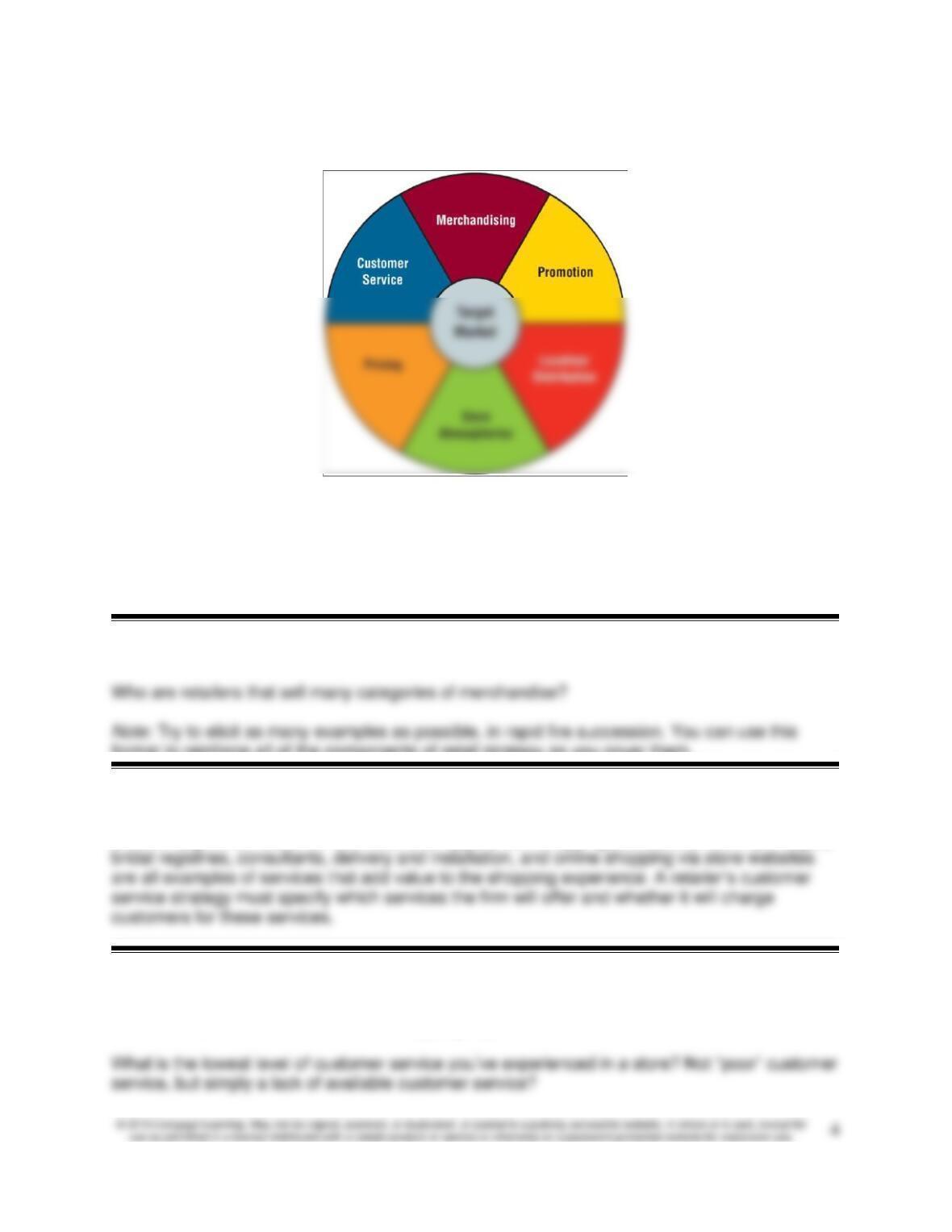
The six components of retail strategy include merchandise strategy, customer service
standards, pricing guidelines, promotion goals, location/distribution decisions, and store
atmosphere choices.
LO 16.3 Given a component of retail strategy, summarize the key strategic
considerations for that component.
LO 16.4 Outline the four bases for categorizing retailers.
LO 16.5 Describe the five basic types of direct marketing and nonstore retailing.
LO 16.6 Given a manufacturer’s goals for retailing their products, determine the most
effective retail strategy.
When selecting retail partners for distribution of their products, manufacturers should select
partners with a retail strategy that’s compatible with the manufacturer’s brand and marketing
objectives.
Chapter 16: Retailing and Direct Marketing
ACTIVATOR EXERCISE: Surviving the Amazon
Purpose: To get students thinking strategically about the decisions retailers make.
Format: Small group discussion, then class presentations.
Time: 20–30 minutes, depending on format.
Activity: Divide students into groups and read the following statement:
recommendations for surviving this aggressive competition from Amazon.
Address the following questions:
• What are Amazon’s advantages over traditional, physical retailers who sell groceries,
household goods, electronics, books, and so on?
After providing time for students to strategize, ask groups to present their findings to the class.
Result: Student strategies will typically cover the types of strategies discussed in this chapter,
including customer service, store atmospherics, pricing, and more. By developing these
Chapter 16: Retailing and Direct Marketing
LECTURE OUTLINE
16-1 Retailing in the United States
Retailing describes the activities involved in selling merchandise to these consumers. Retailers
represent the distribution channel to most consumers, because a typical shopper has little
contact with manufacturers and virtually no contact with wholesaling intermediaries. Retailers
determine locations, store hours, number of sales personnel, store layouts, merchandise
PRESENTATION VISUAL: MindTap Exhibit 16.1 showing top 10 retailers by revenue
Rank
Company
2015 Sales (bill.)
Number of Stores
1
Walmart
$353.1
5,182
2
The Kroger Co.
$103.9
3,747
3
Costco
4
The Home Depot
1,965
5
Walgreens
8,052
6
Target
1,774
7
CVS Health
9,659
8
Amazon.com
9
Albertsons
2,311
1,805
Estimated time: 5–10 minutes
16-2 Retailing Strategy
A retailer develops a marketing strategy based on the firm’s goals and strategic plans. Part of
this strategy includes developing a retailing mix to satisfy the chosen market. The retailing mix
specifies merchandise strategy, customer service standards, pricing guidelines, promotion
goals, location/distribution decisions, and store atmosphere choices.
Chapter 16: Retailing and Direct Marketing
PRESENTATION VISUAL: MindTap Exhibit 16.2 showing the components of retail
strategy
Merchandising Strategy
A retailer’s merchandising strategy guides decisions regarding the items it will offer. A retailer
must decide on general merchandise categories, product lines, specific items within lines, and
the depth and width of its assortments. One retailer might sell only one category of
merchandise, while others might sell in a variety of categories.
Discussion question: Who are some retailers that sell mainly in a single category of
merchandise?
format to reinforce all of the components of retail strategy as you cover them.
Customer Service Strategy
While some stores offer a no-frills shopping experience, others build their retailing strategy
around heightened customer services for shoppers. Gift wrapping, alterations, return privileges,
Discussion question: Who are retailers that concentrate on high levels of customer service?
What are services they offer?
Who are retailers that offer a no-frills shopping experience with little customer service?
Chapter 16: Retailing and Direct Marketing
Note: Tell students it’s OK to mention the same retailers again as we move through these
different components of retail strategy. For example, Walmart’s merchandising strategy is to sell
in multiple categories, but they also opt for no-frills customer service strategy throughout most of
their store.
Pricing Strategy
Prices reflect a retailer’s marketing objectives and policies. They also play a major role in
Discussion question: Who are retailers that have a low price strategy?
Who are retailers that offer a premium price strategy?
Location/Distribution Strategy
Retail experts often cite location as a potential determining factor in the success or failure of a
retail business. A retailer may locate at an isolated site, in a central business district, or in a
planned shopping center. The location decision depends on many factors, including the type of
merchandise, the retailer’s financial resources, characteristics of the target market, and site
availability.
Discussion questions: Who are retailers that have many locations and offer intensive
distribution for the brands they sell?
Chapter 16: Retailing and Direct Marketing
Store Atmospherics
While store location, merchandise selection, customer service, pricing, and promotional
activities all contribute to a retailer’s brand identity, stores also project their personalities through
atmospherics—physical characteristics and amenities that attract customers and satisfy their
shopping needs. Atmospherics include both a store’s exterior and interior décor.
Discussion questions: Who are retailers you like to shop at because the atmosphere is
pleasant, or inviting, or fun? What are some of the characteristics of that store?
16-3 Strategic Considerations for Retail Strategy
A retailer starts to define its strategy by selecting a target market. Factors that influence the
retailer’s selection are the size and profit potential of the market and the level of competition for
its business. Retailers pore over demographic, geographic, and psychographic profiles to
segment markets. In the end, most retailers identify their target markets in terms of certain
demographics.
Merchandising Strategy
To develop a successful merchandise mix, a retailer must weigh several priorities. First, it must
Discussion question: Assume you’re shopping for products in a particular category, such as
electronics, apparel, or makeup. In terms of quality and selection, how do you perceive the
Chapter 16: Retailing and Direct Marketing
Note: Some students feel that you get higher quality choices when shopping in a specialty store,
because those stores are “experts” in that category. For some students, they don’t care and
would rather have the convenience of being able to find multiple categories under one roof.
Customer Service Strategy
Discussion questions: What are some categories of merchandise that would lend themselves
to high levels of customer service?
Pricing strategy
Retailers determine a pricing strategy based on several key factors: type of product, company
objectives, competitor pricing, and customer perceptions. A retailer’s pricing strategy exerts an
important influence on its image among present and potential customers.
Location/Distribution Strategy
Discussion questions: What are some product categories that lend themselves better to
intensive distribution?
What are some categories that lend themselves to more selective distribution?
Promotional Strategy
National retail chains often purchase advertising space in newspapers, on radio, and on
television. Other retailers promote their goods over the Internet or use wireless technology to
Chapter 16: Retailing and Direct Marketing
Example: A retailer with many strategically placed locations might be able to limit
Store Atmospherics
A store’s exterior appearance, including architectural design, window displays, signs, and
entryways, helps identify the retailer and attract its target market shoppers. The interior décor of
Discussion question: Why don’t all stores have store atmospherics that we love?
Estimated time: 10–20 minutes
16-4 Categorizing Retailers
Note: This section can sometimes be confusing for students after all the time they spent
discussing retail strategy. Retail strategy is about the decisions a retailer makes about the type
of store they want to be. Categorizing is about grouping retailers by the strategic decision they
made. That is why many of the methods below for categorizing retailers seem similar to the
Chapter 16: Retailing and Direct Marketing
or categorize them by product lines carried—or another method. It’s the same group of retailers
that are just being categorized using different methods.
Classification by Form of Ownership
Perhaps the easiest method for categorizing retailers is by ownership structure, distinguishing
between chain stores and independent retailers. Chain stores are groups of retail outlets that
operate under central ownership and management, while an independent retailer is someone
who is responsible for their own business.
Example: Target, Sephora, and Safeway are all chain stores.
Note: This classification is a reflection of a retailer’s merchandising strategy of carrying one or
many categories, but also touches on their location/distribution strategy of having many or few
locations.
Classification by Services Provided
Another category differentiates retailers by the services they provide to customers. This
classification system is essentially a continuum between self-service and full-service retailers.
The middle of that continuum is often called self-selection.
Note: This classification is a reflection of a retailer’s customer service strategy and is simply a
way of trying to categorize retailers according to their strategic decision in this area.
Chapter 16: Retailing and Direct Marketing
Classification by Product Lines
Grouping retailers by product lines produces three major categories: specialty stores, general-
merchandise retailers, and food retailers.
General merchandise retailers carry a wide variety of product lines stocked in some depth and
distinguish themselves from specialty retailers by the large number of product lines they carry.
Example: Target and Walmart
Classroom activity: Divide students into groups and assign them one of the following retailers.
Ask them to categorize the retailers using each of the four methods discussed in this section.
Barnes & Noble
Key Takeaway: Categorizing is a way of grouping retailers with similar characteristics.
These are not mutually exclusive. The same retailer can be categorized using a variety of
methods.
Estimated time: 15–25 minutes
16-5 Direct Marketing and Nonstore Retailing
Although the majority of retail transactions still occur in physical stores, direct marketing and
Chapter 16: Retailing and Direct Marketing
Some companies use these tactics as their sole method for distributing and promoting products,
while others use them to complement their physical stores and traditional promotional methods.
Direct and interactive marketing expenditures are responsible for hundreds of billions of dollars
in yearly purchases.
Direct Mail
Direct mail is a form of direct marketing that comes in many forms: sales letters, postcards,
brochures, booklets, catalogs, and DVDs.
Discussion questions: Who has a friend or family member who is an independent rep for a
company that does direct sales? Or maybe you are a rep yourself? What is the company?
What are some advantages of direct selling? What are some disadvantages?
Direct-Response Retailing
Direct-response retailing is often a hybrid of physical retail, online retail, and direct mail
promotion. Customers of a direct-response retailer can order merchandise by mail or telephone,
by visiting a mail-order desk in a retail store, or online. The retailer then ships the merchandise
to the customer’s home or to a local retail store for pickup.
Example: With no retail locations, L.L. Bean was historically a direct mail company that
relied entirely on their mailed catalogs to generate phone and mail-in sales. Now the
catalog is more likely to drive sales at their e-commerce site.
Chapter 16: Retailing and Direct Marketing
Automatic Merchandising
Today, nearly 26,000 vending machine operators sell about $7 billion in convenience goods
Discussion questions: What are examples of items you’ve purchased (or rented) in the last
year using automatic merchandising?
What are items you wish were more widely available via vending machine?
16-6 Determining an Effective Retail Strategy for Manufacturers
Note: This section of the chapter provides practical application of the concepts related to retail
When considering their retail strategy, manufacturers must consider their goals for retailing their
products. In turn, they will look for retailers most compatible with those goals. As always, the
basis for selecting retail partners is whether they reach and serve the company’s target market
in a way that is consistent with the company’s objectives and brand. A company like GaGa
would want to ask questions such as the following:
• What types of retailers would attract our target audience?
• What types of retailers already—or would be willing to—carry a product like ours?
Since GaGa produces frozen dessert products, this limits the retail locations where GaGa can
sell its product. A store that doesn’t have any frozen products would probably not be a good fit,
but a retailer with a large frozen food section might be. In addition, GaGa needs to consider
Chapter 16: Retailing and Direct Marketing
where customers would expect to buy a pint of SherBetter. While a butcher shop most likely has
freezers, it’s likely not a good retail partner for GaGa since most customers do not visit a
butcher looking for frozen desserts.
All of these elements must be considered to find retail partners who represent the best fit with
the goals of GaGa’s marketing mix.
Classroom activity: Divide students into groups. Ask them to choose a particular product
category and pretend they are a new manufacturer in that category. As a new company, they
must define their goals and target audience, then select retailers whose retail strategy is
compatible with those goals.
Chapter 16: Retailing and Direct Marketing
LEARN IT TODAY . . . USE IT TOMORROW
VIGNETTE AND ACTIVITY
The opening vignette for Chapter 16 discusses GaGa, maker of frozen desserts. The vignette
describes their products and some approaches to retail distribution they have tried in the past.
Note: Answers to the chapter-ending activity can be discussed in class after the activity
due date.
Let’s learn more about GaGa and see how they navigated decisions about selecting retail
distribution for SherBetter.
Question 1
Michele King discusses SherBetter’s super–premium product status. She says it doesn’t make
sense for GaGa to sell in a “stop and shop” type store because it is priced at $4.99 per pint.
Which type of retailer would best fit GaGa’s location and distribution goals?
Question 2
In considering his location/distribution strategy, Jim King realized that becoming a retailer
himself, by opening scoop shops, wouldn’t work for GaGa because:
a. scoop shops had to be located near a recreational area, and have no other direct
Chapter 16: Retailing and Direct Marketing
Question 3
Jim would like to see the GaGa brand be an umbrella brand with other products in different
categories—not just the frozen dessert category. Suppose that GaGa develops a line of baked
potato chips based on a family recipe. Jim anticipates that the chips would sell best in vending
machines for under $1. This would be an example of:
a. customer service strategy.
b. convenience retailing.
c. nonstore retailing.
d. promotional strategy.
Question 4
In 2003, there was one flavor of SherBetter. Today, the line has expanded to include several
different flavors of SherBetter, sold in pints, as well as novelty bars in several flavors. When a
manufacturer makes a decision regarding the products it will offer, it is called product strategy.
But when a retailer makes decisions regarding the products and product categories it will carry,
it is making decisions regarding ____________.
a. distribution strategy
b. promotional strategy
c. store atmospherics strategy
d. merchandising strategy
Chapter 16: Retailing and Direct Marketing
ADDITIONAL HOMEWORK/CLASSROOM ACTIVITIES
Walmart: Retailing Giant
Purpose: To examine the strategy behind Walmart’s retailing success.
Background: Walmart has generated a number of controversies, but the success of their
retailing approach is undisputed. This exercise is designed to help students understand and
evaluate the strategic business philosophy that Walmart envisages.
Exercise: Give the students some information about Walmart. Alternatively, you could ask your
students to read about Walmart and come to class. You can start this activity by having a quiz
on Walmart.
The founder of Walmart, Sam Walton, was often asked about the secret behind Walmart’s
success. In his 1992 book, he shared “Sam’s Rules for Building a Business,” which the
company claims as a guiding philosophy even today.
• Commit to your business. Believe in it more than anybody else.
• Share your profits with all your associates, and treat them as partners.
After your students have had a moment to digest the list, ask them to vote on which rule is most
important and which is least important. The results of the tally typically trigger a rich discussion:
Why are some more important than others? Can (or should) a retailer ignore any of them?
Why? Do they believe that Walmart itself has followed these rules in recent years? Why or why
not?
Questions for Reflection:
• How many students shop at Walmart? How is it different from shopping in other
stores?
Chapter 16: Retailing and Direct Marketing
Retailing Strategy
Purpose: To help students explore key elements of retailing strategy.
Exercise: Brainstorm with your students a quick list of retailer categories that they are familiar
with. Possibilities include bookstores, convenience stores, after market shops (for customizing
cars, coffee shops, pet stores, clothing boutiques, gift shops, etc.). Then, divide your students
into groups of five to seven people, and ask each group to choose a retailer category. Their
goals are:
• To determine the target customers
Questions for Reflection:
• Do smaller retailers typically pay attention to these elements of retailing strategy?
Why or why not?
• How could research and technology help refine retailing strategy?
Retail Atmospherics
Purpose: To help your students identify the components of effective retail atmospherics.
Background: While we all respond—positively or negatively—to the atmosphere of retail
Chapter 16: Retailing and Direct Marketing
Exercise: Ask your students to identify local businesses that have standout retail atmosphere.
Encourage them to consider both positive and negative examples and to be as specific as
possible about what works and what doesn’t. You may want to remind them that the
signage, to color, to music.
• Your classroom
• Your college or university campus
• Music store
• Vintage clothing store
Questions for Reflection:
• How are atmospherics perceived differently across cultures? Why?
• Are great atmospherics enough for a competitive advantage? Why? (Think Victoria’s
Secret, Hooters, Bath and Body Works, etc.)
Internet Exercise—Wholesaling Industry
Visit the website of the National Association of Wholesaler-Distributors. Click on “About NAW”
and scroll down and click on “About the Industry.” Review the data and prepare a brief report
Chapter 16: Retailing and Direct Marketing
KEY TERMS
Retailing: The activities involved in selling merchandise to consumers.
Atmospherics: The physical characteristics and amenities that attract customers and satisfy
their shopping needs.
carry.
Supermarkets: Stores that sell mainly groceries, but also a wide selection of items in other
categories.
Department store: A series of specialty stores under one roof.
Direct marketing: A broad concept that includes direct mail, direct selling, online retailing,
direct-response retailing, and automatic merchandising.