• Product Placement: Product placement is a public relations strategy that
involves getting a product, service, or company name to appear in a movie,
television show, radio program, magazine, newspaper, video game, video or
audio clip, book, or commercial for another product, on the Internet, or at
special events. It reinforces brand awareness and creates favorable attitudes.
Example: Red Bull hosted Stratos, a multimillion-dollar event where Austrian Felix
Baumgartner skydived from the edge of space—nearly 24 miles above Earth’s
surface. Baumgartner became the first human to break the sound barrier in free
fall, reaching 834 miles per hour before touching down safely in New Mexico. A
major marketing victory for Red Bull, Stratos set its own record as the most-
watched YouTube livestream of all time—more than 8 million viewers tuned in to
the event.
• Experiential Marketing: Experiential and event marketing involve engaging with
consumers in a way that enables them to feel the brand—not just read about it.
• Company Websites: Companies are using their websites as part of their public
relations strategies to:
o Introduce new products and promote existing products
c. Managing Unfavorable Publicity: Crisis management is a coordinated effort to
6. Sales Promotion (16-6, PPT Slide 52, DISC: Promotion)
a. Sales promotion consists of marketing communication activities other than
advertising, personal selling, and public relations, in which a short-term incentive
motivates consumers or members of the distribution channel to purchase a good or
service immediately, either by lowering the price or by adding value. Sales
• Trade sales promotion – promotion activities directed to members of the
marketing channel, such as wholesalers and retailers
b. The objectives of a sales promotion, such as encouraging repeat purchases and
preventing brand switching, depend on the general behavior of targeted customers.
Generally, there are four types of consumers to consider when creating the
objectives for a sales promotion.
• Loyal customers – people who buy your product most or all of the time
c. Tools for Trade Sales Promotion: Trade promotions “push” a product through the
distribution channel, using many of the same sales promotion tools used in
consumer promotions, such as sales contests, premiums, and point-of-purchase
displays. But several tools are unique to manufacturers and channel intermediaries:
• A trade allowance is a price reduction offered by manufacturers to
intermediaries such as wholesalers and retailers
d. Tools for Consumer Sales Promotion: Coupons and Rebates: Coupons and rebates
are a particularly good way to encourage product trial and repurchase. A coupon is
a certificate that entitles a consumer to an immediate price reduction when the
product is purchased. A rebate is a cash refund given for the purchase of a product
during a specific period. The Internet is changing how coupons are distributed and
redeemed. In addition to Internet coupon sites such as Valpak.com and
Coolsavings.com, and social coupon sites such as Groupon and LivingSocial, there
are also deal sites like DealSurf.com that aggregate offers from different sites for
convenience.
• Premiums: A premium is an extra item offered to the consumer, usually in
Examples: An example of a reward is the toy offered in a McDonald’s Happy
Meal. More product for the regular price may come in the form of two-for-the–
• Loyalty Marketing Programs: A loyalty marketing program is a promotional
program designed to build long-term, mutually beneficial relationships between
• Contests and Sweepstakes: Contests and sweepstakes are generally designed to
create interest in a good or service and are often used to encourage brand
switching. To increase their effectiveness, sales promotion managers must make
certain the award will appeal to the target market.
demonstrated or distributed at a retail store or service outlet, or offered online
by request. Sampling at special events is a popular, effective, and high-profile
distribution method.
• Point-of-Purchase Promotion: A point-of-purchase (POP) display is a
Examples: Examples of point-of-purchase displays include shelf “talkers” (signs
attached to store shelves), shelf extenders (attachments that extend shelves so
products stand out), ads on grocery carts and bags, end-aisle and floor-stand
e. Trends in Sales Promotions: Promotions based on social media, email, and
websites have expanded dramatically in recent years, and marketers are now
spending billions of dollars annually on such promotions. Sales promotions online
[return to top]
Discussion Questions
You can assign these questions several ways: in a discussion forum in your LMS; as whole-
class discussions in person; or as a partner or group activity in class. A generic discussion
rubric is provided in the Appendix.
1. Discussion: (LO 16-3, PPT Slides 25-26) Duration 5-10 minutes.
a. Tell students that a well-known rule of thumb in the advertising industry is “Sell the
sizzle, not the steak”—that is, in advertising, the goal is to sell the benefits of the
product, not its attributes. Ask them the following questions:
Promotion
• Why do you think this is important?
• What are some common benefits or attributes used in ads?
• How do these relate to the common appeals listed in Exhibit 16.1?
i. Students’ answers will vary, but they should reflect an understanding of
attributes and benefits.
2. Discussion: (LO 16-4, PPT Slide 31) Duration 5-10 minutes.
a. Lead students on a discussion of advertising by asking them whether TV advertising
like desktops, laptops, and tablets. How do these statistics affect students’ opinions
on the best options for advertising?
i. Students’ answers will vary. Network television reaches a wide and
[return to top]
Additional Activities and Assignments
A generic discussion and writing rubric is provided in the Appendix.
1. Activator Exercise: Effective (and Efficient) Promotion (LO 16–2)
Purpose: For students to evaluate the various types of promotion.
Format: This activity can be facilitated in both a classroom and an online
environment. Instructions for how to facilitate the activity in the classroom and
online are provided below.
Classroom Format: Small group discussion, then class presentations (Estimated
Time: 20-30 minutes)
1. Divide students into groups and ask them to plan a promotional campaign
Promotion
• Specifically, what tactics will you use?
2. When groups have finished, have them each present their ideas. Note how
similar (or different) their plans are.
3. Now, ask them to repeat the exercise – this time for launching a new brand
of athletic apparel. After 5 minutes, ask the groups to share again.
Online Format: Written discussion board posts with responses(Estimated Time: 5-
10 minutes)
1. Provide students with the following writing prompt:
Choose one of the following three types of businesses: season tickets for the local
professional football team, a brand of athletic apparel, or a lawn-care service.
Spend no more than five minutes planning a promotional campaign for the
business you’ve selected. Write a post describing your campaign, and be sure to
answer the following questions:
• How will you tell people about the product or service and convince them
to buy?
2. Have students respond to their classmates’ posts by asking questions and
offering constructive feedback on their campaigns.
Additional questions for a classroom or discussion board: Is advertising always
the best option for promotion? How do your objectives influence your choices?
Result: You might notice how much students rely on advertising as their go-to
promotional tool. However, asking them to complete this process for three different
2. Class activity (LO 16–2)
Format: This activity can be facilitated in both a classroom and an online
environment. Instructions for how to facilitate the activity in the classroom and
online are provided below. (Estimated time: 15-25 minutes)
Classroom Format: Divide students into small groups of three or four. Instruct
them to use the Internet—any online sources they choose—to locate one example
Online Format: If you’re delivering your course online, you can have students do
this on their own and have them post their answers in a discussion board. Use the
following prompt to facilitate this activity:
Using any online sources you choose, locate one example of each of these three types of
3. Class Activity (LO 16–4)
Format: This activity can be facilitated in both a classroom and an online
environment. Instructions for how to facilitate the activity in the classroom and
online are provided below. (Estimated time: 10-20 minutes)
Classroom Format: Divide the class into pairs or groups of three. Have each small
group select one of the following: a local string of pizzerias, a major brand of blood
Online Format: If you’re delivering your course online, you can have students do
this on their own and have them post their answers in a discussion board. Use the
following prompt to facilitate this activity:
4. Class Activity: (LO 16–5)
Format: This activity can be facilitated in both a classroom and an online
environment. Instructions for how to facilitate the activity in the classroom and
online are provided below. (Estimated time: 15-25 minutes)
Classroom Format: Divide the class into small groups of three or four. Ask them to
imagine they manage the website for one of their favorite brands, but they feel the
company’s website does not do an adequate job of harnessing the benefits of public
recommendations, including some detail.
Online Format: If you’re delivering your course online, you can have students do
this on their own and have them post their answers in a discussion board. Use the
following prompt to facilitate this activity:
Imagine that you manage the website for one of your favorite brands, but you feel the
5. Class Activity (LO 16–6)
Format: This activity can be facilitated in both a classroom and an online
environment. Instructions for how to facilitate the activity in the classroom and
online are provided below. (Estimated time: 15-25 minutes)
Classroom Format: Divide the class into groups of three or four, and instruct them
to choose a consumer product with which the whole group is familiar. Ask them to
are in-person or online tools, or both. Invite each group to share their plans with the
class, including the rationale behind the three tools they’ve chosen.
Online Format: If you’re delivering your course online, you can have students do
this on their own and have them post their answers in a discussion board. Use the
following prompt to facilitate this activity:
Choose a consumer product with which you are familiar. Determine whether this product
6. Additional activity: Time for a Commercial Break (LO 16–3)
Purpose: To give students a creative opportunity to experience the ad creation
process.
Background: Each day, advertising surrounds virtually every student, but few give
Format: This activity can be facilitated in both a classroom and an online
environment. Instructions for how to facilitate the activity in the classroom and
online are provided below.
Classroom Format: Divide the class into small groups of three or four, and give
them the following information:
1. Scenario: You run a highly successful tattoo and piercing parlor in your small
west coast city, but you are fairly certain that you and your key competitor
2. Goal: Create a one- to two-minute commercial to reach this audience. There
should be a role for each group member in the commercial. Take into
3. Give the groups time to plan their advertising strategy and then ask each
group to perform their commercial in front of the class. After each
commercial, have the class discuss how effective the commercial was in
reaching its target market and what could have been improved.
Online Format: Video presentation submitted by each student
(Estimated Time: 20-30 minutes)
2. Assume you run a highly successful tattoo and piercing parlor in your small
west coast city, but you are fairly certain that you and your key competitor
have saturated your target audience of people in their teens and twenties. To
grow your business, you need to reach a new market, and research has
shown that men and women in their thirties (and even some in their forties)
are increasingly interested in body art . . . although only a small percent have
actually pursued tattoos or piercing (beyond the ears).
• Write the script for a one- to two-minute commercial for your product.
Additional Questions for Reflection:
• Who is the target audience for these commercials?
7. Online Research Activity (LO 16-6)
Not everyone thinks loyalty marketing programs such as shopper rewards cards are
Additional Resources
External Videos or Playlist
Appendix
Generic Rubrics
Providing students with rubrics helps them understand expectations and components of
assignments. Rubrics help students become more aware of their learning process and
progress, and they improve students’ work through timely and detailed feedback.
Customize these rubrics as you wish. The writing rubric indicates 40 points and the
discussion rubric indicates 30 points.
Standard Writing Rubric
Criteria
Meets Requirements
Needs Improvement
Incomplete
Content
The assignment clearly and
comprehensively
addresses all questions in
the assignment.
The assignment partially
addresses some or all
questions in the
assignment.
The assignment does not
address the questions in
the assignment.
0 points
Research
The assignment is based
upon appropriate and
adequate academic
literature, including peer
reviewed journals and
other scholarly work.
5 points
The assignment is based
upon adequate academic
literature but does not
include peer reviewed
journals and other
scholarly work.
3 points
The assignment is not
based upon appropriate
and adequate academic
literature and does not
include peer reviewed
journals and other
scholarly work.

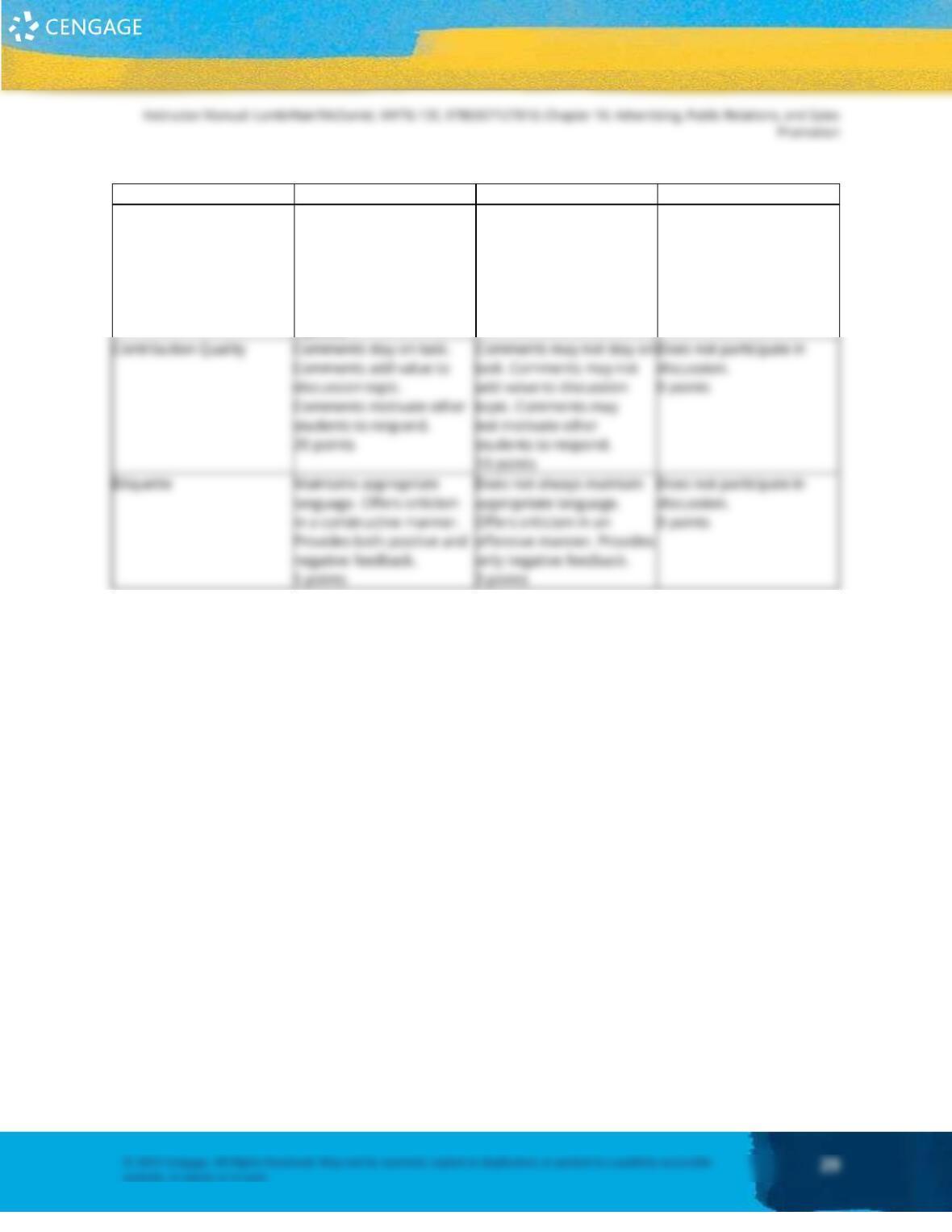
Standard Discussion Rubric
Criteria
Meets Requirements
Needs Improvement
Incomplete
Participation
Submits or participates in
discussion by the posted
deadlines. Follows all
assignment. instructions
for initial post and
responses.
Does not participate or
submit discussion by the
posted deadlines. Does not
follow instructions for
initial post and responses.
3 points
Does not participate in
discussion.
0 points