Chapter 15: Marketing Channels and Supply Chain Management 337
CLASS EXERCISES
Class Exercise 1: Channel Conflict
The objective of this class exercise is to aid student understanding of the dimensions of channel selection
and their possible relationships with channel conflict.
Prompt for students:
Many manufacturers sell products in outlet stores at 25 to 70 percent off retail prices. Retailers do not like
the added competition from their own suppliers despite manufacturers’ claims that they are only selling
last season’s merchandise.
1. How could business objectives, buyer behavior, product attributes, or environmental forces affect a
manufacturer’s decision to distribute through outlet stores?
2. By selling in outlet stores, how have these manufacturers changed their intensity of market coverage?
How is customer service different at an outlet store?
3. Which of the following may be responsible for the conflict between manufacturers and retailers?
a. Lack of clear communication
b. Deviation from role expectations
c. Diversification into product lines traditionally handled by other intermediaries
4. Should retailers develop store brands, refuse to stock certain items, or focus their buying power on one
supplier or group of suppliers? How should the conflict be resolved?
Answers
1. These manufacturers have the resources to control their own channels and apparently have altered
objectives to include increased coverage in new segments. Many manufacturers suggest that because
outlet stores are located outside metro areas, they are not competing directly with retailers. The buyer
338 Chapter 15: Marketing Channels and Supply Chain Management
Class Exercise 2: Market Coverage
The purpose of this exercise is to improve students’ understanding of the intensities of market coverage.
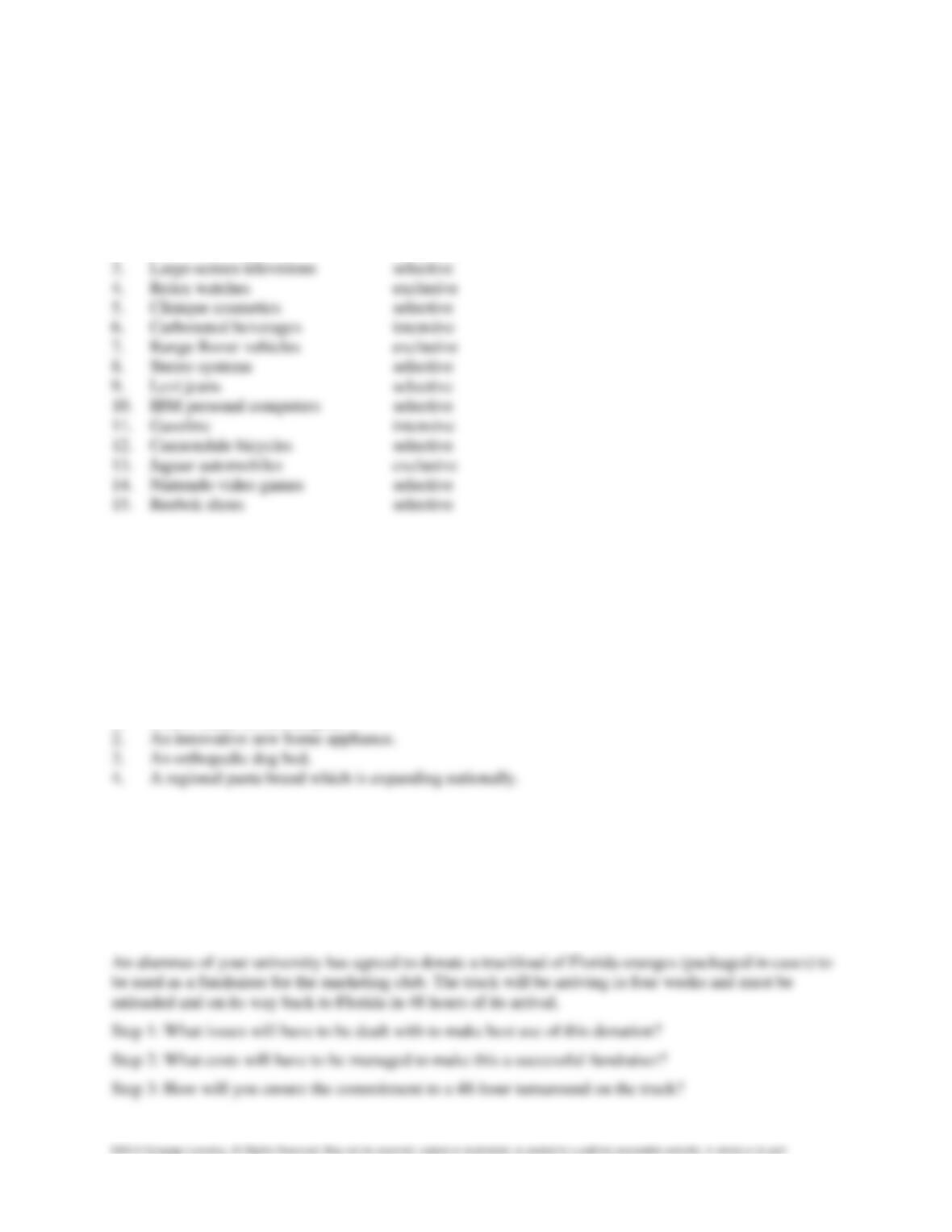
Identify the intensity of market coverage for each of the following products:
Question
Answer
1.
Potato chips
intensive
2.
Gucci handbags
exclusive
4.
Rolex watches
exclusive
6.
Carbonated beverages
intensive
7.
Range Rover vehicles
exclusive
9.
Levi jeans
selective
11.
Gasoline
intensive
13.
Jaguar automobiles
exclusive
14.
Nintendo video games
selective
Class Exercise 3: Finding the Best Distribution Channels
In this chapter, you learned about the complexity of choosing the appropriate channel for distributing
goods and creating value for the organization and the consumers. In this exercise, you will explore the
issues of matching goods to the best suited supply chain—delivering goods to the appropriate consumers.
For each of the following products list the key considerations in selecting a supply chain and the
appropriate level of distribution intensity.
1. A new brand of bubble gum.
Class Exercise 4: Planning a Distribution Strategy for Your School
In this chapter, you learned of the importance of matching the supply chain elements to the strategic
objectives of the product, most importantly to meet the needs of the consumers. In this exercise you will
plan a distribution strategy for your campus.
Base your answers to the following questions based on this scenario:
Chapter 15: Marketing Channels and Supply Chain Management 339
CHAPTER QUIZ
1. Industrial distributors are increasingly carrying more _____ products.
a. convenience
b. business
c. consumer
d. expensive
e. bulky
2. The elimination of marketing intermediaries
a. reduces the total costs to consumers.
b. reduces the total number of transactions.
c. requires that the services they provide be performed by someone else in the marketing channel.
d. is beneficial to both manufacturers and consumers.
e. assures consumers of higher product quality.
3. An agreement in which the products of one organization are distributed through the marketing
channel of another organization is called
a. dual distribution.
b. marketing intermediation.
c. channel conflict.
d. a strategic channel alliance.
e. a channel partnership.
4. When only one outlet in a relatively large geographic area is used to distribute a product that is
consumed over a long period of time, a(n) ___________ channel arrangement is developed.
340 Chapter 15: Marketing Channels and Supply Chain Management
SEMESTER PROJECT
In this chapter, you learned the importance of having your product in the right place for consumers to
access it. In this exercise, you will determine the appropriate channels for you to distribute your product,
you. Since it would be impossible to personally visit every potential employer, in this exercise you will
focus on how to get your resume in a position to be viewed by potential employers.
Step 1: Identify any parameters you want to apply to your product, you. For example, do you want to stay
in the town you currently live in? Another parameter might be the industry you want to work in.
Chapter 15: Marketing Channels and Supply Chain Management 341
ANSWERS TO DISCUSSION AND REVIEW QUESTIONS
1. Describe supply-chain management. Why is it important?
Supply-chain management encapsulates all entities that facilitate product distribution. It is a set of
2. Describe the major functions of marketing channels. Why is it better to accomplish these
functions through channel members’ combined efforts?
The major functions of marketing channels include creating utility and facilitating exchange
3. List several reasons why consumers often blame intermediaries for distribution inefficiencies.
To consumers, intermediaries are not always visible in the distribution system and therefore are not
4. Compare and contrast the four major types of marketing channels for consumer products.
Through which type of channel is each of the following products most likely to be distributed:
a) new automobiles, b) saltine crackers, c) cut-your-own Christmas trees, d) new textbooks, e)
sofas, and f) soft drinks?
The first type of consumer product channel is from producer directly to consumer. Although this type
of channel is the simplest, it is not always the cheapest or most efficient. The second type of channel
342 Chapter 15: Marketing Channels and Supply Chain Management
5. Outline the four most common channels for business products. Describe the products or
situations that lead marketers to choose each channel.
The first type of channel for business products is direct from producer to organizational customer.
Expensive and technically complex products, such as computers and aircraft, are often sold through
6. Describe an industrial distributor. What types of products are marketed through an industrial
distributor?
An industrial distributor is an independent business that takes title to products and carries inventories.
7. Under what conditions is a producer most likely to use more than one marketing channel?
A producer uses more than one marketing channel to reach diverse target markets, such as when the
8. Identify and describe the factors that may influence marketing channel selection decisions.
Channel selection decisions usually are significantly affected by one or more of the following factors:
customer characteristics, product attributes, type of organization, competition, marketing
environmental forces, and characteristics of intermediaries. Business customers generally prefer
9. Explain the differences among intensive, selective, and exclusive methods of distribution.
In intensive distribution, the product is distributed through many outlets for the convenience of
customers; examples of products likely to be distributed intensively include candy, gum, and soft
Chapter 15: Marketing Channels and Supply Chain Management 343
10. “Channel cooperation requires that members support the overall channel goals to achieve
individual goals.” Comment on this statement.
Cooperation is required of all channel members to provide an integrated system which will deliver the
11. Explain the major characteristics of each of the three types of vertical marketing systems
(VMS): corporate, administered, and contractual.
A vertical marketing system (VMS) is coordinated or managed by a single channel member to
12. Discuss the cost and service trade-offs involved in developing a physical distribution system.
As with many marketing decisions, the type of physical distribution system chosen involves a series
13. What are the main tasks involved in order processing?
There are three main tasks involved in order processing: order entry, order handling, and order
delivery. Order entry begins when customers or salespeople place purchase orders via telephone, snail
14. Explain the trade-offs that inventory managers face when reordering products or supplies. How
is the reorder point computed?
Inventory managers must balance the threat of losses due to stock outs against the threat of inventory
15. Explain the major differences between private and public warehouses. How do they differ from
a distribution center?
The primary difference between a public and private warehouse is ownership. Private warehouses are
344 Chapter 15: Marketing Channels and Supply Chain Management
16. Compare and contrast the five major transportation modes in terms of cost, speed, and
dependability.
Railroads
Trucks
Pipelines
Waterways
Airplanes
Selection criteria
Cost
Moderate
High
Low
Very low
Very high
Dependability
Average
High
High
Average
High
Accessibility
High
Very high
Very limited
Limited
Average
17. Under what conditions are tying agreements, exclusive dealing, and dual distribution judged
illegal?
Tying agreements exist when a supplier furnishes a product to a channel member with the stipulation
that the channel member purchase other products as well. Most tying agreements are illegal unless the
Chapter 15: Marketing Channels and Supply Chain Management 345
ANSWERS TO APPLICATION QUESTIONS
1. Supply-chain management involves long-term partnerships among channel members that are
working together to reduce inefficiencies, costs, and redundancies and to develop innovative
approaches to satisfy customers. Select one of the following companies and explain how supply-
chain management could increase marketing productivity.
a. Dell
b. FedEx
2. Marketers can select from three major levels of marketing coverage when determining the
number and kinds of outlets in which to sell a product: intensive, selective, or exclusive
distribution. Characteristics of the product and its target market determine the intensity of
coverage a product should receive. Indicate the intensity level best suited for the following
products, and explain why it is appropriate.
a. Personal computers
3. Describe the decision process you might go through if you were attempting to determine the most
appropriate distribution channel for one of the following:
a. Shotguns for hunters
4. Assume that you are responsible for the physical distribution of computers at a web-based
company. What would you do to ensure product availability, timely delivery, and quality service
for your customers?
Students should discuss each element of a distribution strategy. They could also conduct research into
346 Chapter 15: Marketing Channels and Supply Chain Management
5. Describe the different channels used to distribute Keurig’s K-Cups in terms of customer
characteristics, competition, and characteristics of the intermediaries. How would you define the
intensity of market coverage? Does it make sense? Are there any strategic issues in managing
these marketing channels?
For the first part of the question, students should compare the attributes associated with each
channel (supermarkets, big box stores, specialty stores, coffee websites, Green Mountain
ANSWERS TO INTERNET EXERCISES
Fed Ex
Many companies lack their own distribution systems. Firms in this situation may rely on the services
provided by companies such as FedEx to handle their distribution. Learn more about the services provided
by FedEx at www.fedex.com.
1. What tools does FedEx provide to make the shipping process easier?
2. Other than shipping products, what other services does FedEx provide?
3. Is there information on the FedEx website that would help a potential FedEx customer to
evaluate FedEx regarding some of the selection criteria shown in Table 15.3?
Table 15.3 shows common marketing channels for business products. FedEx sells services directly to
Chapter 15: Marketing Channels and Supply Chain Management 347
ANSWERS TO DEVELOPING YOUR MARKETING PLAN
The information obtained from these questions should assist you in developing various aspects of your
marketing plan found in the Interactive Marketing Plan exercise at www.cengagebrain.com.
1. Marketing intermediaries perform many activities. Using Table 15.2 as a guide, discuss the
types of activities where a channel member could provide needed assistance.
The major ways that channel members can provide assistance is though providing marketing
2. Using Figure 15.2 (or 15.3 if your product is a business product), determine which of the
channel distribution paths is most appropriate for your product. Given the nature of your
product, could it be distributed through more than one of these paths?
3. Determine the level of distribution intensity that is appropriate for your product. Consider the
characteristics of your target market(s), the product attributes, and environmental factors in
your deliberation.
The three categories of distribution intensity are intensive, selective, and exclusive distribution.
4. Discuss the physical functions that will be required for distributing your product, focusing on
materials handling, warehousing, and transportation.
348 Chapter 15: Marketing Channels and Supply Chain Management
COMMENTS ON THE CASES
VIDEO CASE 15.1: TAZA CULTIVATES CHANNEL RELATIONSHIPS
WITH CHOCOLATE
Summary
Taza Chocolate is a small manufacturer of stone-ground organic chocolate made in the classic Mexican
tradition. The company markets most of its products through U.S. retailers, wholesalers, and distributors.
Individual customers around the world can also buy Taza chocolate directly from the Taza website, and
local customers can visit the company’s food truck or factory. The case presents the different marketing
challenges that come with each form of distribution. Taza also seeks to build positive relationships across
the entire supply chain.
Questions for Discussion
1. Which distribution channels does Taza use, and why are they appropriate for this company?
Taza markets most of its products through U.S. retailers, wholesalers, and distributors. Individual
2. In what ways does Taza benefit from selling directly to some consumers? What are some
potential problems of selling directly to consumers?
Students should think creatively about this one. Selling directly to consumers helps the company to
3. In what ways are Taza’s distribution efforts influenced by the fact that its products are
organic?
Taza seeks to make personal connections with all the certified organic growers who supply its
CASE 15.2: DELL DIRECT AND NOT-SO–DIRECT
Summary
This case examines the history if Dell and how it helped change the way personal computers are sold
and distributed. Michael Dell started the computer company in 1984 with the then radical distribution
concept of dealing directly with customers in order to reduce costs and cut out the middle man. Dell
builds each computer to order, based on the specifications of the customer. The online ordering
system worked well in the United States, but to gain even more of a presence in the United States and
internationally, Dell began to sell a limited number of models in major retail establishments like
Walmart in the U.S. and Gome in China.
Questions for Discussion
1. Is Dell using intensive, selective, or exclusive distribution for its market coverage? Why is
this appropriate for Dell’s products and target markets?
Although Dell remains committed to marketing directly to consumers and business customers, it
2. How does Dell’s preference for direct channels affect its decisions about physical
distribution?
Because Dell emphasizes direct channels, it must be prepared to process customers’ orders
3. What issues in channel conflict might arise from Dell’s current distribution arrangements?
Dell is using dual distribution, which may lead to conflicts between Dell’s best interests and its