Chapter 15 – Integrated Marketing Communications and Direct Marketing
15–21
F. Scheduling the Promotion
• Once the design of promotional elements is complete, it is important to determine
the most effective timing of their use.
• The promotion schedule describes:
V. EXECUTING AND ASSESSING THE PROMOTION PROGRAM
• Marketers should pretest each IMC program design before it is actually used to make
changes that improve its effectiveness.
• Posttests should evaluate the impact of each promotion and its contribution toward
achieving objectives.
• To fully benefit from IMC programs:
a. Companies:
• Must create and maintain a test-result database that…
b. Information from the database will:
• Allow informed design and execution decisions.
a. Recently won Advertising Age magazine’s Media Agency of the Year award.
[Video 15-4: PHD Media Video]
Chapter 15 – Integrated Marketing Communications and Direct Marketing
15–22
• Many agencies may still be specialists, focusing on one element of an IMC program.
• To evaluate its IMC programs, a firm uses an IMC audit, which:
a. Analyzes the internal communication network of the firm.
b. Identifies key target audiences.
• In addition to ensuring that traditional forms of communication are integrated,
companies must be able to:
a. Monitor consumer content.
b. Respond to inconsistent messages.
Chapter 15 – Integrated Marketing Communications and Direct Marketing
15–23
LEARNING REVIEW
15-10. What are the stages of the hierarchy of effects?
15-11. What are the four approaches to setting promotion budget?
15-12. How have advertising agencies changed to facilitate the use of IMC programs?
Answer: Some agencies have adopted: (1) a total communications solutions approach;
(2) a long-term perspective in which all forms of promotion are integrated; (3) an IMC
VI. DIRECT MARKETING [LO 15–5]
Direct marketing:
• Has many forms (direct mail, catalogs, television home shopping, telemarketing,
A. The Growth of Direct Marketing
• Increased interest in customer relationship management has contributed to the
dramatic growth in direct marketing.
• The availability of databases and new printing technologies allows marketers to:
a. Design customized direct marketing programs.
• Economically, direct marketing:
a. Growth has outpaced total economic growth.
• Direct marketing expenditures of $146 billion…
Chapter 15 – Integrated Marketing Communications and Direct Marketing
15–24
B. The Value of Direct Marketing
• Consumers benefit from direct marketing efforts, which enables them to:
a. Order products or services by phone or mail.
• Direct marketing generates several benefits that create value. Consumers:
a. Don’t have to go to a store. f. Have more fun and privacy.
b. Can shop 24 hours a day. g. Receive excellent customer service.
• The value of direct marketing for sellers can be described in terms of the
responses it generates:
a. Direct orders.
• Are the result of a direct marketing offer that…
b. Lead generation.
• Is the result of a direct marketing offer designed to…
c. Traffic generation.
Chapter 15 – Integrated Marketing Communications and Direct Marketing
15–25
C. Technological, Global, and Ethical Issues in Direct Marketing
• Information technology and databases:
a. Are the result of organizations’ efforts to create profiles of customers:
• Lifestyle, media use, and demographic data.
• Price, quantity, and brand data from businesses where purchases are made.
b. New integrated marketing databases match:
• Consumers’ postal addresses, telephone numbers, and e-mail addresses.
• The Direct Marketing Association estimates that e-mail advertising expenditures
outperform social media advertising by a ratio of 3-to-1.
• Catalog businesses have found they can reduce:
a. Printing costs of by using soy-based ink and recycled paper.
a. Several countries have mandatory “opt–in” requirements for customers to give
permission to include their name on a list for direct marketing solicitations.
b. Mail, telephone, and Internet systems in many countries are not as well
developed as they are in the U.S.
Chapter 15 – Integrated Marketing Communications and Direct Marketing
15–26
• Varies throughout the world.
• Creates the need for alternatives such as:
• Direct marketers face ethical and sustainable challenges that are of increasing
concern to consumers, governments, and direct marketers.
a. Concerns about privacy have led to various attempts to provide guidelines that
balance consumer and business interests.
• The EU passed the Data Protection Directive, a consumer privacy law.
[Video 15-6: Ad Choices Video]
Chapter 15 – Integrated Marketing Communications and Direct Marketing
15–27
MAKING RESPONSIBLE DECISIONS
Ethics: What is the Future of Your Privacy?
In 2003, the Federal Trade Commission opened the National Do-Not-Call Registry to
give Americans a tool for maintaining their privacy on home telephone lines. More than 70
Do-Not-Track regulations suggest that website owners who use cookies to collect
information about consumers’ shopping habits should only do so with the consumers’
consent. Marketers suggest that consumers who share this information are more likely to
receive messages and advertising that better match their interests.
The Direct Marketing Association advocates these solutions:
a. It created DMAchoice, an online tool to help consumers manage the types of mail
LEARNING REVIEW
15-13. The ability to design and use direct marketing programs has increased with the
availability of __________ and __________.
15-14. What are the three types of responses generated by direct marketing activities?
Chapter 15 – Integrated Marketing Communications and Direct Marketing
APPLYING MARKETING KNOWLEDGE
1. After listening to a recent sales presentation, Mary Smith signed up for membership
at the local health club. On arriving at the facility, she learned there was an additional
fee for racquetball court rentals. “I don’t remember that in the sales talk; I thought
they said all facilities were included with the membership fee,” complained Mary.
Describe the problem in terms of the communication process.
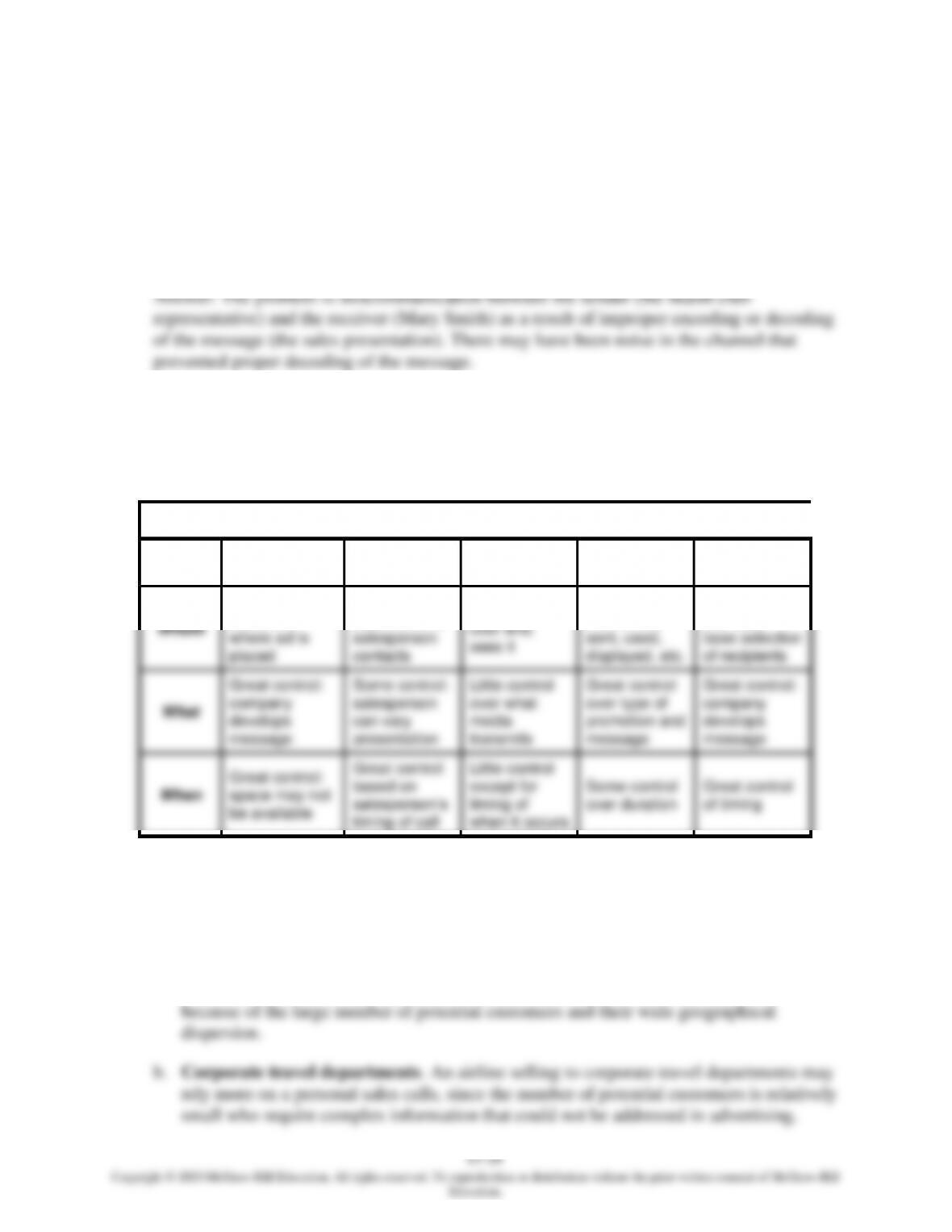
2. Develop a matrix to compare the five elements of the promotional mix on three
criteria—to whom you deliver the message, what you say, and when you say it.
Answer:
PROMOTIONAL ELEMENT
ADVERTISING
PERSONAL
SELLING
PUBLIC
RELATIONS
SALES
PROMOTION
DIRECT
MARKETING
Whom
Some control
based on
where ad is
placed
Great control:
depends who
salesperson
contacts
No control
over who
sees it
Some control
over where
sent, used,
displayed, etc.
Great control
with data
base selection
of recipients
What
Great control:
company
develops
message
Some control:
salesperson
can vary
presentation
Little control
over what
media
transmits
Great control
over type of
promotion and
message
Great control:
company
develops
message
When
Great control:
space may not
be available
Great control
based on
salesperson’s
timing of call
Little control
except for
timing of
when it occurs
Some control
over duration
Great control
of timing
3. Explain how the promotional tools used by an airline would differ if the target
audience were (a) consumers who travel for pleasure and (b) corporate travel
departments that select the airlines to be used by company employees.
Answers:
a. Consumers. When promoting to pleasure travelers, mass advertising would be used
15–29
4. Suppose you introduced a new consumer food product and invested heavily both in
national advertising (pull strategy) and in training and motivating your field sales
force to sell the product to food stores (push strategy). What kinds of feedback would
you receive from both the advertising and your sales force? How could you increase
both the quality and quantity of each?
Answers: In general, you should expect little feedback from your national advertising
campaign and better feedback from your sales force. In either case, if you want to get
5. Fisher-Price Company, long known as a manufacturer of children’s toys, has
introduced a line of clothing for children. Outline a promotional plan to get this
product introduced in the marketplace.
Answer: Fisher-Price should begin to generate publicity targeted at wholesalers and
retailers (push strategy) as well as ultimate consumers (pull strategy) regarding this
6. Many insurance companies sell health insurance plans to companies. In these
companies, the employees pick the plan but the set of offered plans is determined by
the company. Recently, Blue Cross-Blue Shield, a health insurance company, ran a
television ad stating, “If your employer doesn’t offer you Blue Cross-Blue Shield
coverage, ask why.” Explain the promotional strategy behind the advertisement.
Answer: The promotional strategy used is a pull strategy. The channel might be viewed as:
Answer: The promotional strategy used is a pull strategy. The channel might be viewed as:
B LU E C R OS S – BLU E SH IELD
1. TV ad
3. Employer requests plan
4. BC – BS off ers plan to em ployer
Chapter 15 – Integrated Marketing Communications and Direct Marketing
15–30
7. Identify the sales promotion tools that might be useful for (a) Tastee Yogurt, a new
brand introduction, (b) 3M self-sticking Post-It® Notes, and (c) Wrigley’s Spearmint
Gum.
Answers:
a. Tastee Yogurt. The Tastee Yogurt product is in the introductory stage of the product
8. Design an integrated marketing communications program—using each of the five
promotional elements—for Rhapsody, the online music service.
Answers:
a. Advertising. Ads placed in Billboard, Rolling Stone, Wired, and PC Magazine.
Chapter 15 – Integrated Marketing Communications and Direct Marketing
15–31
9. BMW recently introduced its first sport-utility vehicle, the X6, to compete with other
crossover vehicles such as the Mercedes-Benz GLE-class. Design a direct marketing
program to generate (a) leads, (b) traffic in dealerships, and (c) direct orders.
Answers: Students should consider the many forms of direct marketing including direct
mail and catalogs, television, telemarketing, direct selling, direct response advertising and
interactive online marketing. Instructors can remind students of the discussion of nonstore
10. Develop a privacy policy for database managers that provides a balance of consumer
and seller perspectives. How would you encourage voluntary compliance with your
policy? What methods of enforcement would you recommend?
Answer: Students’ answers will vary. To begin the discussion, ask students to consider the
guidelines provided in the European Union Data Protection Directive. The directive
Chapter 15 – Integrated Marketing Communications and Direct Marketing
15–32
BUILDING YOUR MARKETING PLAN
To develop the promotion strategy for your marketing plan, follow the steps
suggested in the planning phase of the promotion decision process described in Figure 15-5.
1. You should (a) identify the target audience, (b) specify the promotion objectives,
(c) set the promotion budget, (d) select the right promotion tools, (e) design the
promotion, and (f) schedule the promotion.
Answers:
a. Target audience. Is there more than one? Who are they? Does the same promotional
approach work for all?
2. Also specify the pretesting and posttesting procedures needed in the implementation
and evaluation phases.
3. Finally, describe how each of your promotion tools are integrated to provide a
consistent message.
Answer: Question #3 addresses the main topic of Chapter 17: How to have an IMC
program in which each promotional tool complements and supports the others.
Helping with Common Student Problems
What students are asked to do in Questions #1, #2, and #3 above is a very, very big order.
Chapter 15 – Integrated Marketing Communications and Direct Marketing
15–33
TEACHING NOTE FOR VIDEO CASE VC-15
Taco Bell: Using IMC to Help Customers Live Mas!
This case describes how Taco Bell used integrated marketing communications (IMC) in
its “Live Mas” campaign and in the introduction of Doritos Locos Tacos. Taco Bell was
[Video 15-7: Taco Bell Video Case (kerin.tv/cr8e/v15-7)]
Synopsis
The founder of Taco Bell, Glen Bell, started his career as a pioneer of the fast-food
industry by opening a restaurant called Bell’s Burgers. One of his nearby competitors was a
similar fast-food restaurant run by two brothers named McDonald, and eventually the
competition between them convinced Bell to switch from hamburgers to tacos. Tacos and taco
Teaching Suggestions
Most students will recognize Taco Bell because they have purchased something from a
Taco Bell restaurant or they have been exposed to Taco Bell advertising and branding efforts.
The following questions can be used to begin discussion of the video case:
1. How many of you have visited a Taco Bell restaurant? If some students are familiar with
2. How many of you have heard the phrase, “Live Mas” or are familiar with the Doritos
Locos Tacos? If any students answer yes, ask them how they became aware of the
Chapter 15 – Integrated Marketing Communications and Direct Marketing
Copyright © 2020 McGraw-Hill Education. All rights reserved. No reproduction or distribution without the prior written consent of McGraw-Hill
Education.
15–34
campaign or the product. Their answers might include television advertising, social media,
and promotions.
These questions should help students begin to see how Taco Bell used integrated marketing
communications and social media to communicate its message.
Answers to Questions
1. What factors contributed to Taco Bell’s early success?
Answer:
.
2. Which of the promotional elements described in Figure 15-2 were used by Taco
Bell in its Doritos Locos Tacos campaign?
Answers:
The introduction of the Doritos Locos Taco represents an excellent example of an
integrated marketing communications campaign utilizing many media alternatives to
reinforce a central message. In fact, according to brand creative director Tracee Larocca it