management and the senior vice presidents of
merchandising, stores, and administration.
1. Merchandising
• The merchandise division is responsible for developing
and coordinating the management of the retailer’s
merchandise offering and ensuring that it is consistent
with the firm’s strategy.
• Merchandising planners are responsible for allocating
merchandise and tailoring the assortment of several
categories for specific stores in a geographic area.
See PPT 15–16
In discussing buyers and
planners, mention the skills
needed to be successful in
each type of job. Ask students
2. Stores
• The senior vice president (SVP) of stores supervises all
activities related to stores, including working with the
regional managers, who supervise district managers, who
• Each region often has regional planners who work as
liaisons between stores in their region and the corporate
planners to ensure that the stores have the right
merchandise, at the right time, in the right quantities.
3. Operations
• The EVP of operations is also in charge of shrinkage and
loss prevention and the operation and maintenance of
the physical assets of the firm
important?
4. Marketing
• The chief marketing officer (CMO) works with staff to
develop advertising, promotion, and social media
programs.
5. Finance
6. Private Label
• The private-label president is responsible for the
conceptualization, design, sourcing, quality control, and
marketing of private-label and exclusive merchandise.
7. Direct Channels
• The president of direct channels is responsible for the
selection and pricing of the merchandise assortment
offered through the Internet, mobile, social, and catalog
and other nonstore channels, the maintenance and
design of the retailer’s website, customer call centers,
and the fulfillment centers that fill orders for individual
customers.
8. Global
• The global operations president oversees retailing
operations outside the home country.
operation are duplicated in the global operations.
IV. Human Resource Management Legal Issues
LO 15-5 Identify the legal issues
involved with human resource
management.
• Managing in today’s complex regulatory environment
requires expertise in labor laws, as well as skills in helping
other managers comply with those laws.
A. Equal Employment Opportunity
• The basic goal of equal employment opportunity
regulations is to protect employees from unfair
discrimination in the workplace.
• Companies cannot treat employees differently simply
based on their race, color, religion, sex, national origin,
age, or disability status.
• Title VII of the Civil Rights Act prohibits discrimination on
the basis of race, national origin, gender, or religion in
company personnel practices.
Discuss the impacts of the equal
employment opportunity law in
changing the retail landscape. Do
you think that these laws are
effective? What are impacts of
B. Compensation
• The Fair Labor Standards Act of 1938 set minimum
wages, maximum hours, child labor standards, and
overtime-pay provisions.
C. Labor Relations
• Labor relations laws describe the process by which
unions can be formed and the ways in which companies
must deal with the unions.
D. Employee Safety and Health
• he basic premise of health and safety laws is that the
employer is obligated to provide each employee with an
environment that is free of hazards that are likely to
cause death or serious injury.
E. Sexual Harassment
• Sexual harassment includes unwelcome sexual advances,
requests for sexual favors, and other inappropriate verbal
or physical conduct.
• Simply creating a hostile work environment can be
considered sexual harassment
Should a manager avoid dating an
employee? Based on the EEOC
guidelines, when would such a
behavior be interpreted as sexual
harassment?
F. Employee Privacy
ANSWERS TO DISCUSSION QUESTIONS AND PROBLEMS
1. How do on-the-job, Internet training, and classroom training differ? What are the
benefits and limitations of each approach?
Classroom training might include lectures, audiovisual presentations, manuals, and
correspondence distributed to the new employees. The initial structured program should
be relatively short so new employees don’t feel they are simply back in school. Effective
2. Give examples of a situation in which a manager of a McDonald’s fast-food restaurant
should utilize different leadership styles.
In the text, we discuss leadership styles in terms of type of leader behaviors, task
performance and group maintenance, and two types of decision-making approaches,
authoritative and participative.
Task performance behaviors are the McDonald’s manager’s efforts to make sure that the
store achieves its goals.
3. Using the interview questions in Exhibit 15-3, role-play with another student in the class
as both the interviewer and the applicant for an assistant store manager position at a
store of your choice.
Students should be encouraged to select a variety of questions for their role plays.
4. Name some laws and regulations that affect the employee management process. Which
do you believe are the easiest for retailers to adhere to? Which are violated the most
often?
Title VII of the Civil Rights Act prohibits discrimination on the basis of race, national origin,
sex, or religion in company personnel practices. Potential violations are investigated by the
Equal Employment Opportunity Commission (EEOC).
The Equal Pay Act, now enforced by the EEOC, prohibits unequal pay for men and women
who perform equal work. Equal work means that the jobs require the same skills, effort,
and responsibility and are performed in the same working environment.
5. What’s the difference between extrinsic and intrinsic rewards? What are the effects of
these rewards on the behavior of retail employees? Under what conditions, would you
recommend that a retailer emphasize intrinsic rewards over extrinsic rewards?
Extrinsic rewards are rewards provided by the retailer. These rewards include financial
compensation and recognition. Intrinsic rewards are positive feelings that people get from
doing the job well. For instance, retailers can help employees identify the intrinsic rewards
of their jobs through contests, which emphasize the “fun” aspects of their jobs and through
job enrichment programs.
6. What are the advantages and disadvantages of the different forms of compensation
programs described in this chapter? Considering the disadvantages only, how can
department managers ameliorate lessen the effects of the disadvantages?
A straight salary compensation plan is easy for the employee to understand and for the
store to administer. Under a straight salary plan, the retailer has flexibility in assigning
salespeople to different activities and sales areas. The major disadvantage of the straight
salary plan is employees’ lack of immediate incentives to improve their productivity. They
tend to concentrate on only the most expensive, fast-moving merchandise. For the retailer,
another issue is that salespeople compensated primarily by incentives don’t develop loyalty
to their employer. Incentives are less effective with inexperienced salespeople, who are less
confident in their skills, because they inhibit learning and also can cause excessive stress.
Because compensation plans based (almost) exclusively on sales incentives generally fail to
promote good customer service, some plans include a fixed salary plus a commission on
total sales or a commission on sales over quota.
7. When evaluating retail employees, some stores use a quantitative approach that relies on
checklists and numerical scores similar to the form in Exhibit 15-5. Other stores use a
more qualitative approach similar to the form in Exhibit 15-4, whereby less time is spent
checking and adding and more time is devoted to discussing strengths and weaknesses in
written form. What are the advantages and disadvantages of quantitative versus
qualitative evaluation systems?
Each evaluation approach has its strengths. Quantitative methods are useful in that they
provide a scale that can be utilized uniformly across departments and stores. This enables
evaluators to get a more balanced appraisal of performance from a broad perspective. In
addition, quantitative methods leave little question as to the relevant evaluative criteria,
8. Some staff pharmacists working for retail chains refuse to dispense the Plan B “morning
after” contraceptive pill because of their religious beliefs. In another situation, Muslims
and Jewish checkout clerks working for supermarket chains refused to touch, scan, or bag
products that contained any pork because of their religious beliefs. Do managers have
the right to force employees to take actions that are contrary to their beliefs? Should
customers be unable to buy products they want because of an employee’s beliefs? Should
employees be required to ignore their religious beliefs? What would you do if you were
faced with these or similar ethically sensitive situations?
Retailers should be very clear of the expectations of sales associates when they are first
10. Drugstore retailers such as CVS place diabetic test strips and perfume behind locked glass
cabinets and nearly all over-the-counter medicines behind Plexiglas panels. What are the
pros and cons of these locked glass cabinets from the retailer’s perspective? From the
customer’s perspective?
Despite their effectiveness in reducing losses through shoplifting, the security measures
described above can unfortunately make the shopping experience less pleasant for honest
customers. These customers are inconvenienced by the need to request assistance in
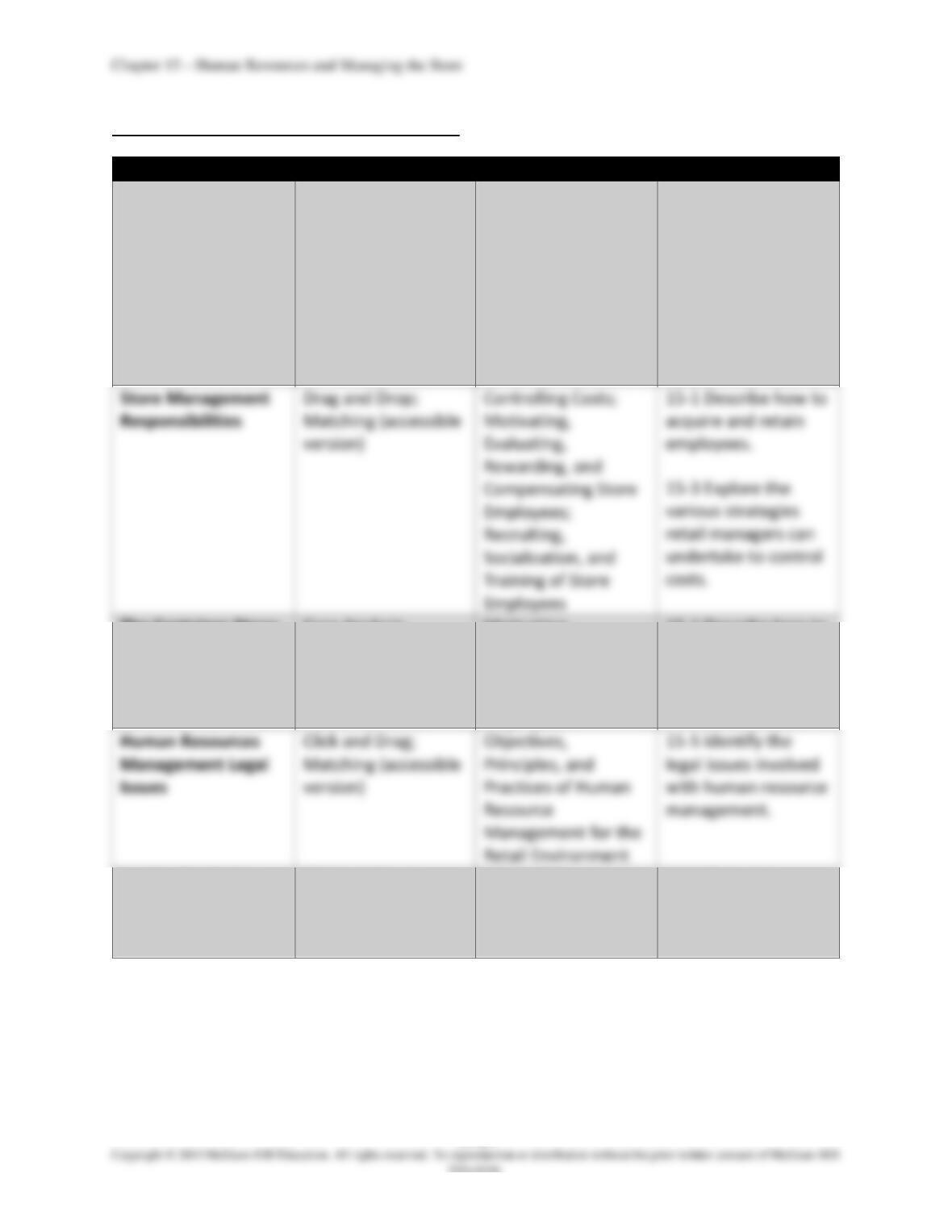
CONNECT ACTIVITIES FOR CHAPTER 15
Activity Title
Activity Type(s)
Topic(s)
Learning Objective(s)
Jeremy’s Jewelry
Case Analysis
Controlling Costs;
Motivating,
Evaluating,
Rewarding, and
Compensating Store
Employees
15-1 Describe how to
acquire and retain
employees.
15-3 Explore the
various strategies
retail managers can
undertake to control
costs.
Training of Store
The Container Store:
Putting Employees
First
Case Analysis
Motivating,
Evaluating,
Rewarding, and
Compensating Store
Employees
15-1 Describe how to
acquire and retain
employees.
with human resource
Leadership Styles
Click and Drag;
Matching (accessible
version)
Leadership
15–2 Illustrate
effective leadership
strategies of a retail
manager.