
Instructor Manual
Lamb/Hair/McDaniel, MKTG 13E, 9780357127810; Chapter 15: Marketing Communications
Table of Contents
Purpose and Perspective of the Chapter …………………………………………………………………………. 2
Cengage Supplements …………………………………………………………………………………………………… 2
Learning Outcomes ……………………………………………………………………………………………………….. 2
Complete List of Chapter Activities and Assessments ……………………………………………………… 3
Key Terms ……………………………………………………………………………………………………………………… 4
What’s New in This Chapter ……………………………………………………………………………………………. 6
Chapter Outline …………………………………………………………………………………………………………….. 7
Discussion Questions …………………………………………………………………………………………………… 20
Additional Activities and Assignments …………………………………………………………………………… 20
Additional Resources ……………………………………………………………………………………………………. 27
External Videos or Playlist ……………………………………………………………………………………………………….. 27
Appendix …………………………………………………………………………………………………………………….. 28
Generic Rubrics ……………………………………………………………………………………………………………………… 28
Standard Writing Rubric …………………………..……………………………………………………………………………… 28
Standard Discussion Rubric ……………………………………………………………………………………………………… 29
Purpose and Perspective of the Chapter
The purpose of this chapter is to learn about the role of promotion. Promotional strategy is
the plan for using the elements of promotion—advertising, public relations, sales
promotion, personal selling, and social media—to meet the firm’s overall objectives and
Cengage Supplements
The following product-level supplements provide additional information that may help you
in preparing your course. They are available in the Instructor Resource Center.
• Transition Guide (provides information about what’s new from edition to edition)
• Educator’s Guide (describes assets in the platform with a detailed breakdown of
activities by chapter with seat time)
Learning Outcomes
The following learning outcomes are addressed in this chapter:
LO 15–1 Discuss the role of promotion in the marketing mix
LO 15–2 Describe the communication process
LO 15–3 Explain the goals and tasks of promotion
LO 15–4 Discuss the elements of the promotional mix
Complete List of Chapter Activities and Assessments
For additional guidance refer to the Teaching Online Guide.
Chapter
Learning
Objective
PPT slide
Activity/Assessment
Duration
Certification
Standard
N/A
MindTap: Why Does
Promotion Matter to Me?
5 minutes
BUSPROG:
Reflective
Thinking
DISC:
Promotion
Communication
15-3
MindTap: Learn It 15-3:
The Goals of Promotion
5 minutes
BUSPROG:
Analytic
DISC:
Promotion
15-4
MindTap: Learn It 15-4:
The Promotional Mix
5 minutes
BUSPROG:
Analytic
DISC:
Promotion
15-5
MindTap: Learn It 15-5:
Promotional Goals and
the AIDA Concept
5 minutes
BUSPROG:
Analytic
DISC:
Promotion
15-7
MindTap: Learn It 15-7:
Factors Affecting the
Promotional Mix
5 minutes
BUSPROG:
Analytic
DISC:
Promotion
15-2
20
Group Activity 1 in PPT
25-30 minutes
BUSPROG:
Analytic
DISC:
Promotion
15-3
28
Knowledge Check 1 in
PPT
5 minutes
BUSPROG:
Analytic
DISC:
Promotion
15-4
39
Group Activity 2 in PPT
20-25 minutes
BUSPROG:
Communication
DISC:
Promotion
[return to top]
Key Terms
advertising: impersonal, one- way mass communication about a product or organization
that is paid for by a marketer.
competitive advantage: one or more unique aspects of an organization that cause target
consumers to patronize that firm rather than competitors.
decoding: interpretation of the language and symbols sent by the source through a
channel.
mass communication: the communication of a concept or message to large audiences.
noise: anything that interferes with, distorts, or slows down the transmission of
information.
owned media: a new category of promotional tactics based on brands becoming
publishers of their own content in order to maximize the brands’ value to customers.
promotional strategy: a plan for the optimal use of the elements of promotion:
advertising, public relations, personal selling, sales promotion, and social media.
public relations: the marketing function that evaluates public attitudes, identifies areas
within the organization the public may be interested in, and executes a program of action
to earn public understanding and acceptance.
[return to top]
What’s New in This Chapter
The following elements are improvements in this chapter from the previous edition:
• Additional material on marketing analytics and campaign development
• New content on digital-based tools and responding to customers
[return to top]
Chapter Outline
In the outline below, each element includes references (in parentheses) to related content. “LO
CH–##” refers to the chapter learning outcome; “PPT Slide #” refers to the slide number in the
PowerPoint deck for this chapter (provided in the PowerPoints section of the Instructor Resource
Center); and, as applicable for each discipline, accreditation or certification standards (“DISC”).
Introduce Chapter 15 and review the learning outcomes. (PPT Slide 2).
1. The Role of Promotion in the Marketing Mix (LO 15-1, PPT Slide 3, DISC: Promotion)
a. Promotion is communication by marketers that informs, persuades, and
reminds potential buyers of a product in order to influence an opinion or elicit a
response. Promotion is a vital part of the marketing mix, informing consumers
b. The main function of a marketer’s promotional strategy is to convince target
customers that the goods and services offered are superior to the competition.
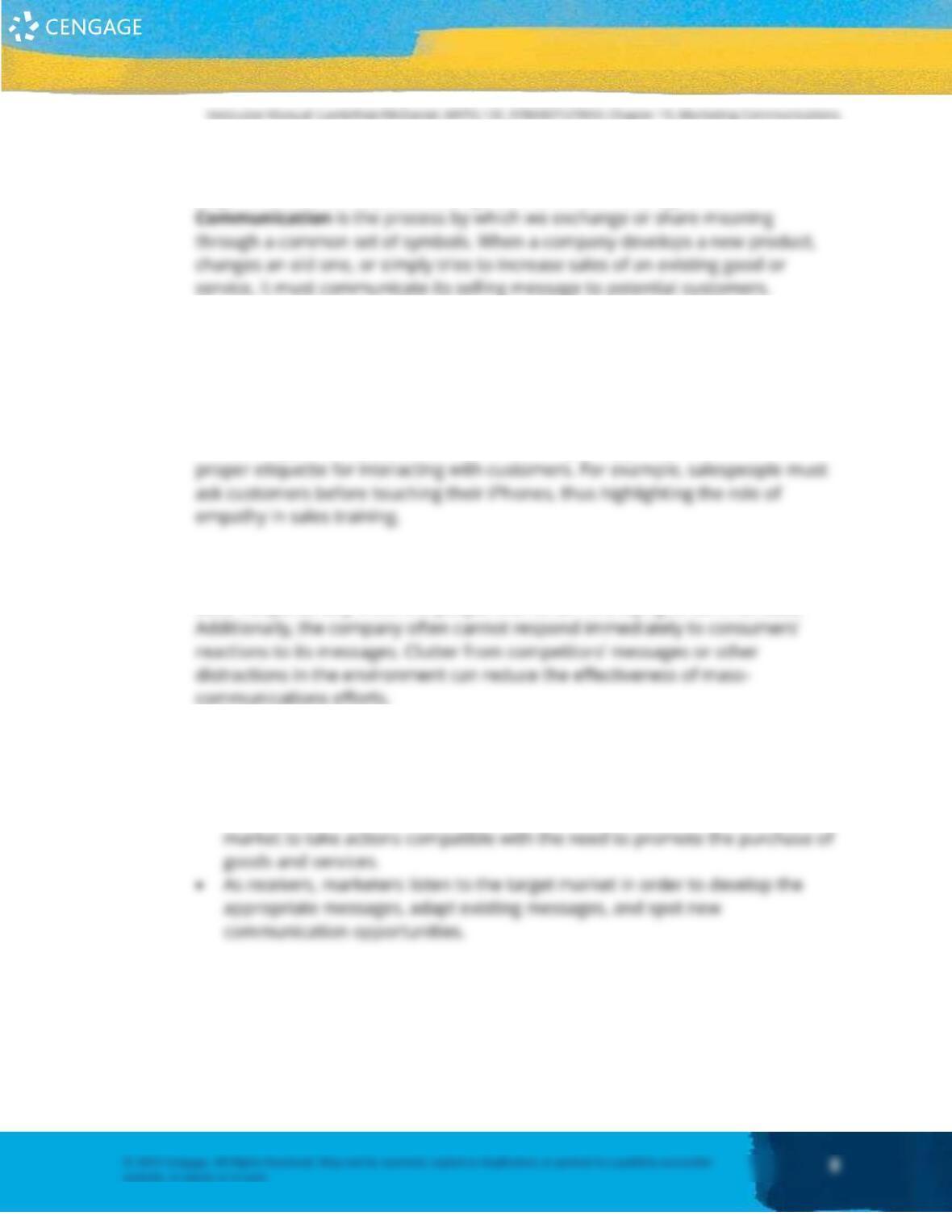
PRESENTATION VISUAL: Exhibit 15.1 Role of Promotion in the Marketing Mix
2. Marketing Communication (LO 15-2, PPT Slide 9, DISC: Promotion)
a. Marketers communicate information about the firm and its products to the
target market and the public through their promotional programs.
b. Interpersonal Communication: Communication can be divided into two major
categories: interpersonal communication and mass communication.
Interpersonal communication is direct, face-to-face communication between
two or more people. When communicating face-to-face, people see the other
person’s reaction and can respond almost immediately.
Example: Apple salespeople are trained not only on Apple’s products but also on
c. Mass Communication: Mass communication involves the communication of a
concept or message to large audiences. When a company advertises, it generally
d. The Communication Process: Most marketing communication is a two-way,
rather than one-way, process. The two-way, or even cyclical, nature of the
modern communication process is illustrated in Exhibit 15.2. Marketers act both
as senders and receivers.
• As senders, marketers attempt to inform, persuade, and remind the target
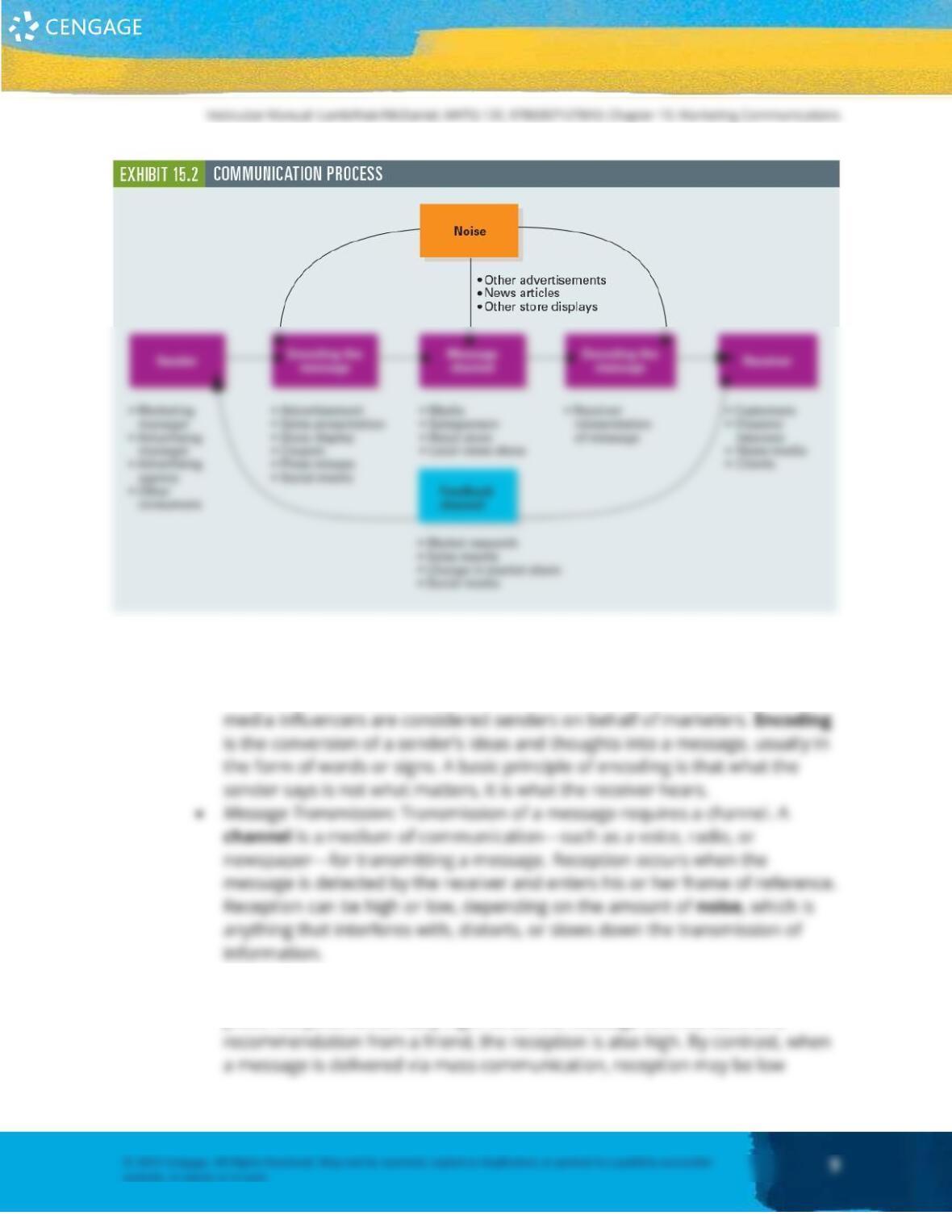
PRESENTATION VISUAL: Exhibit 15.2 Communication Process
• The Sender and Encoding: The sender is the originator of the message in the
communication process. A company or organization is a sender when it
executes an advertisement, press release, or social media campaign. Social
Example: In a face-to-face, interpersonal communication, such as a sales
because the noise level likely is high due to “interference” from other ads in
newspapers or on television, for example.
• The Receiver and Decoding: Marketers communicate their message through a
channel to customers, or receivers, who will decode the message. The
receiver is the person who decodes a message. For a single marketing
message, there can be multiple receivers. This is especially true online
e. With online advertising, marketers are able to get more feedback than before
digital platforms became popular. Online marketers can use web analytics to
obtain some feedback, such as how long customers stay on a website and which
pages they view.
f. Digital platforms and social media have had an impact on the communication
model in two major ways:
g. Today, customers use social media platforms to comment publicly on marketing
efforts. These platforms enable marketers to personalize the feedback channel
3. The Goals of Promotion (LO 15–3, PPT Slide 22, DISC: Promotion)
a. Promotion seeks to modify behavior and thoughts in some way. Promotion can
perform one or more of the following four tasks, sometimes simultaneously:
• Inform the target audience
• Persuade the target audience
action. Typically, it is used during the growth stage, when the target market is
already aware of how the product can fulfill its wants. However, persuasion can
also be an important goal for very competitive mature product categories, such
as household items and soft drinks. Promotional messaging emphasizes the
d. Reminding: Reminder promotion is used to keep the product and brand name
in the public’s mind. It assumes that the target market has already been
persuaded of the merits of the good or service, so it is used during maturity
stage. The purpose is to trigger a memory that leads to a purchase.
Example: IHOP, known for its pancakes, decided to remind people that it had
e. Connecting: The focus of social media is to form relationships with customers
and potential customers through technological ties. The goal of forming these
4. The Promotional Mix (LO 15-4, PPT Slide 29, DISC: Promotion)
a. The promotional mix is a combination of promotional tools—including
advertising, public relations, personal selling, sales promotion, and social
media—used to reach the target market and fulfill the organization’s overall
goals. Data and data analytics help determine how marketers distribute funding
among their promotional mix tactics.
b. Advertising: Advertising is any form of impersonal, one-way mass
communication about a product or organization that is paid for by a marketer.
c. Public Relations: Public relations is the marketing function that evaluates
public attitudes, identifies areas within the organization the public may be
interested in, and executes a program of action to earn public understanding
and acceptance. Public relations helps an organization communicate with its
d. Sales Promotion: Sales promotion consists of marketing activities—other than
personal selling, advertising, and public relations—that stimulate consumer
buying and dealer effectiveness. Sales promotion is generally a short-run tool
used to stimulate immediate increases in demand. Examples of traditional types
of sales promotion include free samples, contests, premiums, trade shows,
e. Personal Selling: Personal selling is a purchase situation involving a personal,
paid-for communication between two people in an attempt to influence each
other. Both the buyer and seller have specific objectives. Traditional methods of
f. Content Marketing and Social Media: Content marketing entails developing
valuable content for interested audience members, and then using digital means
to pull customers to a company’s website to learn about the brand or to make a
g. The Communication Process and the Promotional Mix: Traditionally,
marketing managers were in charge of defining the essence of the brand and
mostly used one-way communication to communicate the brand value. Today,
the communication space and the brand message are increasingly controlled by
the consumers, who can even generate their own content.
h. As a result of the proliferation of new platforms, tools, and ideas, promotional
tactics can be categorized according to media type (see Exhibit 15.3):
• Paid media is a category of promotional tactics based on the traditional
• Owned media is a new category of promotional tactics based on brands
becoming publishers of their own content in order to maximize the brands’
value to customers. Owned media includes the company’s websites as well
as its official presence on Facebook, Twitter, YouTube channels, blogs, and
other digital platforms.
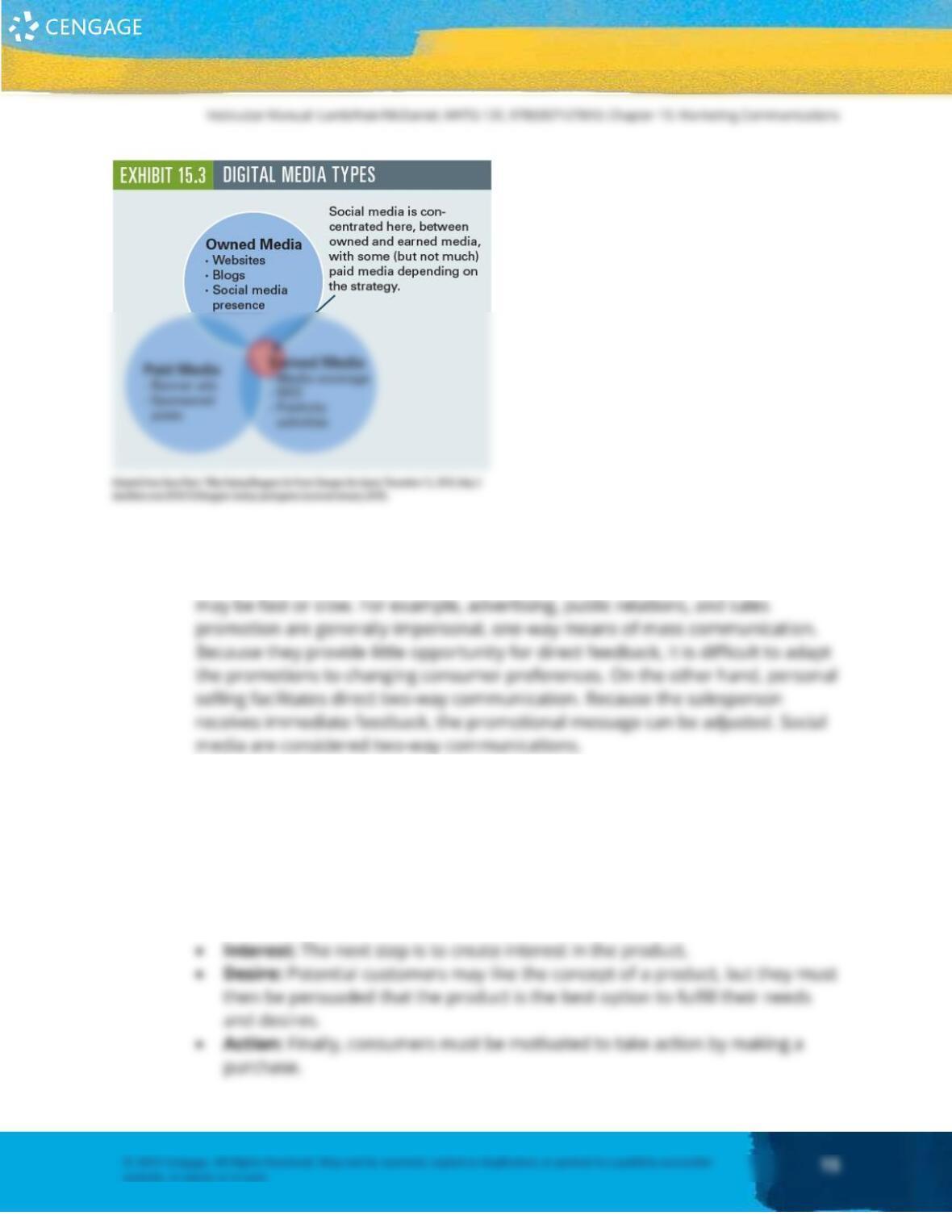
PRESENTATION VISUAL: Exhibit 15.3 Digital Media Types
i. The elements of the promotional mix differ in their ability to affect the target
audience. Promotional mix elements may communicate with the consumer
directly or indirectly. The message flow may be one-way or two-way. Feedback
5. Promotional Goals and the AIDA Concept (LO 15-5, PPT Slide 4`, DISC: Promotion)
a. The AIDA Model: The AIDA concept is a model that outlines the process for
achieving promotional goals in terms of stages of consumer involvement with
the message; the acronym stands for attention, interest, desire, and action.
• Attention: The advertiser must first gain the attention of the target market
because a firm cannot sell something if the market does not know the good
or service exists.