b. Not all consumers progress through all of these stages for every purchase, but
most buyers in high-involvement purchase situations pass through all four
stages.
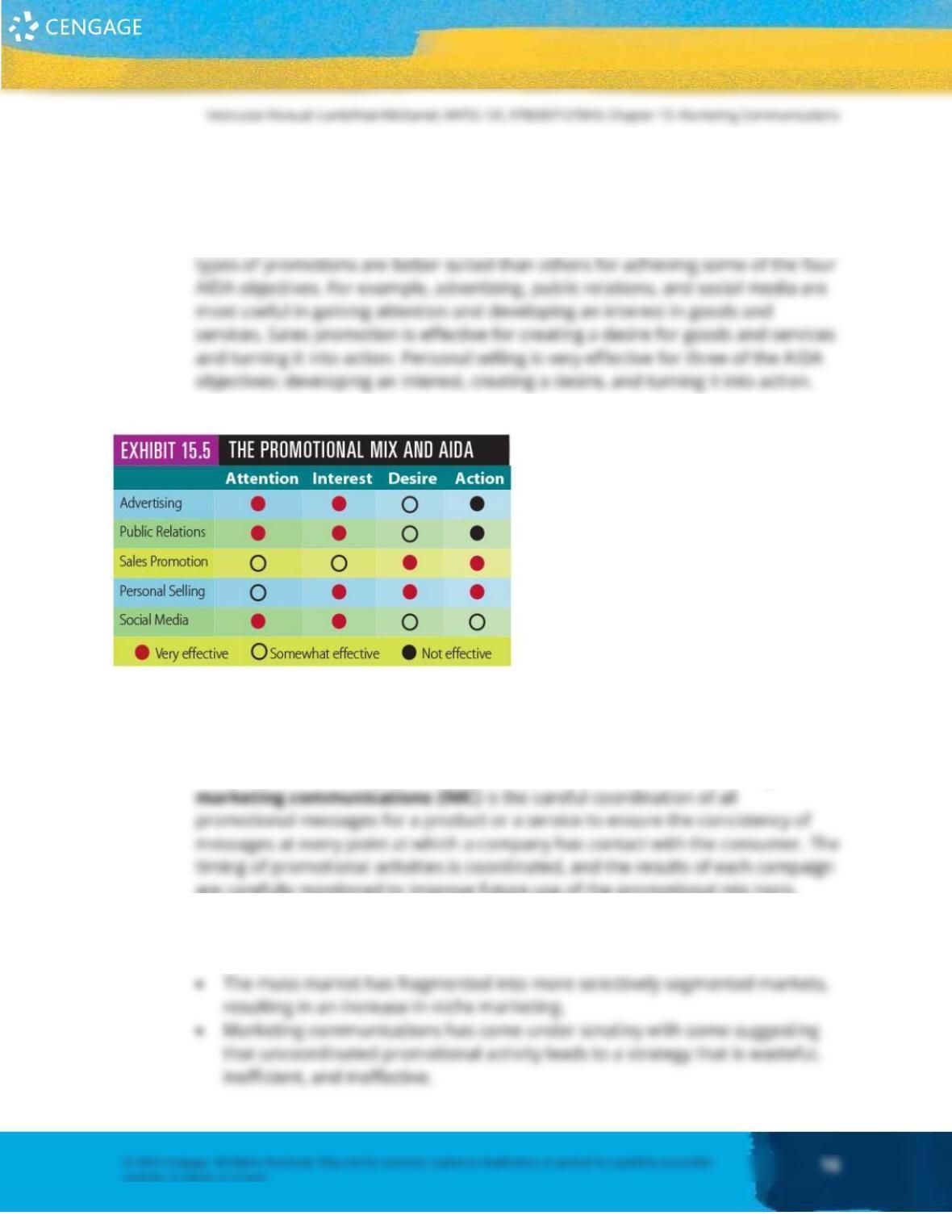
c. AIDA and the Promotional Mix: Exhibit 15.5 depicts the relationship between
the promotional mix and the AIDA model. A closer look shows how different
PRESENTATION VISUAL: Exhibit 15.5 The Promotional Mix and AIDA
6. Integrated Marketing Communications (LO 15–6, PPT Slide 46, DISC: Promotion)
a. Marketing communications for any product or brand should be integrated
across the promotional mix, meaning the message reaching the consumer
should be the same regardless of which type of promotion is used. Integrated
are carefully monitored to improve future use of the promotional mix tools.
b. The IMC concept has been growing in popularity because:
• The proliferation of thousands of media choices has made promotion a more
complicated task.
7. Factors Affecting the Promotional Mix (LO 15-7, PPT Slide 49, DISC: Promotion)
a. Promotional mixes vary a great deal from one product and one industry to the
next, depending on several key factors.
b. Nature of the Product: The characteristics of the product itself can influence
the promotional mix. Business and consumer products require different types of
c. The costs and risks associated with a product influence the promotional mix. As
a general rule, as the costs or risks of buying and using a product or service
increase, personal selling becomes more important. A salesperson must assure
buyers that they are spending their money wisely and not taking an undue
financial risk or social risk.
d. Stages in the Product Life Cycle: Exhibit 15.6 shows the relationship between
the product life cycle and various types of promotions:
• During the introduction stage, the basic goal of promotion is to inform the
target audience that the product is available.
e. Target Market Characteristics: In general, a target market characterized by
widely scattered potential customers, highly informed buyers, and brand-loyal
repeat purchasers requires a promotional mix with more advertising and sales
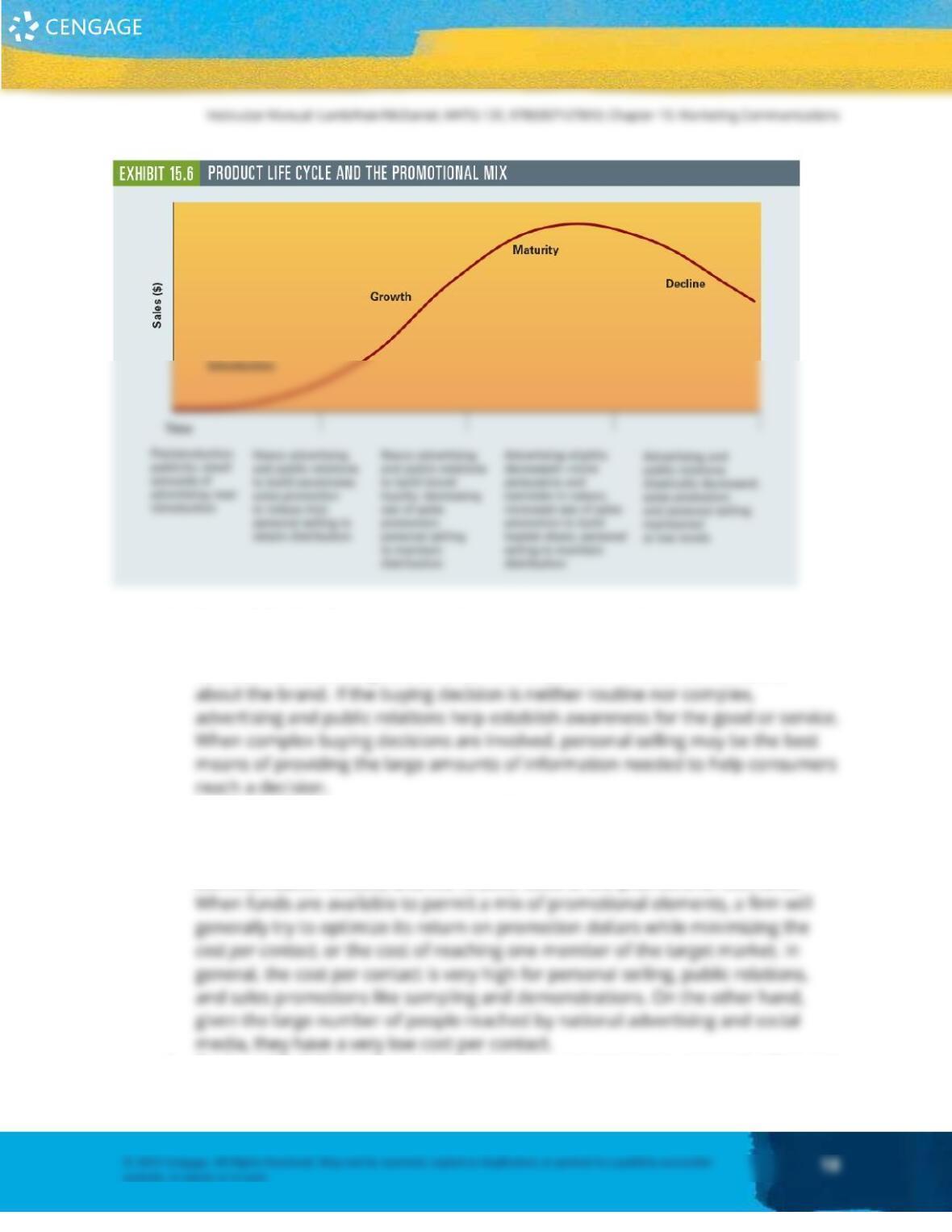
PRESENTATION VISUAL: Exhibit 15.6 Product Life Cycle and the Promotional Mix
f. Type of Buying Decision: Advertising and sales promotion are the most
productive promotion tools to use for products requiring routine buying
decisions because they call attention to the brand or remind the consumer
g. Available Funds: Money, or the lack of it, is often the most important factor in
determining the promotional mix. Usually, there is a trade-off among the funds
available, the number of people in the target market, the quality of
h. Push and Pull Strategies: A push strategy uses aggressive personal selling and
trade advertising to convince a wholesaler or a retailer to carry and sell
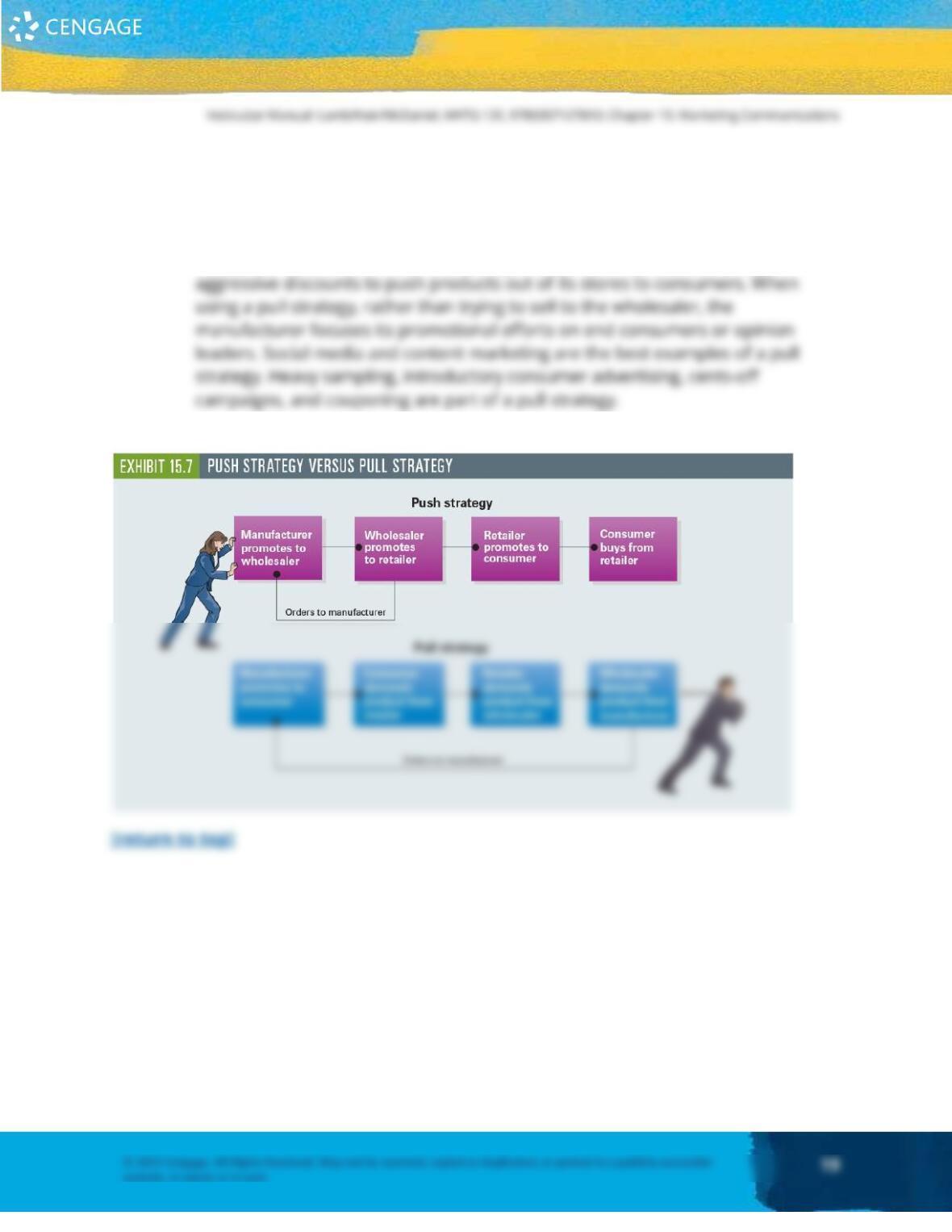
particular merchandise. A pull strategy stimulates consumer demand to obtain
product distribution. Exhibit 15.7 illustrates both strategies. Most organizations
use a combination of these strategies in the promotional mix for their products
or services.
Examples: An example of a push strategy is when Walmart (the retailer) uses
PRESENTATION VISUAL: Exhibit 15.7 Push Strategy Versus Pull Strategy
Discussion Questions
You can assign these questions several ways: in a discussion forum in your LMS; as whole-
class discussions in person; or as a partner or group activity in class. A generic discussion
rubric is provided in the Appendix.
1. Discussion: (LO 15-1, PPT Slides 7-8) Duration 5-10 minutes.
a. Lead students on a discussion of promotional advertising with the following
questions:
• At one time, print and television ads were the primary means of promotion. Can
you identify at least five additional platforms for placing ads that have emerged
over the last 20 years?
2. Discussion: (LO 15-6) Duration 5-10 minutes.
a. From the consumer’s standpoint, a company’s communications are already
integrated. Consumers don’t think in terms of the five elements of promotion
(personal selling, advertising, sales promotion, public relations, and social media).
Most people don’t see or notice the distinctions. Ask students:
• What would happen if communications were not coordinated or well-timed?
[return to top]
Additional Activities and Assignments
A generic discussion and writing rubric is provided in the Appendix.
1. Activator Exercise: Putting the Social in Social Media (LO 15–2)
Purpose: To introduce the concept of how brands and organizations communicate with
consumers.
Format: This activity can be facilitated in both a classroom and an online environment.
Instructions for how to facilitate the activity in the classroom and online are provided
below.
Classroom Format: Small group discussion, then class presentations (Estimated Time:
20-30 minutes)
1. Divide students into groups of three or four.
Online Format: Discussion board with posted response from each student (Estimated
Time: 25-35 minutes)
1. Use the following prompt to facilitate this activity in a discussion board:
Identify a brand you feel does an exceptionally good job of connecting with
2. Have students respond to their classmates’ posts, ask questions, and offer
constructive feedback on their analysis.
Additional questions for a classroom or discussion board: Are brands posting the
same content on different social media platforms? Why or why not? What could brands
do better to connect with consumers via social media?
Result: Students will most likely touch on several key factors, such as the more
2. Class activity (LO 15–2)
Format: This activity can be facilitated in both a classroom and an online environment.
Instructions for how to facilitate the activity in the classroom and online are provided
below. (Estimated time: 10-20 minutes)
Classroom Format: Divide students into small groups of three or four. Instruct each
Online Format: If you’re delivering your course online, you can have students do this
on their own and have them post their answers in a discussion board. Use the following
prompt to facilitate this activity:
Use the Internet to locate either one ad on social media or one ad on a video platform. (Do
3. Class Activity: (LO 15–3)
Format: This activity can be facilitated in both a classroom and an online environment.
Instructions for how to facilitate the activity in the classroom and online are provided
below. (Estimated time: 15-25 minutes)
Classroom Format: Divide students into small groups of three or four. Have the groups
use the Internet to locate four examples of ads—one that informs, one that persuades,
one that reminds, and one that connects. These can be ads from websites, social media,
or video platforms. Invite groups to share and discuss the ads they found. How often
does an ad serve more than one purpose?
Online Format: If you’re delivering your course online, you can have students do this
purpose? Why were the ads effective or ineffective?
4. Class Activity: (LO 15–4)
Format: This activity can be facilitated in both a classroom and an online environment.
Instructions for how to facilitate the activity in the classroom and online are provided
below. (Estimated time: 20-30 minutes)
Classroom Format: Divide students into small groups of four or five. Instruct groups to
Online Format: If you’re delivering your course online, you can have students do this
on their own and have them post their answers in a discussion board. Use the following
prompt to facilitate this activity:
Choose a product, product line, or brand you’d like to work with. It could be
pharmaceuticals, restaurants, sporting goods, or something else, but choose something
5. Class Activity: (LO 15–5)
Format: This activity can be facilitated in both a classroom and an online environment.
Instructions for how to facilitate the activity in the classroom and online are provided
below. (Estimated time: 15-25 minutes)
Classroom Format: Divide students into pairs or groups of three. Have them imagine
they are the brand managers for their favorite brand of beverage, footwear, or
smartphone. Using Exhibit 15.5, ask them to develop a promotional mix for their brand
that will help them accomplish all four objectives in the AIDA model. Remind them to be
as detailed and creative as they can. Invite several groups to share their ideas and
discuss.
Online Format: If you’re delivering your course online, you can have students do this
on their own and have them post their answers in a discussion board. Use the following
prompt to facilitate this activity:
6. Class Activity (LO 15–7)
Instructor Manual: Lamb/Hair/McDaniel, MKTG 13E, 9780357127810; Chapter 15: Marketing Communications
Format: This activity can be facilitated in both a classroom and an online environment.
Instructions for how to facilitate the activity in the classroom and online are provided
below. (Estimated time: 15-25 minutes)
Classroom Format: Divide students into small groups of three or four. Have the groups
choose a vehicle, clothing item, electronic device, or restaurant chain to work with. Ask
each group to analyze the existing promotional mix for the product by determining how
the following factors influenced the brand manager’s decisions:
• Nature of the product
Online Format: If you’re delivering your course online, you can have students do this
on their own and have them post their answers in a discussion board. Use the following
prompt to facilitate this activity:
Imagine you are the new brand manager for your favorite vehicle, clothing item, electronic
device, or restaurant chain. Analyze the existing promotional mix for your product by
determining how the following factors influenced the previous brand manager’s decisions:
• Nature of the product
7. Additional activity: Owned Media (LO 15–4)
Purpose: To give students a creative opportunity to contribute to a brand’s owned
media.
Background: Owned media includes the company’s websites as well as its official
presence on Facebook, Twitter, YouTube channels, blogs, and other digital platforms.
Classroom Format: Divide your class into small groups of three or four. Ask students
to think of a product or brand they would like to work with. Then, direct them to follow
these steps:
1. Brainstorm ideas for some type of contest that will be deployed on a social media
platform that will get consumers talking about and contributing to the brand’s social
2. Share a brief proposal of your campaign, including how it will be promoted, where it
will be deployed, and what incentives you will use to generate participation.
Online Format: Discussion board with posted response from each student (Estimated
Time: 20-30 minutes)
1. Use the following prompt to facilitate this activity in a discussion board:
Think of a product or brand you would like to work with. Brainstorm ideas for some type
of contest that will be deployed on a social media platform that will get consumers
2. Have students respond to their classmates’ posts and offer constructive feedback
and additional ideas for the owned media campaigns.
Additional Questions for Reflection:
• What motivates people to get involved in an owned media campaign?
8. Online Research Activity: Marketing Communication Process (LO 15–2)
Every year the Super Bowl is watched by millions of people around the world. Many
people watch the Super Bowl just to see the commercials. Companies are willing to
spend millions of dollars to advertise during the game to gain access to the Super
Bowl’s broad television audience. Visit the website listed below and select one of the
Super Bowl advertisements. Then, answer the following questions:
• Who was the source (sender) of the message?
• How effectively and what methods were used in encoding the message?
9. Online Research Activity: Integrated Marketing Communications (LO 15–6)
Integrated marketing communications is the careful coordination of all promotional
messages—traditional advertising, direct marketing, social media, interactive, public
relations, sales promotion, personal selling, event marketing, and other
Additional Resources
External Videos or Playlist
Appendix
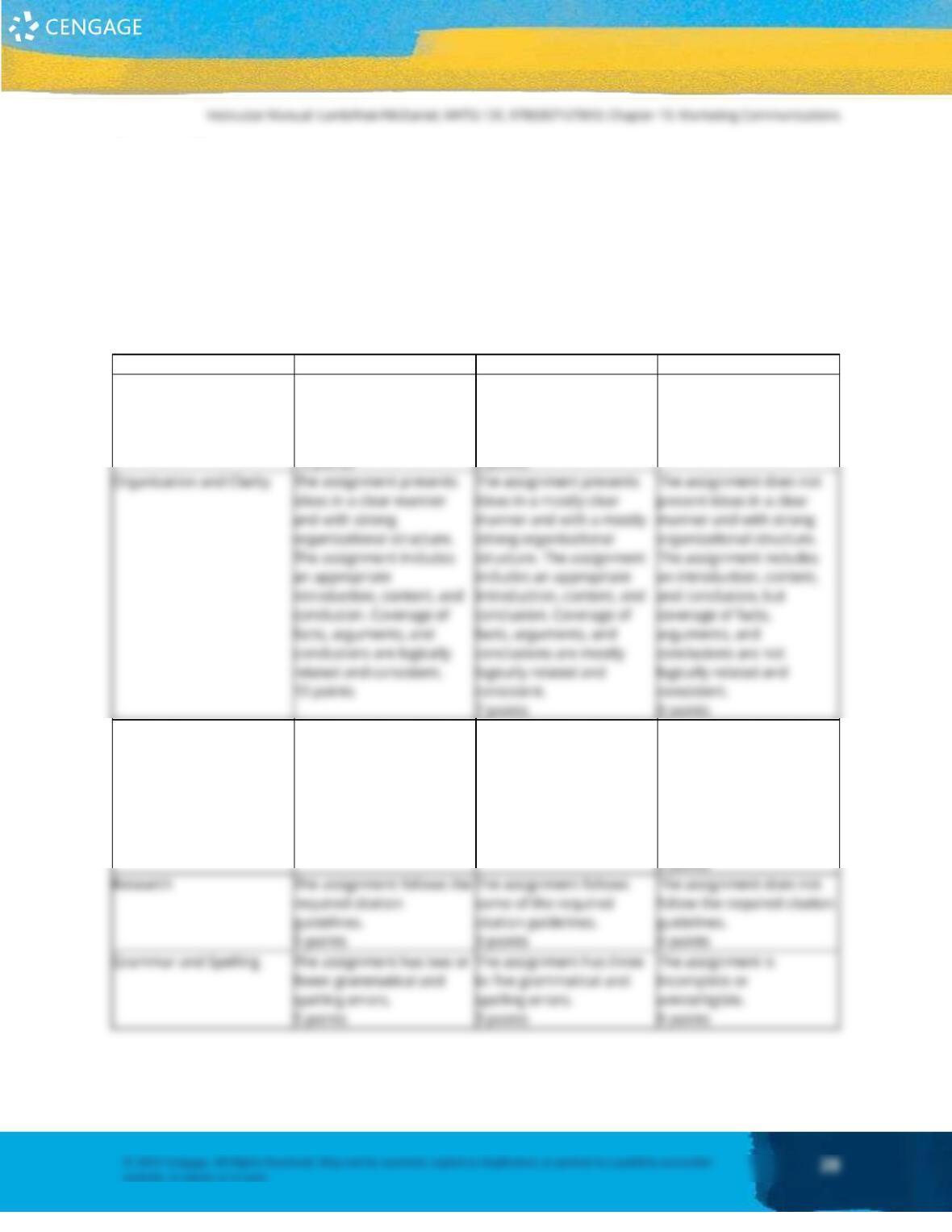
Generic Rubrics
Providing students with rubrics helps them understand expectations and components of
assignments. Rubrics help students become more aware of their learning process and
progress, and they improve students’ work through timely and detailed feedback.
Customize these rubrics as you wish. The writing rubric indicates 40 points and the
discussion rubric indicates 30 points.
Standard Writing Rubric
Criteria
Meets Requirements
Needs Improvement
Incomplete
Content
The assignment clearly and
comprehensively
addresses all questions in
the assignment.
The assignment partially
addresses some or all
questions in the
assignment.
The assignment does not
address the questions in
the assignment.
0 points
Research
The assignment is based
upon appropriate and
adequate academic
literature, including peer
reviewed journals and
other scholarly work.
5 points
The assignment is based
upon adequate academic
literature but does not
include peer reviewed
journals and other
scholarly work.
3 points
The assignment is not
based upon appropriate
and adequate academic
literature and does not
include peer reviewed
journals and other
scholarly work.
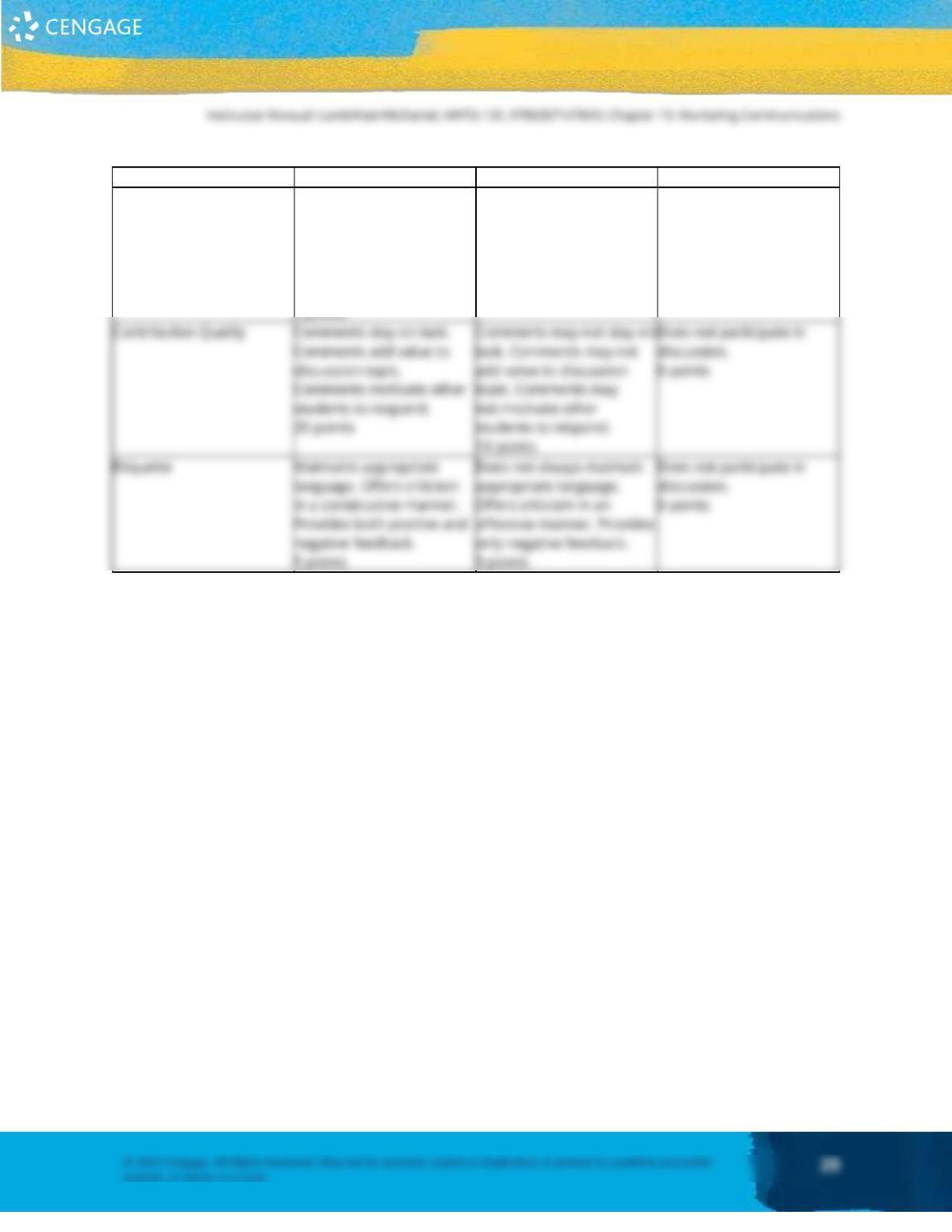
Standard Discussion Rubric
Criteria
Meets Requirements
Needs Improvement
Incomplete
Participation
Submits or participates in
discussion by the posted
deadlines. Follows all
assignment. instructions
for initial post and
responses.
Does not participate or
submit discussion by the
posted deadlines. Does not
follow instructions for
initial post and responses.
3 points
Does not participate in
discussion.
0 points