Chapter 15: Distribution Channels and Supply Chain Management
Note: A single shipping container can contain thousands of units of an item—depending on the
item’s size. And freight ships can carry thousands of these containers.
Warehousing
Products flow through two types of warehouses: storage and distribution. A storage warehouse
holds goods for moderate to long periods in an attempt to balance supply and demand for
producers and purchasers. By contrast, a distribution warehouse assembles and redistributes
Classroom activity: In small groups, ask students to research the distribution networks for one
of the following companies:
Amazon.com
Key Takeaway: The decisions made by the warehousing and storage function of the
supply chain can have a significant impact on costs, lead times, and availability of a
company’s products.
Estimated time: 10–30 minutes (depending on whether you facilitate the classroom activity)
15-6 Modes of Transportation
Logistics managers choose from five major modes of transportation. Each mode has its own
unique characteristics.
Comparing the Five Modes of Transport
Although all shippers consider reliability, speed, and cost when choosing the most appropriate
Chapter 15: Distribution Channels and Supply Chain Management
• Water carriers: fuel, oil, coal, chemicals, minerals, and petroleum products; automobiles,
electronics, clothing, and toys from foreign manufacturers.
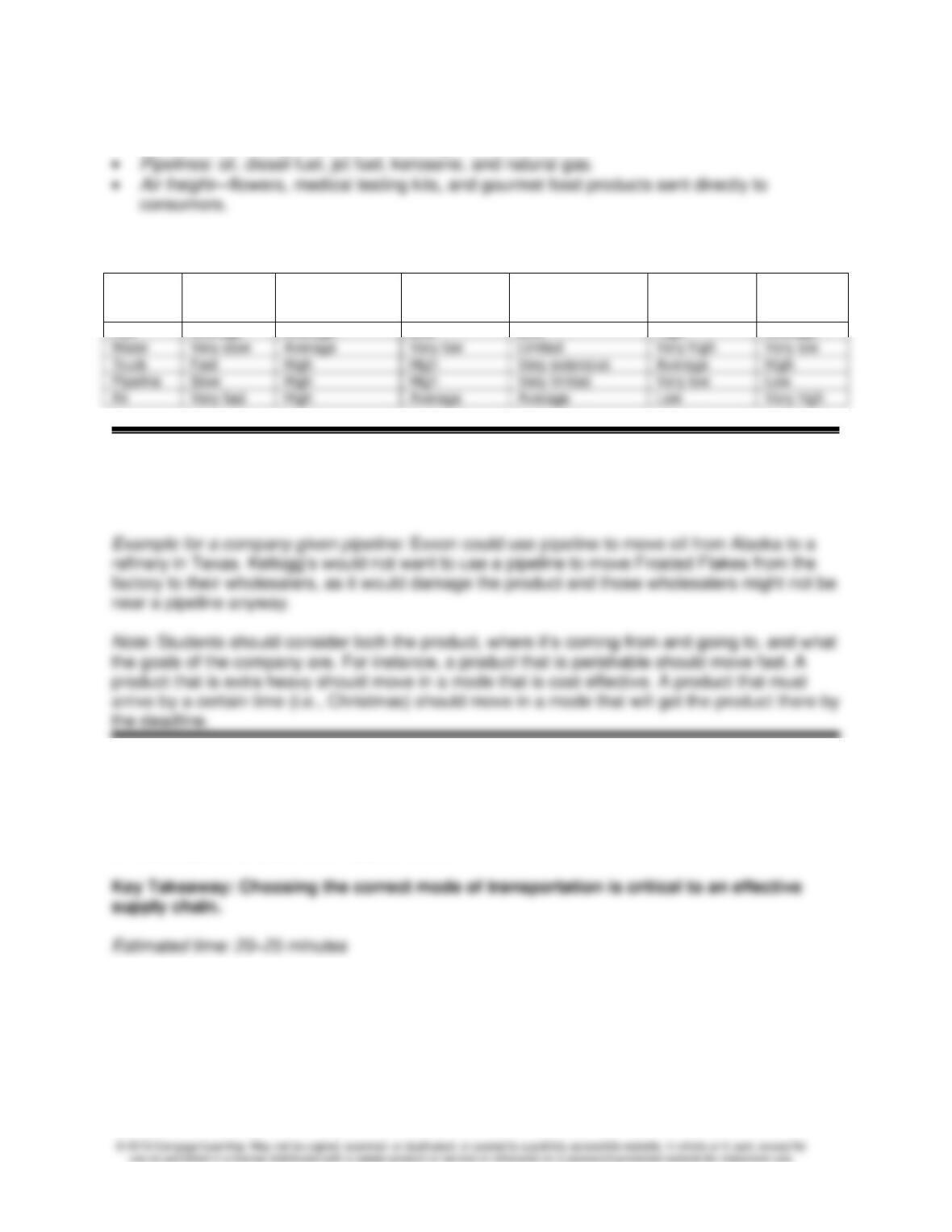
PRESENTATION VISUAL: Exhibit 15.6 comparing the modes of transportation
Mode
Speed
Dependability in
Meeting
Schedules
Frequency of
Shipments
Availability in
Different
Locations
Flexibility in
Handling
Cost
Classroom activity: Divide students into small groups and assign each group one of the
modes of transportation. Ask each group to create a scenario where their mode would be most
appropriate. Also, ask them to create a scenario where their mode would be totally inappropriate
(which can sometimes get comical).
Intermodal operations include a combination of transport modes, such as rail and highway
carriers (piggyback), air and highway carriers (birdyback), and water and air carriers (fishyback),
to improve customer service and achieve cost advantages. Different combinations provide
advantages to firms, depending on the scenario. Managers seek to maximize efficiency across
available options, to save both cost and time.
15–7 Accomplishing the Priorities of a Supply Chain
Note: This section in MindTap brings students through a short scenario that applies the priorities
for a supply chain. It prepares students for the chapter-ending activity. While students will read
this scenario in MindTap for themselves, it can be useful to review in class to ensure full
understanding.
Chapter 15: Distribution Channels and Supply Chain Management
Miniboss scenario
Miniboss has a strategic plan in place for growth, and has prepped its supply chain for
expansion of the TopToddler line of clothing products. It had already identified a number of
fabric suppliers that could handle projected sales volumes. Further, the Miniboss manufacturing
A number of benefits are provided to Miniboss and its customers through this updated supply
chain. First, Miniboss’s supply chain will be more predictable, limiting the chances of being out
of stock and missing out on customer orders. At the same time, shipping costs will be reduced,
as it uses motor carriers instead of more expensive air freight, saving Miniboss money. This
Key Takeaway: When making supply chain decisions, it’s important to consider the key
priorities for that link in the supply chain
Estimated time: 10 minutes
Chapter 15: Distribution Channels and Supply Chain Management
LEARN IT TODAY . . . USE IT TOMORROW
VIGNETTE AND ACTIVITY
The opening vignette for Chapter 15 discusses Miniboss, a hypothetical manufacturer of custom
tailored clothes for toddlers. The vignette introduces their products and their goals for
distributing those products. It offers some questions to spark student inquiry on the topic of
distribution and supply chain management.
Note: Answers to the chapter-ending activity can be discussed in class after the activity
due date.
Selecting Distribution Channels for Miniboss
As Miniboss continues to expand, it must maintain efficient and conflict-free distribution
channels and supply chains. Help Miniboss develop and implement its distribution and supply
chain strategy.
Decision 1
Miniboss is considering the launch of two new product lines.
The first is called Get Dressed Together, clothing that teaches toddlers how to dress
themselves. Miniboss has recently noticed that a number of its customers comment on social
Miniboss would like to utilize direct distribution—along with direct selling—for one of the lines,
while using intermediaries for the other. Which line should use a direct distribution channel?
Option #1—Get Dressed Together
Option#2—Toddler-in-the-Park
Answer to Decision 1
Option #1—Correct. Understanding that the product line requires demonstration to potential
Chapter 15: Distribution Channels and Supply Chain Management
Decision 2
Miniboss plans to enter the Chinese consumer market with its line of TopToddler custom
clothing products. None of its employees, however, have experience marketing and selling in
China. To assure quality door-to-door, Miniboss plans to ship directly to customers and retain
Answer to Decision 2
Option #1—Correct. An agent with experience in the Chinese market will be most useful for
Miniboss as it expands, understanding that agents represent products to specific markets, and
do not take title to product.
Decision 3
Miniboss’s direct distribution channel has traditionally consisted of selling its products directly to
consumers via its website. Miniboss utilizes supply chain partners such as FedEx to deliver the
goods, but doesn’t utilize any marketing intermediaries. Now, however, Miniboss would like to
Option #1—Miniboss retail stores
Option #2—Medium-sized retail chain
Answer to Decision 3
Option #1—Incorrect. Opening its own retail stores would create a vertical channel conflict with
the stores that already carry Miniboss products. In addition, opening stores would require more
resources than Miniboss has available.
Decision 4
Miniboss is considering partnering with Nordstrom to retail one of its product lines. As a retailer,
Nordstrom will purchase and take title to Miniboss’s products, and Miniboss must deliver the
Chapter 15: Distribution Channels and Supply Chain Management
product to Nordstrom on unitized pallets. Nordstrom does not provide sales forecasts to supply
chain partners such as Miniboss.
Answer to Decision 4
Decision 5
Miniboss wants to incorporate an intermodal strategy for its domestic product delivery, looking
to save as much money as possible while keeping delivery times reasonable. It understands
Answer to Decision 5
Option #1—Correct. The combination of rail and truck would be the more inexpensive of the two
options.
Chapter 15: Distribution Channels and Supply Chain Management
ADDITIONAL HOMEWORK/CLASSROOM ACTIVITIES
Distribution Strategy
Purpose: To demonstrate some key trade-offs in creating an effective distribution system.
Background: Unfortunately, most students seem to find distribution to be the least interesting
Relationship to Text: Channel Strategy Decisions
Estimated Class Time: About 20 minutes
Preparation/Materials: You’ll need to bring to class a large bag of well-wrapped candies that
Exercise: Divide your class into small groups and direct each group to choose a “factory
owner.” Present each team with 25 candies and the scenario outlined below. Their job is to plan
a distribution strategy that will maximize profits.
The Scenario: You are the owner of a candy factory and you produced 25 candies. Your
goal is to work with your team to earn as much money as possible by distributing your
candy to your consumers, who will pay $1.00 for each candy that they receive. Your
consumers are represented by the basket at the front of the room; only the candies
deposited in the basket will count as successful deliveries. You will not receive any
money for candies that do not land in the basket, and you will not have a chance to
retrieve them and try again (no second chances in the real world of distribution!).
Chapter 15: Distribution Channels and Supply Chain Management
After you complete the game and divide the candies, ask your class to consider how this
exercise relates to the distribution function of marketing. The link between the number of
Questions for Reflection:
Channel Conflict
Purpose: To vividly demonstrate the potential sources of vertical channel conflict.
Background: Teamwork and trust are essential for marketing channels to attain maximum
Relationship to Text: Vertical Conflict
Estimated Class Time: About 20 minutes
Exercise*: Divide your class into three sections, and ask the students in each section to divide
themselves into smaller groups of four or five people. Then assign each section the role of
retailer, wholesaler, or producer. Instruct the groups to brainstorm two lists of potential gripes
directed toward each of the other two sections. For instance, the groups in the section with the
producer role should develop one list of potential complaints for wholesalers, one for retailers.
Questions for Reflection:
• What are some strategies to avoid unhealthy channel conflict?
• Can some level of channel conflict be productive? Even creative? What are some
hypothetical examples?
*This exercise was adapted from Fujimoto, Wanda H, “Who’s to Blame? A Channel Conflict
Exercise,” Great Ideas for Teaching Marketing, South-Western.
Chapter 15: Distribution Channels and Supply Chain Management
Transportation Modes
Purpose: To explore various transportation modes.
Exercise: Divide your class into small groups. Ask each group to come up with a list of items
that they would find in a supermarket. Once they come up with a list, the group decides what
mode of transportation they would use in order to source their products. The group also lists out
circumstances that would require them to use more than one mode of transportation. Each
group presents its findings to the rest of the class.
Questions for Reflection:
• Why was a particular transportation mode used to source a particular product? What
Distribution Packaging
Purpose: To give your students hands-on experience with packaging for shipment.
Background: Creating the best package for transporting products is distinctly unglamorous, but
Relationship to Text: Protective Packaging and Materials Handling
Estimated Class Time: About 30 minutes
Chapter 15: Distribution Channels and Supply Chain Management
height of eight feet without breaking the egg. The winning package will meet this specification at
the lowest cost per package.
Since each group has two eggs, they may test their package with one, and use the other for
their actual product demonstration.
Give the groups 15 minutes to complete their carriers, and then reconvene as a class for the
Questions for Reflection:
• In developing packaging, must there be a trade-off between efficiency and
effectiveness? If so, what factors should you consider in determining the final
equation?
• Should marketers tolerate any breakage in shipment? Why or why not?
*Source: Adapted from Herrenkohl, Roy C. (2004). Becoming a Team, Mason, Ohio: South-
Western, page 114.
Internet Exercise—Channel Conflicts
Garmin produces a wide range of GPS devices for a variety of applications. Garmin uses
several channels to sell its products, including its own Web store. Visit the Garmin USA website.
How does Garmin avoid channel conflict? Explain your answer.
Chapter 15: Distribution Channels and Supply Chain Management
KEY TERMS
Distribution channels: The individuals and organizations who manage the flow of product from
producers to consumers.
Sales agent: A third-party person or company who represents the producer to wholesalers and
retailers.
Vertical integration: When a producer assumes control over functions that were previously
handled by an intermediary.
Dual distribution: The movement of products through two or more channels to reach the firm’s
target market.
Reverse channels: Channels designed to return goods to their producers.
Horizontal conflict: Disagreements among channel members at the same level, such as two or
more wholesalers or retailers.
Chapter 15: Distribution Channels and Supply Chain Management
Downstream management: The management of finished product storage, outbound logistics,
marketing and sales, and customer service.
Radio frequency identification (RFID): A tiny chip with identification information is placed on
an item. That chip can then be read by a radio frequency scanner from a distance, making
tracking easier.